


 |
市場調查報告書
商品編碼
2119837
中東網路安全:市場佔有率分析、產業趨勢與統計及成長預測(2026-2031 年)Middle East Cybersecurity - Market Share Analysis, Industry Trends & Statistics, Growth Forecasts (2026 - 2031) |
||||||

※ 本網頁內容可能與最新版本有所差異。詳細情況請與我們聯繫。
據 Mordor Intelligence 稱,2025 年中東網路安全市場價值為 205.5 億美元,預計到 2031 年將達到 463.9 億美元,而 2026 年為 235.4 億美元,預測期(2026-2031 年)的複合年成長率為 14.55%。
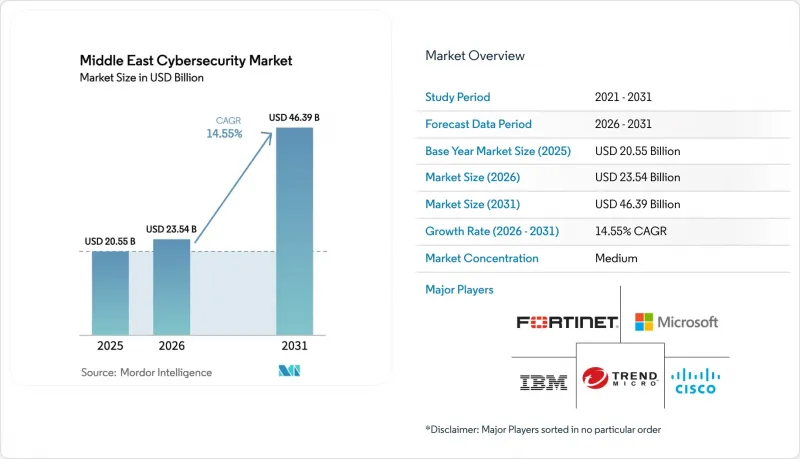
本報告按交付方式(解決方案和服務)、部署方式(本地部署和雲端部署)、企業規模(中小企業和大型企業)、最終用戶產業(銀行、金融服務和保險、醫療保健和生命科學、IT和電信、政府機構等)以及國家/地區進行細分。市場預測以美元(USD)計價。
中東網路安全市場趨勢與洞察
國家支持的襲擊和針對關鍵基礎設施的襲擊正在激增。
國家支持的組織正將其策略從短暫入侵轉向在營運網路中建立持續多年的立足點,例如「檸檬沙暴」宣傳活動就利用了全部區域公共產業的VPN漏洞。與伊朗有關的攻擊者已秘密維持了長達24個月的存取權限,這凸顯了對手對系統破壞能力和長期網路監控的戰略重視。作為應對措施,各國政府加強了即時威脅情報的共用,並改善了跨國協調。例如,阿拉伯聯合大公國網路安全委員會與Group-IB達成協議,協調了15個司法管轄區的事件回應手冊,以促進網路威脅的早期發現、遏制和修復。因此,地緣政治緊張局勢加劇,導致中東網路安全市場在終端加固、OT視覺化工具和取證服務方面的支出持續成長。
政府「願景」計畫要求撥出網路安全預算。
在沙烏地阿拉伯、阿拉伯聯合大公國和卡達,具有法律約束力的國家轉型藍圖已將網路安全置於國家安全的核心優先事項地位。這些計劃正在將網路安全投資從可自由支配的技術支出轉變為公共和私營部門的強制性預算撥款。因此,各組織正在將以前可選項的授權、合規工具和保全服務轉變為必須納入預算的項目,以滿足監管和營運要求。沙烏地阿拉伯於2024年12月推出的法規規定,違規將被處以最高2,500萬沙烏地里亞爾(約660萬美元)的罰款,這有效地加強了企業課責,並支持了多年期網路安全採購計畫。阿拉伯聯合大公國的目標是使人工智慧佔其非石油GDP的20%,這增加了政府服務、企業和關鍵產業對安全數位基礎設施的需求。因此,所有數位服務部署都必須在上線前進行安全認證。這些強制性網路安全標準要求組織持續投資於合規性、監控、風險管理和網路彈性,促使中東網路安全市場從以企劃為基礎的支出模式轉向持續預算模式。
長期勞動力短缺和兩位數工資成長
快速的數位化進程已經超過了網路安全專業人才的供應速度,導致人才長期短缺,阻礙了中東網路安全市場的成長。儘管沙烏地阿拉伯電力公司已實現兩位數的薪資成長,但關鍵職位的招募仍面臨困境。薪資上漲導致營運成本上升、利潤率下降,並延誤了網路安全專案的進度,限制了電力公司高效擴展其安全計畫的能力。人才短缺也影響了關鍵基礎設施(尤其是需要專業知識的領域)先進解決方案的及時部署。雖然大學已擴展了相關課程,但人工智慧、雲端安全和事件回應方面的專業知識仍然不足,這使得企業難以建立強大的網路安全體系並維持市場成長。
細分市場分析
預計到2025年,中東網路安全市場規模中,解決方案將佔52.12%,而服務領域預計將在2026年至2031年間保持18.45%的複合年成長率。隨著企業逐漸放棄事件回應外包,轉而採用以平台為中心的預防性模式,服務收入的成長速度超過了解決方案。這種轉變反映出企業更加重視主動式網路安全管理、持續監控和整合防禦能力。雲端安全態勢管理、應用程式保護和身分編配的需求依然旺盛,因為這些能力是企業環境中零信任策略實施的基礎。此外,高調的基礎設施安全漏洞事件正在加速企業將即時視覺化工具和異常檢測引擎納入採購計劃,因為企業優先考慮的是快速識別和回應威脅。
同時,專業服務團隊繼續專注於合規性審計和紅隊演練等特定細分領域,尤其針對那些需要外部檢驗其安全措施和監管準備的組織。然而,隨著大規模客戶擴大將安全營運中心 (SOC) 內部化,以加強對安全流程、資料可見性和事件回應的控制,託管安全合約正面臨價格壓力。像 Corgea 這樣的 AI 原生供應商已籌集 260 萬美元,用於開發一款適合阿拉伯語程式碼庫的自動化漏洞分類引擎。這凸顯了正在增強解決方案管道並推動市場轉向更自動化、更具情境感知的安全功能的創新。
預計到2025年,雲端工作負載將佔中東網路安全市場73.06%的佔有率,並將在2031年之前以18.32%的複合年成長率成長。海灣合作理事會(GCC)成員國的各部會正在採用「雲端優先」策略,以實現公民服務的現代化、提高營運效率並加強數位服務的交付。隨著這一轉變與SASE和工作負載加密閘道的日益普及相一致,公共部門和企業正在優先考慮安全存取、資料保護和可擴展的雲端營運。目前,機密運算解決方案提供基於硬體的控制功能,可協助組織滿足監管要求,同時保持雲端基礎設施的成本效益和可擴展性優勢。
在核心銀行和國防網路中,由於機構必須遵守嚴格的資料分類、主權和安全要求,本地部署仍然是首選模式。隨著金融機構在監管合規性和先進數位能力需求之間尋求平衡,混合模式也越來越受歡迎。沙烏地阿拉伯一家銀行現在透過本地節點處理銀行間區塊鏈轉賬,同時將分析工作負載儲存在主權雲端。這種雙堆疊方法能夠在彈性雲環境中實現人工智慧驅動的詐欺監控、快速分析和更大的營運靈活性,同時滿足關鍵數據的駐留要求。
其他好處:
- Excel格式的市場預測(ME)表
- 3個月的分析師支持
目錄
第1章:引言
- 研究假設和市場定義
- 調查範圍
第2章:調查方法
第3章執行摘要
第4章 市場狀況
- 市場概覽
- 市場促進因素
- 國家支持的襲擊和針對關鍵基礎設施的襲擊正在激增。
- 政府願景計畫要求保障網路安全預算。
- 海灣合作理事會國家公共部門的雲端優先和SaaS採用情況
- 利用人工智慧安全分析縮短平均修復時間
- 一股併購浪潮席捲國內託管安全服務併購(MSSP),導致捆綁式服務的提供量增加。
- 石油和天然氣產業OT系統向零信任架構的過渡
- 市場限制因素
- 長期勞動力短缺和兩位數工資成長
- 海灣合作理事會和黎凡特地區資料主權法律不一致
- 過時的空氣間隙SCADA系統正在延緩OT安全升級。
- 中小企業供應鏈中影子IT的擴張。
- 監理情勢
- 技術展望
- 波特五力分析
- 宏觀經濟因素對市場的影響
- 產業價值鏈分析
第5章 市場規模與成長預測
- 報價
- 解決方案
- 應用程式安全
- 雲端安全
- 資料安全
- 身分和存取管理
- 基礎設施保護
- 綜合風險管理
- 網路安全設備
- 端點安全
- 服務
- 專業服務
- 託管服務
- 解決方案
- 部署模式
- 雲
- 現場
- 按組織規模
- 中小企業
- 大公司
- 按最終用戶行業分類
- 銀行、金融服務和保險(BFSI)
- 醫療保健和生命科學
- 資訊科技/通訊
- 政府/行政部門
- 零售與電子商務
- 能源公用事業
- 工業製造
- 其他終端用戶產業
- 國家
- 沙烏地阿拉伯
- 阿拉伯聯合大公國
- 卡達
- 科威特
- 巴林
- 其他中東國家
第6章 競爭情勢
- 市場集中度
- 策略趨勢
- 市佔率分析
- 公司簡介
- IBM Corporation
- Cisco Systems Inc.
- Fortinet Inc.
- Microsoft Corporation
- Trend Micro Incorporated
- Palo Alto Networks Inc.
- Check Point Software Technologies Ltd.
- Broadcom Ltd.(Symantec)
- Dell Technologies Inc.
- Intel Corporation
- McAfee LLC
- Huawei Technologies Co. Ltd.
- Zscaler Inc.
- DarkMatter Group
- Help AG(e&)
- CPX Holding(UAE)
- StarLink ME
- Cyway LLC
- BAE Systems AI
- Kaspersky Lab
第7章 市場機會與未來展望
According to Mordor Intelligence, the Middle East cybersecurity market size was valued at USD 20.55 billion in 2025 and estimated to grow from USD 23.54 billion in 2026 to reach USD 46.39 billion by 2031, at a CAGR of 14.55% during the forecast period (2026-2031).
This report is Segmented by Offerings (Solutions, and Services), Deployment (On-Premise, and Cloud), Organization Size (Small and Medium Enterprises, and Large Enterprises), End-User Industry (Banking, Financial Services, and Insurance, Healthcare and Life Sciences, IT and Telecommunication, Government, and More), and Country. The Market Forecasts are Provided in Terms of Value (USD).
Middle East Cybersecurity Market Trends and Insights
Surge in Nation-State and Critical-Infrastructure Attacks
State-sponsored groups have shifted from smash-and-grab intrusions to patient, multi-year footholds in operational networks, as illustrated by the Lemon Sandstorm campaign that exploited VPN flaws across regional utilities. Iranian-linked actors maintained covert access for up to 24 months, highlighting the strategic value that adversaries placed on disruption capabilities and long-term network surveillance. In response, governments strengthened real-time threat intelligence exchanges and improved cross-border coordination. For instance, the UAE Cyber Security Council's pact with Group-IB coordinated incident response playbooks across 15 jurisdictions, supporting faster detection, containment, and remediation of cyber threats. As a result, heightened geopolitical tensions continued to drive premium spending on endpoint hardening, OT visibility tools, and forensics services across the Middle East cybersecurity market.
Government "Vision" Programmes Mandating Cyber Budgets
Legally binding national transformation roadmaps in Saudi Arabia, the UAE, and Qatar have positioned cybersecurity as a core national security priority. These programs are moving cybersecurity investments from discretionary technology spending to mandated budget allocations across public and private entities. As a result, organizations are converting previously optional licenses, compliance tools, and security services into enforceable budget line items to meet regulatory and operational requirements. Saudi regulations introduced in December 2024 stipulated penalties of up to SAR 25 million (USD 6.60 million) for non-compliance, effectively strengthening enterprise accountability and supporting multi-year cybersecurity procurement pipelines. The UAE targeted AI to contribute 20% to non-oil GDP, which increased the need for secure digital infrastructure across government services, enterprises, and critical industries. Consequently, every digital service rollout must undergo security accreditation before launch. These mandatory cybersecurity baselines are shifting the Middle East cybersecurity market from project-based spending to a recurring budget model, as organizations must continuously invest in compliance, monitoring, risk management, and cyber resilience.
Persistent Talent Gap and Double-Digit Wage Inflation
Rapid digitalization outpaced the supply of skilled cybersecurity professionals, creating a persistent talent gap that challenged the growth of the Middle East cybersecurity market. Power utilities in Saudi Arabia struggled to fill key roles, even as they raised salaries at double-digit rates. This wage inflation increased operating costs, compressed margins, and delayed cybersecurity project timelines, limiting utilities' ability to scale security programs efficiently. The shortage also affected the timely deployment of advanced solutions across critical infrastructure, particularly in areas requiring specialized expertise. Although universities expanded their course offerings, expertise in AI, cloud security, and incident response remained scarce, making it difficult for organizations to build resilient cybersecurity capabilities and sustain market growth.
Other drivers and restraints analyzed in the detailed report include:
- Cloud-First and SaaS Adoption Across GCC Public Sector
- AI-Driven Security Analytics Lowering MTTR
- Fragmented Data-Sovereignty Laws Across GCC and Levant
For complete list of drivers and restraints, kindly check the Table Of Contents.
Segment Analysis
Solutions accounted for 52.12% of the Middle East cybersecurity market size in 2025, while services are forecast to register a CAGR of 18.45% during 2026-2031. Services revenue is expanding at a faster pace than solutions revenue as enterprises move away from incident-driven outsourcing and increasingly adopt platform-centric prevention models. This shift reflects a broader focus on proactive cybersecurity management, continuous monitoring, and integrated defense capabilities. Demand remains concentrated in cloud security posture management, application shielding, and identity orchestration, as these capabilities support the implementation of zero-trust policies across enterprise environments. High-profile infrastructure breaches have also accelerated the inclusion of real-time visibility tools and anomaly-detection engines in procurement plans, as organizations prioritize faster threat identification and response.
At the same time, professional services teams continue to address a specialized niche in compliance audits and red-teaming, particularly among organizations that require external validation of security controls and regulatory readiness. However, managed security contracts face pricing pressure as larger customers increasingly insource security operations centers to gain greater control over security processes, data visibility, and incident response. AI-native vendors, such as Corgea, secured USD 2.6 million to develop automated vulnerability-triage engines adapted to Arabic-language code bases, underscoring the innovation now strengthening the solutions pipeline and supporting the market's shift toward more automated and context-aware cybersecurity capabilities.
Cloud workloads accounted for 73.06% of the Middle East cybersecurity market in 2025 and are projected to grow at a 18.32% CAGR through 2031. GCC ministries have adopted "cloud-first" charters to modernize citizen services, improve operational efficiency, and strengthen digital service delivery. This shift has increased the adoption of SASE and workload-encryption gateways, as public-sector entities and enterprises prioritize secure access, data protection, and scalable cloud operations. Confidential computing options now offer hardware-based controls that help organizations meet regulatory requirements while retaining the cost and scalability benefits of cloud infrastructure.
On-premises deployments remain the preferred model for core banking and defense networks, where organizations must comply with stringent data classification, sovereignty, and security requirements. Hybrid models are also gaining traction as institutions balance regulatory compliance with the need for advanced digital capabilities. Saudi banks now route interbank blockchain transfers through local nodes while storing analytics workloads in sovereign clouds. This dual-stack approach protects critical data residency requirements while enabling AI-driven fraud monitoring, faster analytics, and more flexible operations in elastic cloud environments.
Complete Report Scope:
- By Offering
- Solutions
- Application Security
- Cloud Security
- Data Security
- Identity and Access Management
- Infrastructure Protection
- Integrated Risk Management
- Network Security Equipment
- Endpoint Security
- Services
- Professional Services
- Managed Services
- Solutions
- By Deployment Mode
- Cloud
- On-premise
- By Organization Size
- Small and Medium Enterprises (SMEs)
- Large Enterprises
- By End-User Industry
- Banking, Financial Services, and Insurance (BFSI)
- Healthcare and Life Sciences
- IT and Telecommunication
- Government and Public Administration
- Retail and E-Commerce
- Energy and Utilities
- Industrial Manufacturing
- Other End-User Industries
- By Country
- Saudi Arabia
- United Arab Emirates
- Qatar
- Kuwait
- Bahrain
- Rest of Middle East
List of Companies Covered in this Report:
- IBM Corporation
- Cisco Systems Inc.
- Fortinet Inc.
- Microsoft Corporation
- Trend Micro Incorporated
- Palo Alto Networks Inc.
- Check Point Software Technologies Ltd.
- Broadcom Ltd. (Symantec)
- Dell Technologies Inc.
- Intel Corporation
- McAfee LLC
- Huawei Technologies Co. Ltd.
- Zscaler Inc.
- DarkMatter Group
- Help AG (e&)
- CPX Holding (UAE)
- StarLink ME
- Cyway LLC
- BAE Systems AI
- Kaspersky Lab
Additional Benefits:
- The market estimate (ME) sheet in Excel format
- 3 months of analyst support
TABLE OF CONTENTS
1 INTRODUCTION
- 1.1 Study Assumptions and Market Definition
- 1.2 Scope of the Study
2 RESEARCH METHODOLOGY
3 EXECUTIVE SUMMARY
4 MARKET LANDSCAPE
- 4.1 Market Overview
- 4.2 Market Drivers
- 4.2.1 Surge in Nation-State and Critical-Infrastructure Attacks
- 4.2.2 Government Vision Programs Mandating Cyber Budgets
- 4.2.3 Cloud-First and SaaS Adoption Across GCC Public Sector
- 4.2.4 AI-driven Security Analytics Lowering MTTR
- 4.2.5 Merger and Acquisition (M&A) Wave Mmong Local MSSPs Creating Bundled Offerings
- 4.2.6 Oil-and-Gas OT Retrofit to Zero-Trust Architectures
- 4.3 Market Restraints
- 4.3.1 Persistent Talent Gap and Double-digit Wage Inflation
- 4.3.2 Fragmented Data-Sovereignty Laws Across GCC and Levant
- 4.3.3 Legacy Air-gapped SCADA Slowing OT Security Upgrades
- 4.3.4 Shadow-IT Growth in SME Supply Chains
- 4.4 Regulatory Landscape
- 4.5 Technological Outlook
- 4.6 Porter's Five Forces Analysis
- 4.6.1 Threat of New Entrants
- 4.6.2 Bargaining Power of Suppliers
- 4.6.3 Bargaining Power of Buyers
- 4.6.4 Threat of Substitutes
- 4.6.5 Intensity of Competitive Rivalry
- 4.7 Impact of Macroeconomic Factors on the Market
- 4.8 Industry Value-Chain Analysis
5 MARKET SIZE AND GROWTH FORECASTS (VALUE)
- 5.1 By Offering
- 5.1.1 Solutions
- 5.1.1.1 Application Security
- 5.1.1.2 Cloud Security
- 5.1.1.3 Data Security
- 5.1.1.4 Identity and Access Management
- 5.1.1.5 Infrastructure Protection
- 5.1.1.6 Integrated Risk Management
- 5.1.1.7 Network Security Equipment
- 5.1.1.8 Endpoint Security
- 5.1.2 Services
- 5.1.2.1 Professional Services
- 5.1.2.2 Managed Services
- 5.1.1 Solutions
- 5.2 By Deployment Mode
- 5.2.1 Cloud
- 5.2.2 On-premise
- 5.3 By Organization Size
- 5.3.1 Small and Medium Enterprises (SMEs)
- 5.3.2 Large Enterprises
- 5.4 By End-User Industry
- 5.4.1 Banking, Financial Services, and Insurance (BFSI)
- 5.4.2 Healthcare and Life Sciences
- 5.4.3 IT and Telecommunication
- 5.4.4 Government and Public Administration
- 5.4.5 Retail and E-Commerce
- 5.4.6 Energy and Utilities
- 5.4.7 Industrial Manufacturing
- 5.4.8 Other End-User Industries
- 5.5 By Country
- 5.5.1 Saudi Arabia
- 5.5.2 United Arab Emirates
- 5.5.3 Qatar
- 5.5.4 Kuwait
- 5.5.5 Bahrain
- 5.5.6 Rest of Middle East
6 COMPETITIVE LANDSCAPE
- 6.1 Market Concentration
- 6.2 Strategic Moves
- 6.3 Market Share Analysis
- 6.4 Company Profiles (includes Global-level Overview, Market-level Overview, Core Segments, Financials, Strategic Info, Market Rank/Share, Products and Services, Recent Developments)
- 6.4.1 IBM Corporation
- 6.4.2 Cisco Systems Inc.
- 6.4.3 Fortinet Inc.
- 6.4.4 Microsoft Corporation
- 6.4.5 Trend Micro Incorporated
- 6.4.6 Palo Alto Networks Inc.
- 6.4.7 Check Point Software Technologies Ltd.
- 6.4.8 Broadcom Ltd. (Symantec)
- 6.4.9 Dell Technologies Inc.
- 6.4.10 Intel Corporation
- 6.4.11 McAfee LLC
- 6.4.12 Huawei Technologies Co. Ltd.
- 6.4.13 Zscaler Inc.
- 6.4.14 DarkMatter Group
- 6.4.15 Help AG (e&)
- 6.4.16 CPX Holding (UAE)
- 6.4.17 StarLink ME
- 6.4.18 Cyway LLC
- 6.4.19 BAE Systems AI
- 6.4.20 Kaspersky Lab
7 MARKET OPPORTUNITIES AND FUTURE OUTLOOK
- 7.1 White-space and Unmet-need Assessment

 人工智慧驅動的網路安全平台解決方案市場:全球市場預測,2026-2032年
 網路安全:研究訂閱資訊系統安全實施服務市場:全球市場預測(2026-2032)商業網路安全市場:全球市場預測,2026-2032年工業OT網路安全市場-2026-2032年全球市場預測
 滲透測試服務市場:按測試類型、部署類型、服務類型、最終用戶和地區分類
 OT/XIoT網路安全解決方案:市場機會及至2030年的預測電網網路安全市場:按組件、解決方案類型、部署模式、安全類型、最終用戶、國家和地區分類-全球產業分析、市場規模、市場佔有率及2026年至2033年預測
 資料可靠性工程市場預測至2034年-全球可靠度分析,涵蓋可靠性面向、工程方法、資料生命週期、架構、最終用戶和區域
 旅遊安防市場規模、佔有率和成長分析:按解決方案類型、服務類型、部署方式、最終用戶、應用領域、組織規模和地區分類-2026-2033年產業預測