


 |
市場調查報告書
商品編碼
2117194
印度網路安全:市場佔有率分析、產業趨勢與統計及成長預測(2026-2031)India Cybersecurity - Market Share Analysis, Industry Trends & Statistics, Growth Forecasts (2026 - 2031) |
||||||

※ 本網頁內容可能與最新版本有所差異。詳細情況請與我們聯繫。
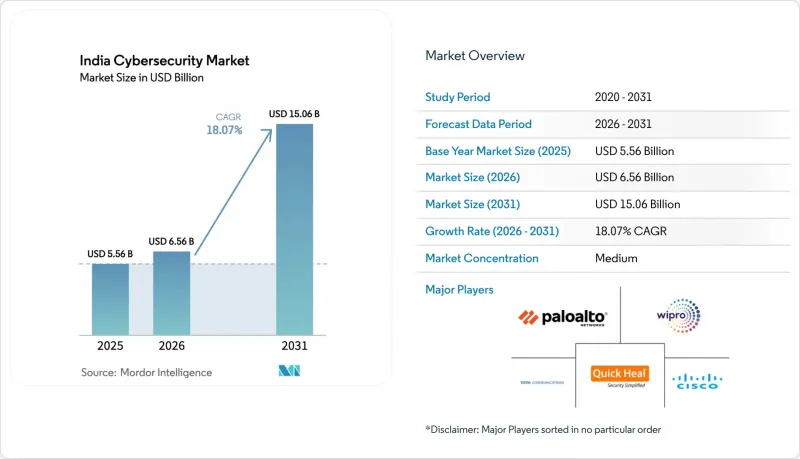
據 Mordor Intelligence 稱,2025 年印度網路安全市場價值 55.6 億美元,預計到 2031 年將從 2026 年的 65.6 億美元成長到 150.6 億美元,預測期(2026-2031 年)的複合年成長率為 18.07%。
本報告按交付方式(解決方案[應用安全、雲端安全等]、服務[專業服務等])、部署方式(雲端、本地部署)、最終用戶產業(銀行、金融服務和保險、醫療保健、IT和電信、工業和國防、零售和電子商務等)以及最終用戶公司規模(大型企業、中小企業)進行分類。市場預測以美元計價。
印度網路安全市場趨勢與洞察
「數位印度」和企業現代化對強而有力的網路安全措施提出了更高的要求。
「數位印度」計畫以前所未有的速度實現了公民服務的數位化,但也擴大了印度的網路攻擊面,使網路安全成為政府各部會和國家機構的關鍵預算項目。通用支付介面(UPI)每月處理超過150億筆交易,如此龐大的交易量迫使銀行整合自適應身分驗證和即時詐欺偵測引擎。一項針對財務長的調查顯示,60%的印度公司計劃在2025年增加安全預算,遠高於47%的全球平均。如今,企業正將零信任查核點融入每一次現代化改造中,從而縮短了身分管理、雲端工作負載和預防資料外泄(DLP)措施的採購週期。
UPI 和即時支付的激增推動了對身分管理和詐欺預防的需求。
統一支付介面 (UPI) 重塑了零售金融,但其便利性也招致了撞庫人員編制和瀏覽器中間人攻擊。光是 2024 年下半年,金融機構就記錄了超過 2500 起安全事件。為了應對這些挑戰,銀行正在積極推廣多因素身份驗證和行為生物識別技術,這推動了身分和存取管理 (IAM) 套件的成長。此外,監管機構也支持產業向零信任架構的轉變,他們優先考慮持續監控而非定期審計,這擴大了人工智慧驅動的詐欺分析供應商的目標市場。
認證安全營運中心分析師短缺
企業正面臨一級和二級分析師招募難題,這推動了監控任務自動化和外包的興起。 CERT-In 和 Fortinet 正與大學合作,將安全課程融入其教育項目,以在未來三年內建立人才儲備。同時,由於服務供應商可以向多個客戶共用有限的專業知識,因此託管偵測與回應 (MDR) 合約正以兩位數的速度成長。
細分市場分析
解決方案仍然是收入支柱,預計到2025年將佔印度網路安全市場佔有率的64.58%。當董事會跟進並批准投資時,網路安全、雲端工作負載保護以及識別及存取管理軟體包往往是首批續約的項目。供應商透過增加人工智慧分析功能和整合儀表板來緩解警報疲勞,從而維持較高的合約續約率。
預計到2031年,印度網路安全服務產業的複合年成長率將達到18.62%,這主要受人員短缺的推動,迫使企業將檢測和回應業務外包。能夠保證在六小時內按照CERT-In規定提交事件報告的託管安全服務提供者正在獲得多年合約。結合合規性和威脅搜尋專業知識的諮詢服務需求也在不斷成長,這表明流程深度而非人員規模,如今已成為推動採購決策的關鍵因素。
到2025年,本地安全措施將佔總支出的54.35%,其中大部分集中在銀行、電信和關鍵基礎設施領域,這些領域的資料主權審計仍然非常嚴格。這些採購公司只有在設備提供開放API,能夠將資料傳輸到雲端SIEM系統時才會升級設備,這表明混合架構正在成為新的標準。
同時,印度網路安全市場的雲端採用率正以21.92%的複合年成長率快速成長,主要得益於99%的印度企業都在經營混合雲端。首席資訊安全官(CISO)們優先考慮身分仲介功能、容器運行時防禦以及能夠自動回應DPDPA監管要求的姿態管理模組。因此,當DevOps的速度優勢超過舊有系統的鎖定效應時,雲端原生供應商就成為首選。
其他好處:
- Excel格式的市場預測(ME)表
- 3個月的分析師支持
目錄
第1章:引言
- 市場定義與研究假設
- 調查範圍
第2章:調查方法
第3章執行摘要
第4章 市場狀況
- 市場概覽
- 市場促進因素
- 「數位印度」和企業現代化對強而有力的網路安全措施提出了更高的要求。
- UPI 和即時支付的激增推動了身分驗證和詐欺預防的需求。
- 政府的《國防生產發展法案》(DPDP Act) 和《CERT-In》合規期限正在加速安全相關支出。
- 5G 和物聯網的部署正在通訊和智慧製造領域暴露出新的攻擊面。
- 針對公共部門和關鍵基礎設施的「RaaS(勒索軟體即服務)」的興起。
- 創業投資和政府津貼正在推動印度網路安全創業生態系統的發展。
- 市場限制因素
- 認證安全營運中心分析師短缺
- 微企業對價格的敏感度限制了企業級解決方案的採用。
- 跨境資料流動相關法規的不一致導致採購延誤。
- 傳統基礎設施的複雜性
- 價值鏈分析
- 重要法規結構的評估
- 對關鍵相關人員的影響評估
- 技術展望
- 波特五力分析
- 宏觀經濟因素的影響
第5章 市場規模與成長預測
- 報價
- 解決方案
- 應用程式安全
- 雲端安全
- 資料安全
- 身分和存取管理
- 基礎設施保護
- 綜合風險管理
- 網路安全
- 端點安全
- 服務
- 專業服務
- 託管服務
- 解決方案
- 部署模式
- 雲
- 現場
- 按最終用戶行業分類
- BFSI
- 衛生保健
- IT/通訊
- 工業與國防
- 零售與電子商務
- 能源公用事業
- 製造業
- 其他
- 按最終用戶公司規模分類
- 大公司
- 中小企業
第6章 競爭情勢
- 市場集中度
- 策略趨勢
- 市佔率分析
- 公司簡介
- Tata Communications
- Wipro Ltd.
- HCLTech
- Infosys Ltd.
- Tech Mahindra Ltd.
- Cisco Systems, Inc.
- Check Point Software Technologies India
- Sophos Technologies Pvt. Ltd.
- Fortinet Technologies India
- McAfee Software(India)Pvt. Ltd.
- Palo Alto Networks, Inc.
- Quick Heal Technologies Ltd.
- Zscaler India Pvt. Ltd.
- Juniper Networks India Pvt. Ltd.
- Trend Micro India Pvt. Ltd.
- IBM India Pvt. Ltd.
- CrowdStrike India Pvt. Ltd.
- Kaspersky Labs India
- Indusface Pvt. Ltd.
- Safe Security(Lucideus)
- eSec Forte Technologies
- SecurityHQ India
- Cyberops Infosec LLP
- Sequretek
- Sectrio(Subex)
- Innefu Labs
第7章 市場機會與未來趨勢
- 評估未開發的領域和未滿足的需求
According to Mordor Intelligence, the India cybersecurity market size was valued at USD 5.56 billion in 2025 and estimated to grow from USD 6.56 billion in 2026 to reach USD 15.06 billion by 2031, at a CAGR of 18.07% during the forecast period (2026-2031).
This report is Segmented by Offering (Solutions [Application Security, Cloud Security, and More], Services [Professional Services, and More]), Deployment Mode (Cloud, On-Premise), End-User Industry (BFSI, Healthcare, IT and Telecom, Industrial and Defense, Retail and E-Commerce, and More), End-User Enterprise Size (Large Enterprises, Smes). The Market Forecasts are Provided in Terms of Value (USD).
India Cybersecurity Market Trends and Insights
Digital India and Enterprise Modernization Mandating Robust Cybersecurity Controls
The Digital India program has digitized citizen services at record speed, expanding the national attack surface and making cybersecurity an integral budget line for ministries and state agencies. UPI processes more than 15 billion transactions each month, a scale that forces banks to integrate adaptive authentication and real-time fraud-detection engines . CFO surveys reveal that 60% of Indian corporates will raise security allocations in 2025, notably higher than the 47% global average. Enterprises now embed zero-trust checkpoints in every modernization sprint, resulting in shorter procurement cycles for identity, cloud-workload, and data-loss-prevention controls.
Surge in UPI and Real-Time Payments Driving Identity/Fraud Protection Demand
The Unified Payments Interface has re-defined retail finance, but its convenience also attracts credential-stuffing and man-in-the-browser attacks. Financial institutions logged more than 2,500 security incidents in the second half of 2024 alone. Banks respond by enforcing multi-factor authentication and behavioral biometrics, which in turn stimulates growth for identity-and-access-management (IAM) suites. The sector's move toward zero-trust architectures is supported by regulators that prioritize continuous monitoring over periodic audits, broadening the addressable market for AI-driven fraud-analytics vendors.
Shortage of Certified SOC Analysts
Enterprises struggle to fill tier-1 and tier-2 analyst seats, driving uptake of automation and outsourced monitoring. CERT-In and Fortinet have partnered with universities to embed security curricula that will seed the talent pipeline over the next three years. In the interim, managed detection and response contracts are growing at double-digit rates because service providers can pool scarce expertise across multiple clients.
Other drivers and restraints analyzed in the detailed report include:
- Government DPDP Act and CERT-In Compliance Deadlines Accelerating Security Spend
- 5G and IoT Roll-outs Exposing New Attack Surface in Telecom and Smart Manufacturing
- Price Sensitivity among MSMEs Limiting Adoption of Enterprise-Grade Solutions
For complete list of drivers and restraints, kindly check the Table Of Contents.
Segment Analysis
Solutions remain the revenue anchor, holding 64.58 % of the India cybersecurity market share in 2025. Network security, cloud-workload protection, and identity-and-access management packages are refreshed first whenever boards approve catch-up spending. Vendors add AI analytics and consolidated dashboards to shrink alert fatigue, keeping renewal rates high.
The services arm of the India cybersecurity market is forecast to post an 18.62 % CAGR to 2031 as talent constraints force organizations to outsource detection and response. Managed security service providers that guarantee six-hour incident reporting-mirroring CERT-In rules-win multi-year contracts. Advisory practices that blend compliance and threat-hunting expertise see rising attach rates, confirming that process depth, not head-count scale, now drives buying decisions.
On-premise controls still claim 54.35 % of 2025 spending, largely inside banking, telecom, and critical-infrastructure estates where data-sovereignty audits remain strict. These buyers refresh appliances only if the gear exposes open APIs that feed cloud SIEMs, proving that hybrid design is the new norm.
Conversely, cloud deployments in the India cybersecurity market race ahead at a 21.92 % CAGR, propelled by the fact that 99 % of domestic firms run hybrid clouds. CISOs prize identity brokering, container runtime defense, and posture-management modules that auto-map to DPDPA controls. Cloud-native vendors thus lead short-lists whenever DevOps speed trumps legacy lock-in.
Complete Report Scope:
- By Offering
- Solutions
- Application Security
- Cloud Security
- Data Security
- Identity and Access Management
- Infrastructure Protection
- Integrated Risk Management
- Network Security
- End-point Security
- Services
- Professional Services
- Managed Services
- Solutions
- By Deployment Mode
- Cloud
- On-Premise
- By End-user Industry
- BFSI
- Healthcare
- IT and Telecom
- Industrial and Defense
- Retail and E-commerce
- Energy and Utilities
- Manufacturing
- Others
- By End-user Enterprise Size
- Large Enterprises
- Small and Medium Enterprises (SMEs)
List of Companies Covered in this Report:
- Tata Communications
- Wipro Ltd.
- HCLTech
- Infosys Ltd.
- Tech Mahindra Ltd.
- Cisco Systems, Inc.
- Check Point Software Technologies India
- Sophos Technologies Pvt. Ltd.
- Fortinet Technologies India
- McAfee Software (India) Pvt. Ltd.
- Palo Alto Networks, Inc.
- Quick Heal Technologies Ltd.
- Zscaler India Pvt. Ltd.
- Juniper Networks India Pvt. Ltd.
- Trend Micro India Pvt. Ltd.
- IBM India Pvt. Ltd.
- CrowdStrike India Pvt. Ltd.
- Kaspersky Labs India
- Indusface Pvt. Ltd.
- Safe Security (Lucideus)
- eSec Forte Technologies
- SecurityHQ India
- Cyberops Infosec LLP
- Sequretek
- Sectrio (Subex)
- Innefu Labs
Additional Benefits:
- The market estimate (ME) sheet in Excel format
- 3 months of analyst support
TABLE OF CONTENTS
1 INTRODUCTION
- 1.1 Market Definition and Study Assumptions
- 1.2 Scope of the Study
2 RESEARCH METHODOLOGY
3 EXECUTIVE SUMMARY
4 MARKET LANDSCAPE
- 4.1 Market Overview
- 4.2 Market Drivers
- 4.2.1 Digital India and Enterprise Modernization Mandating Robust Cybersecurity Controls
- 4.2.2 Surge in UPI and Real-Time Payments Driving Identity/Fraud Protection Demand
- 4.2.3 Government DPDP Act and CERT-In Compliance Deadlines Accelerating Security Spend
- 4.2.4 5G and IoT Roll-outs Exposing New Attack Surface in Telecom and Smart Manufacturing
- 4.2.5 Rise of Ransomware-as-a-Service Targeting Public Sector and Critical Infrastructure
- 4.2.6 Venture Capital and Government Grants Fueling Indian Cybersecurity Start-up Ecosystem
- 4.3 Market Restraints
- 4.3.1 Shortage of Certified SOC Analysts
- 4.3.2 Price Sensitivity among MSMEs Limiting Adoption of Enterprise-Grade Solutions
- 4.3.3 Fragmented Regulation on Cross-border Data Flows Creating Procurement Delays
- 4.3.4 Legacy infrastructure complexity
- 4.4 Value Chain Analysis
- 4.5 Evaluation of Critical Regulatory Framework
- 4.6 Impact Assessment of Key Stakeholders
- 4.7 Technological Outlook
- 4.8 Porter's Five Forces Analysis
- 4.8.1 Bargaining Power of Suppliers
- 4.8.2 Bargaining Power of Consumers
- 4.8.3 Threat of New Entrants
- 4.8.4 Threat of Substitutes
- 4.8.5 Intensity of Competitive Rivalry
- 4.9 Impact of Macro-economic Factors
5 MARKET SIZE AND GROWTH FORECASTS (VALUE)
- 5.1 By Offering
- 5.1.1 Solutions
- 5.1.1.1 Application Security
- 5.1.1.2 Cloud Security
- 5.1.1.3 Data Security
- 5.1.1.4 Identity and Access Management
- 5.1.1.5 Infrastructure Protection
- 5.1.1.6 Integrated Risk Management
- 5.1.1.7 Network Security
- 5.1.1.8 End-point Security
- 5.1.2 Services
- 5.1.2.1 Professional Services
- 5.1.2.2 Managed Services
- 5.1.1 Solutions
- 5.2 By Deployment Mode
- 5.2.1 Cloud
- 5.2.2 On-Premise
- 5.3 By End-user Industry
- 5.3.1 BFSI
- 5.3.2 Healthcare
- 5.3.3 IT and Telecom
- 5.3.4 Industrial and Defense
- 5.3.5 Retail and E-commerce
- 5.3.6 Energy and Utilities
- 5.3.7 Manufacturing
- 5.3.8 Others
- 5.4 By End-user Enterprise Size
- 5.4.1 Large Enterprises
- 5.4.2 Small and Medium Enterprises (SMEs)
6 COMPETITIVE LANDSCAPE
- 6.1 Market Concentration
- 6.2 Strategic Moves
- 6.3 Market Share Analysis
- 6.4 Company Profiles (includes Global level Overview, Market level overview, Core Segments, Financials as available, Strategic Information, Market Rank/Share for key companies, Products and Services, and Recent Developments)
- 6.4.1 Tata Communications
- 6.4.2 Wipro Ltd.
- 6.4.3 HCLTech
- 6.4.4 Infosys Ltd.
- 6.4.5 Tech Mahindra Ltd.
- 6.4.6 Cisco Systems, Inc.
- 6.4.7 Check Point Software Technologies India
- 6.4.8 Sophos Technologies Pvt. Ltd.
- 6.4.9 Fortinet Technologies India
- 6.4.10 McAfee Software (India) Pvt. Ltd.
- 6.4.11 Palo Alto Networks, Inc.
- 6.4.12 Quick Heal Technologies Ltd.
- 6.4.13 Zscaler India Pvt. Ltd.
- 6.4.14 Juniper Networks India Pvt. Ltd.
- 6.4.15 Trend Micro India Pvt. Ltd.
- 6.4.16 IBM India Pvt. Ltd.
- 6.4.17 CrowdStrike India Pvt. Ltd.
- 6.4.18 Kaspersky Labs India
- 6.4.19 Indusface Pvt. Ltd.
- 6.4.20 Safe Security (Lucideus)
- 6.4.21 eSec Forte Technologies
- 6.4.22 SecurityHQ India
- 6.4.23 Cyberops Infosec LLP
- 6.4.24 Sequretek
- 6.4.25 Sectrio (Subex)
- 6.4.26 Innefu Labs
7 MARKET OPPORTUNITIES AND FUTURE TRENDS
- 7.1 White-space and Unmet-need Assessment

 全球網路安全代理人工智慧市場規模、佔有率、趨勢和成長分析報告(2026-2034)
 菲律賓網路安全:市場佔有率分析、產業趨勢與統計及成長預測(2026-2031 年)義大利網路安全:市場佔有率分析、產業趨勢與統計、成長預測(2026-2031)
 2026-2030年全球安全態勢管理(SPM)市場
 2026-2030年全球網路安全市場全球IT與通訊網路安全市場規模、佔有率、趨勢及成長分析報告(2026-2034年)網路欺騙:市場佔有率分析、產業趨勢與統計、成長預測(2026-2031)
 銀行、金融服務和保險 (BFSI) 網路安全市場規模、佔有率和趨勢分析報告:按組件、部署模式、安全類型、行業、最終用戶、地區和細分市場預測 (2026–2033)
 2026年全球網路安全管理市場報告全球油氣網路安全市場規模、佔有率、趨勢和成長分析報告(2026-2034)