


 |
市場調查報告書
商品編碼
2116959
菲律賓網路安全:市場佔有率分析、產業趨勢與統計及成長預測(2026-2031 年)Philippines Cybersecurity - Market Share Analysis, Industry Trends & Statistics, Growth Forecasts (2026 - 2031) |
||||||

※ 本網頁內容可能與最新版本有所差異。詳細情況請與我們聯繫。
據 Mordor Intelligence 稱,菲律賓網路安全市場規模預計在 2026 年達到 2.8268 億美元,高於 2025 年的 2.615 億美元,預計到 2031 年將達到 4.1712 億美元。
預計從 2026 年到 2031 年,其複合年成長率將達到 8.10%。
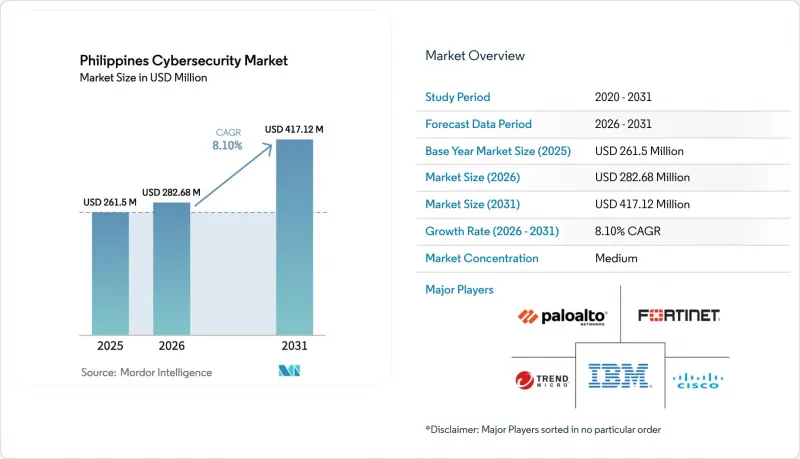
本報告依產品/服務(解決方案[應用安全、雲端安全等]、服務[專業服務等])、部署模式(雲端、本地部署)、終端用戶產業(金融、保險、證券(BFSI)、醫療保健、IT與電信、工業與國防、零售與電子商務等)以及終端用戶企業規模(大型企業、中小企業)進行分類。市場預測以美元計價。
菲律賓網路安全市場趨勢與洞察
「2022-2028 年國家網路安全計畫」的資金將促進企業安全採購。
菲律賓政府的「2023-2028年國家網路安全計畫」為人力資源發展、政策和關鍵基礎設施設定了里程碑,並加快了私人企業的採購週期。先前不願升級的企業現在將專案與該計劃的合規性查核點相匹配,並將資金從可自由支配的試點專案轉移到全面部署。推動這項行動的主要動力是強制性控制措施的清晰度,而不僅僅是預算規模,尤其是在尋求競標資格的政府關聯供應商中。早期受益者包括提供符合公共部門基準的監控和事件回應服務的國內託管安全服務提供者。該計劃知名度的提高也促進了地方政府網路安全能力建設的多邊資金籌措。
IT-BPM 和 BPO 的出口擴張需要符合全球安全框架的要求。
全球客戶對菲律賓外包供應商的SOC 2和ISO 27001認證要求日益提高,網路安全不再只是被視為後勤部門安全措施,而是成為關鍵的收入驅動力。領先的業務流程外包(BPO)公司正在積極應對,將安全營運中心(SOC)納入競標提案,並部署專門的合規團隊以隨時準備接受審計。中型供應商也紛紛效仿,以避免失去高價值契約,安全投資也從馬尼拉擴展到宿霧和克拉克等二線城市。這一趨勢正在強化網路安全認證作為非關稅貿易壁壘的地位。如果沒有這些認證,服務供應商將難以進入醫療保健和金融服務等高度監管的行業。因此,即使是成本敏感型公司也開始為持續監控和第三方風險管理累計。
GIAC/CISSP認證人員短缺導致專案前置作業時間延長。
在菲律賓,擁有GIAC或CISSP認證的活躍網路安全專業人員不足300人,而新加坡則約有3000人。這種巨大的供需缺口導致複雜實施工程延誤。招募週期延長,使得實施進度超出計劃,迫使一些公司推遲升級或縮減功能集以適應現有人才。此外,人才短缺推高了薪資水平,並增加了需要內部管理的本地部署解決方案的整體擁有成本(TCO)。本地專業人員經常被海外雇主以更高的薪資挖走,加劇了本地人才短缺,導致內部專業人才流失。因此,各組織正在轉向雲端保全服務和自動化工具,這些工具既能滿足基本的合規性要求,又能減少對專業人員的依賴。
細分市場分析
截至2025年,解決方案在菲律賓網路安全市場佔有率中佔比50.65%,但預計到2031年,服務業的成長速度將超過解決方案,年複合成長率達9.45%。由於菲律賓國內認證的專業人員不足300人,企業更傾向於利用外部專家資源。網路和雲端安全產品仍然是基礎,但隨著帳戶盜用詐騙的激增,身分和存取管理正日益受到經營團隊的關注。由於企業需要應對來自資訊通訊技術部、國家隱私委員會和中央銀行的許多監管要求,對專業服務(尤其是諮詢和顧問服務)的需求正在蓬勃發展。
資安管理服務正經歷兩位數成長,逐漸取代以往企業內部安全營運中心所承擔的任務。由於工程師短缺,整合專案經常延期,導致客戶轉向承包的雲端交付平台。供應商正透過整合自動化功能並減少對日益稀缺的分析師的依賴來提升自身競爭力。因此,人才短缺既制約了企業內部採用託管安全服務,也推動了業務收益的成長。
到2025年,本地部署架構將以53.90%的市佔率領先,但雲端採用預計將以10.95%的複合年成長率成長,成為所有部署方式中成長最快的。銀行、零售商和政府入口網站正在採用雲端原生安全技術,以利用其彈性擴展和快速修補週期。這項進步正在重新定義雲端的經濟效益,從成本最小化轉向風險緩解;換句話說,不斷更新的控制能力比降低資本支出(CAPEX)更為重要。混合解決方案對擁有傳統資料中心的集團公司極具吸引力,使它們能夠在利用基於SaaS的分析工具獲得更廣泛可見性的同時,管理關鍵業務工作負載。
在全國勞動力短缺的情況下,許多公司將雲端安全視為一種“權宜之計”,將勞動密集的維護工作外包給專業供應商。合規團隊曾經對將資料儲存在海外持謹慎態度,但現在也開始使用符合本地主權要求的區域託管雲端。因此,雲採用已從戰術性的權宜之計發展成為一項戰略支柱。
其他好處:
- Excel格式的市場預測(ME)表
- 3個月的分析師支持
目錄
第1章:引言
- 市場定義與研究假設
- 調查範圍
第2章:調查方法
第3章執行摘要
第4章 市場狀況
- 市場概覽
- 市場促進因素
- 「2022-2028 年國家網路安全計畫」的資金正在促進企業的安全採購。
- 隨著 IT-BPM 和 BPO 出口的擴張,遵守全球安全框架變得越來越重要。
- 電子錢包和數位銀行的快速普及擴大了銀行、金融服務和保險 (BFSI) 行業面臨的威脅範圍。
- 5G 的部署和物聯網在智慧城市的試點實施,正在推動關鍵基礎設施保護的支出增加。
- 針對醫療保健和公共機構的勒索軟體攻擊激增,因此有必要增加對事件回應的投入。
- 人工智慧驅動的事件回應平台
- 市場限制因素
- 高階安全架構師嚴重短缺,導致專案工期和成本大幅增加。
- 由於傳統IT基礎設施需要資本投資,中小企業面臨預算限制。
- 跨境資料主權方面的監管分散化正在減緩向雲端的過渡。
- 銀行、金融服務和保險 (BFSI) 行業以外多因素身份驗證的低採用率增加了剩餘風險。
- 價值鏈分析
- 重要法規結構的評估
- 對關鍵相關人員的影響評估
- 技術展望
- 波特五力分析
- 宏觀經濟因素的影響
第5章 市場規模與成長預測
- 報價
- 解決方案
- 應用程式安全
- 雲端安全
- 資料安全
- 身分和存取管理
- 基礎設施保護
- 綜合風險管理
- 網路安全
- 端點安全
- 服務
- 專業服務
- 託管服務
- 解決方案
- 部署模式
- 雲
- 現場
- 按最終用戶行業分類
- BFSI
- 衛生保健
- IT/通訊
- 工業與國防
- 零售與電子商務
- 能源公用事業
- 製造業
- 其他
- 按最終用戶公司規模分類
- 大公司
- 中小企業
第6章 競爭情勢
- 市場集中度
- 策略趨勢
- 市佔率分析
- 公司簡介
- Cisco Systems Inc.
- Fortinet Inc.
- Trend Micro Inc.
- Palo Alto Networks Inc.
- IBM Corporation
- Check Point Software Technologies Ltd.
- Kaspersky Lab
- Sophos Ltd.
- Dell Technologies Inc.
- Microsoft Corp.(Defender)
- Huawei Technologies Co. Ltd.
- RSA Security LLC
- Accenture PLC(MSSP)
- PLDT Enterprise(ePLDT Cybersecurity)
- Globe Telecom Inc.(Globe Business CyberSec)
- Dragonpay Corp.(Cyber-fraud solutions)
- MicroD International Inc.(MDI Novare)
- eSecure Networks Inc.
- Pointwest Technologies Corp.
- Netpoleon Philippines
第7章 市場機會與未來趨勢
- 評估未開發的領域和未滿足的需求
According to Mordor Intelligence, the philippines cybersecurity market size in 2026 is estimated at USD 282.68 million, growing from 2025 value of USD 261.5 million with 2031 projections showing USD 417.12 million, growing at 8.10% CAGR over 2026-2031.
This report is Segmented by Offering (Solutions [Application Security, Cloud Security, and More], Services [Professional Services, and More]), Deployment Mode (Cloud, On-Premise), End-User Industry (BFSI, Healthcare, IT and Telecom, Industrial and Defense, Retail and E-Commerce, and More), End-User Enterprise Size (Large Enterprises, Smes). The Market Forecasts are Provided in Terms of Value (USD).
Philippines Cybersecurity Market Trends and Insights
National Cybersecurity Plan 2022-2028 funding boosts enterprise security procurement
The Philippine government's National Cybersecurity Plan 2023-2028 establishes workforce-development, policy, and critical-infrastructure milestones that accelerate private procurement cycles. Enterprises formerly hesitant to upgrade are now aligning projects with the plan's compliance checkpoints, redirecting capital from discretionary pilots to full production roll-outs. The clarity of mandated controls-rather than sheer budget volume-has become the primary catalyst for action, especially among government suppliers seeking contract eligibility. Early beneficiaries include domestic managed security service providers that deliver monitoring and incident response aligned to public-sector benchmarks. The plan's visibility also unlocks multilateral funding for cyber-capacity-building in rural jurisdictions.
Expansion of IT-BPM and BPO exports demanding compliance with global security frameworks
Global clients increasingly require SOC 2 and ISO 27001 attestation from Philippine outsourcing vendors, recasting cybersecurity as a revenue-gatekeeper instead of a back-office safeguard. Large BPOs have responded by embedding security operations centers into bid proposals and by allocating dedicated compliance squads to sustain audit readiness. Mid-tier providers follow suit to avoid losing high-value contracts, driving security investments beyond Manila into secondary hubs such as Cebu and Clark. This dynamic positions cybersecurity certifications as non-tariff trade barriers: without them, service providers struggle to penetrate regulated verticals like healthcare or financial services. Consequently, even cost-sensitive firms now budget for continuous monitoring and third-party risk management.
Shortage of GIAC/CISSP-certified talent inflating project lead-times
The Philippines has fewer than 300 GIAC or CISSP-certified cybersecurity professionals in active roles, compared with roughly 3,000 in Singapore, creating a sharp supply-demand gap that stalls complex implementation projects. Lengthy recruitment cycles push deployment timelines beyond planned windows, prompting some enterprises to shelve upgrades or down-scope feature sets to fit the available workforce. The scarcity also inflates salary premiums, raising total cost of ownership for on-premise solutions that require in-house administration. Domestic experts are frequently recruited by overseas employers offering higher pay, deepening the local deficit and eroding institutional knowledge. As a result, organizations pivot toward cloud security services and automation tools that reduce reliance on specialist talent while still meeting baseline compliance obligations.
Other drivers and restraints analyzed in the detailed report include:
- Rapid e-wallet and digital banking adoption accelerating threat-surface in BFSI
- 5G rollout and IoT pilots in smart cities raising critical-infrastructure protection spend
- Cyber-security budgets of Philippine SMEs remain below 2% of IT spend
For complete list of drivers and restraints, kindly check the Table Of Contents.
Segment Analysis
Solutions retained 50.65 % Philippines cybersecurity market share in 2025, but services are projected to outgrow them at a 9.45 % CAGR through 2031. Enterprises prefer external expertise to compensate for the country's pool of fewer than 300 certified specialists. Network and cloud security products remain foundational, while identity-and-access management gains board attention amid soaring account-takeover fraud. Professional services-especially consulting and advisory-see brisk demand as firms navigate overlapping mandates from the Department of Information and Communications Technology, the National Privacy Commission, and the central bank.
Managed security services record double-digit growth and absorb work once handled by in-house security operations centers. Integration projects often face delays because of limited engineering headcount, steering customers toward turnkey cloud-delivered platforms. Vendors differentiate by embedding automation, reducing reliance on scarce human analysts. The talent shortage therefore functions as both a restraint on do-it-yourself deployments and a growth lever for service revenue.
On-premise architectures led the market with 53.90 % share in 2025, yet cloud deployments are slated to expand at 10.95 % CAGR, the fastest among all modes. Banks, retailers, and government portals adopt cloud-native security to exploit elastic scaling and rapid patch cycles. This progression reframes cloud economics from cost minimization to risk mitigation: constantly updated controls trump capex savings. Hybrid blends appeal to conglomerates with legacy data centers, providing control over crown-jewel workloads while consuming SaaS analytics for broad visibility.
As nationwide talent shortages persist, many enterprises portray cloud security as a workaround that outsources labor-intensive maintenance to specialized providers. Compliance teams, once wary of offshore data residency, now leverage regionally hosted clouds that satisfy local sovereignty stipulations. Consequently, cloud adoption has matured into a strategic pillar, not a tactical stopgap.
Complete Report Scope:
- By Offering
- Solutions
- Application Security
- Cloud Security
- Data Security
- Identity and Access Management
- Infrastructure Protection
- Integrated Risk Management
- Network Security
- End-point Security
- Services
- Professional Services
- Managed Services
- Solutions
- By Deployment Mode
- Cloud
- On-Premise
- By End-user Industry
- BFSI
- Healthcare
- IT and Telecom
- Industrial and Defense
- Retail and E-commerce
- Energy and Utilities
- Manufacturing
- Others
- By End-user Enterprise Size
- Large Enterprises
- Small and Medium Enterprises (SMEs)
List of Companies Covered in this Report:
- Cisco Systems Inc.
- Fortinet Inc.
- Trend Micro Inc.
- Palo Alto Networks Inc.
- IBM Corporation
- Check Point Software Technologies Ltd.
- Kaspersky Lab
- Sophos Ltd.
- Dell Technologies Inc.
- Microsoft Corp. (Defender)
- Huawei Technologies Co. Ltd.
- RSA Security LLC
- Accenture PLC (MSSP)
- PLDT Enterprise (ePLDT Cybersecurity)
- Globe Telecom Inc. (Globe Business CyberSec)
- Dragonpay Corp. (Cyber-fraud solutions)
- MicroD International Inc. (MDI Novare)
- eSecure Networks Inc.
- Pointwest Technologies Corp.
- Netpoleon Philippines
Additional Benefits:
- The market estimate (ME) sheet in Excel format
- 3 months of analyst support
TABLE OF CONTENTS
1 INTRODUCTION
- 1.1 Market Definition and Study Assumptions
- 1.2 Scope of the Study
2 RESEARCH METHODOLOGY
3 EXECUTIVE SUMMARY
4 MARKET LANDSCAPE
- 4.1 Market Overview
- 4.2 Market Drivers
- 4.2.1 National Cybersecurity Plan 2022-2028 funding boosts enterprise security procurement
- 4.2.2 Expansion of IT-BPM and BPO exports demanding compliance with global security frameworks
- 4.2.3 Rapid e-wallet and digital banking adoption accelerating threat-surface in BFSI
- 4.2.4 5G rollout and IoT pilots in smart cities raising critical-infrastructure protection spend
- 4.2.5 Surge in ransomware attacks on healthcare and public agencies forcing incident-response investments
- 4.2.6 AI-led incident-response platforms
- 4.3 Market Restraints
- 4.3.1 Acute Shortage of Senior Security Architects Inflating Project Timelines and Costs
- 4.3.2 SME Budget Constraints Owing to Legacy CAPEX-heavy IT Footprints
- 4.3.3 Fragmented Cross-border Data-Sovereignty Rules Slowing Cloud Migrations
- 4.3.4 Low Multi-factor-Auth Adoption Outside BFSI Heightening Residual Risk
- 4.4 Value Chain Analysis
- 4.5 Evaluation of Critical Regulatory Framework
- 4.6 Impact Assessment of Key Stakeholders
- 4.7 Technological Outlook
- 4.8 Porter's Five Forces Analysis
- 4.8.1 Bargaining Power of Suppliers
- 4.8.2 Bargaining Power of Consumers
- 4.8.3 Threat of New Entrants
- 4.8.4 Threat of Substitutes
- 4.8.5 Intensity of Competitive Rivalry
- 4.9 Impact of Macro-economic Factors
5 MARKET SIZE AND GROWTH FORECASTS (VALUE)
- 5.1 By Offering
- 5.1.1 Solutions
- 5.1.1.1 Application Security
- 5.1.1.2 Cloud Security
- 5.1.1.3 Data Security
- 5.1.1.4 Identity and Access Management
- 5.1.1.5 Infrastructure Protection
- 5.1.1.6 Integrated Risk Management
- 5.1.1.7 Network Security
- 5.1.1.8 End-point Security
- 5.1.2 Services
- 5.1.2.1 Professional Services
- 5.1.2.2 Managed Services
- 5.1.1 Solutions
- 5.2 By Deployment Mode
- 5.2.1 Cloud
- 5.2.2 On-Premise
- 5.3 By End-user Industry
- 5.3.1 BFSI
- 5.3.2 Healthcare
- 5.3.3 IT and Telecom
- 5.3.4 Industrial and Defense
- 5.3.5 Retail and E-commerce
- 5.3.6 Energy and Utilities
- 5.3.7 Manufacturing
- 5.3.8 Others
- 5.4 By End-user Enterprise Size
- 5.4.1 Large Enterprises
- 5.4.2 Small and Medium Enterprises (SMEs)
6 COMPETITIVE LANDSCAPE
- 6.1 Market Concentration
- 6.2 Strategic Moves
- 6.3 Market Share Analysis
- 6.4 Company Profiles (includes Global level Overview, Market level overview, Core Segments, Financials as available, Strategic Information, Market Rank/Share for key companies, Products and Services, and Recent Developments)
- 6.4.1 Cisco Systems Inc.
- 6.4.2 Fortinet Inc.
- 6.4.3 Trend Micro Inc.
- 6.4.4 Palo Alto Networks Inc.
- 6.4.5 IBM Corporation
- 6.4.6 Check Point Software Technologies Ltd.
- 6.4.7 Kaspersky Lab
- 6.4.8 Sophos Ltd.
- 6.4.9 Dell Technologies Inc.
- 6.4.10 Microsoft Corp. (Defender)
- 6.4.11 Huawei Technologies Co. Ltd.
- 6.4.12 RSA Security LLC
- 6.4.13 Accenture PLC (MSSP)
- 6.4.14 PLDT Enterprise (ePLDT Cybersecurity)
- 6.4.15 Globe Telecom Inc. (Globe Business CyberSec)
- 6.4.16 Dragonpay Corp. (Cyber-fraud solutions)
- 6.4.17 MicroD International Inc. (MDI Novare)
- 6.4.18 eSecure Networks Inc.
- 6.4.19 Pointwest Technologies Corp.
- 6.4.20 Netpoleon Philippines
7 MARKET OPPORTUNITIES AND FUTURE TRENDS
- 7.1 White-space and Unmet-need Assessment

 全球網路安全代理人工智慧市場規模、佔有率、趨勢和成長分析報告(2026-2034)
 印度網路安全:市場佔有率分析、產業趨勢與統計及成長預測(2026-2031)義大利網路安全:市場佔有率分析、產業趨勢與統計、成長預測(2026-2031)
 2026-2030年全球安全態勢管理(SPM)市場
 2026-2030年全球網路安全市場全球IT與通訊網路安全市場規模、佔有率、趨勢及成長分析報告(2026-2034年)網路欺騙:市場佔有率分析、產業趨勢與統計、成長預測(2026-2031)
 銀行、金融服務和保險 (BFSI) 網路安全市場規模、佔有率和趨勢分析報告:按組件、部署模式、安全類型、行業、最終用戶、地區和細分市場預測 (2026–2033)
 2026年全球網路安全管理市場報告全球油氣網路安全市場規模、佔有率、趨勢和成長分析報告(2026-2034)