

 |
市場調查報告書
商品編碼
2116825
越南網路安全:市場佔有率分析、產業趨勢與統計及成長預測(2026-2031)Vietnam Cybersecurity - Market Share Analysis, Industry Trends & Statistics, Growth Forecasts (2026 - 2031) |
||||||

※ 本網頁內容可能與最新版本有所差異。詳細情況請與我們聯繫。
預計越南網路安全市場規模將從 2025 年的 3.1022 億美元成長到 2026 年的 3.5536 億美元,然後在 2031 年達到 7.0087 億美元,2026 年至 2031 年的複合年成長率為 14.55%。
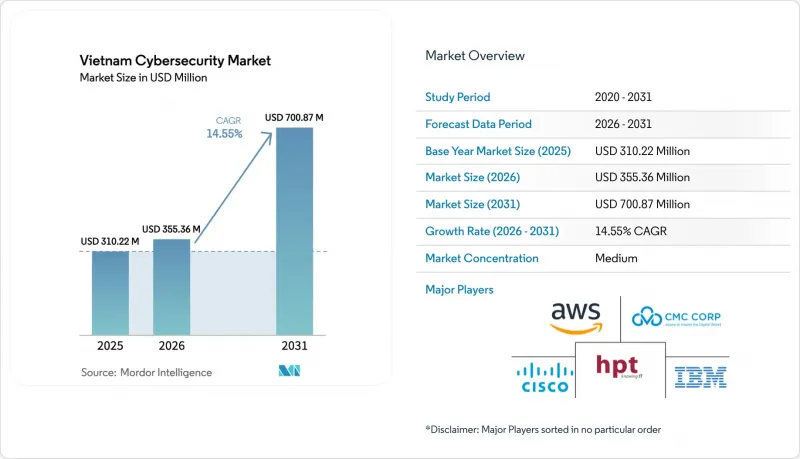
本報告以「交付方式(解決方案、服務)」、「部署方式(雲端、本地部署)」、「組織規模(中小企業、大型企業)」和「最終用戶(金融、保險、證券、醫療保健、IT與電信、工業與國防、零售、能源與公共產業、製造業及其他)」對產業進行分類。市場預測以美元計價。
越南網路安全市場趨勢與洞察
政府大力推動數位轉型(DX),正在加速安全相關支出。
國家數位轉型計畫撥款1億美元用於網路安全,並要求所有公共服務機構在2025年前達到線上成熟度4級。南方電力公司已基本實現合約電子化,預計到2024年12月將簽署560萬份契約,這表明公共部門的採用正在迫使供應商達到類似的安全性標準。八個「越南製造」安全營運中心(SOC)平台已於2023年獲得認證,這些平台正在促進專業知識和資金的進一步在地化,確保國內供應商在公共機構採購安全技術時享有優先權。政府的每一次採用都在向私人企業發出訊號,促使其實施基準安全措施,從而擴大市場需求。
無現金支付的激增正在擴大銀行、金融服務和保險業(BFSI)面臨的攻擊面。
2024年7月,越南對超過1,000萬越南盾的交易強制實施生物識別,但詐騙集團利用基於照片的規避技術,從多家銀行非法盜取了超過1兆越南盾。這凸顯了臉部辨識準確性的挑戰。越南外貿銀行(Vietcombank)的人工智慧反詐騙引擎在一個月內攔截了4萬筆可疑交易,總額達1600億越南盾,展現了即時威脅分析的切實成效。因此,銀行、金融服務和保險(BFSI)機構正在增加對持續身份驗證、行為分析和交易監控解決方案的預算投入,從而擴大了越南的網路安全市場。
合格人員短缺
預計到2028年,越南將需要超過70萬名網路安全專業人員,但76%的企業已經反映人才短缺,導致人事費用上升和引進週期延長。人才流失到海外企業加劇了人才短缺,而大學課程在實踐培訓方面也存在落後。美國國家網路安全協會的「2025 nCademy」平台提供人工智慧驅動的個人化課程,但其對短期人才供應的影響仍然有限。供應商正透過捆綁遠端管理服務和方便用戶使用的SaaS工具來解決這個問題,但專案週期依然漫長。
細分市場分析
2025年,解決方案將佔據越南網路安全市場佔有率的67.12%,其核心是符合第53/2022號法令規定的網路安全設備和基礎設施保護。隨著企業遷移工作負載並遵守生物識別法規,對應用安全、雲端安全和識別及存取安全的需求正在加速成長。網路安全更新周期與超大規模資料中心的推出相契合,而終端安全保護也在隨著遠端辦公趨勢的推進而不斷擴展。
儘管服務業規模較小,但預計到2031年,為彌補人才短缺,服務業將透過外包保全行動來超越產品業,年複合成長率將達到14.86%。託管安全營運中心(SOC)、固定價格事件回應合約和合規諮詢是推動這一快速成長的主要因素。預計到2031年,越南網路安全市場服務業的規模將加倍,這得益於從資本支出重新分配到營運支出的預算。本土供應商利用其地理位置接近性和對監管環境的熟悉程度,而全球供應商則在複雜的轉型項目中具有優勢。
到2025年,雲端運算將佔越南網路安全市場佔有率的56.02%。這促進者Viettel的140兆瓦資料中心滿足資料在地化需求,以及CMC投資2.5億美元的園區計畫。中小企業重視SaaS的敏捷性,而銀行和政府部門則選擇私有雲端來更好地控制敏感資料。這推動了對雲端原生防火牆、容器安全和工作負載保護平台的需求成長。
儘管在舊有系統的產業中,本地部署環境仍然佔據主導地位,但即使是這些產業也開始採用混合架構。跨多重雲端、邊緣和本地環境的統一策略編配正成為採購的基本要求,供應商的藍圖也朝著單一管理平台的方向發展。預計到2031年,越南網路安全市場中雲端部署的安全措施的市場規模將比本地部署支出高出2倍。
其他好處:
- Excel格式的市場預測(ME)表
- 3個月的分析師支持
目錄
第1章:引言
- 研究假設和市場定義
- 調查範圍
第2章:調查方法
第3章執行摘要
第4章 市場狀況
- 市場概覽
- 市場促進因素
- 政府為促進數位轉型而採取的措施正在加速安全相關支出。
- 無現金支付的蓬勃發展正在擴大銀行、金融服務和保險 (BFSI) 行業的攻擊面。
- 2023年起,中小企業將迎來雲端遷移浪潮
- 遵守越南網路安全法和第53號法令的義務
- 超大規模資料中心擴建(Viettel、AWS、FPT)
- 國家主導的針對關鍵基礎設施的APT攻擊日益增多
- 市場限制因素
- 合格人員短缺
- 對價格敏感的中小企業市場
- 監管執法分散
- 對安防設備徵收高額進口關稅
- 產業價值鏈分析
- 監理展望
- 技術展望
- 波特五力分析
- 投資分析
- 宏觀經濟因素評估
第5章 市場規模與成長預測
- 報價
- 解決方案
- 應用程式安全
- 雲端安全
- 資料安全
- 身分和存取管理
- 基礎設施保護
- 綜合風險管理
- 網路安全設備
- 端點安全
- 服務
- 專業服務
- 託管服務
- 解決方案
- 部署模式
- 雲
- 現場
- 按最終用戶行業分類
- BFSI
- 衛生保健
- 資訊科技/通訊
- 工業與國防
- 零售
- 能源公用事業
- 製造業
- 其他終端用戶產業
- 按組織規模
- SME
- 大公司
第6章 競爭情勢
- 市場集中度
- 策略趨勢
- 市佔率分析
- 公司簡介
- Viettel Cyber Security
- FPT Information System
- CMC Cyber Security
- VNPT Information Security Center
- CyRadar(Bkav)
- BKAV Corporation
- HPT Vietnam Corporation
- Savis Technology Group
- IBM Vietnam Co., Ltd.
- Cisco Systems Vietnam
- Microsoft Vietnam
- Dell Technologies Vietnam
- Palo Alto Networks VN Rep. Office
- Fortinet Vietnam
- Amazon Web Services Vietnam
- Kaspersky Lab Vietnam
- Check Point Indochina
- Trend Micro Vietnam
- Mandiant(Google Cloud)Vietnam
- Secureworks(SG and VN)
第7章 市場機會與未來展望
According to Mordor Intelligence, the Vietnam cybersecurity market size is expected to grow from USD 310.22 million in 2025 to USD 355.36 million in 2026 and is forecast to reach USD 700.87 million by 2031 at 14.55% CAGR over 2026-2031.
This report Segments the Industry Into by Offering (Solutions, Services), by Deployment Mode (Cloud, On-Premise), by Organization Size (SMEs, Large Enterprises), and by End User (BFSI, Healthcare, IT and Telecom, Industrial and Defense, Retail, Energy and Utilities, Manufacturing, Others). The Market Forecasts are Provided in Terms of Value (USD).
Vietnam Cybersecurity Market Trends and Insights
Government digital-transformation agenda accelerating security spend
The National Digital Transformation Programme earmarks USD 100 million for cybersecurity and requires every public service to reach level-4 online maturity by 2025. Southern Power Corporation's near-total shift to electronic contracts, 5.6 million executed by December 2024, shows how public-sector adoption forces suppliers to meet the same security standards. Eight "Make in Vietnam" SOC platforms certified in 2023 further localize expertise and funding, ensuring domestic vendors secure a preferential foothold when public agencies procure security technology. Each government deployment creates a signaling effect that nudges private firms to match baseline controls, amplifying market demand.
Cashless-payment boom raising BFSI attack surface
Biometric verification became compulsory for transactions above VND 10 million in July 2024, yet fraud rings manipulated photo-based bypasses to siphon over VND 1,000 billion from multiple banks, underscoring gaps in facial-recognition accuracy. Vietcombank's AI-enabled anti-fraud engine stopped 40,000 suspicious transfers worth VND 160 billion within one month, demonstrating tangible returns on real-time threat analytics. Consequently, BFSI institutions channel higher budgets toward continuous authentication, behavioral analytics and transaction-monitoring suites, widening the Vietnam cybersecurity market.
Certified-talent shortage
Vietnam will need more than 700,000 cybersecurity specialists by 2028, yet 76% of firms already report staffing shortages, inflating salary costs and elongating deployment cycles.Brain drain to overseas employers worsens scarcity, while university curricula lag on hands-on training. The National Cybersecurity Association's 2025 nCademy platform offers AI-personalized courses, but its near-term impact on workforce volume remains limited. Vendors compensate by bundling remote managed services and low-touch SaaS tools, but project timelines still extend.
Other drivers and restraints analyzed in the detailed report include:
- SME cloud-migration wave post-2023
- Mandatory compliance with Cybersecurity Law and Decree 53/2022
- Price-sensitive SME segment
For complete list of drivers and restraints, kindly check the Table Of Contents.
Segment Analysis
Solutions held 67.12% of the Vietnam cybersecurity market in 2025, led by network-security equipment and infrastructure protection mandated under Decree 53/2022. Demand for application, cloud, and identity-access security accelerates as enterprises migrate workloads and comply with biometric rules. Network-security refresh cycles align with hyperscale datacenter launches, while endpoint defenses expand alongside remote-work trends.
Services, though smaller, are projected to outpace products at a 14.86% CAGR through 2031 as organizations outsource security operations to bridge workforce shortages. Managed SOC, incident response retainer and compliance consulting anchor this surge. The Vietnam cybersecurity market size for Services is forecast to double by 2031, capturing budgets reallocated from capital purchases to operating expenses. Domestic providers leverage proximity and regulatory fluency, whereas global vendors win complex transformation projects.
Cloud deployments captured 56.02% of Vietnam cybersecurity market share in 2025, catalyzed by Viettel's 140 MW facility and CMC's USD 250 million campus that satisfy data-localization clauses.Small firms prize SaaS agility, while banks and ministries choose private clouds to retain custody of sensitive data. Demand for cloud-native firewalls, container security and workload-protection platforms scales in parallel.
On-premise estates persist in defense, energy and legacy-system heavy sectors, but even these embrace hybrid designs. Unified policy orchestration across multicloud, edge and premises environments becomes a procurement prerequisite, steering vendor roadmaps toward single-pane management. By 2031 the Vietnam cybersecurity market size for cloud-deployed controls is projected to eclipse on-premise spending by a two-to-one margin.
Complete Report Scope:
- By Offering
- Solutions
- Application Security
- Cloud Security
- Data Security
- Identity and Access Management
- Infrastructure Protection
- Integrated Risk Management
- Network Security Equipment
- Endpoint Security
- Services
- Professional Services
- Managed Services
- Solutions
- By Deployment Mode
- Cloud
- On-Premise
- By End-User Industry
- BFSI
- Healthcare
- IT and Telecom
- Industrial and Defense
- Retail
- Energy and Utilities
- Manufacturing
- Other End-User Industries
- By Organization Size
- SMEs
- Large Enterprises
List of Companies Covered in this Report:
- Viettel Cyber Security
- FPT Information System
- CMC Cyber Security
- VNPT Information Security Center
- CyRadar (Bkav)
- BKAV Corporation
- HPT Vietnam Corporation
- Savis Technology Group
- IBM Vietnam Co., Ltd.
- Cisco Systems Vietnam
- Microsoft Vietnam
- Dell Technologies Vietnam
- Palo Alto Networks VN Rep. Office
- Fortinet Vietnam
- Amazon Web Services Vietnam
- Kaspersky Lab Vietnam
- Check Point Indochina
- Trend Micro Vietnam
- Mandiant (Google Cloud) Vietnam
- Secureworks (SG and VN)
Additional Benefits:
- The market estimate (ME) sheet in Excel format
- 3 months of analyst support
TABLE OF CONTENTS
1 INTRODUCTION
- 1.1 Study Assumptions and Market Definition
- 1.2 Scope of the Study
2 RESEARCH METHODOLOGY
3 EXECUTIVE SUMMARY
4 MARKET LANDSCAPE
- 4.1 Market Overview
- 4.2 Market Drivers
- 4.2.1 Government Digital-Transformation Agenda Accelerating Security Spend
- 4.2.2 Cashless-Payment Boom Raising BFSI Attack Surface
- 4.2.3 SME Cloud-Migration Wave Post-2023
- 4.2.4 Mandatory Compliance with Vietnam Cybersecurity Law and Decree 53/2022
- 4.2.5 Hyperscale Datacenter Build-outs (Viettel, AWS, FPT)
- 4.2.6 Rising State-sponsored APT Attacks on Critical Infrastructure
- 4.3 Market Restraints
- 4.3.1 Certified-Talent Shortage
- 4.3.2 Price-Sensitive SME Segment
- 4.3.3 Fragmented Regulatory Enforcement
- 4.3.4 High Import Tariffs on Security Appliances
- 4.4 Industry Value Chain Analysis
- 4.5 Regulatory Outlook
- 4.6 Technological Outlook
- 4.7 Porter's Five Forces Analysis
- 4.7.1 Bargaining Power of Suppliers
- 4.7.2 Bargaining Power of Buyers
- 4.7.3 Threat of New Entrants
- 4.7.4 Threat of Substitutes
- 4.7.5 Competitive Rivalry
- 4.8 Investment Analysis
- 4.9 Assessment of Macroeconomic Factors
5 MARKET SIZE AND GROWTH FORECASTS (VALUE)
- 5.1 By Offering
- 5.1.1 Solutions
- 5.1.1.1 Application Security
- 5.1.1.2 Cloud Security
- 5.1.1.3 Data Security
- 5.1.1.4 Identity and Access Management
- 5.1.1.5 Infrastructure Protection
- 5.1.1.6 Integrated Risk Management
- 5.1.1.7 Network Security Equipment
- 5.1.1.8 Endpoint Security
- 5.1.2 Services
- 5.1.2.1 Professional Services
- 5.1.2.2 Managed Services
- 5.1.1 Solutions
- 5.2 By Deployment Mode
- 5.2.1 Cloud
- 5.2.2 On-Premise
- 5.3 By End-User Industry
- 5.3.1 BFSI
- 5.3.2 Healthcare
- 5.3.3 IT and Telecom
- 5.3.4 Industrial and Defense
- 5.3.5 Retail
- 5.3.6 Energy and Utilities
- 5.3.7 Manufacturing
- 5.3.8 Other End-User Industries
- 5.4 By Organization Size
- 5.4.1 SMEs
- 5.4.2 Large Enterprises
6 COMPETITIVE LANDSCAPE
- 6.1 Market Concentration
- 6.2 Strategic Moves
- 6.3 Market Share Analysis
- 6.4 Company Profiles (includes Global level Overview, Market level overview, Core Segments, Financials as available, Strategic Information, Market Rank/Share for key companies, Products and Services, and Recent Developments)
- 6.4.1 Viettel Cyber Security
- 6.4.2 FPT Information System
- 6.4.3 CMC Cyber Security
- 6.4.4 VNPT Information Security Center
- 6.4.5 CyRadar (Bkav)
- 6.4.6 BKAV Corporation
- 6.4.7 HPT Vietnam Corporation
- 6.4.8 Savis Technology Group
- 6.4.9 IBM Vietnam Co., Ltd.
- 6.4.10 Cisco Systems Vietnam
- 6.4.11 Microsoft Vietnam
- 6.4.12 Dell Technologies Vietnam
- 6.4.13 Palo Alto Networks VN Rep. Office
- 6.4.14 Fortinet Vietnam
- 6.4.15 Amazon Web Services Vietnam
- 6.4.16 Kaspersky Lab Vietnam
- 6.4.17 Check Point Indochina
- 6.4.18 Trend Micro Vietnam
- 6.4.19 Mandiant (Google Cloud) Vietnam
- 6.4.20 Secureworks (SG and VN)
7 MARKET OPPORTUNITIES AND FUTURE OUTLOOK
- 7.1 White-Space and Unmet-Need Assessment

 中東網路安全:市場佔有率分析、產業趨勢與統計及成長預測(2026-2031 年)
 全球網路安全代理人工智慧市場規模、佔有率、趨勢和成長分析報告(2026-2034)印度網路安全:市場佔有率分析、產業趨勢與統計及成長預測(2026-2031)菲律賓網路安全:市場佔有率分析、產業趨勢與統計及成長預測(2026-2031 年)義大利網路安全:市場佔有率分析、產業趨勢與統計、成長預測(2026-2031)
 2026-2030年全球安全態勢管理(SPM)市場
 2026-2030年全球網路安全市場全球IT與通訊網路安全市場規模、佔有率、趨勢及成長分析報告(2026-2034年)網路欺騙:市場佔有率分析、產業趨勢與統計、成長預測(2026-2031)
 銀行、金融服務和保險 (BFSI) 網路安全市場規模、佔有率和趨勢分析報告:按組件、部署模式、安全類型、行業、最終用戶、地區和細分市場預測 (2026–2033)