

 |
市場調查報告書
商品編碼
2116717
義大利網路安全:市場佔有率分析、產業趨勢與統計、成長預測(2026-2031)Italy Cybersecurity - Market Share Analysis, Industry Trends & Statistics, Growth Forecasts (2026 - 2031) |
||||||

※ 本網頁內容可能與最新版本有所差異。詳細情況請與我們聯繫。
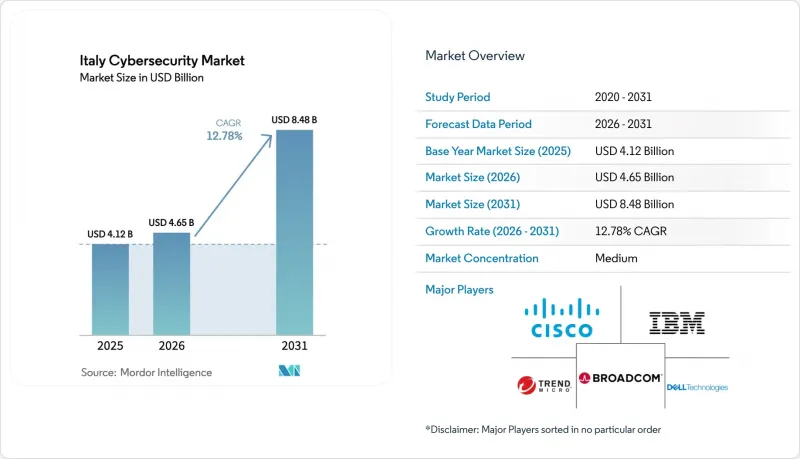
據 Mordor Intelligence 稱,2025 年義大利網路安全市場價值 41.2 億美元,預計到 2031 年將從 2026 年的 46.5 億美元成長至 84.8 億美元,預測期(2026-2031 年)的複合年成長率預計為 12.78%。
本報告按交付方式(解決方案、服務)、部署方式(雲端、本地部署)、組織規模(中小企業、大型企業)和最終用戶(金融、保險、證券、醫療保健、IT、電信及其他)進行分類。市場預測以美元計價。
義大利網路安全市場趨勢與洞察
「數位化優先」的公共服務政策正在加速國家網路邊界計畫的實施。
義大利已將國家復甦和韌性計畫資源的27%用於數位轉型,其中22億美元用於網路安全。國家網路安全局現已強制要求關鍵服務供應商嚴格遵守邊界控制規範,但目前只有2%的政府機構採取了相應措施。隨著市政門戶網站、福利救濟和國民身份證服務等業務上線,羅馬、米蘭和都靈等地的地方政府正在加強其身份管理和零信任框架,通常會與託管安全服務提供商簽訂契約,以彌補內部技能的不足。
義大利工業自動化網路遭受勒索軟體攻擊激增。
2024年第四季,製造業佔工業勒索軟體攻擊事件的70%,攻擊性質正從簡單的資料竊盜轉向營運中斷。光是2025年第一季,歐洲就記錄了135起營運技術(OT)安全漏洞事件。波河流域的工廠正在加強PLC安全防護、分類網路區域並部署人工智慧驅動的異常檢測系統,以避免長達數天的生產停工。安全遠端維護閘道器供應商的需求已達到歷史新高。
義大利語網路安全專業人員的短缺推高了託管安全服務提供者 (MSSP) 的成本。
儘管需求不斷成長,但2022年至2024年間,網路安全相關職缺發布數量下降了10%,導致90%的企業面臨技能缺口。由於本地語言的安全營運中心(SOC)分析師薪資高昂,中小企業被迫將監控業務外包給總部位於米蘭或羅馬的資安管理服務提供者(MSSP)。
細分市場分析
預計到2025年,解決方案將佔據義大利網路安全市場佔有率的64.85%,主要驅動力來自網路防火牆和身分管理平台。與NIS2和DORA相關的預算重新分配,使得各大銀行和公共產業公司保持了強勁的續約勢頭。然而,隨著企業將安全營運中心(SOC)、滲透測試和事件回應外包以緩解人才短缺,預計服務業將超越產品產業,到2031年複合年成長率(CAGR)將達到13.95%。託管偵測與回應(MDR)平台目前正在整合威脅搜尋和監管報告功能,從而有助於企業維持長期合約。預計到2031年,義大利網路安全服務市場規模將超過31.8億美元,主要得益於義大利全天候監控的需求。
隨著顧問團隊主導合規性評估、架構重構和量子安全先導計畫,義大利網路安全市場正在蓬勃發展。專業服務收入在羅馬公共部門叢整合長最快,而託管安全服務提供者 (MSSP) 的採用率在米蘭金融區最高,一級銀行在併購過程中會將日誌關聯分析和數位鑑識外包給專業服務商。身分即服務 (IaaS) 和零信任評估也日益受到醫療網路的關注,這些網路正準備實施電子健康記錄 (EHR)。
到2025年,本地部署解決方案將佔義大利網路安全市場佔有率的59.85%,反映出關鍵基礎設施營運商對資料主權的高度重視。然而,受SaaS生產力套件、遠端辦公以及歐盟境內超大規模資料中心日益成長的信心推動,透過雲端提供的安全措施正以17.55%的複合年成長率快速擴張。預計到2031年,義大利網路安全市場的雲端採用規模將超過43.6億美元,需求預計將集中在雲端原生SIEM、容器運行時防禦以及用於簡化GDPR審計的「策略即程式碼」自動化。
混合架構正成為遷移藍圖中的主導趨勢。威脅情報湖仍然部署在本地,而漏洞掃描和備份加密則正在遷移到SaaS。基於GDPR的跨境資料傳輸條款提高了人們對敏感運算和客戶管理金鑰的關注度。供應商現在將資料居住儀表板捆綁在一起,以吸引那些謹慎的公共機構,這些機構希望將其公民入口網站遷移到位於都靈和博洛尼亞的私有雲端節點。
其他好處:
- Excel格式的市場預測(ME)表
- 3個月的分析師支持
目錄
第1章:引言
- 研究假設和市場定義
- 調查範圍
第2章:調查方法
第3章執行摘要
第4章 市場狀況
- 市場概覽
- 市場促進因素
- 強制推行「數位化優先」的公共服務正在加速國家網路邊界計畫的推進。
- 針對義大利工業自動化網路的勒索軟體攻擊正在激增。
- 歐盟的 NIS2 和 DORA 合規期限促使人們重新分配預算用於安全工具。
- 米蘭和都靈的雲端原生新創公司蓬勃發展,進一步增加了對 SaaS 安全態勢管理的需求。
- 在能源走廊(波河流域)擴大OT/ICS部署;擴大攻擊目標區域
- 政府透過PNRR基金會擴大對「義大利製造」網路平台的支持。
- 市場限制因素
- 義大利語網路安全專業人員的短缺推高了託管安全服務提供者 (MSSP) 的成本。
- 中型製造企業和中小企業普遍認為「安全等於成本中心」。
- 傳統電信基礎設施分散阻礙了零信任技術的普及。
- 在監管嚴格的銀行、金融服務和保險 (BFSI) 領域,從本地部署的硬體安全模組 (HSM) 過渡到雲端存在延遲。
- 監理展望
- 技術展望
- 波特五力分析
- 宏觀經濟因素對市場的影響
- 投資與資金籌措分析
第5章 市場規模與成長預測
- 報價
- 解決方案
- 應用程式安全
- 雲端安全
- 資料安全
- 身分和存取管理
- 基礎設施保護
- 綜合風險管理
- 網路安全設備
- 端點安全
- 其他解決方案
- 服務
- 專業服務
- 託管服務
- 解決方案
- 部署模式
- 雲
- 現場
- 按組織規模
- SME
- 大公司
- 最終用戶
- BFSI
- 衛生保健
- IT/通訊
- 工業與國防
- 零售
- 能源公用事業
- 製造業
- 其他
第6章 競爭情勢
- Strategic Developments
- Vendor Positioning Analysis
- 公司簡介
- IBM Corporation
- Cisco Systems Inc.
- Trend Micro Incorporated
- Broadcom Inc.(Symantec)
- Dell Technologies Inc.
- Fortinet Inc.
- Palo Alto Networks Inc.
- McAfee LLC
- Check Point Software Technologies Ltd.
- Sophos Group plc
- Kaspersky Lab JSC
- Accenture Security
- Leonardo SpA
- Reply SpA(Cluster Reply, Breed Reply)
- TAS Group
- Tinexta Cyber SpA
- Almaviva SpA
- Telsy SpA(TIM Group)
- Cyberoo SpA
- Maggioli Group
第7章 市場機會與未來展望
According to Mordor Intelligence, the Italy cybersecurity market size was valued at USD 4.12 billion in 2025 and estimated to grow from USD 4.65 billion in 2026 to reach USD 8.48 billion by 2031, at a CAGR of 12.78% during the forecast period (2026-2031).
This report is Segmented by Offering (Solutions, Services), Deployment Mode (Cloud, On-Premise), Organization Size (SMEs, Large Enterprises), End User (BFSI, Healthcare, IT and Telecom, and More). The Market Forecasts are Provided in Terms of Value (USD).
Italy Cybersecurity Market Trends and Insights
Digital-First Public-Service Mandates Accelerating National Cyber-Perimeter Programs
Italy earmarked 27% of National Recovery and Resilience Plan resources for digital transition, including USD 2.2 billion for cybersecurity. The National Cybersecurity Agency now obliges essential service providers to meet strict perimeter controls, yet only 2% of public administrations currently comply. As municipal portals, welfare payments and national ID services move online, local authorities in Rome, Milan and Turin are upgrading identity management and zero-trust frameworks, often contracting managed security operators to compensate for in-house skill shortages.
Surge in Ransomware Attacks Targeting Italian Industrial Automation Networks
Manufacturing firms absorbed 70% of industrial ransomware incidents in Q4 2024, a shift from mere data theft to operational sabotage. During Q1 2025 alone, Europe logged 135 OT-focused breaches. Factories along the Po Valley are hardening PLCs, segmenting networks and rolling out AI-driven anomaly detection to avoid multi-day production shutdowns. Vendor demand for secure remote-maintenance gateways has reached record levels.
Scarcity of Italian-Speaking Cyber-Talent Raising MSSP Costs
Cybersecurity job postings fell 10% between 2022 and 2024 even as demand climbed, leaving 90% of organisations with skills gaps. Local-language SOC analysts command premiums, pushing smaller firms to delegate monitoring to managed security service providers headquartered in Milan and Rome.
Other drivers and restraints analyzed in the detailed report include:
- EU NIS2 and DORA Compliance Deadlines Driving Budget Re-allocation Toward Security Tooling
- Cloud-Native Start-up Boom in Milan and Turin Intensifying Demand for SaaS Security Posture Management
- Prevailing 'Security - Cost Center' Mind-set Within Mid-Market Manufacturing SMEs
For complete list of drivers and restraints, kindly check the Table Of Contents.
Segment Analysis
Solutions held 64.85% of Italy cybersecurity market share in 2025, led by network firewalls and identity platforms. Budget reallocations tied to NIS2 and DORA sustain robust refresh cycles among large banks and utilities. However, services are projected to record a 13.95% CAGR to 2031, eclipsing product growth as enterprises outsource SOC, penetration testing and incident response to mitigate the talent deficit. Managed detection and response platforms now bundle threat-hunting and regulatory reporting, creating sticky multi-year contracts. Italy cybersecurity market size for services is set to surpass USD 3.18 billion by 2031, aided by demand for 24/7 monitoring anchored in Italian language.
Italy cybersecurity market expands as consulting teams guide compliance mapping, architecture redesign and quantum-resilience pilots. Professional services revenues are rising fastest in Rome's public-sector cluster, while MSSP uptake is highest in Milan's financial quarter where tier-one banks off-load log correlation and digital-forensics workloads during merger integrations. Identity-as-a-Service and zero-trust assessments also gain traction among healthcare networks preparing for electronic health-record rollouts.
On-premise solutions retained 59.85% of Italy cybersecurity market share in 2025, reflecting strong data-sovereignty preferences among critical infrastructure operators. Yet cloud-delivered controls are climbing at an 17.55% CAGR, driven by SaaS productivity suites, remote work, and rising comfort with EU-hosted hyperscale regions. As the Italy cybersecurity market size for cloud deployment surpasses USD 4.36 billion in 2031, demand concentrates on cloud-native SIEM, container runtime defense and policy-as-code automation that streamlines GDPR audits.
Hybrid architectures dominate transitional road maps: threat-intelligence lakes remain on-premise, while vulnerability scanning and backup encryption shift to SaaS. Cross-border data-transfer clauses under GDPR fuel interest in confidential computing and customer-managed keys. Vendors now bundle data-residency dashboards to win cautious public authorities migrating citizen portals to private-cloud nodes in Turin and Bologna.
Complete Report Scope:
- By Offering
- Solutions
- Application Security
- Cloud Security
- Data Security
- Identity and Access Management
- Infrastructure Protection
- Integrated Risk Management
- Network Security Equipment
- Endpoint Security
- Other Solutions
- Services
- Professional Services
- Managed Services
- Solutions
- By Deployment Mode
- Cloud
- On-Premise
- By Organization Size
- SMEs
- Large Enterprises
- By End User
- BFSI
- Healthcare
- IT and Telecom
- Industrial and Defense
- Retail
- Energy and Utilities
- Manufacturing
- Others
List of Companies Covered in this Report:
- IBM Corporation
- Cisco Systems Inc.
- Trend Micro Incorporated
- Broadcom Inc. (Symantec)
- Dell Technologies Inc.
- Fortinet Inc.
- Palo Alto Networks Inc.
- McAfee LLC
- Check Point Software Technologies Ltd.
- Sophos Group plc
- Kaspersky Lab JSC
- Accenture Security
- Leonardo S.p.A.
- Reply S.p.A. (Cluster Reply, Breed Reply)
- TAS Group
- Tinexta Cyber S.p.A.
- Almaviva S.p.A.
- Telsy S.p.A. (TIM Group)
- Cyberoo S.p.A.
- Maggioli Group
Additional Benefits:
- The market estimate (ME) sheet in Excel format
- 3 months of analyst support
TABLE OF CONTENTS
1 INTRODUCTION
- 1.1 Study Assumptions and Market Definition
- 1.2 Scope of the Study
2 RESEARCH METHODOLOGY
3 EXECUTIVE SUMMARY
4 MARKET LANDSCAPE
- 4.1 Market Overview
- 4.2 Market Drivers
- 4.2.1 Digital-First Public-Service Mandates Accelerating National Cyber-Perimeter Programs
- 4.2.2 Surge in Ransomware Attacks Targeting Italian Industrial Automation Networks
- 4.2.3 EU NIS2 and DORA Compliance Deadlines Driving Budget Re-allocation Towards Security Tooling
- 4.2.4 Cloud-Native Start-up Boom in Milan and Turin Intensifying Demand for SaaS Security Posture Management
- 4.2.5 Growth of OT/ICS Installations in Energy Corridor (Po Valley) Expanding Attack Surface
- 4.2.6 Increased Government Incentives for "Made-in-Italy" Cyber Platforms under PNRR Funds
- 4.3 Market Restraints
- 4.3.1 Scarcity of Italian-speaking Cyber-Talent Raising MSSP Costs
- 4.3.2 Prevailing 'Security - Cost Center' Mind-set Within Mid-Market Manufacturing SMEs
- 4.3.3 Fragmented Legacy Telco Infrastructure Hindering Zero-Trust Roll-outs
- 4.3.4 Slow Migration from On-Prem HSMs in Highly Regulated BFSI Segment
- 4.4 Regulatory Outlook
- 4.5 Technological Outlook
- 4.6 Porter's Five Forces Analysis
- 4.6.1 Threat of New Entrants
- 4.6.2 Bargaining Power of Buyers
- 4.6.3 Bargaining Power of Suppliers
- 4.6.4 Threat of Substitutes
- 4.6.5 Intensity of Competitive Rivalry
- 4.7 Impact of Macroeconomic Factors on the Market
- 4.8 Investment and Funding Analysis
5 MARKET SIZE AND GROWTH FORECASTS (VALUE)
- 5.1 By Offering
- 5.1.1 Solutions
- 5.1.1.1 Application Security
- 5.1.1.2 Cloud Security
- 5.1.1.3 Data Security
- 5.1.1.4 Identity and Access Management
- 5.1.1.5 Infrastructure Protection
- 5.1.1.6 Integrated Risk Management
- 5.1.1.7 Network Security Equipment
- 5.1.1.8 Endpoint Security
- 5.1.1.9 Other Solutions
- 5.1.2 Services
- 5.1.2.1 Professional Services
- 5.1.2.2 Managed Services
- 5.1.1 Solutions
- 5.2 By Deployment Mode
- 5.2.1 Cloud
- 5.2.2 On-Premise
- 5.3 By Organization Size
- 5.3.1 SMEs
- 5.3.2 Large Enterprises
- 5.4 By End User
- 5.4.1 BFSI
- 5.4.2 Healthcare
- 5.4.3 IT and Telecom
- 5.4.4 Industrial and Defense
- 5.4.5 Retail
- 5.4.6 Energy and Utilities
- 5.4.7 Manufacturing
- 5.4.8 Others
6 COMPETITIVE LANDSCAPE
- 6.1 Strategic Developments
- 6.2 Vendor Positioning Analysis
- 6.3 Company Profiles (includes Global level Overview, Market level overview, Core Segments, Financials as available, Strategic Information, Products and Services, and Recent Developments)
- 6.3.1 IBM Corporation
- 6.3.2 Cisco Systems Inc.
- 6.3.3 Trend Micro Incorporated
- 6.3.4 Broadcom Inc. (Symantec)
- 6.3.5 Dell Technologies Inc.
- 6.3.6 Fortinet Inc.
- 6.3.7 Palo Alto Networks Inc.
- 6.3.8 McAfee LLC
- 6.3.9 Check Point Software Technologies Ltd.
- 6.3.10 Sophos Group plc
- 6.3.11 Kaspersky Lab JSC
- 6.3.12 Accenture Security
- 6.3.13 Leonardo S.p.A.
- 6.3.14 Reply S.p.A. (Cluster Reply, Breed Reply)
- 6.3.15 TAS Group
- 6.3.16 Tinexta Cyber S.p.A.
- 6.3.17 Almaviva S.p.A.
- 6.3.18 Telsy S.p.A. (TIM Group)
- 6.3.19 Cyberoo S.p.A.
- 6.3.20 Maggioli Group
7 MARKET OPPORTUNITIES AND FUTURE OUTLOOK
- 7.1 White-space and Unmet-Need Assessment

 全球網路安全代理人工智慧市場規模、佔有率、趨勢和成長分析報告(2026-2034)
 印度網路安全:市場佔有率分析、產業趨勢與統計及成長預測(2026-2031)菲律賓網路安全:市場佔有率分析、產業趨勢與統計及成長預測(2026-2031 年)
 2026-2030年全球安全態勢管理(SPM)市場
 2026-2030年全球網路安全市場全球IT與通訊網路安全市場規模、佔有率、趨勢及成長分析報告(2026-2034年)網路欺騙:市場佔有率分析、產業趨勢與統計、成長預測(2026-2031)
 銀行、金融服務和保險 (BFSI) 網路安全市場規模、佔有率和趨勢分析報告:按組件、部署模式、安全類型、行業、最終用戶、地區和細分市場預測 (2026–2033)
 2026年全球網路安全管理市場報告全球油氣網路安全市場規模、佔有率、趨勢和成長分析報告(2026-2034)