


 |
市場調查報告書
商品編碼
2125365
亞太地區程序化廣告:市場佔有率分析、產業趨勢與統計及成長預測(2026-2031)Asia-Pacific Programmatic Advertising - Market Share Analysis, Industry Trends & Statistics, Growth Forecasts (2026 - 2031) |
||||||

※ 本網頁內容可能與最新版本有所差異。詳細情況請與我們聯繫。
根據 Mordor Intelligence 預測,亞太地區的程式化廣告市場規模預計將從 2025 年的 2,102.2 億美元成長到 2026 年的 2581.7 億美元,然後在 2031 年達到 7203.1 億美元,2026 年至 20312.8%。
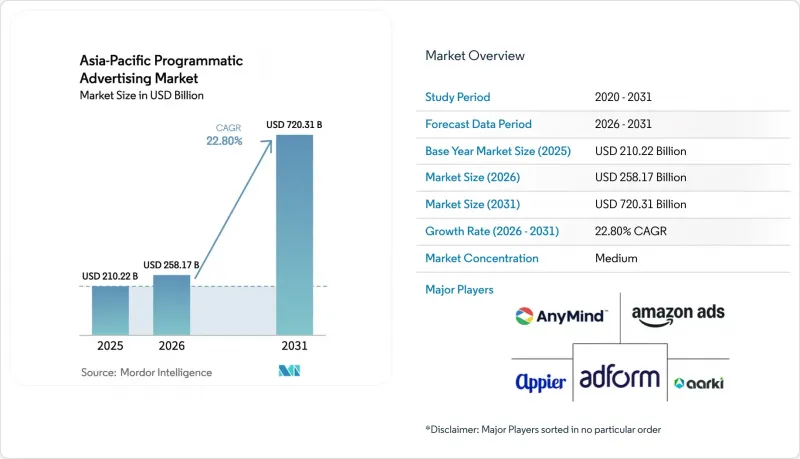
本報告按交易平台(即時競價、私人市場擔保等)、廣告媒介(數位展示廣告、行動顯示器等)、公司規模(中小企業和大型企業)、行業領域(電子商務和零售、銀行、金融服務和保險等)以及國家/地區進行細分。市場預測以美元計價。
亞太地區程序化廣告市場的趨勢與洞察
廣告預算迅速轉向數位管道
2025年,隨著品牌尋求可衡量的受眾層面成效(而傳統媒體難以實現),數位媒體在全部區域的廣告支出佔有率大幅成長。程序化平台也從中受益,行銷人員開始採用歸因工具即時最佳化跨通路用戶旅程。印尼和越南等傳統上線性電視覆蓋範圍有限的市場迅速轉向行動端主導的程式化模式。監管機構透過強制執行透明度和數據存取標準,鼓勵自動化交易,從而促進了這項轉型。因此,甚至之前用於電視的品牌建立預算也開始流入程序化廣告,擴大了符合條件的廣告支出範圍。
行動優先的生態系統正在推動應用程式內廣告的發展。
在亞太地區所有主要市場,行動端廣告展示量已超越桌面端,使得應用程式內廣告位成為亞太程式化廣告市場中最具吸引力的廣告資源。高用戶參與度和豐富的用戶行為數據正在推動競標密度和有效的CPM提升。 AnyMind Group和InMobi等合作夥伴正在實現需求方之間的自動化協調,使發布商的營收年增4.3倍。廣告主正在結合位置和應用程式使用訊號,在門市附近投放即時優惠。同時,發布商正在採用激勵影片和可玩廣告形式,將廣告完成率提升至90%以上。豐富的行動數據也支援符合隱私權保護要求的類似受眾建模,彌補了瀏覽器禁用Cookie帶來的不足。
隱私法規碎片化增加了合規成本。
由於各國資料保護法律各不相同,平台公司不得不為每個市場維護獨立的使用者許可流程、資料儲存位置和報告模板,這導致營運成本增加,並延誤了宣傳活動的啟動。大型供應商可以透過專門的法律團隊來承擔這些負擔,但中小企業則面臨罰款風險,甚至被迫退出盈利的市場。跨境宣傳活動通常需要將使用者資料細分,從而抵消了規模經濟效益。擔心受到處罰的廣告商往往優先選擇擁有經審計合規認證的合作夥伴,這可能導致廣告支出集中,並可能限制新創企業的創新。
細分市場分析
即時競價(RTB) 憑藉其柔軟性和動態定價優勢,預計將在亞太地區的程序化廣告市場佔據最大佔有率,到 2025 年將佔總收入的 46.45%。這個細分市場的規模主要歸功於開放交易平台的流動性和先進的競標調整工具,這些工具能夠最大限度地減少超支。然而,由於對廣告資源品質和品牌安全要求的擔憂,高階廣告主正將預算投入到「自動擔保」模式中,該模式的複合年成長率 (CAGR) 高達 24.06%。隨著發布商將高曝光率的廣告資源打包成固定價格,即使在活動尖峰時段期也能保證穩定的投放,因此「自動擔保」模式在亞太地區程式化廣告市場的佔有率正在不斷成長。 「私人市場擔保」模式則結合了這兩種模式,使買家能夠以優惠條款獲得精心策劃的廣告展示。同時,「非預留固定價格」模式仍然是那些優先考慮價格穩定性而非覆蓋範圍的宣傳活動的理想選擇。
混合購買策略也正在興起。品牌首先透過有保障的廣告位鎖定黃金位置,然後在達到頻次上限後,透過即時競價 (RTB) 逐步擴大覆蓋範圍。例如,X 平台引入 Magnite 來變現剩餘的社群廣告庫存,這表明發布商正在透過結合直接銷售和競標管道來最大化收入。因此,買家可以靈活地在確定性和效率之間進行選擇,從而創造出一個無論使用何種平台都能拓展收入來源的交易環境。
在亞太地區,行動顯示器廣告佔據程序化廣告市場49.10%的佔有率,這主要得益於智慧型手機的普及和卓越的用戶互動指標。詳細的應用程式內資料和第一方識別碼增強了行動端的定向優勢,而激勵式廣告和互動式廣告則在遊戲和電商應用程式中提升了廣告效果。目前規模較小的聯網電視/OTT市場正以24.5%的複合年成長率快速成長,主要得益於觀眾從傳統電視轉向串流媒體。程序化廣告如今已與本地廣播公司和OTT服務對接,使品牌能夠向以往只能透過預付費合約才能觸達的大螢幕受眾。桌面數位展示廣告在以辦公室為主的細分市場仍然保持著一定的影響力,而pDOOH(動態數位戶外廣告)則透過與受眾行動模式相關的動態排期,正在革新戶外廣告的投放方式。
三星與 Hivestack 合作開展了一項以醫療保健為重點的 pDOOH宣傳活動,展示瞭如何透過行動重新導向提升品牌知名度和客流量,從而實現全通路故事敘述。隨著寬頻普及率的提高,連網電視 (CTV) 廣告的曝光量不斷成長,家庭同時觀看的現像也進一步擴大了廣告覆蓋率。因此,廣告主正在將預算分配到各個螢幕上,並加強全通路衡量工具,以將不同媒體的曝光量整合到一個頻次上限中。
其他好處:
- Excel格式的市場預測(ME)表
- 3個月的分析師支持
目錄
第1章:引言
- 本研究的假設與市場定義
- 調查範圍
第2章:調查方法
第3章執行摘要
第4章 市場狀況
- 市場概覽
- 產業相關人員分析
- 波特五力分析
- 產業價值鏈分析
- 監理情勢
- 技術展望
- 宏觀經濟因素的影響
第5章 市場動態
- 市場促進因素
- 亞太地區的廣告預算正迅速從傳統媒體轉向數位媒體。
- 「行動優先」的用戶群正在推動應用程式內廣告空間的擴張。
- 政府主導的5G 部署正在擴大高品質廣告空間的可用性。
- 擴大人工智慧/機器學習在即時宣傳活動最佳化的應用
- 針對亞洲語言和文化最佳化的品牌安全演算法。
- 亞洲二線城市程式化數位戶外廣告網路的興起
- 市場限制因素
- 亞太地區資料隱私法規碎片化
- 主要大都會圈以外地區缺乏熟練的專案開發人員。
- 中國和印度對瀏覽器和OEM層級的設備ID實施限制
- 東南亞地區本地語言內容的優質本地資源有限。
第6章 市場規模與成長預測
- 透過交易平台
- 即時競價(RTB)
- 私人交易平台(有保障)
- 自動擔保類型
- 無限制固定利率
- 透過廣告媒介
- 數位顯示(網路)
- 行動顯示器(應用程式內和網頁)
- 聯網電視/OTT
- 數位戶外廣告
- 按公司規模
- 中小企業
- 大公司
- 按行業分類
- 電子商務與零售
- 媒體與娛樂
- BFSI
- 旅遊與飯店
- 車
- 其他工業部門
- 國家
- 中國
- 日本
- 印度
- 韓國
- 澳洲
- 泰國
- 新加坡
- 馬來西亞
- 其他亞太國家
第7章 競爭情勢
- 市場集中度
- 策略趨勢
- 市佔率分析
- 公司簡介
- Amazon.com LLC(Amazon Advertising)
- Appier Inc.
- Aarki, Inc.
- Adform A/S
- AnyMind Group Pte. Ltd.
- Criteo SA
- Digital Turbine, Inc.
- FreakOut Holdings, Inc.
- Google LLC
- Hivestack Inc.
- Index Exchange Inc.
- InMobi Pte. Ltd.
- Integral Ad Science Holding Corp.
- Komli Media India Private Ltd.
- LoopMe Ltd.
- Magnite, Inc.
- MediaMath, Inc.
- Moloco, Inc.
- PubMatic, Inc.
- Smaato, Inc.
- The Trade Desk, Inc.
- Xandr LLC
第8章 市場機會與未來展望
- 評估未開發的領域和未滿足的需求
According to Mordor Intelligence, the Asia-Pacific programmatic advertising market size is expected to grow from USD 210.22 billion in 2025 to USD 258.17 billion in 2026 and is forecast to reach USD 720.31 billion by 2031 at 22.8% CAGR over 2026-2031.
This report is Segmented by Trading Platform (Real-Time Bidding, Private Marketplace Guaranteed, and More), Advertising Media (Digital Display, Mobile Display, and More), Enterprise Size (Small and Mid-Sized Enterprises and Large Enterprises), Industry Vertical (E-Commerce and Retail, BFSI, and More), and Country. The Market Forecasts are Provided in Terms of Value (USD).
Asia-Pacific Programmatic Advertising Market Trends and Insights
Rapid shift of ad budgets to digital channels
Digital media captured a larger share of advertising spend across Asia-Pacific in 2025 as brands pursued measurable, audience-level outcomes that traditional media struggled to deliver. Programmatic platforms benefited as marketers adopted attribution tools that optimize cross-channel journeys in real time. Markets with historically limited linear TV reach, such as Indonesia and Vietnam, leapfrogged directly into mobile-led programmatic models. Regulators reinforced the shift by mandating transparency and data-access standards that favor automated trading. As a result, programmatic now attracts even brand-building budgets that once defaulted to television, widening the addressable pool of spend.
Mobile-first ecosystem fuels in-app inventory
Mobile devices generate more impressions than desktops across every major APAC market, making in-app ad space the prime real estate for the Asia-Pacific programmatic advertising market. Higher engagement rates and richer behavioral data raise bid density and effective CPMs. Partnerships such as AnyMind Group with InMobi yielded 4.3X year-over-year revenue gains for publishers by automating mediation across demand sources. Advertisers are layering geo-location and app-usage signals to serve real-time offers near stores, while publishers roll out rewarded video and playable formats that drive completion rates above 90%. The depth of mobile data also supports privacy-compliant look-alike modeling that compensates for cookie deprecation on browsers.
Fragmented privacy regulations add compliance cost
Divergent data-protection laws force platforms to maintain market-specific consent flows, data shores, and reporting templates, inflating overheads and delaying campaign launches. Larger vendors absorb the burden through dedicated legal teams, while smaller players risk fines or exit less-profitable markets. Cross-border campaigns must often partition user data, reducing scale advantages. Advertisers, wary of penalties, favor partners with audited compliance credentials, concentrating spend and potentially limiting innovation from startups.
Other drivers and restraints analyzed in the detailed report include:
- AI and machine learning transform optimization
- Government 5G roll-outs create premium inventory
- Talent shortage outside top metros hampers scaling
For complete list of drivers and restraints, kindly check the Table Of Contents.
Segment Analysis
Real-Time Bidding represents the largest slice of the Asia-Pacific programmatic advertising market at 46.45% revenue share in 2025, reflecting its flexibility and dynamic pricing benefits. The segment's scale stems from open exchange liquidity and sophisticated bid-shading tools that minimize overpayment. However, inventory quality concerns and brand-safety requirements have led premium advertisers to commit budgets through Automated Guaranteed, which is growing at a 24.06% CAGR. The Asia-Pacific programmatic advertising market share for Automated Guaranteed is rising as publishers package high-visibility placements with fixed rates, ensuring predictable delivery during peak events. Private Marketplace Guaranteed straddles both models, letting buyers access curated impressions with preferential terms, while Unreserved Fixed-Rate remains a niche option for campaigns prioritizing rate stability over reach.
Hybrid buying strategies are emerging: brands start with a guaranteed block to secure prime slots, then chase incremental reach via RTB as frequency caps are met. Platform integrations, such as X deploying Magnite to monetize remnant social inventory, illustrate how publishers blend direct and auction channels to maximize yield. The outcome is a trading landscape where buyers flex between certainty and efficiency, broadening revenue streams across platform types.
Mobile Display holds 49.10% of the Asia-Pacific programmatic advertising market size due to smartphone ubiquity and superior engagement metrics. Deep in-app data and first-party identifiers reinforce mobile's targeting edge, while rewarded and playable ads drive performance for gaming and commerce apps. Connected TV/OTT, though smaller today, is scaling at a 24.5% CAGR as viewers migrate from linear TV to streaming. Programmatic pipes now plug into local broadcasters and over-the-top services, letting brands execute audience buys across large-screen environments once reserved for upfront deals. Digital Display on desktop maintains pockets of influence in office-centric segments, whereas pDOOH is reinventing outdoor with dynamic scheduling tied to audience movement patterns.
Samsung's healthcare pDOOH campaign with Hivestack synchronized mobile retargeting, showcasing omnichannel storytelling that boosts recall and lifts foot traffic. As broadband penetration widens, CTV ad loads rise, and household co-viewing provides incremental reach. Advertisers, therefore, allocate budgets across screens, reinforcing omnichannel measurement tools that stitch exposures into unified frequency caps.
Complete Report Scope:
- By Trading Platform
- Real-Time Bidding (RTB)
- Private Marketplace Guaranteed
- Automated Guaranteed
- Unreserved Fixed-Rate
- By Advertising Media
- Digital Display (Web)
- Mobile Display (In-App and Web)
- Connected TV/OTT
- Digital Out-of-Home
- By Enterprise Size
- Small and Mid-sized Enterprises (SMEs)
- Large Enterprises
- By Industry Vertical
- E-commerce and Retail
- Media and Entertainment
- BFSI
- Travel and Hospitality
- Automotive
- Other Industry Verticals
- By Country
- China
- Japan
- India
- South Korea
- Australia
- Thailand
- Singapore
- Malaysia
- Rest of Asia-Pacific
List of Companies Covered in this Report:
- Amazon.com LLC (Amazon Advertising)
- Appier Inc.
- Aarki, Inc.
- Adform A/S
- AnyMind Group Pte. Ltd.
- Criteo S.A.
- Digital Turbine, Inc.
- FreakOut Holdings, Inc.
- Google LLC
- Hivestack Inc.
- Index Exchange Inc.
- InMobi Pte. Ltd.
- Integral Ad Science Holding Corp.
- Komli Media India Private Ltd.
- LoopMe Ltd.
- Magnite, Inc.
- MediaMath, Inc.
- Moloco, Inc.
- PubMatic, Inc.
- Smaato, Inc.
- The Trade Desk, Inc.
- Xandr LLC
Additional Benefits:
- The market estimate (ME) sheet in Excel format
- 3 months of analyst support
TABLE OF CONTENTS
1 INTRODUCTION
- 1.1 Study Assumptions and Market Definitions
- 1.2 Scope of the Study
2 RESEARCH METHODOLOGY
3 EXECUTIVE SUMMARY
4 MARKET LANDSCAPE
- 4.1 Market Overview
- 4.2 Industry Stakeholder Analysis
- 4.3 Porter's Five Forces Analysis
- 4.3.1 Bargaining Power of Suppliers
- 4.3.2 Bargaining Power of Buyers/Consumers
- 4.3.3 Threat of New Entrants
- 4.3.4 Threat of Substitute Products
- 4.3.5 Intensity of Competitive Rivalry
- 4.4 Industry Value Chain Analysis
- 4.5 Regulatory Landscape
- 4.6 Technological Outlook
- 4.7 Impact of Macroeconomic Factors
5 MARKET DYNAMICS
- 5.1 Market Drivers
- 5.1.1 Rapid shift of Asia Pacific ad budgets from traditional to digital channels
- 5.1.2 Mobile-first user base fuelling in-app inventory growth
- 5.1.3 Government-led 5G roll-outs expanding high-quality ad slots
- 5.1.4 Rising adoption of AI/ML for real-time campaign optimisation
- 5.1.5 Brand-safety algorithms tailored for Asian languages and cultures
- 5.1.6 Emergence of programmatic digital out-of-home networks in tier-2 Asian cities
- 5.2 Market Restraints
- 5.2.1 Fragmented data-privacy regulations across Asia Pacific markets
- 5.2.2 Shortage of skilled programmatic talent outside top metro areas
- 5.2.3 Browser and OEM-level restrictions on device IDs in China and India
- 5.2.4 Limited premium local inventory for vernacular content in South-East Asia
6 MARKET SIZE AND GROWTH FORECASTS (VALUES)
- 6.1 By Trading Platform
- 6.1.1 Real-Time Bidding (RTB)
- 6.1.2 Private Marketplace Guaranteed
- 6.1.3 Automated Guaranteed
- 6.1.4 Unreserved Fixed-Rate
- 6.2 By Advertising Media
- 6.2.1 Digital Display (Web)
- 6.2.2 Mobile Display (In-App and Web)
- 6.2.3 Connected TV/OTT
- 6.2.4 Digital Out-of-Home
- 6.3 By Enterprise Size
- 6.3.1 Small and Mid-sized Enterprises (SMEs)
- 6.3.2 Large Enterprises
- 6.4 By Industry Vertical
- 6.4.1 E-commerce and Retail
- 6.4.2 Media and Entertainment
- 6.4.3 BFSI
- 6.4.4 Travel and Hospitality
- 6.4.5 Automotive
- 6.4.6 Other Industry Verticals
- 6.5 By Country
- 6.5.1 China
- 6.5.2 Japan
- 6.5.3 India
- 6.5.4 South Korea
- 6.5.5 Australia
- 6.5.6 Thailand
- 6.5.7 Singapore
- 6.5.8 Malaysia
- 6.5.9 Rest of Asia-Pacific
7 COMPETITIVE LANDSCAPE
- 7.1 Market Concentration
- 7.2 Strategic Moves
- 7.3 Market Share Analysis
- 7.4 Company Profiles (includes Global level Overview, Market level overview, Core Segments, Financials as available, Strategic Information, Market Rank/Share for key companies, Products and Services, and Recent Developments)
- 7.4.1 Amazon.com LLC (Amazon Advertising)
- 7.4.2 Appier Inc.
- 7.4.3 Aarki, Inc.
- 7.4.4 Adform A/S
- 7.4.5 AnyMind Group Pte. Ltd.
- 7.4.6 Criteo S.A.
- 7.4.7 Digital Turbine, Inc.
- 7.4.8 FreakOut Holdings, Inc.
- 7.4.9 Google LLC
- 7.4.10 Hivestack Inc.
- 7.4.11 Index Exchange Inc.
- 7.4.12 InMobi Pte. Ltd.
- 7.4.13 Integral Ad Science Holding Corp.
- 7.4.14 Komli Media India Private Ltd.
- 7.4.15 LoopMe Ltd.
- 7.4.16 Magnite, Inc.
- 7.4.17 MediaMath, Inc.
- 7.4.18 Moloco, Inc.
- 7.4.19 PubMatic, Inc.
- 7.4.20 Smaato, Inc.
- 7.4.21 The Trade Desk, Inc.
- 7.4.22 Xandr LLC
8 MARKET OPPORTUNITIES AND FUTURE OUTLOOK
- 8.1 White-space and Unmet-Need Assessment

 中東和非洲程序化廣告:市場佔有率分析、行業趨勢和統計數據以及成長預測(2026-2031 年)北美程序化廣告:市場佔有率分析、產業趨勢與統計及成長預測(2026-2031 年)歐洲程序化廣告:市場佔有率分析、產業趨勢與統計及成長預測(2026-2031 年)程序化廣告:市場佔有率分析、產業趨勢與統計、成長預測(2026-2031)OTT程序化廣告:市場佔有率分析、產業趨勢與統計、成長預測(2026-2031年)動態創新最佳化軟體:市場佔有率分析、產業趨勢與統計、成長預測(2026-2031)
 程序化廣告市場:2026-2032年全球市場預測(依廣告格式、設備類型、平台類型、技術類型及產業分類)
 程序化展示廣告市場分析及預測(至2035年):依類型、產品類型、服務、技術、組件、應用、設備、流程、部署模式及最終用戶分類
 2026年全球付費會員計畫平台市場報告2026年全球動態創新最佳化(DCO)市場報告