


 |
市場調查報告書
商品編碼
2117605
動態創新最佳化軟體:市場佔有率分析、產業趨勢與統計、成長預測(2026-2031)Dynamic Creative Optimization Software - Market Share Analysis, Industry Trends & Statistics, Growth Forecasts (2026 - 2031) |
||||||

※ 本網頁內容可能與最新版本有所差異。詳細情況請與我們聯繫。
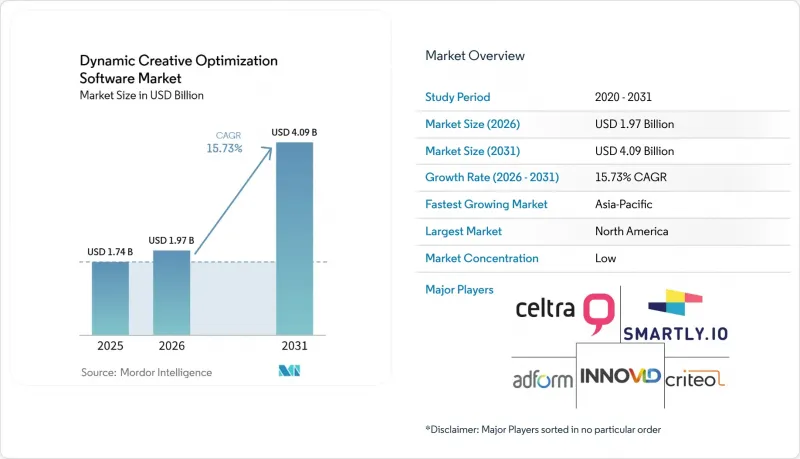
根據 Mordor Intelligence 預測,動態創新最佳化 (DCO) 軟體的市場規模預計將從 2025 年的 17.4 億美元和 2026 年的 19.7 億美元成長到 2031 年的 40.9 億美元,2026 年至 2031 年的年複合成長率(CAGR)為 15%。
本報告按元件(軟體和服務)、部署模式(雲端、本地部署、混合部署)、應用程式領域(展示廣告、社群媒體廣告等)、企業規模(大型企業和中小企業)、最終用戶(銀行、金融服務和保險、醫療保健和生命科學等)以及地區進行細分。市場預測以美元計價。
全球動態創新最佳化 (DCO) 軟體市場趨勢與洞察
程序化和個人化廣告的成長
預計到2026年,全球廣告支出將超過1兆美元,其中程式化管道預計將佔數位廣告投資的80%以上。如此龐大的規模使得動態創新最佳化軟體市場對廣告主至關重要,因為他們必須在不依賴人工製作的情況下提供大量的創新組合。同一個宣傳活動可能需要針對不同的受眾群體、裝置、地區和廣告位投放不同的訊息。動態創新工具透過將已通過核准的素材和決策規則與每次廣告展示關聯起來,從而實現對這些組合的管理。電通預測,到2027年,亞太地區79%的廣告支出將由演算法驅動,這將使程式化廣告的應用範圍擴展到現有程式化市場之外。隨著程式化廣告活動的增加,廣告主需要一個能夠在不增加創新和媒體團隊工作量的前提下,保持廣告相關性的平台。
生成式人工智慧與機器學習在創新決策中的應用
生成式人工智慧正在改變廣告主為動態宣傳活動準備創新素材的方式。它使團隊能夠以傳統製作流程無法企及的大規模創建、調整和測試已通過核准的素材集。當宣傳活動需要針對每個產品、地區或管道客製化訊息時,這項功能尤其實用。隨著製作速度的提升,對更嚴格控制的需求也隨之而來,因為審核團隊仍需要確保符合品牌、監管和平台的要求。 Mediaocean 於 2026 年 6 月發布了 NIVO AI,將 Innovid 智慧體整合到創新產生、預測評分、宣傳活動投放和報告流程中。該公司報告稱,在其試點專案中,與手動設定宣傳活動活動相比,工作流程效率提升高達 90%,這凸顯了買家為何越來越希望將人工智慧功能整合到營運工作流程中,而不是作為獨立功能提供。
隱私法規和第三方訊號的遺失
不斷變化的隱私要求正在改變平台可用於即時選擇創新的資料。谷歌於2025年4月調整了Chrome瀏覽器的Cookie政策,並於同年10月逐步淘汰了大部分「隱私沙盒」。從整體合規環境來看,廣告商仍需展現負責任的同意實踐,並限制個人資料的使用。 2026年3月,法國行政法院維持了對Criteo公司處以的4,000萬歐元(約4,500萬美元)GDPR罰款,原因是該公司未能提供同意證明和刪除權。在動態創新最佳化(DCO)軟體市場,這些壓力正在推動情境定向、第一方資料的使用以及注重隱私的決策。這也導致工程和管治工作量增加,可能會延長廣告商的購買週期並提高實施成本。
細分市場分析
截至2025年,按組件分類,軟體在動態創新最佳化軟體市場中佔據71.24%的佔有率。軟體提供核心系統,用於組裝創新變體、應用決策規則並在適當的時間投放選定的版本。其主導地位反映了軟體在程序化宣傳活動管理中的核心作用。廣告主利用這一層將範本與受眾、產品和廣告位等輸入資訊關聯起來。此外,軟體層必須在自動廣告投放的時間限制內運作。
預計2026年至2031年間,服務市場將以18.82%的複合年成長率成長。這一快速成長反映了市場對部署支援、創新策劃、資訊流整合和持續宣傳活動分析的需求。許多廣告主缺乏內部團隊來同時在網路電視、社群媒體和零售媒體等多個管道上部署複雜的廣告活動。 Mediaocean將於2026年發布的NIVO AI就是一個平台提供者將工作流程支援功能整合到其產品中的例證。隨著大規模廣告主尋求涵蓋技術和宣傳活動活動營運兩方面的支持,授權軟體和託管最佳化之間的界線正變得越來越模糊。
至2025年,以採用模式分類,雲端採用將佔據68.41%的市場。雲端平台能夠提供在宣傳活動期間創建和測試大量創新組合所需的處理能力。它們還支援透過分散式基礎設施進行跨市場分發。當廣告主需要在宣傳活動進行過程中快速更新內容時,這些功能非常有用。因此,雲端採用適合那些優先考慮速度、柔軟性和廣泛地域覆蓋範圍的廣告主。
預計2026年至2031年間,混合部署將以17.69%的複合年成長率成長。當內部管治或資料居住法規限制使用公共雲端系統時,混合部署為買家提供了一種將資料處理和創新交付分開的方法。敏感的受眾和客戶資料可以保存在本地或私人環境中,而創新交付則使用雲端基礎架構。當本地化要求嚴格或內部政策限制基於雲端的處理時,本地部署仍然是一個可行的選擇。混合模式的日益普及凸顯了動態創新最佳化軟體的必要性,該軟體能夠同時兼顧宣傳活動成效和資料管理。這種方案使買家能夠在利用可擴展的交付基礎設施的同時,將敏感資料置於自身管治之下。
區域分析
2025年,北美將佔據區域市場34.62%的佔有率。該地區擁有大規模的零售媒體生態系統,包括亞馬遜、沃爾瑪互聯、克羅格以及零售商自有的網路。此外,眾多大型廣告主也在此進行跨通路的程序化宣傳活動。高度發展的連網電視和電商媒體生態系統正在推動對能夠利用家庭和零售數據來最佳化創新的平台的需求。 2026年5月,Criteo和電通法國共同推出了完全整合的MCP影片宣傳活動;同年6月,Mediaocean採用了NIVO AI技術。
預計亞太地區在2026年至2031年間將以19.18%的複合年成長率成長,成為動態創新最佳化軟體市場所有地區中成長最快的地區。 2025年,全部區域的程序化廣告成長了24%,其中中國成長25%,印度成長21%。電通預測,到2027年,演算法廣告將佔亞太地區廣告支出的79%,高於2024年的59.5%。儘管日本的程序化廣告活動十分活躍,但根據《藥事法》,廣告審核流程可能需要多輪人工審核。
2025年,歐洲在動態創新最佳化(DCO)軟體市場佔有顯著佔有率,其中英國、德國和法國位居領先地位。在這些國家,成熟的數位廣告實踐和充足的預算支持對DCO平台的持續需求。南美洲正在發展成為一個DCO應用日益普及的地區,這主要得益於電子商務的成長以及巴西和阿根廷程式化廣告的擴張。中東和非洲仍處於DCO應用的早期階段,但沙烏地阿拉伯和阿拉伯聯合大公國隨著數位基礎設施的擴展和線上商務的成長,對數位廣告的投資正在增加。
其他好處:
- Excel格式的市場預測(ME)表
- 3個月的分析師支持
目錄
第1章:引言
- 研究假設和市場定義
- 調查範圍
第2章:調查方法
第3章執行摘要
第4章 市場狀況
- 市場概覽
- 市場促進因素
- 程序化和個人化廣告的成長
- 將生成式人工智慧和機器學習引入創新決策
- 零售媒體與商業廣告的擴張
- 各通路對創新自動化的需求日益成長
- 應對觀眾訊號下降的創造性方案
- 即時提供產品資訊、價格、庫存狀況、天氣和位置資訊。
- 市場限制因素
- 隱私法規和第三方訊號的遺失
- 該平台的“圍牆花園”和互通性限制
- 生成式人工智慧帶來的創新管治風險
- 零售媒體、連網電視、社群媒體和開放網路之間的衡量標準分散。
- 宏觀經濟因素對市場的影響
- 產業價值鏈分析
- 科技趨勢
- 監理情勢
- 波特五力分析
第5章 市場規模與成長預測
- 按組件
- 軟體
- 服務
- 部署模式
- 雲
- 現場
- 混合
- 透過使用
- 展示廣告
- 社群媒體廣告
- 影片廣告
- 連網電視 (CTV) 廣告
- 零售媒體廣告
- 數位戶外廣告 (DOOH)
- 電子郵件和自有媒體廣告
- 按公司規模
- 大公司
- 小型企業
- 最終用戶
- IT/通訊
- BFSI
- 醫療保健和生命科學
- 零售與電子商務
- 工業製造
- 教育和研究機構
- 媒體與娛樂
- 政府/行政部門
- 旅遊與飯店
- 其他最終用戶
- 按地區
- 北美洲
- 美國
- 加拿大
- 墨西哥
- 南美洲
- 巴西
- 阿根廷
- 其他南美國家
- 歐洲
- 德國
- 英國
- 法國
- 俄羅斯
- 西班牙
- 其他歐洲國家
- 亞太地區
- 中國
- 日本
- 印度
- 韓國
- 東南亞
- 其他亞太國家
- 中東和非洲
- 中東
- 沙烏地阿拉伯
- 阿拉伯聯合大公國
- 其他中東國家
- 非洲
- 南非
- 奈及利亞
- 其他非洲國家
- 中東
- 北美洲
第6章 競爭情勢
- 市場集中度
- 策略趨勢
- 市佔率分析
- 公司簡介
- Celtra, Inc.
- Smartly.io Inc.
- Innovid Corp.
- Adform A/S
- Criteo SA
- Jivox Corporation
- Bannerflow AB
- Clinch US Inc.
- Clinch Labs Ltd.
- Adzymic Pte Ltd
- Zuuvi ApS
- RevJet, Inc.
- Choozle, Inc.
- Aarki, Inc.
- Creatopy Inc.
- Nativo, Inc.
- AdButler Inc.
- Spongecell, Inc.
- Groovinads SL
- Gamned SAS
- The COOL Company SAS
- Storyteq BV
第7章 市場機會與未來展望
According to Mordor Intelligence, the dynamic creative optimization software market size is projected to expand from USD 1.74 billion in 2025 and USD 1.97 billion in 2026 to USD 4.09 billion by 2031, registering a CAGR of 15.73% between 2026 and 2031.
This report is Segmented by Component (Software, and Services), Deployment Mode (Cloud, On-Premise, and Hybrid), Application (Display Advertising, Social Media Advertising, and More), Enterprise Size (Large Enterprises, and Small and Medium Enterprises), End User (BFSI, Healthcare and Life Sciences, and More), and Geography. The Market Forecasts are Provided in Terms of Value (USD).
Global Dynamic Creative Optimization Software Market Trends and Insights
Growth in Programmatic and Personalized Advertising
Global advertising expenditure is set to surpass USD 1 trillion in 2026, while programmatic channels are expected to account for more than 80% of digital investment. This scale makes the dynamic creative optimization software market relevant to advertisers who must serve many creative combinations without relying on manual production. A campaign can require different messages for audience groups, devices, locations, and placements. Dynamic creative tools make those combinations manageable by linking approved assets and decision rules to each impression. Dentsu expects 79% of Asia-Pacific advertising spend to be algorithmically driven by 2027, which broadens the adoption base beyond established programmatic markets. As programmatic activity increases, advertisers need platforms that can maintain relevance without increasing the workload for creative and media teams.
Generative AI and Machine Learning in Creative Decisioning
Generative AI is changing how advertisers prepare creative material for dynamic campaigns. It allows teams to produce, adapt, and test larger sets of approved assets than traditional production processes allow. This capability is useful when campaigns require messages tailored by product, location, or channel. Faster production also creates a need for stronger controls, as review teams must still verify compliance with brand, legal, and platform requirements. Mediaocean launched NIVO AI in June 2026, placing Innovid agents across creative generation, predictive scoring, campaign trafficking, and reporting. The company reported pilot workflow improvements of up to 90% compared with manual campaign setup, underscoring why buyers increasingly expect AI functions to be integrated into the operating workflow rather than offered as a separate feature.
Privacy Regulation and Third-Party Signal Loss
Privacy requirements are changing the data that platforms can use to select a creative in real time. Google changed its approach to Chrome cookie deprecation in April 2025 and later dismantled much of the Privacy Sandbox in October 2025. The wider compliance environment still requires advertisers to demonstrate responsible consent practices and limit the use of personal data. France's Conseil d'Etat upheld a EUR 40 million (USD 45 Million) GDPR fine against Criteo in March 2026, relating to consent demonstration and the right to erasure. For the dynamic creative optimization software market, this pressure favors contextual targeting, first-party data activation, and privacy-aware decisioning. It also adds engineering and governance work, which can lengthen buying cycles and increase the expected implementation costs for advertisers.
Other drivers and restraints analyzed in the detailed report include:
- Expansion of Retail Media and Commerce Advertising
- Need for Cross-Channel Creative Automation
- Platform Walled Gardens and Limited Interoperability
For complete list of drivers and restraints, kindly check the Table Of Contents.
Segment Analysis
Software held 71.24% of the dynamic creative optimization software market share by component in 2025. It provides the core system that assembles creative versions, applies decision rules, and delivers the selected version at the required time. Its leading position reflects the central role of software in operating campaigns at programmatic scale. Advertisers use this layer to connect templates with audience, product, and placement inputs. The software layer must also work within the time limits of automated advertising delivery.
Services are projected to expand at a CAGR of 18.82% from 2026 to 2031. The faster growth reflects the need for implementation support, creative planning, feed integration, and ongoing campaign analysis. Many advertisers do not have internal teams that can configure complex deployments across connected television, social media, and retail media at the same time. Mediaocean's 2026 NIVO AI launch illustrates how platform providers are embedding workflow support into their product offerings. The distinction between licensed software and managed optimization is becoming less clear as large buyers seek support that covers both technology and campaign operations.
Cloud deployment accounted for 68.41% of the market share by deployment mode in 2025. Cloud platforms can provide the processing capacity needed to create and test many creative combinations during an active campaign. They also support cross-market delivery through distributed infrastructure. These capabilities are valuable when advertisers need to update content rapidly in response to campaign inputs. Cloud deployment is therefore well-suited to advertisers who prioritize speed, flexibility, and wide geographic reach.
Hybrid deployment is projected to expand at a CAGR of 17.69% from 2026 to 2031. It gives buyers a way to separate data processing from creative delivery when internal governance or data residency rules limit the use of public cloud systems. Sensitive audience or customer data can remain in an on-premise or private environment, while creative delivery can use cloud infrastructure. On-premises deployment remains relevant when localization requirements are strict or when internal policy restricts cloud-based processing. The growing adoption of hybrid models underscores the need for dynamic creative optimization software to address both campaign performance and data control. This option can help a buyer keep sensitive data under its own governance while still using scalable serving infrastructure.
Complete Report Scope:
- By Component
- Software
- Services
- By Deployment Mode
- Cloud
- On-Premise
- Hybrid
- By Application
- Display Advertising
- Social Media Advertising
- Video Advertising
- Connected Television (CTV) Advertising
- Retail Media Advertising
- Digital Out-of-Home (DOOH) Advertising
- Email and Owned Media Advertising
- By Enterprise Size
- Large Enterprises
- Small and Medium Enterprises
- By End User
- IT and Telecommunication
- BFSI
- Healthcare and Life Sciences
- Retail and E-Commerce
- Industrial Manufacturing
- Education and Research Institutions
- Media and Entertainment
- Government and Administration
- Travel and Hospitality
- Other End Users
- By Geography
- North America
- United States
- Canada
- Mexico
- South America
- Brazil
- Argentina
- Rest of South America
- Europe
- Germany
- United Kingdom
- France
- Russia
- Spain
- Rest of Europe
- Asia-Pacific
- China
- Japan
- India
- South Korea
- Southeast Asia
- Rest of Asia-Pacific
- Middle East and Africa
- Middle East
- Saudi Arabia
- United Arab Emirates
- Rest of Middle East
- Africa
- South Africa
- Nigeria
- Rest of Africa
- Middle East
- North America
Geography Analysis
North America held 34.62% of the regional market in 2025. The region has a large retail media ecosystem, including Amazon, Walmart Connect, Kroger, and retailer-owned networks. It also has a concentration of large advertisers operating programmatic campaigns across several channels. The depth of its connected television and commerce media ecosystem supports demand for platforms that can adapt creative using household and retail data. Criteo and Dentsu France launched a fully orchestrated MCP video campaign in May 2026, while Mediaocean introduced NIVO AI in June 2026.
Asia-Pacific is projected to expand at a CAGR of 19.18% from 2026 to 2031, the highest regional rate in the dynamic creative optimization software market. Programmatic advertising grew 24% across the region in 2025, with 25% growth in China and 21% in India. Dentsu expects algorithmic buying to account for 79% of Asia-Pacific advertising spend by 2027, compared with 59.5% in 2024. Japan has robust programmatic activity, but advertising review processes under the Pharmaceutical Affairs Act can involve multiple rounds of human approval.
Europe accounted for a significant share of the dynamic creative optimization software market in 2025, led by the United Kingdom, Germany, and France. Mature digital advertising activity and larger budgets support ongoing demand for DCO platforms in these countries. South America is developing as an adoption region, with Brazil and Argentina supported by e-commerce growth and increasing programmatic activity. The Middle East and Africa are at an earlier stage, while Saudi Arabia and the United Arab Emirates are increasing digital advertising investment through broader digital infrastructure and online commerce.
- Celtra, Inc.
- Smartly.io Inc.
- Innovid Corp.
- Adform A/S
- Criteo S.A.
- Jivox Corporation
- Bannerflow AB
- Clinch US Inc.
- Clinch Labs Ltd.
- Adzymic Pte Ltd
- Zuuvi ApS
- RevJet, Inc.
- Choozle, Inc.
- Aarki, Inc.
- Creatopy Inc.
- Nativo, Inc.
- AdButler Inc.
- Spongecell, Inc.
- Groovinads S.L.
- Gamned SAS
- The COOL Company SAS
- Storyteq B.V.
Additional Benefits:
- The market estimate (ME) sheet in Excel format
- 3 months of analyst support
TABLE OF CONTENTS
1 INTRODUCTION
- 1.1 Study Assumptions and Market Definition
- 1.2 Scope of the Study
2 RESEARCH METHODOLOGY
3 EXECUTIVE SUMMARY
4 MARKET LANDSCAPE
- 4.1 Market Overview
- 4.2 Market Drivers
- 4.2.1 Growth in Programmatic and Personalized Advertising
- 4.2.2 Generative AI and Machine Learning Adoption in Creative Decisioning
- 4.2.3 Expansion of Retail Media and Commerce Advertising
- 4.2.4 Rising Need for Cross-Channel Creative Automation
- 4.2.5 Creative Signal Substitution for Declining Audience Signals
- 4.2.6 Real-Time Product, Price, Inventory, Weather, and Location Feeds
- 4.3 Market Restraints
- 4.3.1 Privacy Regulation and Third-Party Signal Loss
- 4.3.2 Platform Walled Gardens and Limited Interoperability
- 4.3.3 Creative Governance Risk from Generative AI
- 4.3.4 Fragmented Measurement Across Retail Media, CTV, Social, and Open Web
- 4.4 Impact of Macroeconomic Factors on the Market
- 4.5 Industry Value-Chain Analysis
- 4.6 Technology Outlook
- 4.7 Regulatory Landscape
- 4.8 Porter's Five Forces Analysis
- 4.8.1 Threat of New Entrants
- 4.8.2 Bargaining Power of Suppliers
- 4.8.3 Bargaining Power of Buyers
- 4.8.4 Threat of Substitutes
- 4.8.5 Intensity of Competitive Rivalry
5 MARKET SIZE AND GROWTH FORECASTS (VALUE)
- 5.1 By Component
- 5.1.1 Software
- 5.1.2 Services
- 5.2 By Deployment Mode
- 5.2.1 Cloud
- 5.2.2 On-Premise
- 5.2.3 Hybrid
- 5.3 By Application
- 5.3.1 Display Advertising
- 5.3.2 Social Media Advertising
- 5.3.3 Video Advertising
- 5.3.4 Connected Television (CTV) Advertising
- 5.3.5 Retail Media Advertising
- 5.3.6 Digital Out-of-Home (DOOH) Advertising
- 5.3.7 Email and Owned Media Advertising
- 5.4 By Enterprise Size
- 5.4.1 Large Enterprises
- 5.4.2 Small and Medium Enterprises
- 5.5 By End User
- 5.5.1 IT and Telecommunication
- 5.5.2 BFSI
- 5.5.3 Healthcare and Life Sciences
- 5.5.4 Retail and E-Commerce
- 5.5.5 Industrial Manufacturing
- 5.5.6 Education and Research Institutions
- 5.5.7 Media and Entertainment
- 5.5.8 Government and Administration
- 5.5.9 Travel and Hospitality
- 5.5.10 Other End Users
- 5.6 By Geography
- 5.6.1 North America
- 5.6.1.1 United States
- 5.6.1.2 Canada
- 5.6.1.3 Mexico
- 5.6.2 South America
- 5.6.2.1 Brazil
- 5.6.2.2 Argentina
- 5.6.2.3 Rest of South America
- 5.6.3 Europe
- 5.6.3.1 Germany
- 5.6.3.2 United Kingdom
- 5.6.3.3 France
- 5.6.3.4 Russia
- 5.6.3.5 Spain
- 5.6.3.6 Rest of Europe
- 5.6.4 Asia-Pacific
- 5.6.4.1 China
- 5.6.4.2 Japan
- 5.6.4.3 India
- 5.6.4.4 South Korea
- 5.6.4.5 Southeast Asia
- 5.6.4.6 Rest of Asia-Pacific
- 5.6.5 Middle East and Africa
- 5.6.5.1 Middle East
- 5.6.5.1.1 Saudi Arabia
- 5.6.5.1.2 United Arab Emirates
- 5.6.5.1.3 Rest of Middle East
- 5.6.5.2 Africa
- 5.6.5.2.1 South Africa
- 5.6.5.2.2 Nigeria
- 5.6.5.2.3 Rest of Africa
- 5.6.5.1 Middle East
- 5.6.1 North America
6 COMPETITIVE LANDSCAPE
- 6.1 Market Concentration
- 6.2 Strategic Moves
- 6.3 Market Share Analysis
- 6.4 Company Profiles (includes Global Level Overview, Market Level Overview, Core Segments, Financials as available, Strategic Information, Market Rank/Share, Products and Services, Recent Developments)
- 6.4.1 Celtra, Inc.
- 6.4.2 Smartly.io Inc.
- 6.4.3 Innovid Corp.
- 6.4.4 Adform A/S
- 6.4.5 Criteo S.A.
- 6.4.6 Jivox Corporation
- 6.4.7 Bannerflow AB
- 6.4.8 Clinch US Inc.
- 6.4.9 Clinch Labs Ltd.
- 6.4.10 Adzymic Pte Ltd
- 6.4.11 Zuuvi ApS
- 6.4.12 RevJet, Inc.
- 6.4.13 Choozle, Inc.
- 6.4.14 Aarki, Inc.
- 6.4.15 Creatopy Inc.
- 6.4.16 Nativo, Inc.
- 6.4.17 AdButler Inc.
- 6.4.18 Spongecell, Inc.
- 6.4.19 Groovinads S.L.
- 6.4.20 Gamned SAS
- 6.4.21 The COOL Company SAS
- 6.4.22 Storyteq B.V.
7 MARKET OPPORTUNITIES AND FUTURE OUTLOOK
- 7.1 White-Space and Unmet-Need Assessment

 程序化全像廣告市場規模、佔有率和成長分析:按產品、部署方式、廣告格式、最終用戶產業和地區分類 - 產業預測,2026-2033 年
 中東和非洲程序化廣告:市場佔有率分析、行業趨勢和統計數據以及成長預測(2026-2031 年)亞太地區程序化廣告:市場佔有率分析、產業趨勢與統計及成長預測(2026-2031)北美程序化廣告:市場佔有率分析、產業趨勢與統計及成長預測(2026-2031 年)歐洲程序化廣告:市場佔有率分析、產業趨勢與統計及成長預測(2026-2031 年)程序化廣告:市場佔有率分析、產業趨勢與統計、成長預測(2026-2031)OTT程序化廣告:市場佔有率分析、產業趨勢與統計、成長預測(2026-2031年)
 程序化廣告市場:2026-2032年全球市場預測(依廣告格式、設備類型、平台類型、技術類型及產業分類)
 2026年全球付費會員計畫平台市場報告2026年全球動態創新最佳化(DCO)市場報告