


 |
市場調查報告書
商品編碼
2125330
程序化廣告:市場佔有率分析、產業趨勢與統計、成長預測(2026-2031)Programmatic Advertisement - Market Share Analysis, Industry Trends & Statistics, Growth Forecasts (2026 - 2031) |
||||||

※ 本網頁內容可能與最新版本有所差異。詳細情況請與我們聯繫。
根據 Mordor Intelligence 估計,程式化廣告市場在 2026 年的價值將達到 7,200 億美元,高於 2025 年的 6,500 億美元,預計到 2031 年將達到 1.17 兆美元。
預計 2026 年至 2031 年的複合年成長率為 10.34%。
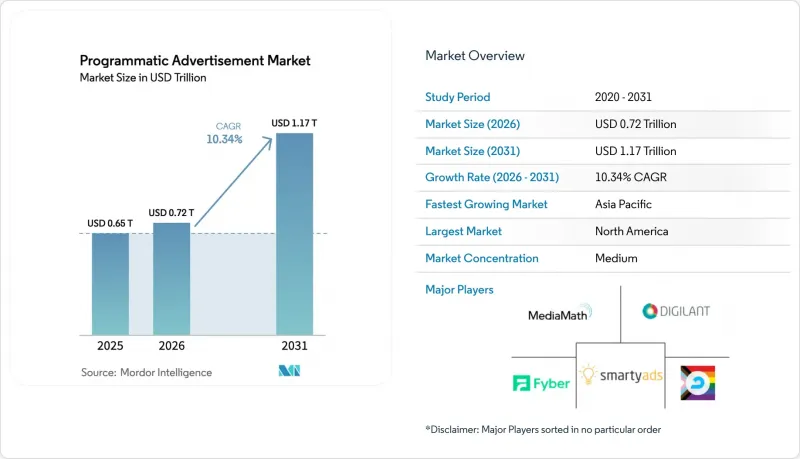
本報告按交易平台(即時競價、私人市場等)、廣告管道/形式(橫幅廣告、影片等)、裝置(桌上型電腦、行動裝置、智慧電視)、產業(零售/電子商務、媒體/娛樂等)、公司規模(中小企業、大型企業)和地區進行細分。市場預測以美元計價。
全球程序化廣告市場趨勢與洞察
將優質庫存遷移到私人市場
根據 Magnite 報告顯示,2024 年全年,優質出版商持續將其核心廣告資源轉移至僅限邀請的平台,平均結算價格也因品牌安全得到保障而上漲。封閉式競標能夠提供更高的收入確定性和更低的詐欺風險,使得私密交易日益成為買賣雙方的首選。一家全球新聞媒體在 2025 年初將實況活動廣告位與生活風格內容捆綁銷售,最終獲得的 CPM 比公開交易價格高出三分之一以上。由此產生的結構性結果是,剩餘的廣告展示量將繼續留在公開交易平台上,而高價值的廣告資源將集中到特定的交易平台,從而有效地重塑流動性格局。隨著這一轉變的加速,透明的供應路徑和可審計的報告標準將成為滿足高階需求的關鍵要素。
人工智慧驅動的競標最佳化
2024年,預測點擊後價值的機器學習模型從試點階段進入主流應用階段,並在2025年第一季整合到主要的需求端平台(DSP)。一家歐洲訂閱服務在應用生命週期價值(LTV)加權競標後,六個月內每美元支出帶來的收入成長了35%。零售商現在也開始根據SKU等級的利潤貢獻來調整競標。這些例子表明,隨著演算法即時最佳化競標,經營團隊的關注點正從成本控制轉向加速成長。因此,成功指標正在圍繞增量利潤而非曝光量重新定義,企業內部媒體團隊對資料科學人才的依賴也日益增強。競爭優勢越來越依賴專有預測資料集和快速回饋循環的結合。
第三方 cookie 的遺失導致歐洲用戶 ID 池縮小。
嚴格的歐洲隱私法規加速了2024年識別碼數量的減少。一家跨市場出版商集團報告稱,新政策生效後,第三方識別碼數量立即下降了20%。其中一半的降幅透過第一方登入和加密電子郵件雜湊得以彌補,從而提高了轉換率,並減少了參與廣告主的無效展示次數。儘管規模較小,但在獲得用戶許可的情況下,已觀察到可擴展的成果,這表明基於出版商關係的定向能力將塑造未來的定向框架。然而,過渡成本和衡量指標的中斷正在限制短期成長,預計將對程序化廣告市場整體的複合年成長率(CAGR)造成1.7個百分點的下行壓力。
細分市場分析
到2025年,即時競價(RTB)將佔據程序化廣告市場佔有率的41.30%,凸顯其在擴大覆蓋範圍的重要性。然而,隨著「程序化保證」的興起(預計到2031年將以24.15%的複合年成長率成長),RTB的市佔率正在逐步下降。這反映出廣告主對優質廣告位固定價格確定性的需求。將劇集內容和即時新聞打包成擔保廣告組合的出版商,其廣告位往往提前數週售罄,這表明市場對擔保投放的潛在需求。一種混合模式正在興起:買家在保持公開競標以實現規模化的同時,透過擔保管道確保策略時機,從而推動平台多元化發展。因此,供應端合作夥伴正在擴展其API,以支援在單一工作流程中執行多種交易類型。
程序化廣告市場的參與企業企業意識到,擔保交易能夠提高預測準確性和收入穩定性,吸引品牌廣告支出從以往的線性電視轉向其他管道。同時,即時競標也不斷創新,例如競標調整和自動最低出價。隨著這些多種模式的並存,供應商正在開發整合式儀錶板,以提供跨交易類型的績效可見性,從而減少營運摩擦。在整個預測期內,能夠提供跨通路和多交易管治的交易合作夥伴將佔據可觀的市場佔有率,尤其是在那些集中管理全通路預算的品牌中。
展示橫幅廣告仍然佔據34.25%的曝光量,對於重定向和頻率調整仍然至關重要。然而,隨著市場以25.1%的複合年成長率成長至2031年,程序化影片預計將佔據廣告支出成長的大部分佔有率。社群媒體上的短影片內容與客廳螢幕上的長影片相輔相成,形成持續的影片體驗,使用戶全天的接觸點翻倍。一個歐洲汽車品牌透過將垂直螢幕影片與自適應的6秒廣告片結合,展現了創新的協同效應,最終使用戶到店意願提升了28%。
隨著廣告主將富媒體、音訊和新興的身臨其境型廣告單元整合到統一的影片預算中,與視訊格式相關的程式化廣告市場規模預計將進一步擴大。為了應對這一趨勢,衡量供應商正在提供“整合覆蓋曲線”,將聯網電視、行動裝置和戶外廣告的曝光量匯總成一套單一且無重複的指標。跨格式的創新素材整合如今已成為區分頂級宣傳活動和一般廣告活動的關鍵,廣告公司正在加速宣傳活動基於雲端的素材版本控制和人工智慧驅動的編輯套件。
區域分析
北美鞏固了其作為最大區域中心的地位,預計到2025年將保持37.50%的程序化廣告市場佔有率。政治選舉週期注入了新的資金,而已被證明有效率的自動化工作流程也得到了廣泛應用。最佳化的供應路徑持續彌合發布商和買家之間的差距,從而提升了發布商的獲利能力並降低了需求端費用。透明的管道有望確保買家的忠誠度,進一步鞏固該地區作為新指標(例如基於「無塵室」的覆蓋範圍檢驗和效果報告)試驗場的地位。
預計到2031年,亞太地區將以12.3%的複合年成長率成長,成為迄今為止成長最快的地區。行動優先的消費行為和電子商務的快速發展正在推動廣告展示的流動性,以應用程式為中心的生態系統正在繞過傳統的舊有系統,尤其是在印度和印尼。 2025年,東南亞一家串流媒體應用程式在體育賽事期間實施的即時廣告插入技術實現了創紀錄的觀看完成率,凸顯了該地區已做好迎接先進的伺服器端廣告插入技術的準備。各國政府正在製定以歐洲先例為藍本的隱私立法,鼓勵供應商從營運初就納入用戶同意框架。這種前瞻性的合規承諾可能會帶來比成熟市場在過去成長階段所面臨的更為純淨的廣告資源池。
儘管嚴格的監管措施減少了第三方 Cookie 的數量,但歐洲仍然是一個至關重要的市場。發布商越來越關注經過身份驗證的流量,而利用加密電子郵件雜湊的早期嘗試已使合格的銀行申請數量比基於 Cookie 的重定向廣告增加了 17%。雖然合規性增加了營運負擔,但由於確定性定向,廣告效果依然穩定,該地區的程序化廣告市場保持著中等個位數的成長動能。拉丁美洲和中東及非洲地區的廣告支出總額落後於歐洲,但在智慧型手機普及率和都市區戶外廣告數位化的推動下,這些地區的成長速度相對較快。投資者正在投資該地區的身份驗證新創企業,這表明廣告商對中期規模化發展充滿信心。
其他好處:
- Excel格式的市場預測(ME)表
- 3個月的分析師支持
目錄
第1章:引言
- 研究假設和市場定義
- 調查範圍
第2章:調查方法
第3章執行摘要
第4章 市場狀況
- 市場概覽
- 市場促進因素
- 優質廣告資源向私人市場轉移,推高了每千次曝光成本 (CPM)。
- 人工智慧驅動的競標報酬率。
- 美國和日本聯網電視程式化廣告激增。
- 來自零售媒體的第一方數據驅動預算利用。
- cookie 時代之後,情境導向廣告再次興起。
- 亞洲5G賦能的即時行動RTB成長
- 市場限制因素
- 第三方 cookie 的消失正在縮小歐洲的 ID 池。
- 新興市場的廣告詐騙和供應鏈不透明問題
- 中小型廣告商在程序化廣告領域面臨人才短缺問題
- 隱私法的差異阻礙了跨國收購。
- 監理展望
- 技術展望
- 波特五力分析
第5章 市場規模與成長預測
- 透過交易平台
- 即時競價(公開競標)
- 私人市場
- 程序化擔保
- 優惠套餐(無限固定利率)
- 頭部競價
- 透過廣告管道/形式
- 全橫幅
- 影片
- 行動顯示器
- 聯網電視(CTV)
- 數位戶外廣告 (DOOH)
- 其他
- 透過裝置
- 桌面
- 移動的
- 智慧電視
- 按行業分類
- 零售與電子商務
- 媒體與娛樂
- 車
- BFSI
- 醫療保健和製藥
- 其他
- 按公司規模
- 中小企業
- 大公司
- 按地區
- 北美洲
- 美國
- 加拿大
- 拉丁美洲
- 巴西
- 阿根廷
- 墨西哥
- 其他拉丁美洲國家
- 歐洲
- 德國
- 英國
- 法國
- 義大利
- 西班牙
- 其他歐洲國家
- 亞太地區
- 中國
- 日本
- 韓國
- 印度
- 澳洲
- 紐西蘭
- 其他亞太國家
- 中東和非洲
- 阿拉伯聯合大公國
- 沙烏地阿拉伯
- 南非
- 其他中東和非洲國家
- 北美洲
第6章 競爭情勢
- 策略發展
- 供應商定位分析
- 公司簡介
- Alphabet Inc.(Google Ads)
- Meta Platforms, Inc.
- Amazon.com, Inc.
- The Trade Desk, Inc.
- Magnite, Inc.
- PubMatic, Inc.
- Index Exchange, Inc.
- Verizon Communications Inc.(Yahoo)
- Adobe Inc.
- Microsoft Corp.(Xandr)
- MediaMath Inc.
- War Room Holdings, Inc.
- Digilant
- Fyber NV
- SmartyAds
- Choozle, Inc.
- Zeta Global Holdings Corp.
- Criteo SA
- Roku, Inc.
- AppLovin Corp.
- OpenX Technologies, Inc.
- TripleLift, Inc.
- Adform A/S
第7章 市場機會與未來展望
According to Mordor Intelligence, programmatic advertising market size in 2026 is estimated at USD 0.72 trillion, growing from 2025 value of USD 0.65 trillion with 2031 projections showing USD 1.17 trillion, growing at 10.34% CAGR over 2026-2031.
This report is Segmented Trading Platform (Real-Time Bidding, Private Marketplace, and More), Advertising Channel / Format (Display Banner, Video, and More), Device (Desktop, Mobile, Smart TV), Industry Vertical (Retail and E-Commerce, Media and Entertainment, and More), Enterprise Size (SMBs, Large Enterprises), Geography. The Market Forecasts are Provided in Terms of Value (USD).
Global Programmatic Advertisement Market Trends and Insights
Premium Inventory Migration to Private Marketplaces
Premium publishers continued to shift flagship inventory into invitation-only environments throughout 2024, lifting average clearing prices as brand-safety assurances Magnite. Buyers and sellers alike increasingly default to private deals because closed auctions combine higher revenue certainty with reduced fraud exposure. One global news outlet bundled live-event slots with lifestyle content in early 2025 and secured CPMs more than one-third above its open-exchange rate. The structural outcome is that remnant impressions will remain in open exchanges while high-value supply gravitates to curated marketplaces, effectively redrawing liquidity maps. As this migration gains momentum, transparent supply paths and auditable reporting standards become table stakes for premium demand.
AI-Driven Bid Optimisation
Machine-learning models that predict post-click value moved from pilot to mainstream in 2024 and were embedded across leading demand-side platforms by Q1 2025 . A European subscription service recorded a 35% uplift in six-month revenue per advertising dollar after applying lifetime-value-weighted bidding, and retailers now adjust bids based on SKU-level margin contribution. These examples show management focus pivoting from cost control to growth acceleration as algorithms refine bid prices in real time. The net effect is a redefinition of success metrics around incremental profit rather than impressions served, deepening the reliance on data-science talent within in-house media teams. Competitive advantage increasingly hinges on proprietary predictive datasets coupled with fast feedback loops.
Third-Party-Cookie Loss Shrinking ID Pools in Europe
Europe's stringent privacy regime accelerated identifier contraction in 2024 when a multi-market publisher group reported a 20% drop in third-party IDs immediately after new policy enforcement. Half of that loss was recovered through first-party sign-ins and encrypted email hashes, leading to higher win rates and lower impression waste for participating advertisers. Smaller yet consented audiences demonstrate scalable outcomes, indicating that addressability anchored in publisher relationships will shape future targeting frameworks. Nonetheless, transition costs and measurement disruptions constrain short-term growth, shaving an estimated 1.7 percentage points from the projected CAGR across the programmatic advertising market.
Other drivers and restraints analyzed in the detailed report include:
- Connected-TV Programmatic Surge
- Retail-Media First-Party Data Unlocking Budgets
- Ad-Fraud and Supply-Chain Opacity in Emerging Markets
For complete list of drivers and restraints, kindly check the Table Of Contents.
Segment Analysis
Real-Time Bidding accounted for 41.30% of programmatic advertising market share in 2025, underscoring its prominence for incremental reach. Yet the segment's proportion is gradually declining as Programmatic Guaranteed accelerates at a 24.15% CAGR to 2031, reflecting advertiser demand for fixed-price certainty in premium slots. Publishers that bundled episodic content and live news into guaranteed portfolios sold out weeks ahead of schedule, demonstrating latent demand for assured delivery. A hybrid future is emerging in which buyers maintain open auctions for scale while reserving strategic moments through guaranteed pipes, increasing platform diversification. Supply-side partners are therefore expanding APIs to accommodate multi-deal-type execution in a single workflow.
Programmatic advertising market participants recognise that guaranteed deals improve forecast accuracy and yield stability, attracting brand dollars once confined to linear television. Meanwhile, real-time auctions continue to innovate with bid-shading and floor-price automation. The coexistence of these paths encourages technology vendors to develop consolidated dashboards that visualise performance across deal types, reducing operational friction. Over the forecast period, trading partners that deliver cross-channel, multi-deal governance will capture outsized wallet share, particularly from brands centralising omnichannel budgets.
Display banners still represented 34.25% of impressions and remain indispensable for retargeting and frequency balancing. Nevertheless, programmatic video is set to capture the dominant share of incremental spend as its market size grows at a 25.1% CAGR through 2031. Short-form content on social feeds complements long-form streaming on living-room screens, forming contiguous video journeys that multiply touchpoints throughout the day. A European automotive brand combined vertical video with adaptive six-second bumpers and saw visit intent rise 28%, illustrating creative synergies.
As buyers integrate rich-media, audio, and emerging immersive units into unified video budgets, the programmatic advertising market size attached to video formats is poised to widen further. Measurement vendors are responding with unified reach curves that aggregate connected-TV, mobile, and out-of-home exposures into a single, deduplicated metric set. The cross-format orchestration of creative assets now differentiates leading campaigns from median performers, spurring agencies to invest in cloud-based asset-versioning and AI-driven editing suites.
Complete Report Scope:
- By Trading Platform
- Real-Time Bidding (Open Auction)
- Private Marketplace
- Programmatic Guaranteed
- Preferred Deals (Unreserved Fixed-Rate)
- Header Bidding
- By Advertising Channel / Format
- Display Banner
- Video
- Mobile Display
- Connected TV (CTV)
- Digital Out-of-Home (DOOH)
- Others
- By Device
- Desktop
- Mobile
- Smart TV
- By Industry Vertical
- Retail and E-Commerce
- Media and Entertainment
- Automotive
- BFSI
- Healthcare and Pharma
- Others
- By Enterprise Size
- SMBs
- Large Enterprises
- By Geography
- North America
- United States
- Canada
- Latin America
- Brazil
- Argentina
- Mexico
- Rest of Latin America
- Europe
- Germany
- United Kingdom
- France
- Italy
- Spain
- Rest of Europe
- Asia-Pacific
- China
- Japan
- South Korea
- India
- Australia
- New Zealand
- Rest of Asia-Pacific
- Middle East and Africa
- United Arab Emirates
- Saudi Arabia
- South Africa
- Rest of Middle East and Africa
- North America
Geography Analysis
North America sustained a 37.50% programmatic advertising market share in 2025, cementing its status as the largest regional hub. Political election cycles injected fresh funds that remained in automated workflows after proving efficient. Supply-path optimisation continues to shorten the distance between publisher and buyer, lifting publisher yield and lowering demand-side fees. Transparent routes are expected to lock in buyer loyalty, reinforcing the region's role as the test bed for new measurement standards such as clean-room-based reach verification and outcome reporting.
Asia-Pacific is forecast to expand at a 12.3% CAGR to 2031, making it the fastest-growing region by a clear margin. Mobile-first consumer behavior and rapid e-commerce adoption fuel impression liquidity, especially in India and Indonesia, where app-centric ecosystems bypass desktop legacies. A Southeast-Asian streaming app's real-time ad insertion during 2025 sporting events achieved record view-through rates, highlighting regional readiness for advanced server-side ad insertion. Governments are drafting privacy statutes modelled on European precedents, prompting vendors to embed consent frameworks from inception. This proactive compliance stance could yield a structurally cleaner supply pool than mature markets faced in earlier growth waves.
Europe remains pivotal despite stricter regulations that trimmed third-party-cookie pools. Publishers double down on authenticated traffic, and early encrypted-email-hash collaborations delivered a 17% boost in qualified banking applications versus cookie-based retargeting. Although compliance raises operational overhead, deterministic addressability is stabilising performance, keeping the programmatic advertising market size in the region on a mid-single-digit growth path. Latin America and the Middle East and Africa trail in absolute spend but register rapid relative growth, driven by smartphone penetration and urban out-of-home digitisation. Investors are funnelling capital into regional verification start-ups, signalling advertiser confidence in medium-term scalability.
- Alphabet Inc. (Google Ads)
- Meta Platforms, Inc.
- Amazon.com, Inc.
- The Trade Desk, Inc.
- Magnite, Inc.
- PubMatic, Inc.
- Index Exchange, Inc.
- Verizon Communications Inc. (Yahoo)
- Adobe Inc.
- Microsoft Corp. (Xandr)
- MediaMath Inc.
- War Room Holdings, Inc.
- Digilant
- Fyber N.V.
- SmartyAds
- Choozle, Inc.
- Zeta Global Holdings Corp.
- Criteo S.A.
- Roku, Inc.
- AppLovin Corp.
- OpenX Technologies, Inc.
- TripleLift, Inc.
- Adform A/S
Additional Benefits:
- The market estimate (ME) sheet in Excel format
- 3 months of analyst support
TABLE OF CONTENTS
1 INTRODUCTION
- 1.1 Study Assumptions and Market Definition
- 1.2 Scope of the Study
2 RESEARCH METHODOLOGY
3 EXECUTIVE SUMMARY
4 MARKET LANDSCAPE
- 4.1 Market Overview
- 4.2 Market Drivers
- 4.2.1 Premium Inventory Migration to Private Marketplaces Fuelling CPMs
- 4.2.2 AI-Driven Bid Optimisation Elevating ROAS in Europe
- 4.2.3 Connected-TV Programmatic Surge in the US and Japan
- 4.2.4 Retail-Media First-Party Data Unlocking Budgets
- 4.2.5 Contextual Targeting Renaissance Post-Cookie
- 4.2.6 5G-Enabled Real-Time Mobile RTB Growth in Asia
- 4.3 Market Restraints
- 4.3.1 Third-Party-Cookie Loss Shrinking ID Pools in Europe
- 4.3.2 Ad-Fraud and Supply-Chain Opacity in Emerging Markets
- 4.3.3 Programmatic Talent Scarcity Among SMB Advertisers
- 4.3.4 Divergent Privacy Laws Stalling Cross-Border Buys
- 4.4 Regulatory Outlook
- 4.5 Technological Outlook
- 4.6 Porter's Five Forces Analysis
- 4.6.1 Bargaining Power of Suppliers
- 4.6.2 Bargaining Power of Buyers/Consumers
- 4.6.3 Threat of New Entrants
- 4.6.4 Threat of Substitute Products
- 4.6.5 Intensity of Competitive Rivalry
5 MARKET SIZE AND GROWTH FORECASTS (VALUE)
- 5.1 By Trading Platform
- 5.1.1 Real-Time Bidding (Open Auction)
- 5.1.2 Private Marketplace
- 5.1.3 Programmatic Guaranteed
- 5.1.4 Preferred Deals (Unreserved Fixed-Rate)
- 5.1.5 Header Bidding
- 5.2 By Advertising Channel / Format
- 5.2.1 Display Banner
- 5.2.2 Video
- 5.2.3 Mobile Display
- 5.2.4 Connected TV (CTV)
- 5.2.5 Digital Out-of-Home (DOOH)
- 5.2.6 Others
- 5.3 By Device
- 5.3.1 Desktop
- 5.3.2 Mobile
- 5.3.3 Smart TV
- 5.4 By Industry Vertical
- 5.4.1 Retail and E-Commerce
- 5.4.2 Media and Entertainment
- 5.4.3 Automotive
- 5.4.4 BFSI
- 5.4.5 Healthcare and Pharma
- 5.4.6 Others
- 5.5 By Enterprise Size
- 5.5.1 SMBs
- 5.5.2 Large Enterprises
- 5.6 By Geography
- 5.6.1 North America
- 5.6.1.1 United States
- 5.6.1.2 Canada
- 5.6.2 Latin America
- 5.6.2.1 Brazil
- 5.6.2.2 Argentina
- 5.6.2.3 Mexico
- 5.6.2.4 Rest of Latin America
- 5.6.3 Europe
- 5.6.3.1 Germany
- 5.6.3.2 United Kingdom
- 5.6.3.3 France
- 5.6.3.4 Italy
- 5.6.3.5 Spain
- 5.6.3.6 Rest of Europe
- 5.6.4 Asia-Pacific
- 5.6.4.1 China
- 5.6.4.2 Japan
- 5.6.4.3 South Korea
- 5.6.4.4 India
- 5.6.4.5 Australia
- 5.6.4.6 New Zealand
- 5.6.4.7 Rest of Asia-Pacific
- 5.6.5 Middle East and Africa
- 5.6.5.1 United Arab Emirates
- 5.6.5.2 Saudi Arabia
- 5.6.5.3 South Africa
- 5.6.5.4 Rest of Middle East and Africa
- 5.6.1 North America
6 COMPETITIVE LANDSCAPE
- 6.1 Strategic Developments
- 6.2 Vendor Positioning Analysis
- 6.3 Company Profiles (includes Global level Overview, Market level overview, Core Segments, Financials as available, Strategic Information, Products and Services, and Recent Developments)
- 6.3.1 Alphabet Inc. (Google Ads)
- 6.3.2 Meta Platforms, Inc.
- 6.3.3 Amazon.com, Inc.
- 6.3.4 The Trade Desk, Inc.
- 6.3.5 Magnite, Inc.
- 6.3.6 PubMatic, Inc.
- 6.3.7 Index Exchange, Inc.
- 6.3.8 Verizon Communications Inc. (Yahoo)
- 6.3.9 Adobe Inc.
- 6.3.10 Microsoft Corp. (Xandr)
- 6.3.11 MediaMath Inc.
- 6.3.12 War Room Holdings, Inc.
- 6.3.13 Digilant
- 6.3.14 Fyber N.V.
- 6.3.15 SmartyAds
- 6.3.16 Choozle, Inc.
- 6.3.17 Zeta Global Holdings Corp.
- 6.3.18 Criteo S.A.
- 6.3.19 Roku, Inc.
- 6.3.20 AppLovin Corp.
- 6.3.21 OpenX Technologies, Inc.
- 6.3.22 TripleLift, Inc.
- 6.3.23 Adform A/S
7 MARKET OPPORTUNITIES AND FUTURE OUTLOOK
- 7.1 White-Space and Unmet-Need Assessment

 中東和非洲程序化廣告:市場佔有率分析、行業趨勢和統計數據以及成長預測(2026-2031 年)亞太地區程序化廣告:市場佔有率分析、產業趨勢與統計及成長預測(2026-2031)北美程序化廣告:市場佔有率分析、產業趨勢與統計及成長預測(2026-2031 年)歐洲程序化廣告:市場佔有率分析、產業趨勢與統計及成長預測(2026-2031 年)OTT程序化廣告:市場佔有率分析、產業趨勢與統計、成長預測(2026-2031年)動態創新最佳化軟體:市場佔有率分析、產業趨勢與統計、成長預測(2026-2031)
 程序化廣告市場:2026-2032年全球市場預測(依廣告格式、設備類型、平台類型、技術類型及產業分類)
 程序化展示廣告市場分析及預測(至2035年):依類型、產品類型、服務、技術、組件、應用、設備、流程、部署模式及最終用戶分類
 2026年全球付費會員計畫平台市場報告2026年全球動態創新最佳化(DCO)市場報告