


 |
市場調查報告書
商品編碼
2118040
OTT程序化廣告:市場佔有率分析、產業趨勢與統計、成長預測(2026-2031年)OTT Programmatic Advertising - Market Share Analysis, Industry Trends & Statistics, Growth Forecasts (2026 - 2031) |
||||||

※ 本網頁內容可能與最新版本有所差異。詳細情況請與我們聯繫。
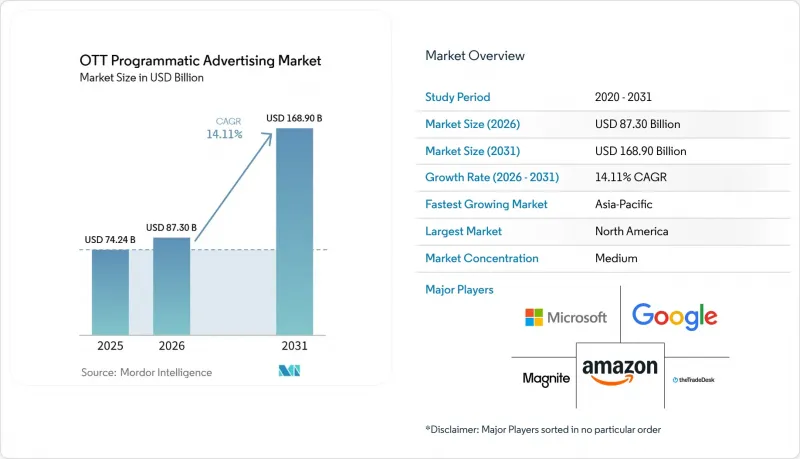
根據 Mordor Intelligence 預測,OTT 程式化廣告市場規模將從 2025 年的 742.4 億美元和 2026 年的 873 億美元成長到 2031 年的 1,689 億美元,2026 年至 2031 年的複合年成長率為 14.11%。
本報告按平台類型(即時競價、私人市場、程式化擔保等)、廣告形式(影片廣告、展示廣告、互動廣告等)、設備類型(智慧型手機、平板電腦等)、終端用戶產業(媒體娛樂、零售電商、汽車等)和地區細分。市場預測以美元計價。
全球OTT程序化廣告市場趨勢與洞察
CTV主導的程序化廣告支出擴張
連網電視 (CTV) 是 OTT 程式化廣告市場需求的最主要驅動力,它正在改變廣告主在電視、影片和成效廣告之間分配預算的方式。 Premion 和 Advertiser Perceptions 的一份報告顯示,大多數 CTV 廣告主預計會增加支出,這表明預算擴張並非僅限於少數早期採用者。研究還發現,CTV 和 OTT 交易中很大一部分預計將採用程序化購買方式,而大部分 CTV 預算由整合的混合購買團隊管理。這表明自動化正在成為一種營運標準,而不再只是一個專業管道。此外,IAB 的研究表明,許多增加 CTV 支出的廣告主正在從其線性電視預算中分配新增資金,這證實了 OTT 程序化廣告市場正在吸收傳統媒體的資金,而不是等待全新的廣告需求。同時,投資 CTV 的中小型廣告主數量顯著增加,擴大了買家群體。這意味著,隨著工具變得更加自助和易於管理,准入門檻正在降低。預算來源的變化、程序化處理量的增加以及買家參與度的提高,使得 OTT 程序化廣告市場的需求狀況比單純的用戶數量所顯示的更為強勁。
逐步淘汰第三方 Cookie 將加速第一方定向廣告的發展。
第三方 Cookie 的不確定性已從單一平台問題演變為更廣泛的訊號品質問題。這促使廣告商更傾向於擁有強大且基於許可的身份基礎的環境。儘管Google在 2025 年 4 月決定不完全淘汰 Chrome 中的第三方 Cookie,從而解決了一個技術問題,但 Safari 的限制、Firefox 的 Cookie 拆分以及基於同意的資料遺失仍然在許多數位廣告領域減少了可用的受眾訊號。這種轉變為 OTT 程序化廣告市場創造了比較優勢,因為串流媒體服務通常基於用戶資訊和應用程式登入憑證來識別受眾,而不是僅依賴瀏覽器 Cookie。與能夠跨螢幕和會話保持符合隱私規定的受眾匹配的廣播公司、營運商和平台建立夥伴關係的價值也在不斷提升。因此,廣告支出並未消失,而是轉向了擁有更豐富的同意數據、更強大的身份持久性和更清晰的身份驗證框架的發布商和廣告資源所有者。實際上,這使得 OTT 程序化廣告市場能夠獲得以前依賴不可靠的開放網路定向訊號和不可靠的受眾識別的預算。
由於隱私保護措施導致訊號遺失,受眾群體圖譜受到限制。
訊號遺失不再是暫時的調整問題,而是對OTT程式化廣告市場,尤其是登入深度淺或用戶關係不持久的廣告資源,持續構成壓力。 Safari的限制、Firefox的cookie分區、基於用戶同意的退出機制以及行動裝置識別碼的重置,都減少了可用於在更廣泛的數位生態系統中進行受眾匹配的可尋址資料量。這在可以依賴已認證用戶環境的高階串流媒體平台和受眾匹配率及CPM支援較弱的長尾OTT及快速廣告資源之間造成了明顯的差距。 Comscore的一項調查顯示,許多受訪者計劃加強情境定向,這表明許多買家正在嘗試適應ID準確性的降低,而不是完全彌補跨平台識別能力的缺失。在類似的環境下,頻次管理也變得更加困難,因為ID基礎設施的削弱使得控制跨多個串流媒體服務和設備的重疊曝光變得更加困難。因此,儘管OTT程序化廣告市場仍在持續成長,但大部分成長集中在資料豐富的平台,這些平台即使在更嚴格的隱私條件下也能維持受眾的效用。
細分市場分析
到2025年,即時競價(RTB)將佔據最大的平台佔有率,達到38.44%。但在OTT程序化廣告市場,程序化保證廣告預計將以14.43%的複合年成長率(CAGR)實現最快成長,直至2031年。即時競價能保持其主導地位,是因為它長期以來一直是數位視訊和聯網電視廣告資源在廣泛需求池中的預設交易方式。這種傳統做法仍然非常重要,因為許多廣告主使用RTB來保持柔軟性、快速擴展測試活動,並在無需提前投入預算的情況下比較不同發布商的廣告資源表現。然而,OTT程序化廣告市場的關注點正在轉向能夠對價格、投放和受眾品質進行更精細控制的優質廣告資源結構。正因如此,程序化擔保廣告的成長速度超過了其他平台類型,因為優質串流媒體服務的營運商希望在不犧牲收入穩定性或嚴格廣告資源管理的前提下投放數位廣告。
程序化擔保廣告之所以備受關注,是因為它既能為發布商提供固定價格和投放保證,又能保持品牌廣告主期望從數位基礎設施中獲得的定向、報告和工作流程效率。這種平衡在OTT程式化廣告產業至關重要,因為優質發布商必須同時保障盈利和買家信任。私人市場仍然很重要,因為它為經過審核的買家提供品牌安全的廣告資源池,通常能夠實現比公開競標更高的價格和更優質的宣傳活動活動。隨著買家要求在同一交易路徑中獲得檢驗的廣告資源、打包受眾和更少的浪費,精選市場的重要性日益凸顯,推動著人們逐漸摒棄透過無差別的開放式交易平台進行購買的做法。雖然優選交易仍然適用於特定的應用場景,但OTT程序化廣告市場的整體發展方向是將自動化與更嚴格的廣告資源管治結合的交易模式。
預計到2025年,影片廣告將佔OTT程式化廣告市場收入的55.26%,互動廣告到2031年將以14.57%的複合年成長率成長。由於OTT是基於全螢幕影片觀看,影片仍然是主流格式,前置式和片中廣告位在大多數高階串流媒體環境中仍然是原生變現單元。這項基礎也得益於廣告主對OTT的熟悉程度,因為許多品牌買家仍然從電視的觀點評估OTT的效果,即使宣傳活動是在數位系統上運行的。因此,影片的優勢既體現在產品與市場的契合度上,也體現在買家長期以來對在輕鬆觀看環境下呈現的影像、聽覺和動態效果的習慣上。同時,成長最快的趨勢是,在不影響優質視覺體驗的前提下,為觀看體驗增添互動和便利性。
互動廣告的擴張源於以下事實:暫停廣告、可購物疊加層和第二螢幕電商連結等功能將被動曝光轉化為可衡量的行動機會,從而更容易將其與業務成果聯繫起來。 IAB 的一份報告顯示,到 2026 年,電視和影片廣告買家最重要的購買標準將從內容品質轉向定向能力,年增 10 個百分點。這凸顯了廣告形式向數據驅動、結果導向型轉變的趨勢。對於重視涵蓋範圍廣、同時又注重可衡量效果和快速學習循環的中小型廣告主而言,這種轉變尤其重要。包括主螢幕橫幅廣告和暫停式展示廣告在內的展示廣告庫存也在擴大 OTT 程序化廣告市場的商業性覆蓋範圍。自 2026 年 5 月以來,這一趨勢尤為顯著,當時 Equativ 和 Titan OS 在歐洲和南美洲推出了面向聯網電視的程式化主螢幕影片解決方案。純音訊前置式和其他一些較小的疊加格式規模仍然很小,但它們支援 FAST 和與廣播相關的串流媒體類別的盈利,在這些類別中,靈活的庫存配置是有效的。
區域分析
2025年,北美繼續保持其最大區域收入來源的地位,佔據OTT程序化廣告市場佔有率的40.56%。該地區憑藉其在聯網電視硬體高普及率、成熟的DSP和SSP基礎設施以及已具備自動化變現能力的高密度優質出版商群體方面的優勢,佔據主導地位。 The Trade Desk與AccuWeather、《衛報》、赫斯特集團、《新聞周刊》和BuzzFeed等合作夥伴於2026年1月推出的「OpenAds」平台,彰顯了該地區在設計更直接、更透明的競標的主導地位。此外,北美擁有比許多其他地區更健全的買方反詐欺措施,有助於防止優質聯網電視預算的浪費。根據Pixalate的報告,2025年第四季美國聯網電視流量的無效率僅19%,在所提供數據追蹤的主要全球市場中最低。這進一步鞏固了北美作為營運最成熟的區域市場的地位。
預計到2031年,亞太地區的複合年成長率將達到14.72%,成為OTT程式化廣告市場成長最快的區域。這一成長主要得益於印度和東南亞串流媒體滲透率的不斷提高,以及韓國和澳洲聯網電視使用量的持續成長。 2025年,IAB SEA和印度連網電視及OTT委員會發布的數據顯示,該地區74%的行銷人員計劃增加對聯網電視和OTT的投資。這表明,市場需求並非局限於單一國家,而是遍及多個國內市場。 2026年,亞洲視訊產業協會(AVIA)預測,2025年至2030年間,全部區域的高階視訊點播(VOD)將新增125億美元的收入,到2030年底將達到520億美元。這凸顯了程序化廣告買家關注的受眾規模之大。同時,根據 Pixalate 的報告,2026 年第一季亞太地區聯網電視的無效流量率達到了 58%。這表明,隨著該地區的快速成長,市場正在向精選的、私密的市場模式轉變,這種模式使買家能夠更好地管理品質風險。
儘管歐洲、中東和非洲以及南美洲的成熟度各不相同,但歐洲在規模、管治和反詐欺敏感度方面表現突出。德國OVK和BVDW預測,到2026年,程式化廣告收入將超過60億歐元(目前匯率約68.4億美元),佔德國線上展示和影片廣告總收入的80%。這表明,自動化已成為歐洲最大的數位廣告市場之一的標準營運模式。根據Pixalate的數據,2026年第一季英國聯網電視的無效流量率為46.1%,德國為44%。這表明,即使需求日趨成熟,品牌安全措施和供應端檢驗仍然必不可少。中東和非洲以及南美洲的OTT程序化廣告市場仍處於早期階段,雖然採用率正在提高,但基礎設施建設、優質出版商的準備情況以及本地程序化標準在各國之間仍然存在顯著差異。
其他好處:
- Excel格式的市場預測(ME)表
- 3個月的分析師支持
目錄
第1章:引言
- 研究假設和市場定義
- 調查範圍
第2章:調查方法
第3章執行摘要
第4章 市場狀況
- 市場概覽
- 市場促進因素
- CTV主導的程序化廣告支出擴張
- 第三方 Cookie 的逐步淘汰正在加速第一方定向廣告的發展。
- 人工智慧驅動的競標最佳化與動態創新投放
- 擴展零售媒體資料基礎設施,使其包含OTT廣告位
- 我們精心打造的交易平台減少了開放式交易中的浪費。
- 透過伺服器端廣告插入增加可變現廣告展示次數。
- 市場限制因素
- 由於隱私保護造成的訊號損失限制了受眾圖。
- 供應鏈日益複雜,導致確保成交率和透明度的成本不斷上升。
- CTV廣告詐騙和無效流量帶來的壓力
- 計量標準的差異導致預算重新分配延遲。
- 產業價值鏈分析
- 宏觀經濟因素對市場的影響
- 監理情勢
- 技術展望
- 波特五力分析
第5章 市場規模與成長預測
- 依平台類型
- 即時競價
- 私人市場
- 程序化擔保交易
- 優惠
- 其他平台類型
- 廣告格式
- 影片廣告
- 展示廣告
- 互動廣告
- 其他廣告形式
- 依設備類型
- 智慧型手機和平板電腦
- 智慧電視
- 筆記型電腦和桌上型電腦
- 其他設備類型
- 按最終用戶行業分類
- 媒體與娛樂
- 零售與電子商務
- 車
- 醫療和藥品
- 金融服務
- 旅遊與飯店
- 其他終端用戶產業
- 按地區
- 北美洲
- 美國
- 加拿大
- 墨西哥
- 南美洲
- 巴西
- 阿根廷
- 智利
- 其他南美國家
- 歐洲
- 德國
- 英國
- 法國
- 義大利
- 西班牙
- 其他歐洲國家
- 亞太地區
- 中國
- 日本
- 印度
- 韓國
- 澳洲
- 其他亞太國家
- 中東
- 沙烏地阿拉伯
- 阿拉伯聯合大公國
- 卡達
- 其他中東國家
- 非洲
- 南非
- 埃及
- 奈及利亞
- 其他非洲國家
- 北美洲
第6章 競爭情勢
- 市場集中度
- 策略趨勢
- Vendor Positioning Analysis
- 公司簡介
- The Trade Desk, Inc.
- Google LLC
- Amazon.com, Inc.
- Microsoft Corporation
- Magnite, Inc.
- PubMatic, Inc.
- FreeWheel, A Comcast Company
- Roku, Inc.
- Adobe Inc.
- Criteo SA
- Equativ
- Adform A/S
- OpenX Software Ltd.
- Index Exchange Inc.
- Innovid Corp.
- iSpot.tv, Inc.
- VideoAmp, Inc.
- LiveRamp Holdings, Inc.
- StackAdapt Inc.
- Yahoo Inc.
第7章 市場機會與未來展望
According to Mordor Intelligence, the OTT programmatic advertising market size is projected to expand from USD 74.24 billion in 2025 and USD 87.30 billion in 2026 to USD 168.90 billion by 2031, registering a CAGR of 14.11% between 2026 to 2031.
This report is Segmented by Platform Type (Real-Time Bidding, Private Marketplace, Programmatic Guaranteed, and More), Ad Format (Video Ads, Display Ads, and Interactive Ads), Device Type (Smartphones and Tablets, and More), End-User Industry (Media and Entertainment, Retail and E-Commerce, Automotive, and More), and Geography. The Market Forecasts are Provided in Terms of Value (USD).
Global OTT Programmatic Advertising Market Trends and Insights
CTV-Led Programmatic Spend Expansion
Connected television has become the clearest demand engine inside the OTT programmatic advertising market, and it is changing how advertisers split television, video, and performance budgets across screens. Premion and Advertiser Perceptions reported that most CTV advertisers expected to increase spending, which shows that budget growth is not limited to a narrow set of early adopters. The same study found that a significant share of CTV and OTT volume was projected to transact programmatically, while integrated hybrid buying teams controlled a large portion of CTV budgets, which points to automation becoming the operational norm rather than a specialist channel. The IAB also found that many advertisers increasing CTV spending were funding that rise from linear television budgets, which confirms that the OTT programmatic advertising market is absorbing money from legacy media pools instead of waiting for entirely new ad demand. The buyer base is broadening at the same time, as participation from small advertisers investing in CTV has increased notably, which means access barriers are falling as tools become more self-serve and easier to manage. This mix of shifting budget origin, higher programmatic throughput, and wider buyer participation gives the OTT programmatic advertising market a stronger demand profile than subscriber counts alone would suggest.
Third-Party Cookie Deprecation Accelerating First-Party Targeting
Third-party cookie uncertainty stopped being a single platform issue and became a broader signal quality issue, which has pushed advertisers to favor environments with durable, permissioned identity foundations. Google's April 2025 decision not to fully deprecate third-party cookies in Chrome settled one technical question, but Safari restrictions, Firefox cookie partitioning, and consent-led data loss still narrowed usable audience signals across much of digital advertising. That shift creates a comparative advantage for the OTT programmatic advertising market because streaming services usually anchor audience recognition in subscriber or app logins rather than browser cookies alone. It also increases the value of broadcaster, telecom, and platform partnerships that can sustain privacy-compliant audience matching across screens and sessions. The result is that spend does not disappear, but it moves toward publishers and inventory owners with better consented data depth, stronger identity persistence, and cleaner authentication frameworks. In practice, this is helping the OTT programmatic advertising market capture budgets that previously depended on weaker open-web targeting signals and less stable audience resolution.
Privacy-Driven Signal Loss Limiting Audience Graphs
Signal loss is no longer a temporary adjustment issue, and it now acts as a steady pressure point on the OTT programmatic advertising market, especially for inventory without strong login depth or persistent user relationships. Safari restrictions, Firefox cookie partitioning, consent-led opt-outs, and mobile identifier resets all reduce how much addressable data remains available for audience matching across the wider digital ecosystem. This creates a clear split between premium streaming platforms that can rely on authenticated subscriber environments and long-tail OTT or FAST inventory, where audience match rates and CPM support are weaker. Comscore found that many respondents planned to increase contextual targeting, which shows that many buyers are adjusting to lower identity precision instead of fully replacing lost cross-platform recognition. Frequency management becomes harder in the same environment because a weaker identity spine makes it more difficult to control repeated exposure across multiple streaming services and devices. The net effect is that the OTT programmatic advertising market still grows, but more of that growth concentrates around data-rich platforms that can preserve audience utility under tighter privacy conditions.
Other drivers and restraints analyzed in the detailed report include:
- AI-Powered Bid Optimization and Dynamic Creative Deployment
- Retail Media Data Infrastructure Extending Into OTT Inventory
- Supply-Path Complexity Raising Take Rates and Transparency Costs
For complete list of drivers and restraints, kindly check the Table Of Contents.
Segment Analysis
Real-time bidding held the largest platform share at 38.44% in 2025, while programmatic guaranteed is projected to post the fastest growth at a 14.43% CAGR through 2031 within the OTT programmatic advertising market. Real-time bidding kept its lead because it has long served as the default transaction method for digital video and connected TV inventory across broad demand pools. That legacy still matters, since many advertisers use RTB to preserve flexibility, scale testing activity quickly, and compare inventory performance across publishers without committing budget too early. Even so, the center of gravity in the OTT programmatic advertising market is shifting toward premium inventory structures that offer more control over price, delivery, and audience quality. This is why programmatic guaranteed is growing faster than other platform types, as premium streaming owners seek digital execution without giving up revenue stability or inventory discipline.
Programmatic guaranteed is gaining traction because it gives publishers fixed-price certainty and guaranteed delivery, while still preserving targeting, reporting, and workflow efficiencies that brand advertisers expect from digital infrastructure. That balance matters in the OTT programmatic advertising industry, where premium publishers need to protect yield and buyer trust at the same time. Private marketplace activity also remains important because it gives vetted buyers access to brand-safe inventory pools that usually command better pricing and stronger campaign quality than open auction routes. Curated marketplaces are becoming more relevant as buyers look for verified supply, audience packaging, and lower waste in the same transaction path, which reinforces the move away from undifferentiated open exchange buying. Preferred deals still serve selective use cases, but the broader direction of the OTT programmatic advertising market points toward transaction models that combine automation with tighter inventory governance.
Video ads accounted for 55.26% of segment revenue in 2025, while interactive ads are projected to grow at a 14.57% CAGR through 2031 in the OTT programmatic advertising market. Video remained the dominant format because OTT is built around full-screen video consumption, and pre-roll and mid-roll placements remain the native monetization unit for most premium streaming environments. This base also benefits from established advertiser familiarity, as many brand buyers still evaluate OTT performance through a television lens even when campaigns are executed through digital systems. The strength of video, therefore, reflects both product-market fit and a long-standing buyer comfort with sight, sound, and motion in lean-back viewing environments. At the same time, the fastest growth is moving toward formats that add interaction and performance utility to the viewing experience without abandoning the premium visual context.
Interactive ads are expanding because pause ads, shoppable overlays, and second-screen commerce links turn passive exposure into measurable action opportunities that are easier to connect to business outcomes. The IAB reported that targeting capabilities overtook content quality as the top purchase criterion for TV and video buyers in 2026, rising 10 percentage points year over year, which supports the broader move toward more data-responsive and outcome-aware ad formats. That shift is especially relevant for smaller and mid-sized buyers that value measurable performance and faster learning loops more than broad reach alone. Display placements, including homescreen banners and pause-state surfaces, are also widening the commercial surface area of the OTT programmatic advertising market, especially after Equativ and Titan OS launched a programmatic home-screen video solution for connected TVs in Europe and South America in May 2026. Audio-only pre-roll and other minor overlay formats remain small, but they still support monetization in FAST and radio-adjacent streaming categories where flexible inventory packaging is useful.
Complete Report Scope:
- By Platform Type
- Real-Time Bidding
- Private Marketplace
- Programmatic Guaranteed
- Preferred Deals
- Other Platform Types
- By Ad Format
- Video Ads
- Display Ads
- Interactive Ads
- Other Ad Formats
- By Device Type
- Smartphones and Tablets
- Smart TVs
- Laptops and Desktops
- Other Device Types
- By End-User Industry
- Media and Entertainment
- Retail and E-Commerce
- Automotive
- Healthcare and Pharmaceuticals
- Financial Services
- Travel and Hospitality
- Other End User Industries
- By Geography
- North America
- United States
- Canada
- Mexico
- South America
- Brazil
- Argentina
- Chile
- Rest of South America
- Europe
- Germany
- United Kingdom
- France
- Italy
- Spain
- Rest of Europe
- Asia-Pacific
- China
- Japan
- India
- South Korea
- Australia
- Rest of Asia-Pacific
- Middle East
- Saudi Arabia
- United Arab Emirates
- Qatar
- Rest of Middle East
- Africa
- South Africa
- Egypt
- Nigeria
- Rest of Africa
- North America
Geography Analysis
North America held 40.56% of the OTT programmatic advertising market share in 2025, which kept it as the largest regional revenue base. The region benefits from strong connected TV hardware penetration, mature DSP and SSP infrastructure, and a dense premium publisher base that is already configured for automated monetization. The Trade Desk's January 2026 launch of OpenAds with partners including AccuWeather, The Guardian, Hearst, Newsweek, and BuzzFeed showed how the region is also leading in direct and more transparent auction design. North America also shows stronger buy-side discipline in fraud mitigation than many other regions, which helps protect premium connected TV budgets from waste. Pixalate reported a 19% connected TV invalid traffic rate in the United States in Q4 2025, the lowest among major global markets tracked in the supplied material, which supports North America's position as the most operationally mature regional base.
Asia-Pacific is projected to grow at a 14.72% CAGR through 2031, making it the fastest-growing regional block in the OTT programmatic advertising market. Growth is being driven by strong streaming adoption in India and Southeast Asia, along with rising connected TV use in South Korea and Australia. The IAB SEA and India CTV and OTT Council found in 2025 that 74% of marketers across the region planned to increase connected TV and OTT investment, which shows that demand is scaling across multiple national markets rather than one isolated country. The Asia Video Industry Association projected in 2026 that premium video on demand would add USD 12.5 billion in incremental growth revenue across Asia-Pacific between 2025 and 2030 and reach USD 52 billion by decade's end, which underlines the size of the viewing base that programmatic buyers are moving toward. At the same time, Pixalate reported a 58% connected TV invalid traffic rate in Asia-Pacific in Q1 2026, which means the region's rapid growth is also pushing buyers toward curated and private marketplace structures that can better control quality risk.
Europe, the Middle East, Africa, and South America show uneven maturity, with Europe standing out for scale, governance, and higher fraud sensitivity. Germany's OVK and BVDW projected that programmatic revenue would exceed EUR 6 billion in 2026, equivalent to USD 6.84 billion at the supplied conversion, and account for 80% of all German online display and video revenue, which signals that automation is already the default operating model in one of Europe's largest digital ad markets. Pixalate recorded Q1 2026 connected TV invalid traffic rates of 46.1% in the United Kingdom and 44% in Germany, which shows that mature demand does not remove the need for brand-safety controls and supply verification. The Middle East, Africa, and South America remain earlier-stage parts of the OTT programmatic advertising market, where adoption is rising, but infrastructure depth, premium publisher readiness, and local programmatic standards still vary widely across countries.
- The Trade Desk, Inc.
- Google LLC
- Amazon.com, Inc.
- Microsoft Corporation
- Magnite, Inc.
- PubMatic, Inc.
- FreeWheel, A Comcast Company
- Roku, Inc.
- Adobe Inc.
- Criteo S.A.
- Equativ
- Adform A/S
- OpenX Software Ltd.
- Index Exchange Inc.
- Innovid Corp.
- iSpot.tv, Inc.
- VideoAmp, Inc.
- LiveRamp Holdings, Inc.
- StackAdapt Inc.
- Yahoo Inc.
Additional Benefits:
- The market estimate (ME) sheet in Excel format
- 3 months of analyst support
TABLE OF CONTENTS
1 INTRODUCTION
- 1.1 Study Assumptions and Market Definition
- 1.2 Scope of the Study
2 RESEARCH METHODOLOGY
3 EXECUTIVE SUMMARY
4 MARKET LANDSCAPE
- 4.1 Market Overview
- 4.2 Market Drivers
- 4.2.1 CTV-Led Programmatic Spend Expansion
- 4.2.2 Third-Party Cookie Deprecation Accelerating First-Party Targeting
- 4.2.3 AI-Powered Bid Optimization and Dynamic Creative Deployment
- 4.2.4 Retail Media Data Infrastructure Extending Into OTT Inventory
- 4.2.5 Curated Marketplaces Reducing Open-Exchange Waste
- 4.2.6 Server-Side Ad Insertion Improving Monetizable Ad Load
- 4.3 Market Restraints
- 4.3.1 Privacy-Driven Signal Loss Limiting Audience Graphs
- 4.3.2 Supply-Path Complexity Raising Take Rates and Transparency Costs
- 4.3.3 CTV Ad Fraud and Invalid Traffic Pressure
- 4.3.4 Fragmented Measurement Standards Slowing Budget Reallocation
- 4.4 Industry Value Chain Analysis
- 4.5 Impact of Macroeconomic Factors on the Market
- 4.6 Regulatory Landscape
- 4.7 Technological Outlook
- 4.8 Porter's Five Forces Analysis
- 4.8.1 Bargaining Power of Suppliers
- 4.8.2 Bargaining Power of Buyers
- 4.8.3 Threat of New Entrants
- 4.8.4 Threat of Substitutes
- 4.8.5 Industry Rivalry
5 MARKET SIZE AND GROWTH FORECASTS (VALUE)
- 5.1 By Platform Type
- 5.1.1 Real-Time Bidding
- 5.1.2 Private Marketplace
- 5.1.3 Programmatic Guaranteed
- 5.1.4 Preferred Deals
- 5.1.5 Other Platform Types
- 5.2 By Ad Format
- 5.2.1 Video Ads
- 5.2.2 Display Ads
- 5.2.3 Interactive Ads
- 5.2.4 Other Ad Formats
- 5.3 By Device Type
- 5.3.1 Smartphones and Tablets
- 5.3.2 Smart TVs
- 5.3.3 Laptops and Desktops
- 5.3.4 Other Device Types
- 5.4 By End-User Industry
- 5.4.1 Media and Entertainment
- 5.4.2 Retail and E-Commerce
- 5.4.3 Automotive
- 5.4.4 Healthcare and Pharmaceuticals
- 5.4.5 Financial Services
- 5.4.6 Travel and Hospitality
- 5.4.7 Other End User Industries
- 5.5 By Geography
- 5.5.1 North America
- 5.5.1.1 United States
- 5.5.1.2 Canada
- 5.5.1.3 Mexico
- 5.5.2 South America
- 5.5.2.1 Brazil
- 5.5.2.2 Argentina
- 5.5.2.3 Chile
- 5.5.2.4 Rest of South America
- 5.5.3 Europe
- 5.5.3.1 Germany
- 5.5.3.2 United Kingdom
- 5.5.3.3 France
- 5.5.3.4 Italy
- 5.5.3.5 Spain
- 5.5.3.6 Rest of Europe
- 5.5.4 Asia-Pacific
- 5.5.4.1 China
- 5.5.4.2 Japan
- 5.5.4.3 India
- 5.5.4.4 South Korea
- 5.5.4.5 Australia
- 5.5.4.6 Rest of Asia-Pacific
- 5.5.5 Middle East
- 5.5.5.1 Saudi Arabia
- 5.5.5.2 United Arab Emirates
- 5.5.5.3 Qatar
- 5.5.5.4 Rest of Middle East
- 5.5.6 Africa
- 5.5.6.1 South Africa
- 5.5.6.2 Egypt
- 5.5.6.3 Nigeria
- 5.5.6.4 Rest of Africa
- 5.5.1 North America
6 COMPETITIVE LANDSCAPE
- 6.1 Market Concentration
- 6.2 Strategic Moves
- 6.3 Vendor Positioning Analysis
- 6.4 Company Profiles (includes Global Level Overview, Market Level Overview, Core Segments, Financials as available, Strategic Information, Market Rank/Share, Products and Services, Recent Developments)
- 6.4.1 The Trade Desk, Inc.
- 6.4.2 Google LLC
- 6.4.3 Amazon.com, Inc.
- 6.4.4 Microsoft Corporation
- 6.4.5 Magnite, Inc.
- 6.4.6 PubMatic, Inc.
- 6.4.7 FreeWheel, A Comcast Company
- 6.4.8 Roku, Inc.
- 6.4.9 Adobe Inc.
- 6.4.10 Criteo S.A.
- 6.4.11 Equativ
- 6.4.12 Adform A/S
- 6.4.13 OpenX Software Ltd.
- 6.4.14 Index Exchange Inc.
- 6.4.15 Innovid Corp.
- 6.4.16 iSpot.tv, Inc.
- 6.4.17 VideoAmp, Inc.
- 6.4.18 LiveRamp Holdings, Inc.
- 6.4.19 StackAdapt Inc.
- 6.4.20 Yahoo Inc.
7 MARKET OPPORTUNITIES AND FUTURE OUTLOOK
- 7.1 White-Space and Unmet-Need Assessment

 中東和非洲程序化廣告:市場佔有率分析、行業趨勢和統計數據以及成長預測(2026-2031 年)亞太地區程序化廣告:市場佔有率分析、產業趨勢與統計及成長預測(2026-2031)北美程序化廣告:市場佔有率分析、產業趨勢與統計及成長預測(2026-2031 年)歐洲程序化廣告:市場佔有率分析、產業趨勢與統計及成長預測(2026-2031 年)程序化廣告:市場佔有率分析、產業趨勢與統計、成長預測(2026-2031)動態創新最佳化軟體:市場佔有率分析、產業趨勢與統計、成長預測(2026-2031)
 程序化廣告市場:2026-2032年全球市場預測(依廣告格式、設備類型、平台類型、技術類型及產業分類)
 程序化展示廣告市場分析及預測(至2035年):依類型、產品類型、服務、技術、組件、應用、設備、流程、部署模式及最終用戶分類
 2026年全球付費會員計畫平台市場報告2026年全球動態創新最佳化(DCO)市場報告