


 |
市場調查報告書
商品編碼
2125346
北美程序化廣告:市場佔有率分析、產業趨勢與統計及成長預測(2026-2031 年)North America Programmatic Advertisement - Market Share Analysis, Industry Trends & Statistics, Growth Forecasts (2026 - 2031) |
||||||

※ 本網頁內容可能與最新版本有所差異。詳細情況請與我們聯繫。
據 Mordor Intelligence 稱,2025 年北美程式化廣告市場價值 2,649.6 億美元,預計到 2031 年將達到 3991.6 億美元,而 2026 年為 2836.9 億美元,預測期(2026-2031 年)複合年成長率為 7.07%。
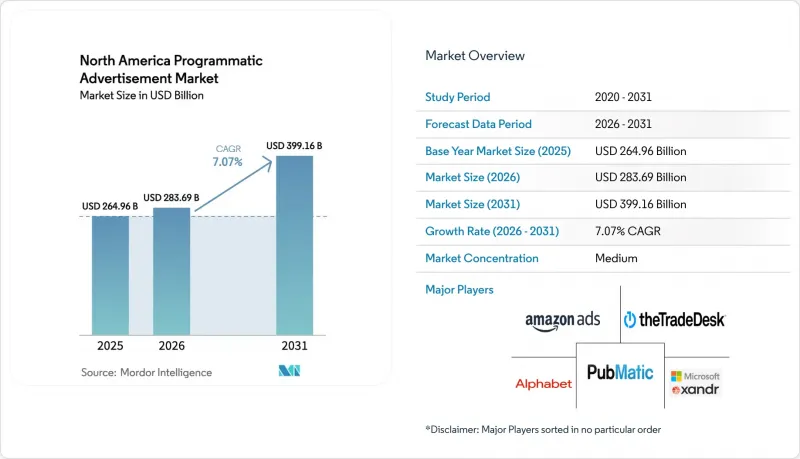
本報告按交易平台(即時競價、私人市場擔保等)、廣告媒介(行動顯示器等)、公司規模(中小企業、大型企業)、終端用戶行業(零售/電商、汽車等)和國家/地區進行細分。市場規模和預測均以美元計價。
北美程序化廣告市場的趨勢與洞察
美國連網電視廣告支出激增是由串流平台推動的。
受政治宣傳活動和大型體育賽事轉播的推動,聯網電視(CTV) 投資成長了 16.2%,預計到 2024 年將達到 214.5 億美元。隨著迪士尼、Roku 和亞馬遜不斷擴展其即時交易平台,程式化廣告目前已佔 CTV 交易的 75%。迪士尼決定將其交易平台開放給亞馬遜 DSP,從而整合了情境數據和購買數據,提升了跨螢幕宣傳活動的績效指標。廣告主也信心十足,95% 的廣告主計劃在 2025 年維持或增加其 CTV 預算。 The Trade Desk 的「Ventura」作業系統旨在簡化 CTV 供應鏈,承諾減少仲介業者並提高衡量精度。
零售媒體網路中第一方數據的優勢
預計到2027年,零售媒體將成為全球第三大廣告管道,市場規模將超過2,338.9億美元。雖然亞馬遜佔據了美國零售媒體廣告收入的75%,但沃爾瑪旗下的Walmart Connect在2024年仍實現了60%的成長,這主要得益於買家群體的多元化。其閉合迴路歸因機制將廣告曝光與購買結果直接關聯起來,這是傳統程序化交易平台在無cookie環境下無法實現的。沃爾瑪考慮收購Vizio以及其積極的異地擴張表明,零售商如今正與需求端平台(DSP)直接競爭。因此,北美程序化廣告市場正在經歷一場結構性重組,各方將更加重視數據合作,以鞏固市場佔有率。
SPO費用正在擠壓出版商的利潤空間。
複雜的供應鏈使得仲介業者能夠攫取高達98%的競標,在極端情況下,優質出版商最終只能拿到其預算的2%。佣金波動往往與內容品質無關,這威脅到小眾出版商的永續性。買家正透過特定管道集中需求,進一步削弱競爭,並擴大佣金差距。隨著收入的減少,出版商正轉向直接銷售和私人市場(PMP),加速北美程序化廣告市場的整合。如果基礎設施成本的降低無法跟上佣金率上漲的步伐,小規模媒體機構將面臨被市場淘汰的風險。
細分市場分析
預計到2025年,即時競價(RTB)將佔廣告支出的57.40%,凸顯其在北美程式化廣告市場的核心地位。隨著品牌對檢驗、高品質且能降低詐欺風險的環境的需求日益成長,私有市場(PMP)中的擔保交易正以9.36%的複合年成長率成長。這種轉變使得資料品質和可見度優先於單純的成本效益,迫使開放式交易平台改善其庫存篩選流程。自動化擔保合約滿足了既需要柔軟性又需要確定性的廣告主的需求,而無預留、固定費率的交易則為發布商即使在波動較大的競標環境中也能提供可預測的收入。這些模式的融合意味著RTB在長尾庫存領域保持著無可比擬的規模,而PMP則確立了其作為高階成長引擎的地位。
向程序化廣告模式 (PMP) 的轉變源於廣告主們認知到,品牌安全、效果衡量和透明度比競標價格的潛在節省更為重要。 OpenX 首創了「即時保證」模式,該模式結合了即時競價 (RTB) 的速度和保證庫存的確定性。這種混合模式體現了市場對效率和課責的雙重需求。因此,北美程序化廣告市場不斷完善交易機制,力求在規模、速度和對加值內容的控制上取得平衡。
2025年,行動顯示器廣告將維持45.85%的市佔率。這主要得益於5G的普及,5G支援豐富的影片和互動格式,能夠隨時隨地吸引用戶。聯網電視雖然規模較小,但憑藉著串流平台程式化基礎設施的成熟,實現了12.21%的最高複合年成長率。桌上型顯示器、數位音訊和數位戶外廣告(DOOH)透過彌合家庭、通勤和公共場所等場景中的情境差異,完善了全通路策略。程序化影片廣告支出達到199.3億美元,其中87.1%的行動影片廣告已透過自動化競標完成交易。 5G和人工智慧創新的融合,打造了沉浸式體驗,北美程式化廣告市場正在向遊戲和社交生態系統拓展。
T-Mobile斥資6億美元收購數位戶外廣告(DOOH)專家Vistar Media,凸顯了這家電信巨頭在螢幕獨立廣告領域的雄心。這筆交易標誌著DOOH的復興,它融合了位置資料、5G網路以及110萬塊螢幕組成的龐大網路。隨著整合的深入,廣告策劃人員正在靈活地在行動裝置、連網電視(CTV)和DOOH之間分配預算,以最大限度地提高覆蓋率和頻率。這些趨勢鞏固了北美程序化廣告市場作為全通路平台的地位。
其他好處:
- Excel格式的市場預測(ME)表
- 3個月的分析師支持
目錄
第1章:引言
- 研究假設和市場定義
- 調查範圍
第2章:調查方法
第3章執行摘要
第4章 市場狀況
- 市場概覽
- 市場促進因素
- 美國連網電視廣告支出激增是由串流平台推動的。
- 零售媒體網路中第一方數據的優勢
- AI最佳化的即時競價可提高中小企業的廣告支出報酬率
- 第三方 cookie 的棄用正在加速 PMP 的採用。
- 5G的推出正在提升行動影片的觀看量。
- 市場限制因素
- 供應路徑最佳化 (SPO) 費用正在擠壓出版商的利潤空間。
- CTV身份圖譜的碎片化限制了覆蓋範圍的擴大。
- 資料隱私訴訟風險(CCPA 和魁北克第 64 號法案)
- 公開交易平台上的廣告詐騙日益增多
- 監理展望
- 技術展望
- 波特五力分析
- 產業相關人員分析
第5章 市場規模與成長預測
- 透過交易平台
- 即時競價(RTB)
- 私人交易平台(有保障)
- 自動擔保類型
- 無限制固定利率
- 透過廣告媒介
- 行動顯示器
- 桌面顯示器
- 聯網電視(CTV)
- 數位音訊
- 數位戶外廣告 (DOOH)
- 按公司規模
- 大公司
- 中小企業
- 按最終用戶行業分類
- 零售與電子商務
- 車
- BFSI
- 媒體與娛樂
- 醫療和製藥
- 旅遊與飯店
- 國家
- 美國
- 加拿大
- 墨西哥
第6章 競爭情勢
- Strategic Developments
- Vendor Positioning Analysis
- 公司簡介
- Alphabet Inc.(Google Advertising)
- The Trade Desk Inc.
- Amazon Advertising(Amazon .com Inc.)
- Xandr(Microsoft Corp.)
- PubMatic Inc.
- Magnite Inc.
- MediaMath Inc.
- Adobe Advertising Cloud
- Roku OneView
- Index Exchange Inc.
- AdRoll(NextRoll Inc.)
- Amobee Inc.
- OpenX Technologies Inc.
- TripleLift Inc.
- Quantcast Corp.
- Verizon Media DSP(Yahoo)
- StackAdapt Inc.
- Centro(Basis Technologies)
- Viant Technology Inc.
- Criteo SA
第7章 市場機會與未來展望
According to Mordor Intelligence, the North America programmatic advertisement market size was valued at USD 264.96 billion in 2025 and estimated to grow from USD 283.69 billion in 2026 to reach USD 399.16 billion by 2031, at a CAGR of 7.07% during the forecast period (2026-2031).
This report is Segmented by Trading Platform (Real-Time Bidding, Private Marketplace Guaranteed, and More), Advertising Media (Mobile Display and More), Enterprise Size (SMBs, Large Enterprises) and End-User Industry (Retail and E-Commerce, Automotive and More) and Country. The Market Sizes and Forecasts are Provided in Terms of Value (USD).
North America Programmatic Advertisement Market Trends and Insights
Surging CTV Ad-Spend Led by U.S. Streaming Platforms
Connected TV investment reached USD 21.45 billion in 2024 after a 16.2% jump tied to political campaigns and major sports broadcasts. Programmatic execution now accounts for 75% of CTV transactions as Disney, Roku, and Amazon expand real-time exchanges. Disney's decision to open its exchange to Amazon DSP combines contextual and purchase data, improving performance metrics for cross-screen campaigns. Advertiser confidence is evident, with 95% planning to sustain or lift CTV budgets in 2025. The Trade Desk's Ventura operating system aims to streamline the CTV supply chain, promising fewer intermediaries and better measurement
Retail Media Networks' First-Party Data Advantage
Retail media has become the third-largest channel worldwide and is forecast to exceed USD 233.89 billion in 2027. Amazon holds 75% of U.S. retail media ad revenue, but Walmart Connect grew 60% in 2024 as buyers diversify. Their closed-loop attribution links ad exposure to purchase outcomes, a capability traditional programmatic exchanges cannot match in a cookieless. Walmart's exploration of acquiring Vizio and its offsite push shows how retailers now compete head-on with demand-side platforms. The result is a structural rebalancing that pushes the North America programmatic advertisement market toward deeper data partnerships to defend share.
SPO Fees Compressing Publisher Margins
Complex supply chains allow intermediaries to capture up to 98% of a bid, leaving premium publishers with only 2% of spend in extreme cases. Fee variability often fails to correlate with content quality, straining sustainability for niche publishers. Buyers concentrate demand through preferred paths, further reducing competition and widening fee spreads. As revenues shrink, publishers pivot to direct sales and PMPs, accelerating consolidation within the North America programmatic advertisement market. Smaller outlets risk displacement if infrastructure cost reductions do not keep pace with rising take rates.
Other drivers and restraints analyzed in the detailed report include:
- AI-Optimised Real-Time Bidding Enhancing ROAS for SMBs
- Deprecation of Third-Party Cookies Accelerating Adoption of PMPs
- Fragmented CTV Identity Graphs Limiting Reach Extension
For complete list of drivers and restraints, kindly check the Table Of Contents.
Segment Analysis
Real-time bidding contributed 57.40% of spend in 2025, underscoring its central role in the North America programmatic advertisement market. Private marketplace guaranteed deals are rising at 9.36% CAGR as brands seek verified, high-quality environments that mitigate fraud risk. The shift elevates data quality and viewability over pure cost efficiency, pressing open exchanges to refine inventory vetting. Automated guaranteed agreements serve advertisers that need both flexibility and certainty, while unreserved fixed-rate transactions give publishers predictable yields during auction volatility. This blend of models positions PMPs as the premium growth engine even as RTB retains unmatched scale for long-tail inventory.
The migration to PMPs stems from advertisers' perception that brand safety, measurement, and transparency now outweigh bid-price savings. OpenX pioneered real-time guaranteed to fuse RTB speed with the certainty of guaranteed inventory. That hybrid design reflects a market need to reconcile efficiency with accountability. As a result, the North America programmatic advertisement market continues to perfect trading mechanics that combine scale, speed, and premium content stewardship.
Mobile display retained 45.85% share in 2025 because 5G coverage supports rich video and interactive formats that engage users on the go. Connected TV, while smaller, posts the fastest 12.21% CAGR thanks to programmatic infrastructure maturity across streaming platforms. Desktop display, digital audio, and digital out-of-home (DOOH) complement omnichannel plans by filling contextual gaps in home, commute, and public spaces. Programmatic video ad spend reached USD 19.93 billion, with 87.1% of mobile video already transacted through automated auctions. Integration of 5G and AI-driven creative makes immersive experiences viable, expanding the North America programmatic advertisement market into gaming and social ecosystems.
T-Mobile's USD 600 million purchase of DOOH specialist Vistar Media confirms telecom giants' ambitions in screen-agnostic advertising. The deal connects location data, 5G, and a network of 1.1 million screens, underscoring DOOH's revival. As convergence proceeds, planners allocate budgets fluidly across mobile, CTV, and DOOH to maximize incremental reach and frequency. These trends cement the North America programmatic advertisement market as a fully omnichannel discipline.
Complete Report Scope:
- By Trading Platform
- Real-Time Bidding (RTB)
- Private Marketplace Guaranteed
- Automated Guaranteed
- Unreserved Fixed-Rate
- By Advertising Media
- Mobile Display
- Desktop Display
- Connected TV (CTV)
- Digital Audio
- Digital Out-of-Home (DOOH)
- By Enterprise Size
- Large Enterprises
- Small and Mid-sized Businesses (SMBs)
- By End-user Industry
- Retail and E-commerce
- Automotive
- BFSI
- Media and Entertainment
- Healthcare and Pharma
- Travel and Hospitality
- By Country
- United States
- Canada
- Mexico
List of Companies Covered in this Report:
- Alphabet Inc. (Google Advertising)
- The Trade Desk Inc.
- Amazon Advertising (Amazon .com Inc.)
- Xandr (Microsoft Corp.)
- PubMatic Inc.
- Magnite Inc.
- MediaMath Inc.
- Adobe Advertising Cloud
- Roku OneView
- Index Exchange Inc.
- AdRoll (NextRoll Inc.)
- Amobee Inc.
- OpenX Technologies Inc.
- TripleLift Inc.
- Quantcast Corp.
- Verizon Media DSP (Yahoo)
- StackAdapt Inc.
- Centro (Basis Technologies)
- Viant Technology Inc.
- Criteo SA
Additional Benefits:
- The market estimate (ME) sheet in Excel format
- 3 months of analyst support
TABLE OF CONTENTS
1 INTRODUCTION
- 1.1 Study Assumptions and Market Definition
- 1.2 Scope of the Study
2 RESEARCH METHODOLOGY
3 EXECUTIVE SUMMARY
4 MARKET LANDSCAPE
- 4.1 Market Overview
- 4.2 Market Drivers
- 4.2.1 Surging CTV Ad-Spend Led by U.S. Streaming Platforms
- 4.2.2 Retail Media Networks First-party Data Advantage
- 4.2.3 AI-Optimised Real-Time Bidding Enhancing ROAS for SMBs
- 4.2.4 De-precation of Third-party Cookies Accelerating Adoption of PMPs
- 4.2.5 5G Roll-out Boosting Mobile Video Impressions
- 4.3 Market Restraints
- 4.3.1 SPO (Supply-Path Optimisation) Fees Compressing Publisher Margins
- 4.3.2 Fragmented CTV Identity Graphs Limiting Reach Extension
- 4.3.3 Data-privacy Litigation Risk (CCPA and Qubec Bill-64)
- 4.3.4 Ad-fraud Inflation in Open Exchanges
- 4.4 Regulatory Outlook
- 4.5 Technological Outlook
- 4.6 Porter's Five Forces Analysis
- 4.6.1 Bargaining Power of Suppliers
- 4.6.2 Bargaining Power of Buyers
- 4.6.3 Threat of New Entrants
- 4.6.4 Threat of Substitutes
- 4.6.5 Intensity of Competitive Rivalry
- 4.7 Industry Stakeholder Analysis
5 MARKET SIZE AND GROWTH FORECASTS (VALUE)
- 5.1 By Trading Platform
- 5.1.1 Real-Time Bidding (RTB)
- 5.1.2 Private Marketplace Guaranteed
- 5.1.3 Automated Guaranteed
- 5.1.4 Unreserved Fixed-Rate
- 5.2 By Advertising Media
- 5.2.1 Mobile Display
- 5.2.2 Desktop Display
- 5.2.3 Connected TV (CTV)
- 5.2.4 Digital Audio
- 5.2.5 Digital Out-of-Home (DOOH)
- 5.3 By Enterprise Size
- 5.3.1 Large Enterprises
- 5.3.2 Small and Mid-sized Businesses (SMBs)
- 5.4 By End-user Industry
- 5.4.1 Retail and E-commerce
- 5.4.2 Automotive
- 5.4.3 BFSI
- 5.4.4 Media and Entertainment
- 5.4.5 Healthcare and Pharma
- 5.4.6 Travel and Hospitality
- 5.5 By Country
- 5.5.1 United States
- 5.5.2 Canada
- 5.5.3 Mexico
6 COMPETITIVE LANDSCAPE
- 6.1 Strategic Developments
- 6.2 Vendor Positioning Analysis
- 6.3 Company Profiles (includes Market level overview, Core Segments, Financials as available, Strategic Information, Products and Services, and Recent Developments)
- 6.3.1 Alphabet Inc. (Google Advertising)
- 6.3.2 The Trade Desk Inc.
- 6.3.3 Amazon Advertising (Amazon .com Inc.)
- 6.3.4 Xandr (Microsoft Corp.)
- 6.3.5 PubMatic Inc.
- 6.3.6 Magnite Inc.
- 6.3.7 MediaMath Inc.
- 6.3.8 Adobe Advertising Cloud
- 6.3.9 Roku OneView
- 6.3.10 Index Exchange Inc.
- 6.3.11 AdRoll (NextRoll Inc.)
- 6.3.12 Amobee Inc.
- 6.3.13 OpenX Technologies Inc.
- 6.3.14 TripleLift Inc.
- 6.3.15 Quantcast Corp.
- 6.3.16 Verizon Media DSP (Yahoo)
- 6.3.17 StackAdapt Inc.
- 6.3.18 Centro (Basis Technologies)
- 6.3.19 Viant Technology Inc.
- 6.3.20 Criteo SA
7 MARKET OPPORTUNITIES AND FUTURE OUTLOOK
- 7.1 White-space and Unmet-need Assessment

 中東和非洲程序化廣告:市場佔有率分析、行業趨勢和統計數據以及成長預測(2026-2031 年)亞太地區程序化廣告:市場佔有率分析、產業趨勢與統計及成長預測(2026-2031)歐洲程序化廣告:市場佔有率分析、產業趨勢與統計及成長預測(2026-2031 年)程序化廣告:市場佔有率分析、產業趨勢與統計、成長預測(2026-2031)OTT程序化廣告:市場佔有率分析、產業趨勢與統計、成長預測(2026-2031年)動態創新最佳化軟體:市場佔有率分析、產業趨勢與統計、成長預測(2026-2031)
 程序化廣告市場:2026-2032年全球市場預測(依廣告格式、設備類型、平台類型、技術類型及產業分類)
 程序化展示廣告市場分析及預測(至2035年):依類型、產品類型、服務、技術、組件、應用、設備、流程、部署模式及最終用戶分類
 2026年全球付費會員計畫平台市場報告2026年全球動態創新最佳化(DCO)市場報告