


 |
市場調查報告書
商品編碼
2122756
越南農業機械:市場佔有率分析、產業趨勢與統計、成長預測(2026-2031)Vietnam Agricultural Machinery - Market Share Analysis, Industry Trends & Statistics, Growth Forecasts (2026 - 2031) |
||||||

※ 本網頁內容可能與最新版本有所差異。詳細情況請與我們聯繫。
據 Mordor Intelligence 稱,2025 年越南農業機械市場價值為 5.6461 億美元,預計將從 2026 年的 6.0121 億美元成長到 2031 年的 8.4234 億美元,預測期(2026-2031 年)的複合年成長率為 6.98%。
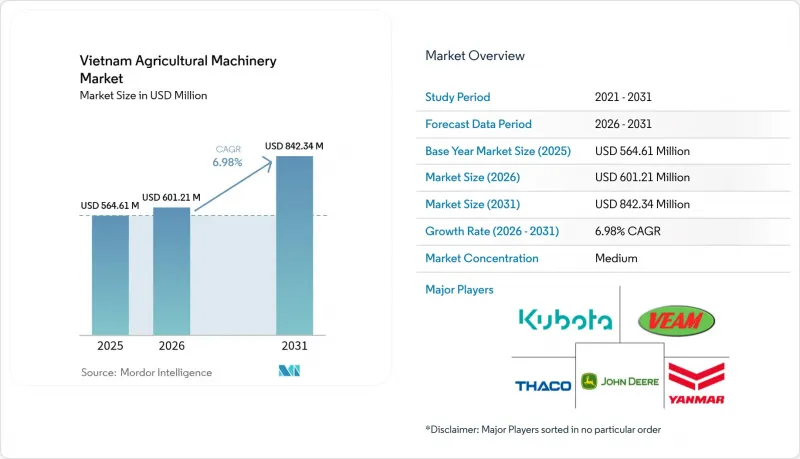
本報告按產品類型(曳引機、播種機械、收割機械、噴灑設備和無人機、乾草和飼料機械以及其他產品類型)和服務模式(業主自營、合約服務和租賃服務)進行分類。市場預測以貨幣價值(美元)表示。
越南農業機械市場趨勢與洞察
農業勞動力減少
到2025年,越南農業勞工將佔農村勞動力的51.94%,比先前的基準值下降4.3%。湄公河三角洲地區的降幅最為顯著。人口外流、氣候變遷的影響以及農民老化迫使生產者用機械取代人工,但能夠操作GPS導航聯合收割機的熟練操作員日益短缺。目前,收割季節主要依賴合約服務,但高峰期操作員的薪資會飆升,這促使人們對自主和半自動農業機械的興趣日益濃厚。久保田公司於2025年1月發布的技術報告證實了針對適應季風氣候的水稻田自動化作業的研究成果。隨著人事費用的持續上漲,機械化不僅成為一種選擇,更成為生存策略。
擴大政府補貼的機械化貸款計劃
2024年7月,一項銀行指令使農業機械融資租賃合法化,進一步完善了綠色信貸組合。截至2024年底,綠色信貸組合規模已達730兆越南盾(約295億美元)。隨後,芹苴省、安江省和同塔省推出了補貼政策,補貼金額最高可達水稻插秧機和精準播種機成本的一半。世界銀行的能力建設項目透過在價值鏈中建立官民合作關係,進一步降低了貸款機構的風險。例如,金甌歌毛省的永強合作社等合作模式,透過融資機制快速擴大農業機械部署規模,每公頃成本降低了6-8美元。國內組裝製造商的產品價格比進口產品低10-20%,因此從補貼中獲益更多,因為更低的價格對小規模更具吸引力。
農田規模極為分散
越南的農場眾多,分散在各個地塊上,平均農場面積不到一公頃。其中大部分是小規模地。這種高度分散的土地限制了規模經濟,需要將聯合收割機等農業機械運送到小規模地,阻礙了效率的提升。此外,不規則形狀的田地和狹窄的道路也限制了大型農業機械的使用。土地法對土地整合有所限制,限制了湄公河三角洲和其他地區的土地所有權。除非開發出超小型農業機械或修改土地所有權法規,否則這些結構性限制預計將繼續阻礙越南農業機械市場的成長。
細分市場分析
到2025年,曳引機將佔越南農業機械市場佔有率的42.3%,這反映了其在770萬公頃稻田犁地的核心作用。功率低於35馬力的四輪驅動曳引機因其能夠輕鬆應對狹窄的堤岸和稻田而佔據主導地位。隨著融資管道的擴展以降低初始成本,以及本地生產技術的進步以保持價格穩定,越南曳引機市場預計將持續成長。久保田公司和洋馬控股公司正在改進20-40馬力的曳引機,使其具備自動駕駛功能,以應對勞動力短缺問題,而國內組裝則專注於生產售價低於1萬美元的產品。從兩輪曳引機轉向四輪曳引機的農民往往更傾向於選擇緊湊型四輪曳引機,這些曳引機還可以用作交通工具,從而擴大了目標客戶群。
儘管噴灑器和無人機目前僅佔總銷售額的個位數百分比,但預計到2031年,它們將以7.8%的複合年成長率實現最快成長。與人工噴灑相比,無人機的單位成本相當,且可節省高達75%的勞動力,這是推動其市場擴張的主要因素。一旦透過許可和保險覆蓋實現安全標準的標準化,越南無人機農業機械市場有望進一步加速發展。 Real-time Robotics公司目前已擁有超過2,800台註冊無人機,其無人機售價比進口產品低20-30%。由於無人機可以即時拍攝農作物影像,因此還可以用於排碳權檢驗,從而為採用無人機的企業開闢新的收入來源。
其他好處:
- Excel格式的市場預測(ME)表
- 3個月的分析師支持
目錄
第1章:引言
- 研究假設和市場定義
- 調查範圍
第2章:調查方法
第3章執行摘要
第4章 市場狀況
- 市場概覽
- 市場促進因素
- 農業工人數量下降
- 擴大政府補貼的機械化貸款計劃
- 美國出口帶來的現金流激增為機器升級提供了資金。
- 無人機噴灑服務成本大幅下降
- 國內OEM廠商的在地化努力
- 農場內部的數據利用平台正在推動對遠端資訊處理技術的需求。
- 市場限制因素
- 農場的規模極為分散。
- 農村地區電氣化率低阻礙了電動曳引機的廣泛應用。
- 網路連線機器面臨的網路安全威脅日益增加。
- 熟練操作人員短缺導致服務成本上升。
- 監理情勢
- 技術展望
- 波特五力分析
第5章 市場規模與成長預測
- 依產品類型
- 聯結機
- 按引擎輸出
- 小於15馬力
- 15~30 HP
- 31~45 HP
- 46~75 HP
- 75馬力或以上
- 透過驅動系統
- 兩輪驅動
- 四輪驅動
- 按引擎輸出
- 收割機械
- 種植/播種機械
- 噴灑和無人機
- 乾草和飼料機械
- 其他產品類型
- 聯結機
- 按服務模式
- 業主操作的機械
- 客製化就業和租賃服務
第6章 競爭情勢
- 市場集中度
- 策略趨勢
- 市佔率分析
- 公司簡介
- Kubota Corporation
- Yanmar Holdings Co., Ltd.
- Vietnam Engine and Agricultural Machinery Corp(VEAM)
- Truong Hai Group Corporation(THACO)
- Deere & Company(TTC Bien Hoa)
- Mahindra & Mahindra Ltd.
- Yamabiko Corporation
- LS Mtron Co., Ltd.(LS Group)
- Zetor Tractors as(HTC Investments)
- Zoomlion Heavy Industry Science and Technology Co., Ltd.
- Netafim Ltd.(Orbia Group)
- Vermeer Manufacturing Co.
第7章 市場機會與未來展望
According to Mordor Intelligence, the Vietnam agricultural machinery market size was valued at USD 564.61 million in 2025 and is estimated to grow from USD 601.21 million in 2026 to USD 842.34 million by 2031, at a CAGR of 6.98% during the forecast period (2026-2031).
This report is Segmented by Product Type (Tractors, Planting and Seeding Machinery, Harvesting Machinery, Spraying and Drones, Haying and Forage Machinery, and Other Product Types), and by Service Model (Owner-Operated Machines and Custom-Hiring and Rental Services). The Market Forecasts are Provided in Terms of Value (USD).
Vietnam Agricultural Machinery Market Trends and Insights
Shrinking Agricultural Labor Pool
In 2025, the agricultural workforce in Vietnam accounted for 51.94% of the rural labor force, a 4.3% decrease from earlier benchmarks. The Mekong Delta witnessed the sharpest decline. Out-migration, climate shocks, and an aging farmer base are forcing growers to replace manual labor with machinery, yet the pool of skilled operators able to handle Global Positioning System-guided combines is tightening. Custom-hiring services now dominate harvest windows, but operator wages spike during peak periods, pushing interest in autonomous and semi-autonomous equipment. Kubota's January 2025 technical bulletin confirms research on wet-field automation tailored for monsoon conditions. As labor costs keep rising, mechanization becomes less an option and more a survival strategy.
Expansion of Government-Subsidized Mechanization Credit Lines
The July 2024 banking circular opened financial leasing for agricultural machinery, complementing a green credit portfolio that reached 730 trillion Vietnamese dong (approximately USD 29.5 billion) by late 2024. Provincial programs in Can Tho, An Giang, and Dong Thap then layered subsidies covering up to half the cost of transplanters and precision seeders. World Bank capacity-building projects further reduce lenders' risk by anchoring public-private partnerships in value chains. Cooperative models, such as Vinh Cuong in Ca Mau, report per-hectare cost savings of USD 6 to USD 8 because the credit pipeline lets them scale fleets quickly. Domestic assemblers, pricing 10% to 20% below imports, benefit disproportionately because subsidies make their lower ticket prices even more attractive to smallholders.
Highly Fragmented Farm Sizes
Vietnam has many farms spread across numerous parcels, with an average farm size of less than one hectare. Among these, the majority operate on small plots. This significant fragmentation limits economies of scale, as transporting machinery like combine harvesters to small plots diminishes efficiency gains. Additionally, irregularly shaped fields and narrow paths hinder the use of larger agricultural implements. Land laws impose restrictions on consolidation, limiting holdings in the Mekong Delta and other regions. Unless ultra-compact machinery is developed or land tenure regulations are revised, this structural limitation is projected to continue hindering the growth of the Vietnam agricultural machinery market.
Other drivers and restraints analyzed in the detailed report include:
- Surge in Rice-Export Cashflows Funding Machine Upgrades
- On-Farm Data Monetization Platforms Boosting Telematics Demand
- Rising Cyber-Security Threats to Connected Machinery
For complete list of drivers and restraints, kindly check the Table Of Contents.
Segment Analysis
Tractors held 42.3% of the Vietnam agricultural machinery market share in 2025, reflecting their central role in tillage across 7.7 million hectares of paddy. Sub-35-horsepower four-wheel-drive units dominate because they navigate narrow bunds and wet fields. The Vietnam agricultural machinery market for tractors is projected to grow in step with credit lines that cut upfront costs and localization that trims prices. Kubota Corporation and Yanmar Holdings Co., Ltd. are refining 20-40 horsepower models with autonomous features to bridge the labor gap, while domestic assemblers are chasing the sub-USD 10,000 tier. Farmers replacing two-wheel units favor compact four-wheel models that can double as transport, widening the addressable base.
Spraying and drones, though only a mid-single-digit slice of revenue today, will post the fastest growth at a 7.8% CAGR to 2031. Unit cost parity with manual spraying and up to 75% labor savings underpin that expansion. The Vietnam agricultural machinery market size for drones could accelerate further if pilot-licensing rules standardize safety and unlock insurance coverage. Registrations already top 2,800 units, and Real-time Robotics undercuts imports by 20%-30%. Because drones capture real-time crop imagery, they dovetail with carbon-credit verification, giving adopters a second revenue stream.
Complete Report Scope:
- By Product Type
- Tractors
- By Engine Power
- Less than 15 HP
- 15 to 30 HP
- 31 to 45 HP
- 46-75 HP
- More than 75 HP
- By Drive Type
- Two-Wheel Drive
- Four-Wheel Drive
- By Engine Power
- Harvesting Machinery
- Planting and Seeding Machinery
- Spraying and Drones
- Haying and Forage Machinery
- Other Product Types
- Tractors
- By Service Model
- Owner-Operated Machines
- Custom-Hiring and Rental Services
List of Companies Covered in this Report:
- Kubota Corporation
- Yanmar Holdings Co., Ltd.
- Vietnam Engine and Agricultural Machinery Corp (VEAM)
- Truong Hai Group Corporation (THACO)
- Deere & Company (TTC Bien Hoa)
- Mahindra & Mahindra Ltd.
- Yamabiko Corporation
- LS Mtron Co., Ltd. (LS Group)
- Zetor Tractors a.s. (HTC Investments)
- Zoomlion Heavy Industry Science and Technology Co., Ltd.
- Netafim Ltd. (Orbia Group)
- Vermeer Manufacturing Co.
Additional Benefits:
- The market estimate (ME) sheet in Excel format
- 3 months of analyst support
TABLE OF CONTENTS
1 Introduction
- 1.1 Study Assumptions and Market Definition
- 1.2 Scope of the Study
2 Research Methodology
3 Executive Summary
4 Market Landscape
- 4.1 Market Overview
- 4.2 Market Drivers
- 4.2.1 Shrinking agricultural labor pool
- 4.2.2 Expansion of government-subsidized mechanization credit lines
- 4.2.3 Surge in rice-export cashflows funding machine upgrades
- 4.2.4 Rapid drop in drone-spraying service costs
- 4.2.5 Domestic original equipment manufacturer localization drive
- 4.2.6 On-farm data monetization platforms boosting telematics demand
- 4.3 Market Restraints
- 4.3.1 Highly fragmented farm sizes
- 4.3.2 Low rural electrification hindering electric tractors
- 4.3.3 Rising cyber-security threats to connected machinery
- 4.3.4 Skilled-operator shortage inflating service costs
- 4.4 Regulatory Landscape
- 4.5 Technological Outlook
- 4.6 Porter's Five Forces Analysis
- 4.6.1 Bargaining Power of Suppliers
- 4.6.2 Bargaining Power of Buyers
- 4.6.3 Threat of New Entrants
- 4.6.4 Threat of Substitutes
- 4.6.5 Intensity of Competitive Rivalry
5 Market Size and Growth Forecasts (Value)
- 5.1 By Product Type
- 5.1.1 Tractors
- 5.1.1.1 By Engine Power
- 5.1.1.1.1 Less than 15 HP
- 5.1.1.1.2 15 to 30 HP
- 5.1.1.1.3 31 to 45 HP
- 5.1.1.1.4 46-75 HP
- 5.1.1.1.5 More than 75 HP
- 5.1.1.2 By Drive Type
- 5.1.1.2.1 Two-Wheel Drive
- 5.1.1.2.2 Four-Wheel Drive
- 5.1.1.1 By Engine Power
- 5.1.2 Harvesting Machinery
- 5.1.3 Planting and Seeding Machinery
- 5.1.4 Spraying and Drones
- 5.1.5 Haying and Forage Machinery
- 5.1.6 Other Product Types
- 5.1.1 Tractors
- 5.2 By Service Model
- 5.2.1 Owner-Operated Machines
- 5.2.2 Custom-Hiring and Rental Services
6 Competitive Landscape
- 6.1 Market Concentration
- 6.2 Strategic Moves
- 6.3 Market Share Analysis
- 6.4 Company Profiles (Includes Global-Level Overview, Market-Level Overview, Core Segments, Financials as Available, Strategic Information, Market Rank/Share for Key Companies, Products and Services, and Recent Developments)
- 6.4.1 Kubota Corporation
- 6.4.2 Yanmar Holdings Co., Ltd.
- 6.4.3 Vietnam Engine and Agricultural Machinery Corp (VEAM)
- 6.4.4 Truong Hai Group Corporation (THACO)
- 6.4.5 Deere & Company (TTC Bien Hoa)
- 6.4.6 Mahindra & Mahindra Ltd.
- 6.4.7 Yamabiko Corporation
- 6.4.8 LS Mtron Co., Ltd. (LS Group)
- 6.4.9 Zetor Tractors a.s. (HTC Investments)
- 6.4.10 Zoomlion Heavy Industry Science and Technology Co., Ltd.
- 6.4.11 Netafim Ltd. (Orbia Group)
- 6.4.12 Vermeer Manufacturing Co.
7 Market Opportunities and Future Outlook

 曳引機橡膠履帶市場:全球市場預測,2026-2032年越野車駕駛室市場:全球市場預測(2026-2032年)
 牆槽機市場規模、佔有率和成長分析:按機器類型、動力源、應用、最終用戶、切割刀片類型和地區分類 - 產業預測,2026-2033年可攜式穀物螺旋輸送機市場:全球市場預測,2026-2032年新能源農業機械市場:全球市場預測(2026-2032年)
 2026年全球自動駕駛農業車輛市場報告
 混凝土雷射找平機市場規模、佔有率和成長分析:按產品類型、電源、應用、最終用戶和地區分類-2026-2033年產業預測
 2026-2030年全球乾草飼料市場
 印度農業機械:市場佔有率分析、產業趨勢與統計及成長預測(2026-2031)
 農業設備市場報告:趨勢、預測與競爭分析(至2035年)