


 |
市場調查報告書
商品編碼
2113550
亞太地區農業機械:市場佔有率分析、產業趨勢與統計及成長預測(2026-2031年)Asia-Pacific Agricultural Machinery - Market Share Analysis, Industry Trends & Statistics, Growth Forecasts (2026 - 2031) |
||||||

※ 本網頁內容可能與最新版本有所差異。詳細情況請與我們聯繫。
根據 Mordor Intelligence 預測,亞太地區農業機械市場規模將從 2025 年的 616.7 億美元成長到 2026 年的 651.4 億美元,然後在 2031 年達到 856.4 億美元,2026 年至 2031 年的複合年成長率為 5.62%。
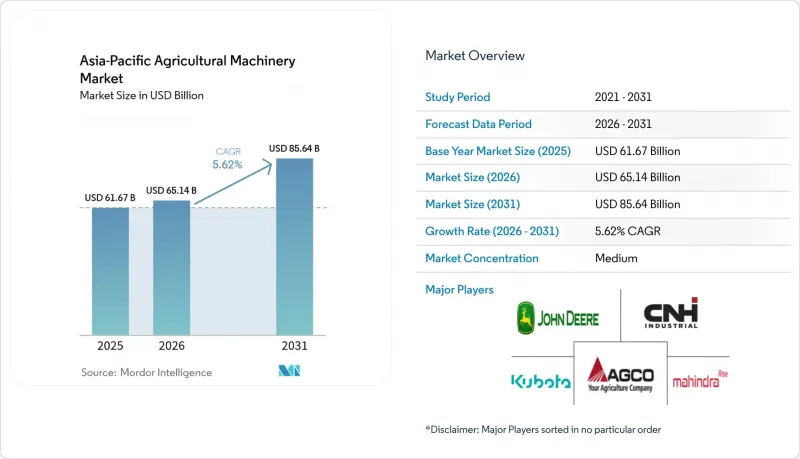
本報告按產品類型(按馬力和類型分類的曳引機、犁地和中耕機械、播種機械、收割機械、乾草和飼料機械、灌溉機械及其他)和地區(中國、印度、日本、澳大利亞和其他亞太地區)進行細分。市場預測以美元計價。
亞太地區農業機械市場趨勢及洞察。
農業勞動力短缺正加速農業機械化。
嚴重的勞動力短缺正在推動對自動化機械的需求。日本農林水產省累計10億日圓(約750萬美元)用於自動化津貼,使蔬菜種植者能夠採用自動收割機,從而減少50%的勞動力投入。在馬來西亞,棕櫚油人工林正在使用自動駕駛卡車和無人機噴灑農藥,以彌補外籍勞工減少造成的勞動力缺口。泰國的稻農採用了高速插秧機,使其日插秧能力提高了五倍。這些措施共同推動了亞太地區整個農業機械市場的設備升級。
精密農業和智慧農機設備的引進
物聯網平台、可變施肥控制器和無人機(UAV)正日益融入田間作業。久保田在泰國開發的農場管理應用程式已在100個試驗田中部署,透過將土壤檢測結果與施肥圖相匹配,產量提高了30%。台灣地區歷時25年的精密農業計畫正在整合地理資訊系統(GIS)、頻譜無人機和雲端分析技術,以最佳化灌溉計畫。北京1.4兆美元的數位基礎設施投資計劃,以及世界銀行提供的3.2億美元氣候友善農業貸款,正在推動未來智慧農機設備的應用。這些措施正在擴大亞太地區農業機械市場中數據驅動型設備的潛在基本客群。
農民數字素養低下
在智慧型手機普及率和通訊基礎設施仍不穩定的地區,數據密集型平台的應用較為落後。儘管泰國「工業4.0」舉措中的培訓計畫以及中國農村地區的寬頻部署正在縮小這一差距,但用戶技能的持續提升仍是發揮精密農業設備最大價值的必要條件。精密農業技術與永續耕作方式的整合有望顯著推動市場成長,但基礎設施和培訓方面的挑戰必須解決,才能實現廣泛應用。
細分市場分析
到2025年,曳引機在亞太地區農業機械市場中佔據57.15%的佔有率。這是因為農民依賴曳引機進行土地耕作、運輸和動力輸出(PTO)作業。在印度,40馬力以下的曳引機銷售量主導;而在澳洲的大型農場,50馬力以上的曳引機也越來越常見。預計到2031年,曳引機市場將穩定成長。多用途曳引機以其多功能性脫穎而出,而行間曳引機則提供諸如GPS導航和可變播種量等功能,以實現精密農業。大同計畫在2025年底前推出韓國首款L4級自動駕駛曳引機,這標誌著競爭的一大飛躍,並可能重新定義消費者的預期。在水稻種植系統中,犁地和間耕機具是第二大類,它們滿足了高效土壤混合和苗床準備的需求。
隨著人事費用上漲,對收割機械的需求也增加。聯合收割機將水稻收割週期從七天縮短至兩天,這一優勢在泰國尤為重要,預計到2024年,泰國的日工資將上漲15%。滴灌設備雖然目前銷售量較低,但卻是成長最快的細分市場,年複合成長率達13.02%,反映出水資源管理法規和獎勵計畫的持續改善。隨著乾旱加速了中國北方平原和印度德干高原地區對微灌技術的採用,對微灌相關設備的需求可能會增加兩倍。提供水泵、肥料/灌溉控制器和雲分析等一體化解決方案的原始設備製造商(OEM)將能夠抓住新的交叉銷售機會。
其他好處:
- Excel格式的市場預測(ME)表
- 3個月的分析師支持
目錄
第1章:引言
- 研究假設和市場定義
- 調查範圍
第2章:調查方法
第3章執行摘要
第4章 市場狀況
- 市場概覽
- 市場促進因素
- 農業勞動力短缺正加速農業機械化。
- 精密農業和智慧農機設備的引進
- 與氣候變遷相關的收益保證獎勵
- 政府為小規模農戶提供的信貸框架
- OEM廠商的「電源即服務」訂閱模式
- 農業碳權額貨幣化的潛力
- 市場限制因素
- 高昂的初始投資成本
- 土地所有權的分散限制了投資報酬率。
- 售後服務體係不完善
- 農民數字素養低下
- 監理情勢
- 技術展望
- 波特五力模型
第5章 市場規模與成長預測
- 依產品類型
- 聯結機
- 馬力
- 小於20馬力
- 21~30 HP
- 31~50 HP
- 50馬力或以上
- 種類
- 通用曳引機
- 行式曳引機
- 小型多用途曳引機
- 其他類型
- 馬力
- 犁地和間耕機械
- 犁
- 光環
- 耕耘機和中耕機
- 其他犁地及農用機械
- 種植機械
- 播種機
- 播種機
- 撒佈器
- 其他播種機
- 收割機械
- 結合
- 飼料收割機
- 其他收割機械
- 乾草和飼料機械
- 割草機
- 打包機
- 其他乾草和飼料機械
- 灌溉機械
- 噴水灌溉
- 滴灌
- 其他灌溉機械
- 其他類型
- 聯結機
- 按地區
- 中國
- 印度
- 日本
- 澳洲
- 其他亞太國家
第6章 競爭情勢
- 市場集中度
- 策略趨勢
- 市佔率分析
- 公司簡介
- Deere & Company
- CLAAS KGaA mbH
- AGCO Corporation
- Kubota Corporation
- CNH Industrial NV
- Yanmar Co. Ltd.
- Same Deutz-Fahr(SDF Group)
- Lovol Heavy Industry(Weichai Group)
- Mahindra and Mahindra Ltd.
- Iseki & Co., Ltd.
- International Tractors Ltd.(Sonalika Group)
- Daedong Corporation
- Zoomlion Heavy Industry Science & Technology Co., Ltd.
第7章 市場機會與未來展望
According to Mordor Intelligence, the Asia-Pacific agricultural machinery market size is expected to grow from USD 61.67 billion in 2025 to USD 65.14 billion in 2026 and is forecast to reach USD 85.64 billion by 2031 at 5.62% CAGR over 2026-2031.
This report is Segmented by Product Type (Tractors by Horsepower and Type, Plowing and Cultivating Machinery, Planting Machinery, Harvesting Machinery, Haying and Forage Machinery, Irrigation Machinery, and Other Types) and Geography (China, India, Japan, Australia, and Rest of Asia-Pacific). The Market Forecasts are Provided in Terms of Value (USD).
Asia-Pacific Agricultural Machinery Market Trends and Insights
Farm-labor scarcity accelerating mechanization
Severe worker shortages lift demand for hands-free machinery. Japan's agriculture ministry earmarked JPY 1 billion (USD 7.5 million) for automation grants, leading vegetable growers to deploy autonomous harvesters that slash labor inputs by 50%. Malaysian palm estates now rely on self-driving trucks and drone sprayers to offset curtailed migrant inflows. Thai rice operations adopt high-speed transplanters, lifting daily planting capacity fivefold. Together, these responses accelerate equipment turnover across the Asia-Pacific agricultural machinery market.
Precision-farming adoption and smart implements
IoT platforms, variable-rate controllers, and UAVs are penetrating field operations. Kubota's Thai farm-management application logged 100 pilot plots, boosting yields up to 30% by matching soil tests to fertilizer maps. Taiwan's 25-year precision-agriculture program now integrates GIS, multispectral drones, and cloud analytics to refine irrigation scheduling. Beijing's USD 1.4 trillion digital-infrastructure pledge, alongside a USD 320 million World Bank loan for climate-smart practices, underwrites future smart-implement uptake. These initiatives widen the addressable base for data-driven devices within the Asia-Pacific agricultural machinery market.
Low digital literacy among farmers
Adoption of data-rich platforms lags where smartphone penetration and connectivity remain spotty. Training programs embedded in Thailand's 4.0 initiative and China's rural broadband rollout are narrowing the gap, yet consistent user-skill building is still required to unlock full value from precision equipment. The integration of precision farming technologies and sustainable practices positions the market for substantial growth, though infrastructure and training challenges need to be addressed for widespread adoption.
Other drivers and restraints analyzed in the detailed report include:
- Climate-linked yield-assurance incentives
- Ag-carbon credit monetization potential
- Fragmented land holdings limiting ROI
For complete list of drivers and restraints, kindly check the Table Of Contents.
Segment Analysis
Tractors represented 57.15% of the Asia-Pacific agricultural machinery market share in 2025 as growers rely on them for land preparation, transport, and power take-off tasks. The tractor market is projected to widen steadily through 2031 as below-40 HP models dominate Indian sales and above-50 HP units gain traction in Australian broad-acre farms. Utility tractors stand out for versatility, whereas row-crop variants support GPS steering and variable-rate seeding for precision agriculture. Daedong's plan to introduce Korea's first level-4 autonomous tractor by end-2025 signals a competitive leap that could reshape buyer expectations. Complementary plowing and cultivating implements form the second-largest category, as rice systems demand efficient puddling and seedbed preparation.
Demand for harvesting machinery follows labor-cost escalation. Combine harvesters cut rice reaping time from seven to two days, a gain valued in Thailand, where daily wages jumped 15% in 2024. Drip irrigation equipment, while currently smaller in revenue, is the fastest-growing sub-segment at 13.02% CAGR, reflecting intensified water-management mandates and incentive schemes. The attached to micro-irrigation could triple as drought episodes spur adoption across China's northern plains and India's Deccan plateau. OEMs offering bundled pumps, fertigation controllers, and cloud analytics stand to capture emerging cross-sell opportunities.
Complete Report Scope:
- By Product Type
- Tractors
- Horsepower
- Below 20 HP
- 21 - 30 HP
- 31 - 50 HP
- Above 50 HP
- Type
- Utility Tractor
- Row-Crop Tractor
- Compact Utility Tractor
- Other Types
- Horsepower
- Plowing and Cultivating Machinery
- Ploughs
- Harrows
- Cultivators and Tillers
- Other Ploughing and Cultivating Machinery
- Planting Machinery
- Seed Drills
- Planters
- Spreaders
- Other Planting Machinery
- Harvesting Machinery
- Combine Harvesters
- Forage Harvetsers
- Other Harvesting Machinery
- Haying and Forage Machinery
- Mowers
- Balers
- Other Haying and Forage Machinery
- Irrigation Machinery
- Sprinkler Irrigation
- Drip Irrigation
- Other Irrigation Machinery
- Other Types
- Tractors
- By Geography
- China
- India
- Japan
- Australia
- Rest of Asia-Pacific
List of Companies Covered in this Report:
- Deere & Company
- CLAAS KGaA mbH
- AGCO Corporation
- Kubota Corporation
- CNH Industrial N.V.
- Yanmar Co. Ltd.
- Same Deutz-Fahr (SDF Group)
- Lovol Heavy Industry (Weichai Group)
- Mahindra and Mahindra Ltd.
- Iseki & Co., Ltd.
- International Tractors Ltd. (Sonalika Group)
- Daedong Corporation
- Zoomlion Heavy Industry Science & Technology Co., Ltd.
Additional Benefits:
- The market estimate (ME) sheet in Excel format
- 3 months of analyst support
TABLE OF CONTENTS
1 Introduction
- 1.1 Study Assumptions and Market Definition
- 1.2 Scope of the Study
2 Research Methodology
3 Executive Summary
4 Market Landscape
- 4.1 Market Overview
- 4.2 Market Drivers
- 4.2.1 Farm-Labor Scarcity Accelerating Mechanization
- 4.2.2 Precision-Farming Adoption and Smart Implements
- 4.2.3 Climate-Linked Yield-Assurance Incentives
- 4.2.4 Government Credit Lines Targeting Smallholders
- 4.2.5 OEM "Power-as-a-Service" Subscription Models
- 4.2.6 Ag-Carbon Credit Monetization Potential
- 4.3 Market Restraints
- 4.3.1 High Up-Front Capital Costs
- 4.3.2 Fragmented Land Holdings Limiting ROI
- 4.3.3 Poor After-Sales Service Networks
- 4.3.4 Low Digital Literacy Among Farmers
- 4.4 Regulatory Landscape
- 4.5 Technological Outlook
- 4.6 Porter's Five Forces
- 4.6.1 Threat of New Entrants
- 4.6.2 Bargaining Power of Buyers
- 4.6.3 Bargaining Power of Suppliers
- 4.6.4 Threat of Substitutes
- 4.6.5 Intensity of Competitive Rivalry
5 Market Size and Growth Forecasts (Value)
- 5.1 By Product Type
- 5.1.1 Tractors
- 5.1.1.1 Horsepower
- 5.1.1.1.1 Below 20 HP
- 5.1.1.1.2 21 - 30 HP
- 5.1.1.1.3 31 - 50 HP
- 5.1.1.1.4 Above 50 HP
- 5.1.1.2 Type
- 5.1.1.2.1 Utility Tractor
- 5.1.1.2.2 Row-Crop Tractor
- 5.1.1.2.3 Compact Utility Tractor
- 5.1.1.2.4 Other Types
- 5.1.1.1 Horsepower
- 5.1.2 Plowing and Cultivating Machinery
- 5.1.2.1 Ploughs
- 5.1.2.2 Harrows
- 5.1.2.3 Cultivators and Tillers
- 5.1.2.4 Other Ploughing and Cultivating Machinery
- 5.1.3 Planting Machinery
- 5.1.3.1 Seed Drills
- 5.1.3.2 Planters
- 5.1.3.3 Spreaders
- 5.1.3.4 Other Planting Machinery
- 5.1.4 Harvesting Machinery
- 5.1.4.1 Combine Harvesters
- 5.1.4.2 Forage Harvetsers
- 5.1.4.3 Other Harvesting Machinery
- 5.1.5 Haying and Forage Machinery
- 5.1.5.1 Mowers
- 5.1.5.2 Balers
- 5.1.5.3 Other Haying and Forage Machinery
- 5.1.6 Irrigation Machinery
- 5.1.6.1 Sprinkler Irrigation
- 5.1.6.2 Drip Irrigation
- 5.1.6.3 Other Irrigation Machinery
- 5.1.7 Other Types
- 5.1.1 Tractors
- 5.2 By Geography
- 5.2.1 China
- 5.2.2 India
- 5.2.3 Japan
- 5.2.4 Australia
- 5.2.5 Rest of Asia-Pacific
6 Competitive Landscape
- 6.1 Market Concentration
- 6.2 Strategic Moves
- 6.3 Market Share Analysis
- 6.4 Company Profiles (Includes Global Level Overview, Market Level Overview, Core Segments, Financials As Available, Strategic Information, Market Rank/Share For Key Companies, Products And Services, And Recent Developments)
- 6.4.1 Deere & Company
- 6.4.2 CLAAS KGaA mbH
- 6.4.3 AGCO Corporation
- 6.4.4 Kubota Corporation
- 6.4.5 CNH Industrial N.V.
- 6.4.6 Yanmar Co. Ltd.
- 6.4.7 Same Deutz-Fahr (SDF Group)
- 6.4.8 Lovol Heavy Industry (Weichai Group)
- 6.4.9 Mahindra and Mahindra Ltd.
- 6.4.10 Iseki & Co., Ltd.
- 6.4.11 International Tractors Ltd. (Sonalika Group)
- 6.4.12 Daedong Corporation
- 6.4.13 Zoomlion Heavy Industry Science & Technology Co., Ltd.
7 Market Opportunities and Future Outlook

 2026-2030年全球乾草飼料市場
 越南農業機械:市場佔有率分析、產業趨勢與統計、成長預測(2026-2031)
 農業設備市場報告:趨勢、預測與競爭分析(至2035年)法國農業機械:市場佔有率分析、行業趨勢和統計數據以及成長預測(2026-2031 年)
 除草機器人市場 - 全球預測,2026-2032年非洲農業機械:市場佔有率分析、產業趨勢與統計及成長預測(2026-2031 年)中國農業機械:市場佔有率分析、產業趨勢與統計及成長預測(2026-2031年)北美農業機械:市場佔有率分析、產業趨勢與統計、成長預測(2026-2031)歐洲農業機械:市場佔有率分析、行業趨勢和統計數據、成長預測(2026-2031 年)農作物殘渣處理機械市場-2026-2032年全球市場預測