


 |
市場調查報告書
商品編碼
2113752
法國農業機械:市場佔有率分析、行業趨勢和統計數據以及成長預測(2026-2031 年)France Agricultural Machinery - Market Share Analysis, Industry Trends & Statistics, Growth Forecasts (2026 - 2031) |
||||||

※ 本網頁內容可能與最新版本有所差異。詳細情況請與我們聯繫。
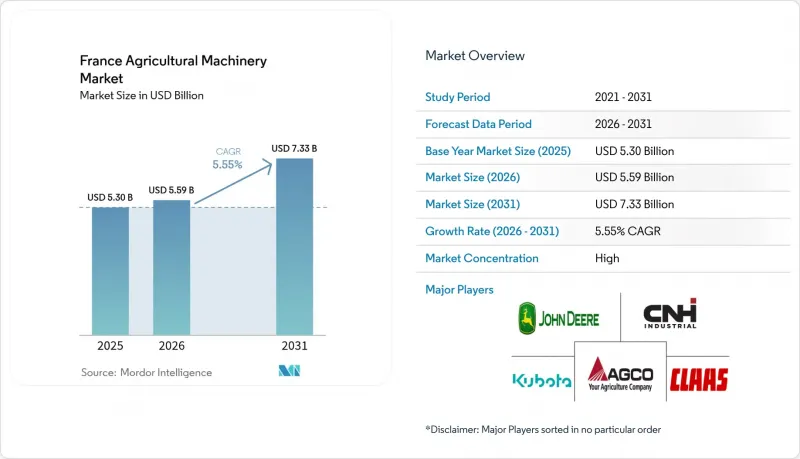
據 Mordor Intelligence 稱,2025 年法國農業機械市場價值 53 億美元,預計到 2031 年將達到 73.3 億美元,而 2026 年為 55.9 億美元,預測期(2026-2031 年)的複合年成長率預計為 5.55%。
本報告按產品類型分類(曳引機、犁地機械、播種機械、噴霧器、灌溉機械、收割機械、乾草和飼料機械以及其他)。市場預測以美元計價。
法國農業機械市場趨勢與洞察
農業勞動力短缺問題日益嚴重。
農業部在2025年預算案中推出的「季節性農場工人永久支持計畫」免除了雇主對低於一定工資門檻的僱員繳納社會保障金,但該計畫未能解決勞動力結構性下降的問題。在勞動力短缺的背景下,自動除草機器人的應用正以前所未有的速度發展。據Naio Technologies等公司稱,100%電動機器人每小時可完成高達1,000平方公尺的工作,有效取代了有機農業中禁止使用化學品的人工勞動。承包商採用的集群模式正成為一種關鍵解決方案,使小規模農戶無需資本投入即可使用先進的自動化技術,而承包商則可透過在多個農場開展業務實現規模經濟。
大型農場對大馬力曳引機的需求不斷成長
隨著法國農業向大規模農場整合,動力需求正發生根本性轉變。儘管整體市場萎縮,但預計到2024年,註冊的300馬力以上曳引機的數量將顯著成長。這一趨勢反映了經濟現實:像博塞和香檳這樣的地區,大型農場需要能夠操作更多種類農具並更快完成田間作業的設備,以維持因投入成本通膨而受到擠壓的利潤率。在平均面積超過200公頃的法國農場中,人們越來越傾向於將大馬力曳引機視為提高生產率的手段,而不僅僅是農業設備,並透過減少勞動力和提高作業柔軟性來證明其較高價格的合理性。
高昂的初始成本和維修成本
與傳統曳引機相比,精密農業曳引機的平均價格上漲了15%至20%。此外,GPS導航和自動駕駛系統的維護需要專業技術人員,導致服務費用高。 「設備即服務(EaaS)」模式作為部分解決方案正在興起,它允許農民透過營運成本而非資本投資的方式使用先進機械,但由於偏遠地區難以找到承包商,該模式的普及程度仍然有限。
細分市場分析
到2025年,曳引機將佔農業機械市場佔有率的31.60%,鞏固其作為現代法國農場動力和資料中心的地位。市場需求集中在150馬力及以上的細分市場,該細分市場中先進的液壓系統支撐著可變播種機和智慧噴霧器。在50馬力以下的細分市場,由於葡萄酒利潤率下降,專門用於葡萄園的機械正面臨壓力。 2024年,該細分市場的新註冊量降至2,531台。從2026年到2031年,隨著博塞地區的大型土地所有者不斷整合土地並減少每公頃的作業週期,預計大馬力子類別農業機械的市場規模成長速度將超過農業機械整體支出的成長速度。全球導航衛星(GNSS)天線和ISOBUS UT顯示器等數位售後設備正在推高二手價格,延長以舊換新週期,並增加經銷商的終身業務收益。加上政府補貼推動的對自動導航系統的需求,曳引機製造商正在採用基於訂閱的遠端資訊處理服務和空中更新,以確保售後持續的商機。
隨著用水配額收緊,農民對抗旱能力的需求日益成長,灌溉設備在所有產品線中實現了最高的複合年成長率,達到23.1%。滴灌系統在高價值的蔬果田中佔據主導地位,而配備可變流量噴灌的中心支軸式噴灌機則更適合大面積的穀物田。由於「法國2030」津貼中針對與土壤感測器連接的水泵的撥款,預計到2031年,聯網微灌套件的農業機械市場將實現成長。雲端控制面板將多個中心支軸式噴灌機、氣象站和肥料/灌溉噴頭集中管理,使承包商能夠更好地管理分散的客戶。原始設備製造商(OEM)正在工廠整合4G/LTE閘道器,以簡化邊緣到雲端的連接,並符合《一般資料保護規則》(GDPR)的同意協議。
其他好處:
- Excel格式的市場預測(ME)表
- 3個月的分析師支持
目錄
第1章:引言
- 研究假設和市場定義
- 調查範圍
第2章:調查方法
第3章執行摘要
第4章 市場狀況
- 市場概覽
- 市場促進因素
- 農業勞動力短缺問題日益嚴重。
- 大型農場對大馬力曳引機的需求日益成長
- 政府對精密農業設備的補貼
- 對能夠應對氣候變遷的機械設備的需求日益成長
- 在承包商車隊中引入自主現場機器人
- 擴大「設備即服務(EaaS)」的資金籌措模式
- 市場限制因素
- 高昂的初始成本和維修成本
- 對資料所有權和網路安全的擔憂
- 電網為電子設備充電的容量限制
- 數位標準碎片化阻礙了互通性
- 監理情勢
- 技術展望
- 波特五力分析
第5章 市場規模與成長預測
- 依產品類型
- 聯結機
- 小於50馬力
- 50~99 HP
- 100~149 HP
- 150馬力或以上
- 犁地和間耕機械
- 犁
- 光環
- 旋耕機和耕耘機
- 其他設備
- 種植機械
- 播種機
- 播種機
- 撒佈器
- 其他種植機械
- 噴霧器
- 灌溉機械
- 滴灌系統
- 噴水灌溉系統
- 其他灌溉機械
- 收割機械
- 結合
- 其他收割機械
- 乾草和飼料機械
- 割草機和壓草機
- 打包機
- 其他乾草和飼料機械
- 其他類型
- 聯結機
第6章 競爭情勢
- 市場集中度
- 策略趨勢
- 市佔率分析
- 公司簡介
- Deere & Company
- CNH Industrial NV
- AGCO Corporation
- Kubota Corporation
- Claas KGaA mbH
- Same Deutz-Fahr(SDF Group)
- Yanmar Co. Ltd.
- Mahindra and Mahindra Ltd.
- Lovol International Heavy Industry Co Ltd(Weichai Group)
- Iseki and Co. Ltd
- TAFE(Amalgamations Group)
- Zoomlion Heavy Industry Science and Technology Co., Ltd.
- Argo Tractors SpA
- Lindsay Corporation
- Kuhn Group(Bucher Industries AG)
- Netafim(Orbia Advance Corp.)
第7章 市場機會與未來展望
According to Mordor Intelligence, the agricultural machinery market size in France was valued at USD 5.30 billion in 2025 and estimated to grow from USD 5.59 billion in 2026 to reach USD 7.33 billion by 2031, at a CAGR of 5.55% during the forecast period (2026-2031).
This report is Segmented by Product Type (Tractors, Plowing and Cultivating Machinery, Planting Machinery, Sprayers, Irrigation Machinery, Harvesting Machinery, Haying and Forage Machinery, and Other Types). The Market Forecasts are Provided in Terms of Value (USD).
France Agricultural Machinery Market Trends and Insights
Increasing Shortage of Agricultural Labor
The Ministry of Agriculture's permanent scheme for seasonal agricultural worker assistance, introduced in the 2025 budget, exempts employers from contributions for hires under specific salary thresholds, yet fails to address the structural decline in available workers. This labor scarcity is driving unprecedented adoption of autonomous weeding robots, with companies like Naio Technologies reporting 100% electric robots achieving work rates up to 1,000 square meters per hour, effectively replacing manual labor in organic farming operations where chemical alternatives are prohibited. The contractor fleet model is emerging as a critical solution, allowing smaller farms to access sophisticated automation without capital investment, while contractors achieve economies of scale across multiple operations.
Growing Demand for High-Horsepower Tractors in Large Farms
The consolidation of French agriculture into larger operational units is driving a fundamental shift in power requirements, with tractors exceeding 300 horsepower experiencing high registration growth in 2024 despite overall market contraction. This trend reflects the economic reality that large-scale operations in regions like Beauce and Champagne require equipment capable of handling wider implements and faster field operations to maintain profitability margins compressed by input cost inflation. French farms averaging over 200 hectares increasingly view high-horsepower tractors as productivity multipliers rather than mere field implements, justifying premium pricing through reduced labor requirements and enhanced operational flexibility.
High Upfront and Maintenance Cost
The average price of precision-enabled tractors has increased 15-20% over conventional alternatives, while maintenance costs for GPS guidance and autonomous systems require specialized technician expertise that commands premium service rates. Equipment-as-a-service models are emerging as a partial solution, allowing farmers to access advanced machinery through operational expense structures rather than capital investments, though adoption remains limited by contractor availability in remote regions.
Other drivers and restraints analyzed in the detailed report include:
- Government Subsidies for Precision Farming Equipment
- Rising Need for Climate-Smart Machinery
- Data Ownership and Cyber-Security Concerns
For complete list of drivers and restraints, kindly check the Table Of Contents.
Segment Analysis
Tractors contributed 31.60% agricultural machinery market share in 2025, cementing their role as the power and data hub for modern French farms. Demand clusters at >= 150 horsepower where advanced hydraulics support variable-rate seeders and smart sprayers. Below 50 horsepower, specialty vineyard units face pressure from muted wine margins. Registrations fell to 2,531 units in 2024. The agricultural machinery market size for the high-horsepower subclass is forecast to outpace overall equipment spending between 2026 and 2031 as large holdings in Beauce consolidate land and pursue fewer passes per hectare. Digital retrofits, such as Global Navigation Satellite System (GNSS) antennas and ISOBUS UT displays, push resale values higher, extending trade-in cycles while raising lifetime service revenues for dealers. Combined with subsidy-driven demand for auto-guidance, tractor Original Equipment Manufacturer (OEMs) are layering subscription telematics and over-the-air updates to lock in post-sale recurring income opportunities.
Irrigation equipment registers a 23.1% CAGR, the highest among product lines, as farms seek drought resilience amid tightened abstraction quotas. Drip systems dominate high-value fruit and vegetable acres, whereas center-pivot retrofits with variable-rate sprinklers are more suitable for broad-acre cereals. The agricultural machinery market size for connected micro-irrigation kits is poised to grow by 2031, enabled by France 2030 grants covering soil-sensor-linked pumps. Cloud dashboards cluster multiple pivots, weather stations, and fertigation injectors, allowing contractors to oversee dispersed clients. OEMs are integrating 4G/LTE gateways factory-side to simplify edge-to-cloud connectivity under General Data Protection Regulation (GDPR) consent protocols.
Complete Report Scope:
- By Product Type
- Tractors
- Below 50 HP
- 50 - 99 HP
- 100 - 149 HP
- 150 HP and Above
- Plowing and Cultivating Machinery
- Plows
- Harrows
- Rotovators and Cultivators
- Other Equipment
- Planting Machinery
- Seed Drills
- Planters
- Spreaders
- Other Planting Machinery
- Sprayers
- Irrigation Machinery
- Drip Irrigation Systems
- Sprinkler Irrigation Systems
- Other Irrigation Machinery
- Harvesting Machinery
- Combine Harvesters
- Other Harvesting Machinery
- Haying and Forage Machinery
- Mowers and Conditioners
- Balers
- Other Haying and Forage Machinery
- Other Types
- Tractors
List of Companies Covered in this Report:
- Deere & Company
- CNH Industrial N.V.
- AGCO Corporation
- Kubota Corporation
- Claas KGaA mbH
- Same Deutz-Fahr (SDF Group)
- Yanmar Co. Ltd.
- Mahindra and Mahindra Ltd.
- Lovol International Heavy Industry Co Ltd (Weichai Group)
- Iseki and Co. Ltd
- TAFE (Amalgamations Group)
- Zoomlion Heavy Industry Science and Technology Co., Ltd.
- Argo Tractors S.p.A.
- Lindsay Corporation
- Kuhn Group (Bucher Industries AG)
- Netafim (Orbia Advance Corp.)
Additional Benefits:
- The market estimate (ME) sheet in Excel format
- 3 months of analyst support
TABLE OF CONTENTS
1 Introduction
- 1.1 Study Assumptions and Market Definition
- 1.2 Scope of the Study
2 Research Methodology
3 Executive Summary
4 Market Landscape
- 4.1 Market Overview
- 4.2 Market Drivers
- 4.2.1 Increasing shortage of agricultural labor
- 4.2.2 Growing demand for high-horsepower tractors in large farms
- 4.2.3 Government subsidies for precision farming equipment
- 4.2.4 Rising need for climate-smart machinery
- 4.2.5 Adoption of autonomous field robots by contractor fleets
- 4.2.6 Growth of equipment-as-a-service financing models
- 4.3 Market Restraints
- 4.3.1 High upfront and maintenance cost
- 4.3.2 Data ownership and cyber-security concerns
- 4.3.3 Grid capacity limits for electrified machinery charging
- 4.3.4 Fragmented digital standards inhibiting interoperability
- 4.4 Regulatory Landscape
- 4.5 Technological Outlook
- 4.6 Porter's Five Forces Analysis
- 4.6.1 Bargaining Power of Buyers
- 4.6.2 Bargaining Power of Suppliers
- 4.6.3 Threat of New Entrants
- 4.6.4 Threat of Substitutes
- 4.6.5 Intensity of Competitive Rivalry
5 Market Size and Growth Forecasts (Value)
- 5.1 By Product Type
- 5.1.1 Tractors
- 5.1.1.1 Below 50 HP
- 5.1.1.2 50 - 99 HP
- 5.1.1.3 100 - 149 HP
- 5.1.1.4 150 HP and Above
- 5.1.2 Plowing and Cultivating Machinery
- 5.1.2.1 Plows
- 5.1.2.2 Harrows
- 5.1.2.3 Rotovators and Cultivators
- 5.1.2.4 Other Equipment
- 5.1.3 Planting Machinery
- 5.1.3.1 Seed Drills
- 5.1.3.2 Planters
- 5.1.3.3 Spreaders
- 5.1.3.4 Other Planting Machinery
- 5.1.4 Sprayers
- 5.1.5 Irrigation Machinery
- 5.1.5.1 Drip Irrigation Systems
- 5.1.5.2 Sprinkler Irrigation Systems
- 5.1.5.3 Other Irrigation Machinery
- 5.1.6 Harvesting Machinery
- 5.1.6.1 Combine Harvesters
- 5.1.6.2 Other Harvesting Machinery
- 5.1.7 Haying and Forage Machinery
- 5.1.7.1 Mowers and Conditioners
- 5.1.7.2 Balers
- 5.1.7.3 Other Haying and Forage Machinery
- 5.1.8 Other Types
- 5.1.1 Tractors
6 Competitive Landscape
- 6.1 Market Concentration
- 6.2 Strategic Moves
- 6.3 Market Share Analysis
- 6.4 Company Profiles (Includes Global Level Overview, Market Level Overview, Core Segments, Financials as Available, Strategic Information, Market Rank/Share for Key Companies, Products and Services, and Recent Developments)
- 6.4.1 Deere & Company
- 6.4.2 CNH Industrial N.V.
- 6.4.3 AGCO Corporation
- 6.4.4 Kubota Corporation
- 6.4.5 Claas KGaA mbH
- 6.4.6 Same Deutz-Fahr (SDF Group)
- 6.4.7 Yanmar Co. Ltd.
- 6.4.8 Mahindra and Mahindra Ltd.
- 6.4.9 Lovol International Heavy Industry Co Ltd (Weichai Group)
- 6.4.10 Iseki and Co. Ltd
- 6.4.11 TAFE (Amalgamations Group)
- 6.4.12 Zoomlion Heavy Industry Science and Technology Co., Ltd.
- 6.4.13 Argo Tractors S.p.A.
- 6.4.14 Lindsay Corporation
- 6.4.15 Kuhn Group (Bucher Industries AG)
- 6.4.16 Netafim (Orbia Advance Corp.)
7 Market Opportunities and Future Outlook

 2026-2030年全球乾草飼料市場
 越南農業機械:市場佔有率分析、產業趨勢與統計、成長預測(2026-2031)
 農業設備市場報告:趨勢、預測與競爭分析(至2035年)亞太地區農業機械:市場佔有率分析、產業趨勢與統計及成長預測(2026-2031年)
 除草機器人市場 - 全球預測,2026-2032年非洲農業機械:市場佔有率分析、產業趨勢與統計及成長預測(2026-2031 年)中國農業機械:市場佔有率分析、產業趨勢與統計及成長預測(2026-2031年)北美農業機械:市場佔有率分析、產業趨勢與統計、成長預測(2026-2031)歐洲農業機械:市場佔有率分析、行業趨勢和統計數據、成長預測(2026-2031 年)農作物殘渣處理機械市場-2026-2032年全球市場預測