


 |
市場調查報告書
商品編碼
2120762
北美農業機械:市場佔有率分析、產業趨勢與統計、成長預測(2026-2031)North America Agricultural Machinery - Market Share Analysis, Industry Trends & Statistics, Growth Forecasts (2026 - 2031) |
||||||

※ 本網頁內容可能與最新版本有所差異。詳細情況請與我們聯繫。
根據 Mordor Intelligence 預測,北美農業機械市場規模將從 2025 年的 543 億美元和 2026 年的 575 億美元成長到 2031 年的 766 億美元,2026 年至 2031 年的年複合成長率(CAGR)為 5.90%。
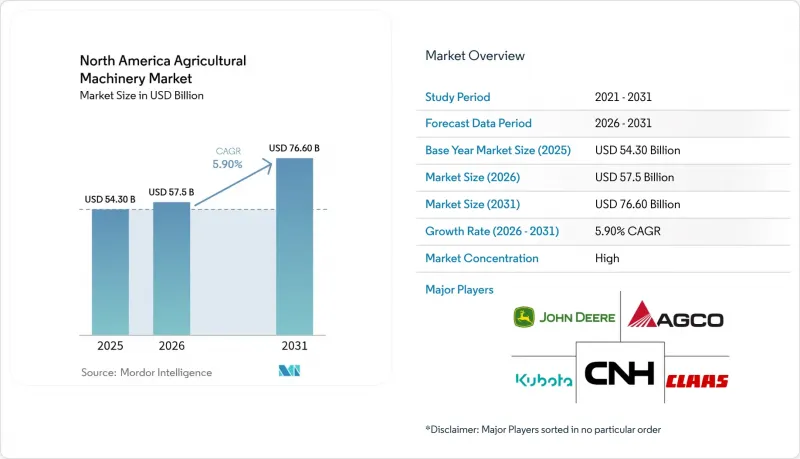
本報告按類型(曳引機、農業機械、灌溉機械、收割機械、乾草和飼料機械及其他)和地區(美國、加拿大、墨西哥及其他北美國家)進行分類。市場預測以貨幣價值(美元)表示。
北美農業機械市場趨勢與洞察
強勁的農業收入前景和補貼計劃
即使農作物收入下降,聯邦政府的支持計畫仍在持續支撐對農業機械的需求。 2022年3月,加拿大政府投資於農業機械創新和技術,加強了公共資金在維持資本投資的角色。政府直接支付,包括專注於氣候變遷減緩的撥款,起到了緩衝作用,使生產者能夠在農作物價格下跌的情況下維持投資。農業法案延長了作物保險補貼,並推出了針對精密農業設備的專項津貼,以減少氮肥流失,從而有效降低了GPS導航播種機和可變施肥機的成本。加拿大透過穩定草原地區生產者收入的項目也呈現類似的趨勢。同時,墨西哥已投入大量資金用於小規模農戶的機械化,主要農業省份尤其受益匪淺。透過補貼改善融資,縮短了設備更換週期,因為操作人員正在用可進行精密農業作業的車輛替換老舊曳引機。
勞動力短缺加劇和薪資上漲
農業勞動力市場正迅速趨緊,許多生產者表示勞動力短缺是他們面臨的最大阻礙因素。農場平均薪資持續上漲,而季節性工人簽證批准的延誤又延長了招募流程。根據美國農業機械製造商協會(AEM)的數據顯示,2023年四輪驅動曳引機的銷量從2022年的3466台成長到4564台,增幅達31.7%,這反映出為了彌補勞動力短缺,機械化程度的提高日益普遍。這種薪資上漲的壓力尤其影響到蔬菜收割、果園管理和牲畜飼養等勞力密集領域,推動了自動駕駛曳引機、除草機器人和自走式飼料收割機的應用。加拿大也面臨類似的困境,各州紛紛推出激勵措施以吸引工人在收穫季節工作,而墨西哥則因農村人口向城市遷移而失去了傳統的勞動力基礎。合作社正在籌集資金共同購買機械設備,機械化已成為中型農場生存的必要條件。
先進農業機械的初始成本和維護成本都很高。
曳引機、播種機和聯合收割機的價格飆升,給生產者,尤其是小規模農戶,帶來了巨大的經濟壓力。最新的精密農業設備購置成本高昂,而包括軟體訂閱和昂貴零件在內的維護費用更是加重了他們的負擔。對於小規模農戶而言,即使是小型機械,如果沒有補貼貸款,也可能難以負擔。因此,大型農場(能夠將成本分攤到廣闊的面積上)與難以證明投資合理性的小規模農戶之間的技術差距正在擴大。這種情況導致市場成長集中在能夠透過提高效率和精密農業效益來收回投資的大型農場。
細分市場分析
按車型分類,預計2025年,曳引機將佔北美農業機械市場規模的47.3%。曳引機在各種農業系統中發揮著至關重要的作用,並且仍然是播種作業的基礎。根據美國農業機械製造商協會(AEM)的數據顯示,2022年至2023年,100馬力及以上曳引機和四輪驅動曳引機的零售分別成長了5.2%和31.7%。這個細分市場受益於經過全面田間測試並驗證了運作的自動駕駛維修,從而消除了人們對無人化農業的疑慮。這些創新凸顯了曳引機在機械化中的核心作用,它們整合了能夠提高效率和生產力的精準技術。這種主導地位表明,農場仍然優先考慮能夠處理多種任務的多功能設備,同時也在適應能夠增強連接性和操作控制的新型數位平台。
預計灌溉機械將成為成長最快的領域,2026年至2031年的複合年成長率將達到6.4%。隨著北美地區水資源短缺緩解計畫的擴展,灌溉設備的需求正在加速成長;在墨西哥,隨著中心支軸式噴灌系統的推廣,灌溉設備的應用也正在加速普及。在永續水資源管理和應對氣候變遷的需求驅動下,預計該領域的成長速度將超過其他類別。精準灌溉系統與數位化監測工具的整合度日益提高,使農民能夠在保持產量的同時最佳化用水。這一成長趨勢反映了灌溉機械從輔助功能向策略性投資的轉變,使其成為農業機械需求中最具活力的領域之一。
其他好處:
- Excel格式的市場預測(ME)表
- 3個月的分析師支持
目錄
第1章:引言
- 研究假設和市場定義
- 調查範圍
第2章:調查方法
第3章執行摘要
第4章 市場狀況
- 市場概覽
- 市場促進因素
- 農民收入和補貼計劃前景強勁
- 勞動力短缺加劇和薪資上漲
- 精密農業的引進正在加速設備的更新換代。
- 來自原始設備製造商 (OEM) 的嵌入式金融服務正在提升購買力。
- 基於訂閱的機器使用模式
- 為支持引進低排放量設備,提供「氣候智慧型」津貼。
- 市場限制因素
- 先進機械設備初始成本和維護成本都很高。
- 大宗商品價格波動抑制了資本支出週期。
- 由於利率上漲,農場層級的信貸收緊。
- 電動曳引機電池用半導體供應受限
- 監理情勢
- 技術展望
- 波特五力模型
第5章 市場規模與成長預測
- 按類型
- 聯結機
- 小於40馬力
- 40~100 HP
- 超過100馬力
- 四驅曳引機
- 裝置
- 犁
- 馬鋤
- 耕耘機和中耕機
- 其他設備
- 灌溉機械
- 噴灌
- 滴灌
- 其他灌溉設施
- 收割機械
- 結合
- 飼料收割機
- 其他收割機
- 乾草和飼料機械
- 割草機
- 打包機
- 其他乾草和飼料機械
- 其他類型
- 聯結機
- 按地區
- 美國
- 加拿大
- 墨西哥
- 其他北美國家
第6章 競爭情勢
- 市場集中度
- 策略趨勢
- 市佔率分析
- 公司簡介
- Deere & Company
- CNH Industrial NV
- AGCO Corporation
- Kubota Corporation
- CLAAS KGaA mbH
- Mahindra & Mahindra Limited
- Netafim Inc.
- Lindsay Corporation
- Trimble Inc.
- Horsch Maschinen GmbH
- KUHN SAS
- Bernard Krone Holding SE & Co. KG
- The Toro Company
- Vermeer Corporation
- JC Bamford Excavators Ltd.
第7章 市場機會與未來展望
According to Mordor Intelligence, the North America agricultural machinery market size is projected to expand from USD 54.3 billion in 2025 and USD 57.5 billion in 2026 to USD 76.6 billion by 2031, registering a 5.90% CAGR between 2026 to 2031.
This report is Segmented by Type (Tractor, Equipment, Irrigation Machinery, Harvesting Machinery, Haying and Forage Machinery, and Other Types) and by Geography (United States, Canada, Mexico, and Rest of North America). The Market Forecasts are Provided in Terms of Value (USD).
North America Agricultural Machinery Market Trends and Insights
Robust Farm-Income Outlook and Subsidy Programs
Federal support programs continue to underpin machinery demand even as crop receipts soften. In March 2022, the Government of Canada invested in agricultural machinery innovation and technology, reinforcing the role of public funding in sustaining capital expenditure. Direct government payments, including climate-focused allocations, have provided a cushion that allowed producers to maintain investment despite lower crop prices. The Farm Bill extended crop insurance subsidies and introduced targeted grants for precision equipment that reduce nitrogen runoff, lowering the effective cost of GPS-guided planters and variable-rate spreaders. Canada mirrors this pattern through programs that stabilized income for prairie growers, while Mexico's initiatives allocated significant funding to smallholder mechanization, disproportionately benefiting key agricultural states. Subsidy-driven liquidity compresses replacement cycles, as operators trade in older tractors for precision-ready fleets.
Rising Labor Scarcity and Wage Inflation
Agricultural labor markets have tightened sharply, with many producers ranking workforce availability as their primary constraint. Average farm wages have continued to climb, while seasonal visa processing delays have extended hiring timelines. According to the Association of Equipment Manufacturers (AEM), sales of 4WD tractors increased by 31.7%, from 3,466 units in 2022 to 4,564 in 2023, reflecting the increasing adoption of mechanization to offset labor shortages. This wage pressure disproportionately affects labor-intensive segments such as vegetable harvesting, orchard management, and livestock handling, driving adoption of autonomous tractors, robotic weeders, and self-propelled forage harvesters. Canada faces parallel constraints, with provinces offering incentives to attract operators during harvest, while Mexico's rural-to-urban migration is eroding the traditional labor pool. Cooperatives are pooling capital for shared machinery fleets, making mechanization a survival imperative for mid-sized operations.
High Upfront and Maintenance Costs of Advanced Machinery
The rising cost of tractors, planters, and combines has placed significant financial pressure on producers, particularly smaller operators. Modern precision equipment carries high purchase prices, while maintenance expenses add further strain through software subscriptions and premium replacement parts. For smallholders, even compact machinery can be prohibitively expensive without subsidized financing. The result is a widening technology gap between large-scale farms, which can spread costs across extensive acreage, and smaller producers, who struggle to justify investments. This dynamic concentrates market growth among larger operations that can achieve payback through efficiency gains and precision farming benefits.
Other drivers and restraints analyzed in the detailed report include:
- Precision-Agriculture Adoption Accelerating Equipment Replacement
- Climate-Smart Grants Driving Low-Emission Equipment
- Volatile Commodity Prices Curbing Capital Expenditure (CapEx) Cycles
For complete list of drivers and restraints, kindly check the Table Of Contents.
Segment Analysis
By type, tractors accounted for market share of 47.3% of the North America agricultural machinery market size in 2025. Tractors remain the backbone of crop operations, reflecting their indispensable role across diverse farming systems. According to the Association of Equipment Manufacturers (AEM), retail sales of tractors above 100 HP and 4WD tractors increased by 5.2% and 31.7% respectively from 2022 to 2023. The segment benefits from autonomous retrofits that have been tested extensively, validating real-world uptime and reducing skepticism about driverless tillage. These innovations highlight tractors as the central hub of mechanization, integrating precision technologies that improve efficiency and productivity. Their dominance underscores how farms continue to prioritize versatile equipment capable of handling multiple tasks, while also adapting to new digital platforms that enhance connectivity and operational control.
Irrigation machinery is projected to post the fastest 6.4% CAGR from 2026 to 2031. Irrigation equipment is gaining momentum as water-scarcity mitigation projects expand across North America, with center-pivot conversions accelerating adoption in Mexico. This segment is anticipated to outpace other categories, driven by the need for sustainable water management and climate resilience. Precision irrigation systems are increasingly integrated with digital monitoring tools, enabling farmers to optimize water use while maintaining yields. The growth trajectory reflects how irrigation machinery is evolving from a support function into a strategic investment, positioning itself as one of the most dynamic areas of agricultural equipment demand.
Complete Report Scope:
- By Type
- Tractor
- Less Than 40 HP
- 40 to 100 HP
- More than 100 HP
- 4WD Tractors
- Equipment
- Plows
- Harrows
- Cultivators and Tillers
- Other Equipment
- Irrigation Machinery
- Sprinkler
- Drip
- Other Irrigation
- Harvesting Machinery
- Combine Harvesters
- Forage Harvesters
- Other Harvesting
- Haying and Forage Machinery
- Mowers
- Balers
- Other Haying and Forage
- Other Types
- Tractor
- By Geography
- United States
- Canada
- Mexico
- Rest of North America
List of Companies Covered in this Report:
- Deere & Company
- CNH Industrial N.V.
- AGCO Corporation
- Kubota Corporation
- CLAAS KGaA mbH
- Mahindra & Mahindra Limited
- Netafim Inc.
- Lindsay Corporation
- Trimble Inc.
- Horsch Maschinen GmbH
- KUHN SAS
- Bernard Krone Holding SE & Co. KG
- The Toro Company
- Vermeer Corporation
- J.C. Bamford Excavators Ltd.
Additional Benefits:
- The market estimate (ME) sheet in Excel format
- 3 months of analyst support
TABLE OF CONTENTS
1 Introduction
- 1.1 Study Assumptions and Market Definition
- 1.2 Scope of the Study
2 Research Methodology
3 Executive Summary
4 Market Landscape
- 4.1 Market Overview
- 4.2 Market Drivers
- 4.2.1 Robust farm-income outlook and subsidy programs
- 4.2.2 Rising labor scarcity and wage inflation
- 4.2.3 Precision-agriculture adoption accelerating equipment replacement
- 4.2.4 Original Equipment Manufacturer (OEM) embedded-finance boosting purchasing power
- 4.2.5 Subscription-based machinery access models
- 4.2.6 Climate-Smart grants driving low-emission equipment
- 4.3 Market Restraints
- 4.3.1 High upfront and maintenance costs of advanced machinery
- 4.3.2 Volatile commodity prices curbing capital expenditure (CapEx) cycles
- 4.3.3 Interest-rate-driven credit tightening at the farm level
- 4.3.4 Battery-grade semiconductor supply constraints for e-tractors
- 4.4 Regulatory Landscape
- 4.5 Technological Outlook
- 4.6 Porter's Five Forces
- 4.6.1 Bargaining Power of Suppliers
- 4.6.2 Bargaining Power of Buyers
- 4.6.3 Threat of New Entrants
- 4.6.4 Threat of Substitute Products
- 4.6.5 Intensity of Competitive Rivalry
5 Market Size and Growth Forecasts (Value)
- 5.1 By Type
- 5.1.1 Tractor
- 5.1.1.1 Less Than 40 HP
- 5.1.1.2 40 to 100 HP
- 5.1.1.3 More than 100 HP
- 5.1.1.4 4WD Tractors
- 5.1.2 Equipment
- 5.1.2.1 Plows
- 5.1.2.2 Harrows
- 5.1.2.3 Cultivators and Tillers
- 5.1.2.4 Other Equipment
- 5.1.3 Irrigation Machinery
- 5.1.3.1 Sprinkler
- 5.1.3.2 Drip
- 5.1.3.3 Other Irrigation
- 5.1.4 Harvesting Machinery
- 5.1.4.1 Combine Harvesters
- 5.1.4.2 Forage Harvesters
- 5.1.4.3 Other Harvesting
- 5.1.5 Haying and Forage Machinery
- 5.1.5.1 Mowers
- 5.1.5.2 Balers
- 5.1.5.3 Other Haying and Forage
- 5.1.6 Other Types
- 5.1.1 Tractor
- 5.2 By Geography
- 5.2.1 United States
- 5.2.2 Canada
- 5.2.3 Mexico
- 5.2.4 Rest of North America
6 Competitive Landscape
- 6.1 Market Concentration
- 6.2 Strategic Moves
- 6.3 Market Share Analysis
- 6.4 Company Profiles (Includes Global Level Overview, Market Level Overview, Core Segments, Financials as Available, Strategic Information, Market Rank/Share for Key Companies, Products and Services, and Recent Developments)
- 6.4.1 Deere & Company
- 6.4.2 CNH Industrial N.V.
- 6.4.3 AGCO Corporation
- 6.4.4 Kubota Corporation
- 6.4.5 CLAAS KGaA mbH
- 6.4.6 Mahindra & Mahindra Limited
- 6.4.7 Netafim Inc.
- 6.4.8 Lindsay Corporation
- 6.4.9 Trimble Inc.
- 6.4.10 Horsch Maschinen GmbH
- 6.4.11 KUHN SAS
- 6.4.12 Bernard Krone Holding SE & Co. KG
- 6.4.13 The Toro Company
- 6.4.14 Vermeer Corporation
- 6.4.15 J.C. Bamford Excavators Ltd.
7 Market Opportunities and Future Outlook

 2026-2030年全球乾草飼料市場
 越南農業機械:市場佔有率分析、產業趨勢與統計、成長預測(2026-2031)
 農業設備市場報告:趨勢、預測與競爭分析(至2035年)亞太地區農業機械:市場佔有率分析、產業趨勢與統計及成長預測(2026-2031年)法國農業機械:市場佔有率分析、行業趨勢和統計數據以及成長預測(2026-2031 年)
 除草機器人市場 - 全球預測,2026-2032年非洲農業機械:市場佔有率分析、產業趨勢與統計及成長預測(2026-2031 年)中國農業機械:市場佔有率分析、產業趨勢與統計及成長預測(2026-2031年)歐洲農業機械:市場佔有率分析、行業趨勢和統計數據、成長預測(2026-2031 年)農作物殘渣處理機械市場-2026-2032年全球市場預測