


 |
市場調查報告書
商品編碼
2113373
中國農業機械:市場佔有率分析、產業趨勢與統計及成長預測(2026-2031年)China Agricultural Machinery - Market Share Analysis, Industry Trends & Statistics, Growth Forecasts (2026 - 2031) |
||||||

※ 本網頁內容可能與最新版本有所差異。詳細情況請與我們聯繫。
據 Mordor Intelligence 稱,2025 年中國農業機械市場價值 220 億美元,預計從 2026 年的 235.1 億美元成長到 2031 年的 327.6 億美元,預測期(2026-2031 年)複合年成長率為 6.85%。
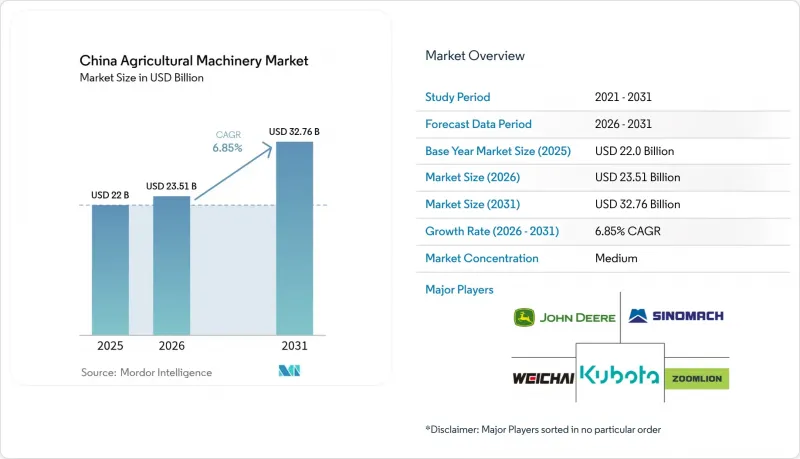
本報告按機械類型(曳引機、農業設備、噴霧器、收割機、乾草和飼料機械以及其他農業機械)進行分類。市場預測以貨幣價值(美元)表示。
中國農業機械市場趨勢與洞察
農村勞動力的減少正在加速機械化。
由於人口從農村向城市遷移以及農業勞動力減少,中國農業部門的機械化程度日益提高。 2023年,中國的都市化率達66.16%,較上年成長0.94%。這主要是由於年輕人離開農村地區。這種人口結構的變化推動了對聯合收割機和精準播種機等自動化設備的需求成長。政府支持的服務合作社也使小規模農戶能夠共用機械設備。這種機械化趨勢在沿海糧食產區最為顯著,這些地區的都市化率高,季節性人事費用也高。
對高功率智慧曳引機提供慷慨補貼
政府計畫為大馬力、精密農業曳引機提供大量補貼,以促進技術應用。這些措施幫助農民將老舊的低馬力設備升級為最新系統。以舊換新計畫降低了購置成本,尤其惠及非農業勞動力較多的地區。這些政策支持措施也增強了國內製造商的市場地位。
高昂的初始成本和不平等的融資管道
對小規模農戶而言,先進農業機械的成本是一大挑戰。農村地區有限的資金和不穩定的融資管道阻礙了機械的購買。雖然保險制度有助於風險評估,但農業貸款的可近性因地區而異。機械外包服務提供了一種替代方案,但在偏遠山區,此類服務的可近性有限。缺乏全面的金融解決方案仍然是阻礙農場管理現代化進程的一大障礙。
細分市場分析
預計到2025年,曳引機將佔據中國農機市場55.40%的佔有率。儘管由於農場整合,大型曳引機越來越受歡迎,但兩輪驅動車型在現有車隊中仍佔據主導地位。政府的獎勵正在推動曳引機向四驅CVT平台轉型,以適應多功能農具。曳引機市場透過技術整合展現出穩定的成長潛力,但小規模製造商難以滿足軟體需求,可能成為被收購的目標。
受環保法規和變數噴灑技術推廣的推動,預計噴霧器將成為銷售成長率最高的產品,到2031年複合年成長率將達到8.4%。國內製造商正將地面噴霧器與採用北斗導航的整合式控制系統結合,以最大限度地減少化學品浪費。儘管低馬力收割機價格承壓,但收割設備的出貨量仍在持續成長,尤其是在小麥產區。導航系統、遠端資訊處理和預測性維護功能正逐漸成為各類農業機械的標準配備。
其他好處:
- Excel格式的市場預測(ME)表
- 3個月的分析師支持
目錄
第1章:引言
- 研究假設和市場定義
- 調查範圍
第2章:調查方法
第3章執行摘要
第4章 市場狀況
- 市場概覽
- 市場促進因素
- 農村地區勞動力短缺正在加速機械化進程。
- 對大馬力智慧曳引機提供慷慨補貼
- 技術創新
- 為確保糧食安全,各國提高了糧食生產目標。
- 人工智慧驅動的預測性維護服務包
- 採用電動動力傳動系統
- 市場限制因素
- 高昂的初始成本和信貸取得方面的不平等
- 農田碎片化降低了管理效率。
- 原物料和電池價格波動
- 對農民資料隱私和網路安全的擔憂
- 監理情勢
- 技術展望
- 波特五力分析
第5章 市場規模與成長預測
- 按機器類型
- 聯結機
- 25~100 HP
- 100馬力或以上
- 裝置
- 犁
- 光環
- 旋耕機和耕耘機
- 播種施肥機
- 肥料撒佈器
- 其他設備
- 噴霧器
- 田間噴霧器
- 果園噴霧器
- 其他噴霧器
- 收割機械
- 結合
- 飼料收割機
- 其他收割機械
- 乾草和飼料機械
- 割草機和壓草機
- 打包機
- 其他乾草和飼料機械
- 其他農業機械
- 聯結機
第6章 競爭情勢
- 市場集中度
- 策略趨勢
- 市佔率分析
- 公司簡介
- Sinomach-China National Machinery Industry Corporation(YTO Group Corporation)
- Zoomlion Heavy Industry Science and Technology Co., Ltd.
- Kubota Corporation
- Deere & Company
- Jiangsu Changfa Group
- Weichai Group(Shandong Heavy Industry Group Co., Ltd.)
- CNH Industrial NV
- AGCO Corporation
- CLAAS KGaA mbH
- Iseki & Co., Ltd.
- Jiangsu World Agriculture Machinery Co., Ltd(World Group)
- Taian Taishan Guotai Tractors Co., Ltd.
- LS Group
- Yanmar Holdings Co., Ltd.
- Hangzhou Donghua Chain Group Co., Ltd.(Changzhou Dongfeng Agricultural Machinery Group Co., Ltd.)
第7章 市場機會與未來展望
According to Mordor Intelligence, the China agricultural machinery market size was valued at USD 22.0 billion in 2025 and estimated to grow from USD 23.51 billion in 2026 to reach USD 32.76 billion by 2031, at a CAGR of 6.85% during the forecast period (2026-2031).
This report is Segmented by Machinery Type (Tractors, Equipment, Sprayers, Harvesting Machinery, Haying and Forage Machinery, and Other Agricultural Machinery). The Market Forecasts are Provided in Terms of Value (USD).
China Agricultural Machinery Market Trends and Insights
Shrinking Rural Labor Pool Accelerating Mechanization
China's agricultural sector is undergoing mechanization due to rural-urban migration and a declining agricultural workforce. China's urbanization rate reached 66.16% in 2023, an increase of 0.94% from the previous year, driven by youth migration from rural areas. This demographic shift has increased demand for automated equipment, including combine harvesters and precision planters. Government-supported service cooperatives enable smallholder farmers to access shared machinery. The mechanization trend is most prominent in coastal grain-producing regions, which experience higher urbanization rates and seasonal labor costs.
Generous Subsidies for High-horsepower and Smart Tractors
Government programs offer enhanced subsidies for high-horsepower, precision-ready tractors to encourage technology adoption. These initiatives support farmers in upgrading from older, low-horsepower equipment to modern systems. Trade-in programs reduce purchase costs, particularly benefiting regions with significant off-farm employment. The policy support has also strengthened domestic manufacturers' market position.
High Upfront Cost and Uneven Credit Access
Advanced agricultural machinery costs present significant challenges for small-scale farmers. Limited financial resources and inconsistent rural credit access restrict equipment purchases. While insurance programs improve risk assessment, agricultural loan availability varies by region. Machinery outsourcing services provide an alternative but have limited reach in remote and mountainous areas. The lack of comprehensive financial solutions continues to impede operational upgrades.
Other drivers and restraints analyzed in the detailed report include:
- Rapid Technology Upgrades
- Food-security Push Raising Grain-output Targets
- Fragmented Farm Plots Lowering Operational Efficiency
For complete list of drivers and restraints, kindly check the Table Of Contents.
Segment Analysis
Tractors account for 55.40% of the China agricultural machinery market share in 2025. Large-frame units are increasing in popularity due to farm consolidation, while two-wheel-drive models remain predominant in existing fleets. Government incentives support the transition to four-wheel-drive CVT platforms that accommodate multi-function implements. The tractor segment shows steady growth potential through technology integration, though smaller manufacturers struggle to meet software requirements, making them potential acquisition targets.
Sprayers demonstrate the highest revenue growth at an 8.4% CAGR through 2031, driven by environmental regulations and variable-rate technology adoption. Domestic manufacturers are combining ground sprayers with unified control systems using BeiDou navigation to minimize chemical waste. Harvesting equipment volumes continue to increase, particularly in wheat-producing regions, despite pricing pressures in lower-horsepower segments. Guidance systems, telematics, and predictive maintenance capabilities are becoming standard features across machinery types.
Complete Report Scope:
- By Machinery Type
- Tractors
- 25-100 HP
- Above 100 HP
- Equipment
- Plows
- Harrows
- Rotovators and Cultivators
- Seed and Fertilizer Drills
- Fertilizer Spreaders
- Other Equipment
- Sprayers
- Field-crop Sprayers
- Orchard Sprayers
- Other Sprayers
- Harvesting Machinery
- Combine Harvesters
- Forage Harvesters
- Other Harvesting Machinery
- Haying and Forage Machinery
- Mowers and Conditioners
- Balers
- Other Haying and Forage Machinery
- Other Agricultural Machinery
- Tractors
List of Companies Covered in this Report:
- Sinomach-China National Machinery Industry Corporation (YTO Group Corporation)
- Zoomlion Heavy Industry Science and Technology Co., Ltd.
- Kubota Corporation
- Deere & Company
- Jiangsu Changfa Group
- Weichai Group (Shandong Heavy Industry Group Co., Ltd.)
- CNH Industrial N.V.
- AGCO Corporation
- CLAAS KGaA mbH
- Iseki & Co., Ltd.
- Jiangsu World Agriculture Machinery Co., Ltd (World Group)
- Taian Taishan Guotai Tractors Co., Ltd.
- LS Group
- Yanmar Holdings Co., Ltd.
- Hangzhou Donghua Chain Group Co., Ltd. (Changzhou Dongfeng Agricultural Machinery Group Co., Ltd.)
Additional Benefits:
- The market estimate (ME) sheet in Excel format
- 3 months of analyst support
TABLE OF CONTENTS
1 Introduction
- 1.1 Study Assumptions and Market Definition
- 1.2 Scope of the Study
2 Research Methodology
3 Executive Summary
4 Market Landscape
- 4.1 Market Overview
- 4.2 Market Drivers
- 4.2.1 Shrinking Rural Labor Pool Accelerating Mechanization
- 4.2.2 Generous Subsidies for High-horsepower and Smart Tractors
- 4.2.3 Rapid Technology Upgrades
- 4.2.4 Food-security Push Raising Grain-output Targets
- 4.2.5 AI-driven Predictive-maintenance Service Bundles
- 4.2.6 Adoption of Electric Power-trains
- 4.3 Market Restraints
- 4.3.1 High Upfront Cost and Uneven Credit Access
- 4.3.2 Fragmented Farm Plots Lowering Operational Efficiency
- 4.3.3 Volatile Raw-material and Battery Prices
- 4.3.4 Farmer Data-privacy and Cyber-security Concerns
- 4.4 Regulatory Landscape
- 4.5 Technological Outlook
- 4.6 Porter's Five Forces Analysis
- 4.6.1 Bargaining Power of Suppliers
- 4.6.2 Bargaining Power of Buyers
- 4.6.3 Threat of New Entrants
- 4.6.4 Threat of Substitute Products
- 4.6.5 Intensity of Competitive Rivalry
5 Market Size and Growth Forecasts (Value)
- 5.1 By Machinery Type
- 5.1.1 Tractors
- 5.1.1.1 25-100 HP
- 5.1.1.2 Above 100 HP
- 5.1.2 Equipment
- 5.1.2.1 Plows
- 5.1.2.2 Harrows
- 5.1.2.3 Rotovators and Cultivators
- 5.1.2.4 Seed and Fertilizer Drills
- 5.1.2.5 Fertilizer Spreaders
- 5.1.2.6 Other Equipment
- 5.1.3 Sprayers
- 5.1.3.1 Field-crop Sprayers
- 5.1.3.2 Orchard Sprayers
- 5.1.3.3 Other Sprayers
- 5.1.4 Harvesting Machinery
- 5.1.4.1 Combine Harvesters
- 5.1.4.2 Forage Harvesters
- 5.1.4.3 Other Harvesting Machinery
- 5.1.5 Haying and Forage Machinery
- 5.1.5.1 Mowers and Conditioners
- 5.1.5.2 Balers
- 5.1.5.3 Other Haying and Forage Machinery
- 5.1.6 Other Agricultural Machinery
- 5.1.1 Tractors
6 Competitive Landscape
- 6.1 Market Concentration
- 6.2 Strategic Moves
- 6.3 Market Share Analysis
- 6.4 Company Profiles (Includes Global-level Overview, Market-level Overview, Core Segments, Financials as Available, Strategic Information, Market Rank/Share, Products and Services, Recent Developments)
- 6.4.1 Sinomach-China National Machinery Industry Corporation (YTO Group Corporation)
- 6.4.2 Zoomlion Heavy Industry Science and Technology Co., Ltd.
- 6.4.3 Kubota Corporation
- 6.4.4 Deere & Company
- 6.4.5 Jiangsu Changfa Group
- 6.4.6 Weichai Group (Shandong Heavy Industry Group Co., Ltd.)
- 6.4.7 CNH Industrial N.V.
- 6.4.8 AGCO Corporation
- 6.4.9 CLAAS KGaA mbH
- 6.4.10 Iseki & Co., Ltd.
- 6.4.11 Jiangsu World Agriculture Machinery Co., Ltd (World Group)
- 6.4.12 Taian Taishan Guotai Tractors Co., Ltd.
- 6.4.13 LS Group
- 6.4.14 Yanmar Holdings Co., Ltd.
- 6.4.15 Hangzhou Donghua Chain Group Co., Ltd. (Changzhou Dongfeng Agricultural Machinery Group Co., Ltd.)
7 Market Opportunities and Future Outlook

 2026-2030年全球乾草飼料市場
 越南農業機械:市場佔有率分析、產業趨勢與統計、成長預測(2026-2031)
 農業設備市場報告:趨勢、預測與競爭分析(至2035年)亞太地區農業機械:市場佔有率分析、產業趨勢與統計及成長預測(2026-2031年)法國農業機械:市場佔有率分析、行業趨勢和統計數據以及成長預測(2026-2031 年)
 除草機器人市場 - 全球預測,2026-2032年非洲農業機械:市場佔有率分析、產業趨勢與統計及成長預測(2026-2031 年)北美農業機械:市場佔有率分析、產業趨勢與統計、成長預測(2026-2031)歐洲農業機械:市場佔有率分析、行業趨勢和統計數據、成長預測(2026-2031 年)農作物殘渣處理機械市場-2026-2032年全球市場預測