

 |
市場調查報告書
商品編碼
2121698
非洲農業機械:市場佔有率分析、產業趨勢與統計及成長預測(2026-2031 年)Africa Agricultural Machinery - Market Share Analysis, Industry Trends & Statistics, Growth Forecasts (2026 - 2031) |
||||||

※ 本網頁內容可能與最新版本有所差異。詳細情況請與我們聯繫。
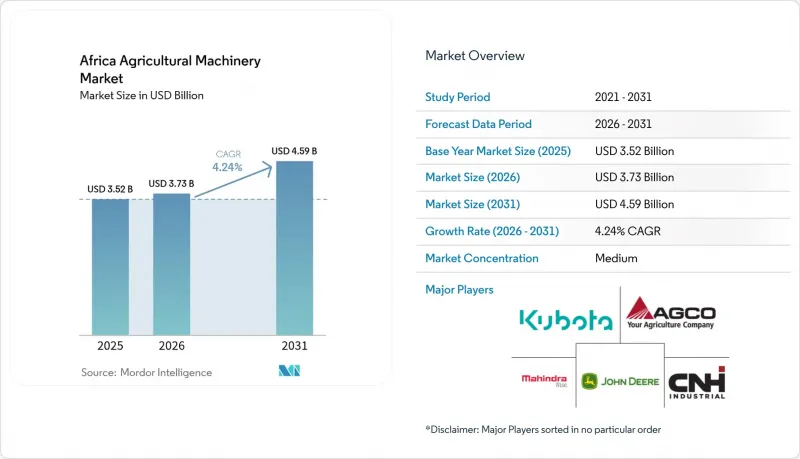
根據 Mordor Intelligence 預測,非洲農業機械市場規模將從 2025 年的 35.2 億美元成長到 2026 年的 37.3 億美元,然後在 2031 年達到 45.9 億美元,2026 年至 2031 年的複合年成長率為 4.24%。
本報告按產品類型(曳引機、犁地和中耕機械、播種機械、噴霧器、灌溉機械、收割機械、乾草和飼料機械等)和地區(南非、奈及利亞等)進行細分。市場預測以美元計價。
非洲農業機械市場趨勢與洞察
農業勞動力減少
農村青年持續湧入蓬勃發展的都市區尋求就業機會,導致從事土地耕作和收割的季節性工人數量減少。在內羅畢,普通工人的平均月薪預計將從2018年的105.20美元上漲至2024年的124.90美元,其他城市也出現了類似的成長,這給傳統上依賴家庭勞動力的兩公頃以下農場的盈利能力帶來了壓力。合作社正在透過數位租賃平台和共用所有權計劃來應對這一挑戰,這些計劃將固定成本分攤到多個用戶身上,從而確保曳引機的使用時間。根據世界銀行統計,到2023年,奈及利亞農業部門的就業人數佔總就業人數的34.3%。這一數字在2021年至2023年間下降了7.4%,但下降幅度並不穩定。因此,日益嚴重的勞動力短缺正在成為推動農業機械化的結構性動力,即使是對那些不願採用機械化的農民也是如此。
政府對機械化的支持措施和補貼
目前,公共計畫透過補貼購置成本、縮短投資回收期以及提供操作人員培訓,顯著提高了農機設備的普及率。這些計畫旨在讓更多農民,包括小規模農戶,都能獲得機械化服務。奈及利亞於2026年2月啟動了舉措,旨在透過以折扣價提供曳引機和農機,到2028年將全國機械化率從12%提高到25%。該舉措有望幫助解決農業部門生產力低下和勞動力短缺等挑戰。 2023年,肯亞農業部推出了「國家農業機械化政策」及相關舉措,以促進農業機械化,目標是將動力利用率從目前的30%提高到50%。這些措施旨在提高農業效率和產量。這些補貼將投資回收期縮短至四年以內,使機械化更容易惠及小規模農戶,從而促進農業部門生產力的提高和經濟成長。
售後服務網分散
由於農村地區經銷商數量有限,曳引機車主不得不長時間等待才能找到認證技師和原廠配件。奈及利亞的大多數曳引機都遠離認證服務中心,車主別無選擇,只能依賴非官方維修人員。這些非官方維修人員的維修往往會使保固失效,為車主帶來更多難題。製造商正在推行行動服務車和遠距離診斷等措施來解決這些問題。然而,這些解決方案嚴重依賴可靠的通訊基礎設施和充足的技師培訓,而這兩項在全國範圍內仍然不盡人意。缺乏完善的服務基礎設施顯著降低了曳引機的利用率,導致機械化投資回報率降低,並抑制了未來的購買意願。
細分市場分析
曳引機是最大的產品類型,預計到2025年將佔非洲農業機械市場佔有率的42.6%。由於大多數農地面積不足2公頃,因此功率低於40馬力的曳引機佔據了很大的銷售佔有率。小型曳引機在肯亞、衣索比亞和加納很受歡迎,因為它們也可以用作運輸車輛和簡易農具的動力來源。隨著融資方案允許合作社和合約服務提供者擁有曳引機,預計非洲的曳引機市場將進一步擴大。功率在40至99馬力之間的中功率曳引機在共享土地的農場中越來越受歡迎,而功率超過100馬力的曳引機仍然集中在南非和埃及。
預計到2031年,噴霧器市場將以5.1%的複合年成長率成長,在所有類別中增速最高。這主要歸功於出口導向園藝產業為應對歐盟安全標準下日益嚴格的農藥殘留限制而採取的措施。在肯亞的鮮切花生產群集中,由於政府補貼一半的購買成本,能夠減少農藥用量的精準噴霧器正變得越來越普及。隨著氣溫升高導致病蟲害日益嚴重,預計非洲農業機械市場對噴霧器的需求將顯著成長。儘管基數較小,但隨著氣候適應型作物管理成為政策重點,其成長率預計將超過其他任何細分市場。
其他好處:
- Excel格式的市場預測(ME)表
- 3個月的分析師支持
目錄
第1章:引言
- 研究假設和市場定義
- 調查範圍
第2章:調查方法
第3章執行摘要
第4章 市場狀況
- 市場概覽
- 市場促進因素
- 農業勞動力減少
- 政府機械化政策與補貼
- 計量收費的設備融資平台。
- 數位化和遠端資訊處理整合
- 氣候變遷加劇,加速了機械化進程。
- 與碳權掛鉤的機械化獎勵
- 市場限制因素
- 售後服務網分散
- 初始設備成本高
- 仿冒品和來自灰色市場的進口商品
- 外匯持續波動
- 監理情勢
- 技術展望
- 波特五力分析
第5章 市場規模與成長預測
- 依產品類型
- 聯結機
- 小於40馬力
- 40~99 HP
- 100馬力或以上
- 犁地和翻土機械
- 犁
- 光環
- 旋耕機和耕耘機
- 其他設備
- 種植機械
- 播種機
- 播種機
- 撒佈器
- 其他種植機械
- 噴霧器
- 手持式/背包式
- 聯結機式
- 可拖曳/牽引型
- 自推進式
- 無人機/無人飛行器式噴霧器
- 灌溉機械
- 滴灌系統
- 噴水灌溉系統
- 其他灌溉機械
- 收割機械
- 結合
- 其他收割機械
- 乾草和飼料機械
- 割草機和壓草機
- 打包機
- 其他乾草和飼料機械
- 聯結機
- 按地區
- 奈及利亞
- 南非
- 肯亞
- 埃及
- 衣索比亞
- 其他非洲國家
第6章 競爭情勢
- 市場集中度
- 策略趨勢
- 市佔率分析
- 公司簡介
- Deere & Company
- CNH Industrial NV
- AGCO Corporation
- Mahindra & Mahindra Limited
- Kubota Corporation
- Tractors and Farm Equipment Limited(TAFE)
- Yanmar Holdings Co., Ltd.
- International Tractors Limited
- CLAAS KGaA mbH
- Weichai Lovol Intelligent Agricultural Technology Co., Ltd.(Weichai Power Co., Ltd.)
- SDF SpA(Same Deutz-Fahr)
- Agrimont Industrial Group
- Dongfeng Agricultural Machinery Group Co., Ltd.
- Zoomlion Heavy Industry Science and Technology Co., Ltd.
- Zetor Tractors as(HTC Holding)
第7章 市場機會與未來展望
According to Mordor Intelligence, the Africa agricultural machinery market size is projected to grow from USD 3.52 billion in 2025 to USD 3.73 billion in 2026 and is forecast to reach USD 4.59 billion by 2031 at a 4.24% CAGR over 2026-2031.
This report is Segmented by Product Type (Tractors, Plowing and Cultivating Machinery, Planting Machinery, Sprayers, Irrigation Machinery, Harvesting Machinery, Haying and Forage Machinery, and Other Types) and by Geography (South Africa, Nigeria, and More). The Market Forecasts are Provided in Terms of Value (USD).
Africa Agricultural Machinery Market Trends and Insights
Declining Agricultural Labor
Rural youth continue to migrate toward service jobs in growing urban centers, shrinking the seasonal workforce available for land preparation and harvest. In Nairobi, the monthly wage for a general laborer increased from USD 105.2 in 2018 to USD 124.9 in 2024, with similar increments observed in other municipalities, squeezing margins for farms under two hectares that traditionally relied on family labor. Cooperatives are countering by pooling resources to secure tractor hours through digital rental platforms and shared-ownership schemes that spread fixed costs across many users. According to the World Bank, in 2023, employment in the agricultural sector accounted for 34.3% of total employment in Nigeria . Between 2021 and 2023, this figure decreased by 7.4%, although the decline was irregular rather than consistent. Growing labor scarcity, therefore, acts as a structural push toward mechanization, even among conservative adopters.
Government Mechanization Schemes and Subsidies
Public programs are now subsidizing acquisition costs, reducing payback periods, and including operator training, significantly improving equipment affordability. These programs aim to make mechanization accessible to a broader range of farmers, including small-scale operators. Nigeria's February 2026 initiative aims to increase national mechanization levels from 12% to 25% by 2028 by providing discounted tractors and implements . This initiative is projected to address the challenges of low productivity and labor shortages in the agricultural sector. In 2023, the Kenyan Ministry of Agriculture introduced a National Agricultural Mechanization Policy and related initiatives to enhance farm mechanization, aiming to increase motorized power use from the current 30% to 50%. These efforts are designed to improve agricultural efficiency and output. These subsidies reduce break-even periods to less than four years, encouraging even small-scale operators to adopt mechanization, thereby fostering greater productivity and economic growth in the agricultural sector.
Fragmented After-Sales Service Networks
The limited presence of dealers in rural areas forces tractor owners to wait for extended periods to access certified technicians or genuine parts. A large portion of tractors in Nigeria are situated at considerable distances from authorized workshops, leaving operators with no choice but to rely on informal mechanics. These mechanics often perform repairs that void warranties, creating additional challenges for owners. Manufacturers have introduced initiatives such as mobile service vans and remote diagnostics to address these issues. However, these solutions are heavily dependent on reliable connectivity and adequate technician training, both of which remain inconsistent across the country. In the absence of a robust service infrastructure, tractor utilization rates decline significantly, resulting in lower returns on mechanization investments and discouraging future purchases.
Other drivers and restraints analyzed in the detailed report include:
- Pay-As-You-Go Equipment Financing Platforms
- Digitization and Telematics Integration
- Counterfeit and Gray-Market Imports
For complete list of drivers and restraints, kindly check the Table Of Contents.
Segment Analysis
Tractors are the largest product type, accounting for 42.6% of the Africa agricultural machinery market share in 2025, with units under 40 horsepower representing a significant share of sales, as the majority of farms remain below 2 hectares. Compact machines double as transport vehicles and power sources for simple implements, explaining their popularity in Kenya, Ethiopia, and Ghana. The Africa agricultural machinery market size for tractors is projected to grow as financing schemes make ownership viable for cooperatives and contract service providers. Medium-power tractors between 40 and 99 horsepower are gaining ground among estates pooling acreage, while models above 100 horsepower stay concentrated in South Africa and Egypt.
Sprayers expand at a 5.1% CAGR through 2031, the highest among all categories, as export-oriented horticulture faces tighter residue ceilings under European Union safety rules. Precision sprayers that cut chemical volumes are spreading in Kenyan floriculture clusters, aided by subsidies that reimburse half the purchase cost. The Africa agricultural machinery market for sprayers is anticipated to grow significantly, driven by rising pest pressure linked to warmer temperatures. Although starting from a smaller base, growth outpaces every other segment as climate-resilient crop management becomes a policy priority.
Complete Report Scope:
- By Product Type
- Tractors
- Less than 40 HP
- 40 - 99 HP
- 100 HP and Above
- Plowing and Cultivating Machinery
- Plows
- Harrows
- Rotovators and Cultivators
- Other Equipment
- Planting Machinery
- Seed Drills
- Planters
- Spreaders
- Other Planting Machinery
- Sprayers
- Handheld/Knapsack
- Tractor-Mounted
- Trailed/Pull-Type
- Self-Propelled
- UAV/Drone Sprayers
- Irrigation Machinery
- Drip Irrigation Systems
- Sprinkler Irrigation Systems
- Other Irrigation Machinery
- Harvesting Machinery
- Combine Harvesters
- Other Harvesting Machinery
- Haying and Forage Machinery
- Mowers and Conditioners
- Balers
- Other Haying and Forage Machinery
- Tractors
- By Geography
- Nigeria
- South Africa
- Kenya
- Egypt
- Ethiopia
- Rest of Africa
List of Companies Covered in this Report:
- Deere & Company
- CNH Industrial N.V.
- AGCO Corporation
- Mahindra & Mahindra Limited
- Kubota Corporation
- Tractors and Farm Equipment Limited (TAFE)
- Yanmar Holdings Co., Ltd.
- International Tractors Limited
- CLAAS KGaA mbH
- Weichai Lovol Intelligent Agricultural Technology Co., Ltd. (Weichai Power Co., Ltd.)
- SDF S.p.A (Same Deutz-Fahr)
- Agrimont Industrial Group
- Dongfeng Agricultural Machinery Group Co., Ltd.
- Zoomlion Heavy Industry Science and Technology Co., Ltd.
- Zetor Tractors a.s. (HTC Holding)
Additional Benefits:
- The market estimate (ME) sheet in Excel format
- 3 months of analyst support
TABLE OF CONTENTS
1 Introduction
- 1.1 Study Assumptions and Market Definition
- 1.2 Scope of the Study
2 Research Methodology
3 Executive Summary
4 Market Landscape
- 4.1 Market Overview
- 4.2 Market Drivers
- 4.2.1 Declining agricultural labor
- 4.2.2 Government mechanization schemes and subsidies
- 4.2.3 Pay-as-you-go equipment financing platforms
- 4.2.4 Digitization and telematics integration
- 4.2.5 Climate volatility accelerating mechanization
- 4.2.6 Carbon-credit-linked mechanization incentives
- 4.3 Market Restraints
- 4.3.1 Fragmented after-sales service networks
- 4.3.2 High up-front equipment costs
- 4.3.3 Counterfeit and gray-market imports
- 4.3.4 Persistent foreign-exchange volatility
- 4.4 Regulatory Landscape
- 4.5 Technological Outlook
- 4.6 Porter's Five Forces Analysis
- 4.6.1 Bargaining Power of Suppliers
- 4.6.2 Bargaining Power of Buyers
- 4.6.3 Threat of New Entrants
- 4.6.4 Threat of Substitutes
- 4.6.5 Intensity of Competitive Rivalry
5 Market Size and Growth Forecasts (Value)
- 5.1 By Product Type
- 5.1.1 Tractors
- 5.1.1.1 Less than 40 HP
- 5.1.1.2 40 - 99 HP
- 5.1.1.3 100 HP and Above
- 5.1.2 Plowing and Cultivating Machinery
- 5.1.2.1 Plows
- 5.1.2.2 Harrows
- 5.1.2.3 Rotovators and Cultivators
- 5.1.2.4 Other Equipment
- 5.1.3 Planting Machinery
- 5.1.3.1 Seed Drills
- 5.1.3.2 Planters
- 5.1.3.3 Spreaders
- 5.1.3.4 Other Planting Machinery
- 5.1.4 Sprayers
- 5.1.4.1 Handheld/Knapsack
- 5.1.4.2 Tractor-Mounted
- 5.1.4.3 Trailed/Pull-Type
- 5.1.4.4 Self-Propelled
- 5.1.4.5 UAV/Drone Sprayers
- 5.1.5 Irrigation Machinery
- 5.1.5.1 Drip Irrigation Systems
- 5.1.5.2 Sprinkler Irrigation Systems
- 5.1.5.3 Other Irrigation Machinery
- 5.1.6 Harvesting Machinery
- 5.1.6.1 Combine Harvesters
- 5.1.6.2 Other Harvesting Machinery
- 5.1.7 Haying and Forage Machinery
- 5.1.7.1 Mowers and Conditioners
- 5.1.7.2 Balers
- 5.1.7.3 Other Haying and Forage Machinery
- 5.1.1 Tractors
- 5.2 By Geography
- 5.2.1 Nigeria
- 5.2.2 South Africa
- 5.2.3 Kenya
- 5.2.4 Egypt
- 5.2.5 Ethiopia
- 5.2.6 Rest of Africa
6 Competitive Landscape
- 6.1 Market Concentration
- 6.2 Strategic Moves
- 6.3 Market Share Analysis
- 6.4 Company Profiles (Includes Global Level Overview, Market Level Overview, Core Segments, Financials as Available, Strategic Information, Market Rank/Share for Key Companies, Products and Services, and Recent Developments)
- 6.4.1 Deere & Company
- 6.4.2 CNH Industrial N.V.
- 6.4.3 AGCO Corporation
- 6.4.4 Mahindra & Mahindra Limited
- 6.4.5 Kubota Corporation
- 6.4.6 Tractors and Farm Equipment Limited (TAFE)
- 6.4.7 Yanmar Holdings Co., Ltd.
- 6.4.8 International Tractors Limited
- 6.4.9 CLAAS KGaA mbH
- 6.4.10 Weichai Lovol Intelligent Agricultural Technology Co., Ltd. (Weichai Power Co., Ltd.)
- 6.4.11 SDF S.p.A (Same Deutz-Fahr)
- 6.4.12 Agrimont Industrial Group
- 6.4.13 Dongfeng Agricultural Machinery Group Co., Ltd.
- 6.4.14 Zoomlion Heavy Industry Science and Technology Co., Ltd.
- 6.4.15 Zetor Tractors a.s. (HTC Holding)
7 Market Opportunities and Future Outlook

 2026-2030年全球乾草飼料市場
 越南農業機械:市場佔有率分析、產業趨勢與統計、成長預測(2026-2031)
 農業設備市場報告:趨勢、預測與競爭分析(至2035年)亞太地區農業機械:市場佔有率分析、產業趨勢與統計及成長預測(2026-2031年)法國農業機械:市場佔有率分析、行業趨勢和統計數據以及成長預測(2026-2031 年)
 除草機器人市場 - 全球預測,2026-2032年中國農業機械:市場佔有率分析、產業趨勢與統計及成長預測(2026-2031年)北美農業機械:市場佔有率分析、產業趨勢與統計、成長預測(2026-2031)歐洲農業機械:市場佔有率分析、行業趨勢和統計數據、成長預測(2026-2031 年)農作物殘渣處理機械市場-2026-2032年全球市場預測