


 |
市場調查報告書
商品編碼
2121778
印度農業機械:市場佔有率分析、產業趨勢與統計及成長預測(2026-2031)India Agricultural Machinery - Market Share Analysis, Industry Trends & Statistics, Growth Forecasts (2026 - 2031) |
||||||

※ 本網頁內容可能與最新版本有所差異。詳細情況請與我們聯繫。
據 Mordor Intelligence 稱,印度農業機械市場預計到 2026 年價值將達到 196.5 億美元,高於 2025 年的 181.5 億美元,預計到 2031 年將達到 292.7 億美元。
預計從 2026 年到 2031 年,其複合年成長率將達到 8.28%。
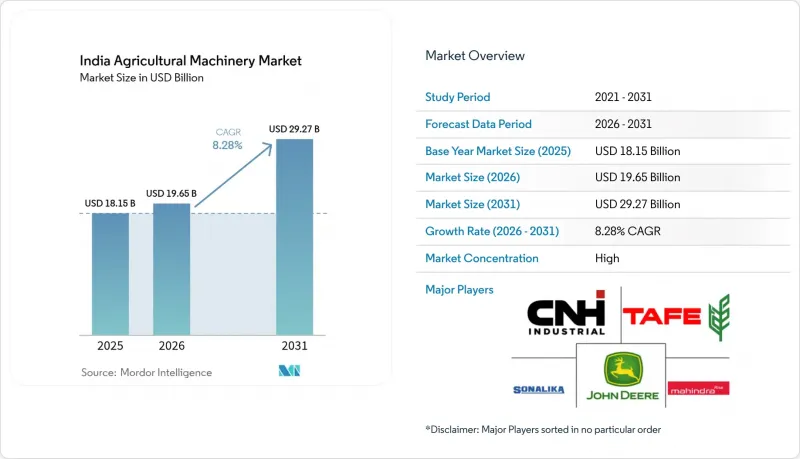
本報告按類型(曳引機、農業設備、灌溉機械、收割機械等)和最終用戶農場規模(小規模農場、中型農場等)進行分類。市場預測以美元計價。
印度農業機械市場趨勢與洞察
政府促進機械化引進的政策
根據「農業機械化支持計畫」(SMAM)的政策措施,購買單一農機可獲得40%至50%的補貼,而農機租賃中心的補貼最高可達80%。光是在北方邦,SMAM在2014年至2024年間就投入了656.6億印度盧比(約合7.9億美元),發放了17.6萬台農機,並建立了10769個農機租賃中心。這些措施正在擴大小規模農戶群體取得高性能農機的管道。此外,諸如「農民無人機」補貼和國家糧食安全任務下實施的作物專項支持等配套舉措,進一步提升了對高精度農機的需求。這些項目不僅降低了初始成本,還加強了售後服務,從而促進了不同農業氣候帶的永續機械化。
由於人口不斷外流到都市區,農村地區出現勞動力短缺。
根據家庭調查數據,以農業為主要收入來源的人口中,僅有9%仍在從事農業工作,遠低於先前超過50%的比例。季節性勞動力外流在播種和收穫季節達到高峰,加劇了勞動力短缺,但機械化可以透過及時犁地、播種和收割來彌補這一缺口。聯合收割機在稻米和小麥輪作中至關重要,可減少高達30%的勞動需求,並將收穫後損失降低2-4個百分點。透過合約中心共用機械設備,可以更有效地利用稀缺設備,即使在勞動力短缺的地區也能維持種植密度。
設備成本高昂,融資管道有限。
儘管政府提供了豐厚的補貼,購買中型曳引機仍然需要花費超過60萬印度盧比(約7,200美元),這對許多小農來說難以負擔。正規貸款機構通常要求提供抵押品,而且利率差額仍然比優惠利率高出200-300個基點,這阻礙了高成本投資。雖然農機租賃中心可以緩解成本障礙,但它們的分佈並不均衡。印度東部每個地區不到12個租賃中心,而北部一些地區則超過45個,加劇了區域間的差距。
細分市場分析
預計到2025年,曳引機將維持40.12%的銷售佔有率,凸顯其在各種種植系統中犁地和運輸的基礎性作用。灌溉機械是成長最快的細分市場,其中微灌泵和滴灌系統以10.18%的複合年成長率成長,這主要得益於抗旱計畫和不斷上漲的電價推動了精準灌溉的發展。犁、耙和旋耕機等機械設備受益於小規模農戶機械化程度的提升。這些機械設備提供入門級機械化解決方案,所需的資本投入比曳引機更少。在旺季勞動力短缺日益嚴重的背景下,收割機械市場正穩定成長,聯合收割機和飼料收割機對於商業農業中及時收割作物至關重要。
將全球導航衛星系統 (GNSS) 與傳統農業機械整合的適配器,正在將傳統曳引機轉變為智慧機器,能夠以±2.5公分的精度進行直線犁地和播種,從而減少6%至8%的投入浪費。電動輔助旋耕機和電池驅動的果園噴霧器正受到優先考慮低噪音和零排放的果農的青睞。隨著打包機、割草機和覆蓋機在旨在遏制露天焚燒的殘茬管理措施中變得越來越重要,印度農業機械市場持續多元化發展。市場領導者正透過模組化附件生態系統來應對這項挑戰,使單一曳引機底盤能夠容納20多種不同類型的專用農業機械,從而實現所有權成本在多個收入來源上的分散。
其他好處:
- Excel格式的市場預測(ME)表
- 3個月的分析師支持
目錄
第1章:引言
- 研究假設和市場定義
- 調查範圍
第2章:調查方法
第3章執行摘要
第4章 市場狀況
- 市場概覽
- 市場促進因素
- 政府促進機械化引進的政策
- 農村地區勞動力短缺是由於人口持續向都市區流出所造成的。
- 農民生產組織和合約農業的整合
- 可實現資金籌措的數位信貸平台
- 電氣設備的獎勵正在加速其普及。
- 氣候保險正在促進農業機械化。
- 市場限制因素
- 高昂的設備成本和融資限制
- 土地所有權的分散化阻礙了規模經濟的實現。
- 各州的排放氣體法規不盡相同。
- 熟練的遠端資訊處理工程師短缺
- 監理情勢
- 技術展望
- 波特五力分析
第5章 市場規模與成長預測
- 按類型
- 聯結機
- 小於50馬力
- 50~75 HP
- 76~100 HP
- 101~150 HP
- 150馬力或以上
- 裝置
- 犁
- 光環
- 旋耕機和耕耘機
- 播種機和肥料撒佈機
- 其他設備(挖洞機、電動除草機等)
- 灌溉機械
- 噴水灌溉
- 滴灌
- 其他灌溉設備(中心支軸式噴灌系統、微型噴灌等)
- 收割機械
- 結合
- 飼料收割機
- 其他收割機械(甘蔗收割機、馬鈴薯收割機等)
- 乾草和飼料農業機械
- 割草機和壓草機
- 打包機
- 其他乾草飼料機械(翻曬機、耙草機等)
- 聯結機
- 按最終用戶農場規模分類
- 小規模農場(小於5公頃)
- 中型農場(5-20公頃)
- 大型農場(20公頃或以上)
第6章 競爭情勢
- 市場集中度
- 策略趨勢
- 市佔率分析
- 公司簡介
- Mahindra & Mahindra Ltd
- TAFE Motors and Tractors Limited
- Deere & Company
- CNH Industrial NV
- International Tractors Limited(Sonalika)
- Escorts Kubota Limited
- VST Tillers Tractors Ltd.
- AGCO Corporation
- CLAAS KGaA mbH
- Yanmar Holdings Co., Ltd.
- SDF Group SpA
- Tirth Agro Technology Private Limited
- Kirloskar Group
- Jain Irrigation Systems Ltd.
第7章 市場機會與未來展望
According to Mordor Intelligence, India agricultural machinery market size market size in 2026 is estimated at USD 19.65 billion, growing from 2025 value of USD 18.15 billion with 2031 projections showing USD 29.27 billion, growing at 8.28% CAGR over 2026-2031.
This report is Segmented by Type (Tractors, Equipment, Irrigation Machinery, Harvesting Machinery, and More) and by End-User Farm Size (Smallholdings, Medium Farms, and More). The Market Forecasts are Provided in Terms of Value (USD).
India Agricultural Machinery Market Trends and Insights
Government schemes boosting mechanization adoption
Policy interventions under SMAM provide 40%-50% subsidies on individual machinery purchases and up to 80% on custom-hiring centers. In Uttar Pradesh alone, SMAM disbursed INR 65.66 billion (USD 790 million) between 2014 and 2024, distributing 176,000 machines and establishing 10,769 custom-hiring centers, which collectively expand access to high-capacity equipment across smallholder communities. Complementary initiatives such as the Kisan Drone subsidy and crop-specific support under the National Food Security Mission channel further demand high-precision implements. These programs not only minimize upfront costs but also strengthen after-sales networks, thereby fostering sustained mechanization across diverse agro-climatic zones.
Rural labor shortage caused by sustained migration to urban centers
Household survey data indicate that only 9% of main income earners remain in farming, down from historic norms above 50%. Seasonal out-migration peaks during planting and harvesting, intensifying labor deficits that mechanization can bridge through timely tillage, sowing, and harvesting. Combine harvesters cut labor requirements by up to 30% and reduce post-harvest losses by 2-4 percentage points, making them indispensable in rice-wheat rotations. Equipment sharing through custom-hiring centers further leverages scarce machinery to maintain cropping intensities in labor-scarce districts.
High equipment cost and limited credit access
Despite generous subsidies, a mid-horsepower tractor still requires an outlay exceeding INR 600,000 (USD 7,200), a sum beyond the reach of many marginal growers. Formal lenders often demand collateral, and interest spreads remain 200-300 basis points above prime lending, deterring big-ticket investments. Custom-hiring centers cushion the cost hurdle but are unevenly distributed, eastern India hosts fewer than 12 centers per district versus 45-plus in parts of the north, perpetuating regional disparities.
Other drivers and restraints analyzed in the detailed report include:
- FPOs and contract farming aggregation
- Digital credit platforms enabling financing
- Fragmented landholdings limit scale efficiency
For complete list of drivers and restraints, kindly check the Table Of Contents.
Segment Analysis
Tractors retained a 40.12% revenue share in 2025, underscoring their foundational role in tillage and haulage across diverse cropping systems. Irrigation Machinery is the fastest growing segment with micro-irrigation pumps and drip systems advancing at a 10.18% CAGR, propelled by drought-mitigation programs and rising electricity tariffs that favor precision watering. Equipment segments, including plows, harrows, and rotovators, benefit from the mechanization push in smallholder farming, where these implements provide entry-level mechanization solutions that require lower capital investment than tractors. Harvesting machinery experiences steady growth as labor shortages intensify during peak seasons, with combine harvesters and forage harvesters becoming essential for timely crop collection in commercial farming operations.
Adapters that merge global navigation satellite systems with traditional implements are converting conventional tractors into smart machines that execute straight-line plowing and seed placement within +-2.5 cm precision, reducing input waste by 6%-8%. Electric-assist rotovators and battery-powered orchard sprayers are gaining traction among fruit growers, where low noise and zero emissions are prized. The India agricultural machinery market continues to diversify as balers, mowers, and mulchers gain relevance in residue-management schemes aimed at curbing open-field burning. Market leaders respond with modular attachment ecosystems, allowing a single tractor chassis to support over 20 task-oriented implements, thereby spreading ownership cost over multiple revenue streams.
Complete Report Scope:
- By Type
- Tractors
- Less than 50 HP
- 50 to 75 HP
- 76 to 100 HP
- 101 to 150 HP
- Greater than 150 HP
- Equipment
- Plows
- Harrows
- Rotovators and Cultivators
- Seed and Fertilizer Drills
- Other Equipment (Post-Hole Diggers, Power Weeders, etc.)
- Irrigation Machinery
- Sprinkler Irrigation
- Drip Irrigation
- Other Irrigation Machinery (Center-Pivot Systems, Micro-Sprinklers, etc.)
- Harvesting Machinery
- Combine Harvesters
- Forage Harvesters
- Other Harvesting Machinery (Sugarcane Harvesters, Potato Harvesters, etc.)
- Haying and Forage Machinery
- Mowers and Conditioners
- Balers
- Other Haying and Forage Machinery (Tedders, Rakes, etc.)
- Tractors
- By End-User Farm Size
- Smallholdings (Less than 5 ha)
- Medium Farms (5 to 20 ha)
- Large Farms (Greater than 20 ha)
List of Companies Covered in this Report:
- Mahindra & Mahindra Ltd
- TAFE Motors and Tractors Limited
- Deere & Company
- CNH Industrial N.V.
- International Tractors Limited (Sonalika)
- Escorts Kubota Limited
- VST Tillers Tractors Ltd.
- AGCO Corporation
- CLAAS KGaA mbH
- Yanmar Holdings Co., Ltd.
- SDF Group S.p.A.
- Tirth Agro Technology Private Limited
- Kirloskar Group
- Jain Irrigation Systems Ltd.
Additional Benefits:
- The market estimate (ME) sheet in Excel format
- 3 months of analyst support
TABLE OF CONTENTS
1 Introduction
- 1.1 Study Assumptions and Market Definition
- 1.2 Scope of the Study
2 Research Methodology
3 Executive Summary
4 Market Landscape
- 4.1 Market Overview
- 4.2 Market Drivers
- 4.2.1 Government Schemes Boosting Mechanization Adoption
- 4.2.2 Rural labor shortage caused by sustained migration to urban centers
- 4.2.3 FPOs and Contract Farming Aggregation
- 4.2.4 Digital Credit Platforms Enabling Financing
- 4.2.5 Electric Equipment Incentives Accelerating Adoption
- 4.2.6 Climate Insurance Favoring Mechanized Cultivation
- 4.3 Market Restraints
- 4.3.1 High Equipment Cost and Limited Credit Access
- 4.3.2 Fragmented Landholdings Limit Scale Efficiency
- 4.3.3 Emission Norms Vary Across States
- 4.3.4 Lack of Skilled Telematics Technicians
- 4.4 Regulatory Landscape
- 4.5 Technological Outlook
- 4.6 Porter's Five Forces Analysis
- 4.6.1 Bargaining Power of Suppliers
- 4.6.2 Bargaining Power of Buyers
- 4.6.3 Threat of New Entrants
- 4.6.4 Threat of Substitutes
- 4.6.5 Intensity of Competitive Rivalry
5 Market Size and Growth Forecasts (Value)
- 5.1 By Type
- 5.1.1 Tractors
- 5.1.1.1 Less than 50 HP
- 5.1.1.2 50 to 75 HP
- 5.1.1.3 76 to 100 HP
- 5.1.1.4 101 to 150 HP
- 5.1.1.5 Greater than 150 HP
- 5.1.2 Equipment
- 5.1.2.1 Plows
- 5.1.2.2 Harrows
- 5.1.2.3 Rotovators and Cultivators
- 5.1.2.4 Seed and Fertilizer Drills
- 5.1.2.5 Other Equipment (Post-Hole Diggers, Power Weeders, etc.)
- 5.1.3 Irrigation Machinery
- 5.1.3.1 Sprinkler Irrigation
- 5.1.3.2 Drip Irrigation
- 5.1.3.3 Other Irrigation Machinery (Center-Pivot Systems, Micro-Sprinklers, etc.)
- 5.1.4 Harvesting Machinery
- 5.1.4.1 Combine Harvesters
- 5.1.4.2 Forage Harvesters
- 5.1.4.3 Other Harvesting Machinery (Sugarcane Harvesters, Potato Harvesters, etc.)
- 5.1.5 Haying and Forage Machinery
- 5.1.5.1 Mowers and Conditioners
- 5.1.5.2 Balers
- 5.1.5.3 Other Haying and Forage Machinery (Tedders, Rakes, etc.)
- 5.1.1 Tractors
- 5.2 By End-User Farm Size
- 5.2.1 Smallholdings (Less than 5 ha)
- 5.2.2 Medium Farms (5 to 20 ha)
- 5.2.3 Large Farms (Greater than 20 ha)
6 Competitive Landscape
- 6.1 Market Concentration
- 6.2 Strategic Moves
- 6.3 Market Share Analysis
- 6.4 Company Profiles (includes Global level Overview, Market level overview, Core Segments, Financials as available, Strategic Information, Market Rank/Share for key companies, Products and Services, and Recent Developments)
- 6.4.1 Mahindra & Mahindra Ltd
- 6.4.2 TAFE Motors and Tractors Limited
- 6.4.3 Deere & Company
- 6.4.4 CNH Industrial N.V.
- 6.4.5 International Tractors Limited (Sonalika)
- 6.4.6 Escorts Kubota Limited
- 6.4.7 VST Tillers Tractors Ltd.
- 6.4.8 AGCO Corporation
- 6.4.9 CLAAS KGaA mbH
- 6.4.10 Yanmar Holdings Co., Ltd.
- 6.4.11 SDF Group S.p.A.
- 6.4.12 Tirth Agro Technology Private Limited
- 6.4.13 Kirloskar Group
- 6.4.14 Jain Irrigation Systems Ltd.
7 Market Opportunities and Future Outlook

 2026年全球自動駕駛農業車輛市場報告
 2026-2030年全球乾草飼料市場
 越南農業機械:市場佔有率分析、產業趨勢與統計、成長預測(2026-2031)
 農業設備市場報告:趨勢、預測與競爭分析(至2035年)亞太地區農業機械:市場佔有率分析、產業趨勢與統計及成長預測(2026-2031年)法國農業機械:市場佔有率分析、行業趨勢和統計數據以及成長預測(2026-2031 年)
 除草機器人市場 - 全球預測,2026-2032年非洲農業機械:市場佔有率分析、產業趨勢與統計及成長預測(2026-2031 年)中國農業機械:市場佔有率分析、產業趨勢與統計及成長預測(2026-2031年)北美農業機械:市場佔有率分析、產業趨勢與統計、成長預測(2026-2031)