


 |
市場調查報告書
商品編碼
2121720
南美洲農藥市場:市場佔有率分析、產業趨勢與統計及成長預測(2026-2031 年)South America Agrochemicals - Market Share Analysis, Industry Trends & Statistics, Growth Forecasts (2026 - 2031) |
||||||

※ 本網頁內容可能與最新版本有所差異。詳細情況請與我們聯繫。
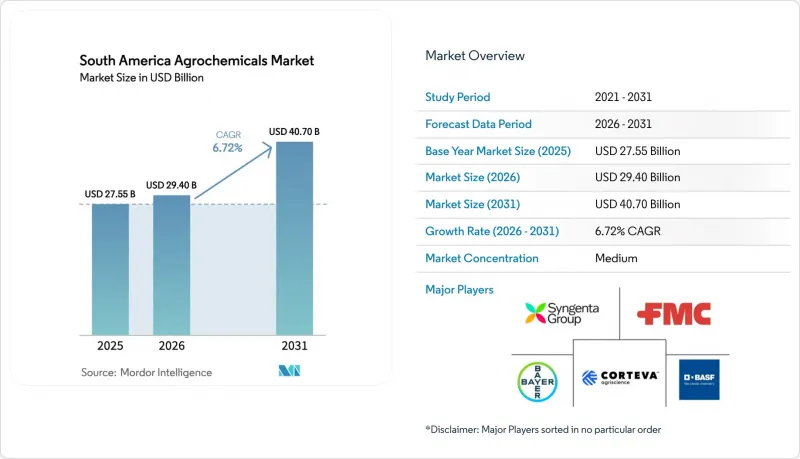
根據 Mordor Intelligence 估計,2025 年南美洲農藥市值為 275.5 億美元,2026 年將達到 294 億美元。
此外,預計到 2031 年,該產業規模將成長至 407 億美元,在預測期(2026-2031 年)內,年複合成長率將達到 6.72%。
本報告按產品類型(化肥、農藥、助劑等)、作物類型(穀物、油籽、豆類等)和國家(巴西、阿根廷等)進行細分。市場預測以貨幣價值(美元)表示。
南美洲農藥市場趨勢與洞察
擴大大豆種植面積
在巴西,2024-2025年度大豆種植面積將達4,620萬公頃,比前一年增加3.8%。在阿根廷,2025年大豆種植面積將達1,680萬公頃,從先前乾旱導致的產量下降中恢復過來。隨著種植面積的擴大,除草劑的使用量也增加。這是因為除草劑,包括Glyphosate、殘效播前除草劑和燒除劑,每公頃需要連續施用2-3次。化肥需求也在穩定成長。巴西大豆種植的平均氮磷鉀肥用量從2020年的每公頃168公斤增加到2025年的每公頃185公斤。大豆-玉米雙季種植模式的推廣縮短了施藥週期,使用高地噴霧器施用的「即用型」液體除草劑也越來越受歡迎。目前,巴西大豆種植面積的97%都種植了抗除草劑品種。雖然使用這些品種進行「Over-The-Top」除草劑可以提高雜草控制效率,但也促進了莧屬植物的抗藥性。
採用抗除草劑生物技術種子
在2025年的種植季,抗Glyphosate和抗草銨膦的大豆種子在阿根廷和巴西的大豆種子銷售中佔據了絕大部分佔有率。科迪華的「Enlist E3」平台擴大了在巴西的市場佔有率,帶動了其配套除草劑「Enlist One」和「Enlist Duo」的銷售成長。 「Credenz」品種採用了BASF的「Xtend」技術,擴大了其在阿根廷的種植面積,並促進了「Engenia」的銷售量。雖然性狀與農藥的整合為一體化供應商提供了持續的收入來源,但也導致購買力集中在那些能夠協商折扣的大農戶手中。在巴拉圭,由於合作社提供了種子、除草劑和融資方案,2023年至2025年間,認證種子的使用量顯著增加。
對合成活性成分實施更嚴格的禁令
巴西國家衛生監督局 (ANVISA) 計畫在 2026 年 12 月前逐步淘汰百草枯,並在 2027 年前將 2,4-D 的使用限制在封閉系統中。 2024 年,百草枯佔巴西除草劑銷售量的 8%。以草銨膦和氟磺胺草醚取代百草枯將使每公頃成本增加高達 50%,並需要新的施用藥物方案。阿根廷農業和食品安全品質管理局 (SENASA) 已宣佈在 2027 年年中前禁止使用Chlorpyrifos和Carbofuran,這將影響玉米和甘蔗的農藥施用計劃。為遵守法規而進行的投資將使大型農場受益。小規模農戶可能必須減少施藥頻率,面臨減產的風險。
細分市場分析
2025年,作物保護化學品將佔據市場主導地位,以產品類型計算,銷售額佔比將達到65.8%。這凸顯了除草劑、殺蟲劑、殺菌劑和其他農藥在保護全部區域廣大農田方面發揮的關鍵作用。化肥將佔據第二大市場佔有率,這得益於巴西的免稅進口政策,該政策確保了尿素和鉀肥的進口,即使全球價格波動也能保證進口。助劑雖然市佔率較小,但已成為成長最快的細分市場。預計到2031年,該細分市場將以9.2%的複合年成長率成長,這主要得益於精準噴灑系統和無人機噴灑技術的普及,以及在日益複雜的罐混製劑中對先進表面活性劑、漂移抑製劑和pH調節劑的需求。
在作物保護領域,除草劑仍然是主要的需求促進因素,這得益於抗除草劑大豆種植系統的廣泛應用。殺蟲劑和殺菌劑由於病蟲害對棉花、玉米、大豆、葡萄和其他高價值作物造成的壓力,仍扮演重要角色。化學肥料的成長與點施和變數施肥技術的引入密切相關,這些技術提高了每公頃處理面積的化學肥料用量。在有利的政策和穩定的需求支持下,化肥市場,特別是氮肥和鉀肥,持續成長。雖然植物生長調節劑的市場規模仍然較小,但由於其利潤率高,且在甘蔗和出口水果作物中的應用不斷擴大,因此呈現穩定成長的態勢。預計到2031年,這一細分市場將持續成長。
其他好處:
- Excel格式的市場預測(ME)表
- 3個月的分析師支持
目錄
第1章:引言
- 研究假設和市場定義
- 調查範圍
第2章:調查方法
第3章執行摘要
第4章 市場狀況
- 市場概覽
- 市場促進因素
- 擴大大豆種植面積
- 引進生物技術開發的抗除草劑種子
- 政府化肥補貼計劃
- 出口導向特色作物的成長
- 與氣候變遷相關的作物保險覆蓋範圍
- 人工智慧驅動的精準噴塗技術
- 市場限制因素
- 加強對合成活性成分的監管
- 原料成本波動(石油衍生中間體)
- 主要雜草物種的除草劑抗藥性增強
- 亞馬遜走廊的物流瓶頸
- 監理情勢
- 技術展望
- 波特五力分析
第5章 市場規模與成長預測
- 依產品類型
- 肥料
- 氮基
- 磷酸鹽基
- 加州
- 其他肥料
- 殺蟲劑
- 除草劑
- 殺蟲劑
- 消毒劑
- 其他農藥
- 佐劑
- 植物生長調節劑
- 肥料
- 按作物類型
- 穀類和穀類食品
- 油籽/豆類
- 水果和蔬菜
- 經濟作物
- 草坪和觀賞植物
- 國家
- 巴西
- 阿根廷
- 哥倫比亞
- 智利
- 秘魯
- 其他南美國家
第6章 競爭情勢
- 市場集中度
- 策略趨勢
- 市佔率分析
- 公司簡介
- Bayer AG
- Syngenta Group
- BASF SE
- Corteva Agriscience
- FMC Corporation
- UPL Ltd.
- Sumitomo Chemical Co., Ltd.
- Nufarm Ltd.
- Nutrien Ltd.
- Yara International ASA
- Lavoro Agro Holding SA
- Haifa Negev technologies LTD
- Albaugh LLC
- Compo Expert Brasil Fertilizantes Ltda.(Azoty Group SA)
第7章 市場機會與未來展望
According to Mordor Intelligence, the South America agrochemicals market size was valued at USD 27.55 billion in 2025 and is estimated to reach USD 29.40 billion in 2026, further projected to grow to USD 40.70 billion by 2031, expanding at a CAGR of 6.72% over the forecast period (2026-2031).
This report is Segmented by Product Type (Fertilizers, Crop Protection Chemicals, Adjuvants, and More), by Crop Type (Cereals and Grains, Oilseeds and Pulses, and More), and by Country (Brazil, Argentina, and More). The Market Forecasts are Provided in Terms of Value (USD).
South America Agrochemicals Market Trends and Insights
Expansion of soybean cultivation area
Brazil planted 46.2 million ha of soybeans in the 2024-2025 season, up 3.8% year on year, and Argentina reached 16.8 million ha in 2025, reversing prior drought losses. Larger acreage lifts herbicide volumes because each hectare receives 2-3 sequential applications, including glyphosate, residual pre-emergents, and burndown chemistries. Fertilizer demand is increasing steadily. The average NPK usage in Brazilian soybean cultivation rose to 185 kg per hectare in 2025, compared to 168 kg per hectare in 2020. The intensified soy-corn double-crop model compresses spray windows, favoring ready-to-mix liquids applied via high-clearance sprayers. Herbicide-tolerant varieties now cover 97% of Brazilian soybean hectares, enabling over-the-top applications that streamline weed control but spur resistance in Amaranthus species.
Adoption of Herbicide-Tolerant Biotech Seeds
Glyphosate- and glufosinate-tolerant traits dominated the majority of soybean seed sales in Argentina and Brazil during the 2025 planting season. Corteva's Enlist E3 platform gained a higher market share in Brazil, lifting sales of complementary herbicides Enlist One and Enlist Duo. BASF's Credenz varieties with Xtend technology captured larger Argentine acreage, boosting Engenia volumes. Trait-chemistry linkages lock in recurring revenue for integrated suppliers but concentrate purchasing power among large growers that negotiate discounts. The use of certified seeds in Paraguay increased significantly between 2023 and 2025, driven by cooperatives offering bundled packages that included seeds, herbicides, and credit.
Stricter Bans on Synthetic Active Ingredients
Brazilian National Health Surveillance Agency (ANVISA) scheduled paraquat phase-out by December 2026 and restricted 2,4-D use to closed systems by 2027. Paraquat represented 8% of Brazilian herbicide volume in 2024. Substitution with glufosinate or saflufenacil raises per-hectare costs by up to 50% and requires new application timing. National Service of Agri-Food Health and Quality SENASA (Argentina) announced bans on chlorpyrifos and carbofuran by mid-2027, impacting corn and sugarcane insecticide programs. Compliance investments favor large farms. Smaller growers may cut application frequency, risking yield losses.
Other drivers and restraints analyzed in the detailed report include:
- Government fertilizer subsidy programs
- Climate-linked crop-insurance uptake
- Volatile Raw-Material Costs (Oil-Derived Intermediates)
For complete list of drivers and restraints, kindly check the Table Of Contents.
Segment Analysis
Crop protection chemicals dominated the market in 2025, contributing 65.8% of product-type revenue. This emphasizes the role of herbicides, insecticides, fungicides, and other pesticides in protecting vast hectares of crops across the region. Fertilizers accounted for the next largest market share of revenue, supported by Brazil's zero-tariff import policy, which ensured high urea and potash volumes despite global price fluctuations. Adjuvants, while comprising a smaller share, emerged as the fastest-growing segment. This segment is projected to grow at a 9.2% CAGR through 2031, driven by the adoption of precision-spraying systems, drone applications, and the demand for advanced surfactants, drift-control agents, and pH conditioners in increasingly complex tank mixes.
Within crop protection, herbicides remain the key driver of demand, supported by herbicide-tolerant soybean systems. Insecticides and fungicides continue to play a vital role due to pest and disease pressures affecting crops such as cotton, corn, soybeans, grapes, and other high-value crops. Adjuvant growth is closely associated with the adoption of spot-spraying and variable-rate technologies, which boost adjuvant usage per treated hectare. Fertilizers continue to gain traction, particularly in nitrogenous and potassic products, supported by favorable policies and consistent demand. Plant growth regulators, while accounting for niche market value, show steady growth due to their high margins and expanding applications in sugarcane and export-oriented fruit crops. This niche segment is anticipated to experience specialized growth through 2031.
Complete Report Scope:
- By Product Type
- Fertilizers
- Nitrogenous
- Phosphatic
- Potassic
- Other Fertilizers
- Crop Protection Chemicals
- Herbicides
- Insecticides
- Fungicides
- Other Pesticides
- Adjuvants
- Plant Growth Regulators
- Fertilizers
- By Crop Type
- Cereals and Grains
- Oilseeds and Pulses
- Fruits and Vegetables
- Commercial Crops
- Turf and Ornamentals
- By Country
- Brazil
- Argentina
- Colombia
- Chile
- Peru
- Rest of South America
List of Companies Covered in this Report:
- Bayer AG
- Syngenta Group
- BASF SE
- Corteva Agriscience
- FMC Corporation
- UPL Ltd.
- Sumitomo Chemical Co., Ltd.
- Nufarm Ltd.
- Nutrien Ltd.
- Yara International ASA
- Lavoro Agro Holding S.A.
- Haifa Negev technologies LTD
- Albaugh LLC
- Compo Expert Brasil Fertilizantes Ltda. (Azoty Group S.A)
Additional Benefits:
- The market estimate (ME) sheet in Excel format
- 3 months of analyst support
TABLE OF CONTENTS
1 Introduction
- 1.1 Study Assumptions and Market Definition
- 1.2 Scope of the Study
2 Research Methodology
3 Executive Summary
4 Market Landscape
- 4.1 Market Overview
- 4.2 Market Drivers
- 4.2.1 Expansion of soybean cultivation area
- 4.2.2 Adoption of herbicide-tolerant biotech seeds
- 4.2.3 Government fertilizer subsidy programs
- 4.2.4 Growth in export-oriented specialty crops
- 4.2.5 Climate-linked crop-insurance uptake
- 4.2.6 AI-driven precision-spraying technologies
- 4.3 Market Restraints
- 4.3.1 Stricter bans on synthetic active ingredients
- 4.3.2 Volatile raw-material costs (oil-derived intermediates)
- 4.3.3 Rising herbicide resistance in key weed species
- 4.3.4 Amazon corridor logistics bottlenecks
- 4.4 Regulatory Landscape
- 4.5 Technological Outlook
- 4.6 Porter's Five Forces Analysis
- 4.6.1 Threat of New Entrants
- 4.6.2 Bargaining Power of Suppliers
- 4.6.3 Bargaining Power of Buyers
- 4.6.4 Threat of Substitutes
- 4.6.5 Intensity of Competitive Rivalry
5 Market Size and Growth Forecasts (Value)
- 5.1 By Product Type
- 5.1.1 Fertilizers
- 5.1.1.1 Nitrogenous
- 5.1.1.2 Phosphatic
- 5.1.1.3 Potassic
- 5.1.1.4 Other Fertilizers
- 5.1.2 Crop Protection Chemicals
- 5.1.2.1 Herbicides
- 5.1.2.2 Insecticides
- 5.1.2.3 Fungicides
- 5.1.2.4 Other Pesticides
- 5.1.3 Adjuvants
- 5.1.4 Plant Growth Regulators
- 5.1.1 Fertilizers
- 5.2 By Crop Type
- 5.2.1 Cereals and Grains
- 5.2.2 Oilseeds and Pulses
- 5.2.3 Fruits and Vegetables
- 5.2.4 Commercial Crops
- 5.2.5 Turf and Ornamentals
- 5.3 By Country
- 5.3.1 Brazil
- 5.3.2 Argentina
- 5.3.3 Colombia
- 5.3.4 Chile
- 5.3.5 Peru
- 5.3.6 Rest of South America
6 Competitive Landscape
- 6.1 Market Concentration
- 6.2 Strategic Moves
- 6.3 Market Share Analysis
- 6.4 Company Profiles (Includes Global Level Overview, Market Level Overview, Core Segments, Financials as Available, Strategic Information, Market Rank/Share for Key Companies, Products and Services, and Recent Developments)
- 6.4.1 Bayer AG
- 6.4.2 Syngenta Group
- 6.4.3 BASF SE
- 6.4.4 Corteva Agriscience
- 6.4.5 FMC Corporation
- 6.4.6 UPL Ltd.
- 6.4.7 Sumitomo Chemical Co., Ltd.
- 6.4.8 Nufarm Ltd.
- 6.4.9 Nutrien Ltd.
- 6.4.10 Yara International ASA
- 6.4.11 Lavoro Agro Holding S.A.
- 6.4.12 Haifa Negev technologies LTD
- 6.4.13 Albaugh LLC
- 6.4.14 Compo Expert Brasil Fertilizantes Ltda. (Azoty Group S.A)
7 Market Opportunities and Future Outlook

 右旋苯醚菊酯市場規模、佔有率和成長分析:按製劑、應用、目標害蟲、分銷管道和地區分類 - 產業預測,2026-2033年
 農業化學品市場報告:趨勢、預測和競爭分析(至2035年)
 2034年酶基工業化學品市場預測-按酵素類型、原料、生產方法、功能特性、最終用戶和地區分類的全球分析
 作物缺水緩解劑及噴劑的市場機會、成長促進因素、產業趨勢分析及2026-2035年預測
 農藥儲槽市場:全球市場預測,2026-2032年
 北美農藥市場:市佔率分析、產業趨勢與統計及成長預測(2026-2031 年)印尼農藥市場:市場佔有率分析、產業趨勢與統計及成長預測(2026-2031)非洲農藥:市場佔有率分析、產業趨勢與統計及成長預測(2026-2031 年)印度農業化學品:市場佔有率分析、產業趨勢與統計及成長預測(2026-2031)馬來西亞農藥市場:市場佔有率分析、產業趨勢與統計及成長預測(2026-2031)