

 |
市場調查報告書
商品編碼
2113184
馬來西亞農藥市場:市場佔有率分析、產業趨勢與統計及成長預測(2026-2031)Malaysia Agrochemicals - Market Share Analysis, Industry Trends & Statistics, Growth Forecasts (2026 - 2031) |
||||||

※ 本網頁內容可能與最新版本有所差異。詳細情況請與我們聯繫。
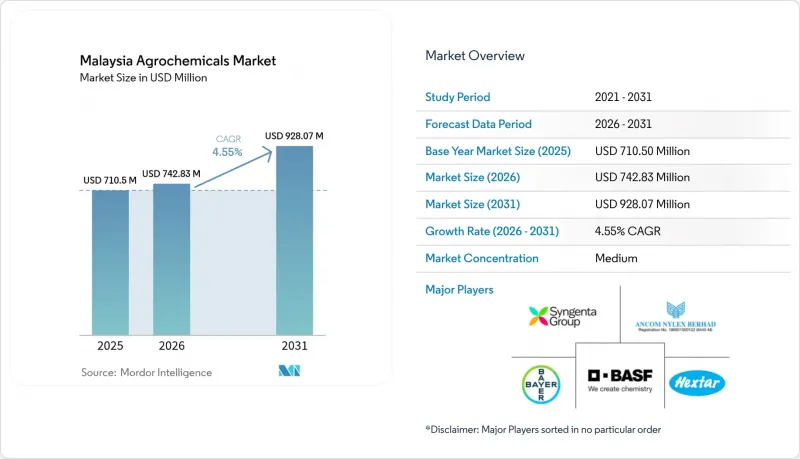
根據 Mordor Intelligence 預測,馬來西亞農藥市場規模將從 2025 年的 7.105 億美元成長到 2026 年的 7.4283 億美元,然後在 2031 年達到 9.2807 億美元,2026 年至 2031 年的複合年成長率為 4.55%。
本報告按產品類型(化肥、農藥、助劑、植物生長調節劑)和作物類型(穀物、油籽和豆類、其他)進行細分。市場預測以貨幣價值(美元)表示。
馬來西亞農藥市場趨勢與洞察
糧食需求不斷成長以及提高作物產量的必要性
馬來西亞的米自給率一直停滯在60%至70%之間,這促使「2021-2030年國家農業食品政策」設定目標,將水稻平均單產從每公頃3.75噸提高到5噸。在吉蘭丹州、彭亨州和登嘉樓州實施的「五季水稻種植」舉措正在擴大化肥和農藥的使用週期,特別是尿素、複合肥(氮磷鉀肥)和合成擬除蟲菊酯類農藥。這種集約化種植模式也蔓延到保護性耕作領域,施肥、灌溉和黏蟲板監測正在取代廣譜殺蟲劑的使用。 FarmByte-Agrobank平台提供信貸額度,用於購買生產材料,並將生產者與一款整合了作物管理建議的應用程式連接起來,從而促進已經登記的產品的使用。都市區收入的成長推動了對優質農產品的需求,鼓勵使用已獲得出口合規認證的無殘留生產材料。
政府對化肥稅的補助和優惠待遇
2025年預算累計3億馬幣(約7,200萬美元)用於新的農業項目,以及26億馬幣(約6.24億美元)用於扶持棕櫚油產業。一項針對柴油燃料的補貼計畫使運輸農藥的物流公司每公升只需支付2.15馬幣(約合0.52美元),從而降低了35%的分銷成本。政府提供聯邦土地發展局(FELDA)的1億馬幣(約2,400萬美元)植樹造林津貼,用於支付早期階段的樹苗和農藥費用。進口化肥免徵銷售稅和服務稅,使複合肥(NPK)的到岸成本降低了3%至5%,減輕了符合良好農業規範(GAP)認證的小規模農戶的負擔。
人工林人手不足限制了施肥率。
人工林工人絕大多數(佔80%)是外籍勞工,但由於簽證發放延誤,到2024年將有4.2萬個職缺,導致施肥作業延誤長達三週。各種植園都在採用緩釋尿素,以將養分有效期延長至90天,並減少施肥次數。機器人應用計畫旨在將棕櫚油種植中每位工人的耕作面積從10公頃提高到17公頃,並將除草劑噴灑的人工時間減少40%。各公司也正在推廣使用背負式靜電噴霧器,以縮短每行噴灑時間。雖然自動化緩解了人手不足,但高昂的資本支出阻礙了小規模種植園採用自動化技術,因此該行業呼籲政府提供諸如縮短折舊免稅額等激勵措施。
細分市場分析
2025年,殺蟲劑佔馬來西亞農藥市佔率的45.78%。這反映了熱帶害蟲對多年生作物種植人工林造成的嚴重危害。除草劑市場繼續保持主導地位,這主要是由於勞動力短缺,在不成熟的棕櫚油種植園中,化學除草尤為重要,因此大量使用Glyphosate和甲磺隆。在扁捲葉蛾(Metisa plana)爆發期間,殺蟲劑的需求激增。 2024年的一項試驗表明,使用無人機進行蘇力菌空中噴灑可使幼蟲發生率降低72%。由於靈芝病造成的產量損失,殺菌劑的使用量也在增加,其中,由於其長效殘留,內吸性三唑類殺菌劑是樹幹注射的首選。隨著可變噴灑速率技術的普及,輔助劑的使用量也在增加,該技術依靠均勻的頻譜來確保藥劑滲透到樹冠層。植物生長調節劑主要由乙烯利和細胞分裂素組合藥物組成,年複合成長率達9.41%。這主要歸功於其能誘導龍眼和榴槤開花,並促進油棕櫚在苗圃中的組織培養繁殖。
化肥是最大的銷售量板塊。氮肥配方在水稻種植中佔據主導地位,而鉀肥配方在人工林人工林營養管理方案中的採用率已達18%,有效減少了養分流失,並符合馬來西亞永續植物保護組織(MSPO)的環境指標。由於出口買家對品質要求日益嚴格,高價值水果專用葉面肥料的銷售量正經歷兩位數成長。
其他好處:
- Excel格式的市場預測(ME)表
- 3個月的分析師支持
目錄
第1章:引言
- 研究假設和市場定義
- 調查範圍
第2章:調查方法
第3章執行摘要
第4章 市場狀況
- 市場概覽
- 市場促進因素
- 病蟲害爆發數量增加
- 糧食需求不斷成長,以及提高作物產量的必要性。
- 政府對化肥稅的補助和優惠待遇
- 油棕櫚和橡膠人工林的擴張
- 精密農業服務介紹
- 利用農業金融科技擴大小規模農戶的貸款
- 市場限制因素
- 嚴格的環境法規和殘留物標準
- 透過基因編輯技術引進抗蟲害作物品種
- 假農藥氾濫
- 人工林人手不足限制了噴灑農藥的使用。
- 監理情勢
- 技術展望
- 波特五力分析
第5章 市場規模與成長預測
- 依產品類型
- 肥料
- 氮基
- 磷酸鹽基
- 加州
- 其他肥料
- 殺蟲劑
- 除草劑
- 殺蟲劑
- 消毒劑
- 其他農藥
- 佐劑
- 植物生長調節劑
- 肥料
- 按作物類型
- 穀物和穀類
- 油籽/豆類
- 水果和蔬菜
- 經濟作物
- 草坪和觀賞草
- 其他作物
第6章 競爭情勢
- 市場集中度
- 策略趨勢
- 市佔率分析
- 公司簡介
- Hextar Group of Companies
- Bayer AG
- Syngenta Group
- Nufarm
- Ancom Nylex Berhad
- BASF SE
- UPL Ltd
- Corteva Agriscience
- Yara International ASA
- Crop Protection(M)Sdn Bhd
- Agricultural Chemicals(M)Sdn Bhd
- Farmcochem Sdn Bhd
- PK Fertilizers Sdn Bhd
- Central Minerals and Chemicals Sdn Bhd
- Kenso Corporation Sdn Bhd
第7章 市場機會與未來展望
According to Mordor Intelligence, the Malaysia agrochemicals market size is expected to grow from USD 710.50 million in 2025 to USD 742.83 million in 2026 and is forecast to reach USD 928.07 million by 2031 at 4.55% CAGR over 2026-2031.
This report is Segmented by Product Type (Fertilizers, Pesticides, Adjuvants, and Plant Growth Regulators) and Crop Type (Grains and Cereals, Oilseeds and Pulses, and More). The Market Forecasts are Provided in Terms of Value (USD).
Malaysia Agrochemicals Market Trends and Insights
Rising food demand and need for higher crop productivity
Malaysia's rice self-sufficiency rate stalled between 60% and 70%, prompting the National Agrofood Policy 2021-2030 to raise average paddy yields from 3.75 metric tons per hectare to 5.0 metric tons per hectare. The five-season paddy initiative in Kelantan, Pahang, and Terengganu magnifies fertilizer and pesticide cycles, especially urea, compound NPK, and synthetic pyrethroids. Intensification extends to protected horticulture, where fertigation and sticky-trap monitoring are displacing broad-spectrum sprays. Credit lines from the FarmByte-Agrobank platform cover input purchases and link growers to bundled crop-advice apps, fostering adoption of registered products. Rising urban incomes support premium produce, encouraging residue-free inputs with export compliance certification.
Government subsidies and fertilizer tax incentives
Budget 2025 earmarked RM300 million (USD 72 million) for new agricultural projects and RM2.6 billion (USD 624 million) for palm oil sector support. Under the targeted diesel subsidy, logistics operators hauling agrochemicals pay RM2.15 per liter (USD 0.52), trimming distribution costs by 35%. Replanting grants of RM100 million (USD 24 million) to the Federal Land Development Authority (FELDA) cover seedling and pesticide expenses during the immature phases. The Sales and Service Tax exemption on imported fertilizers lower landed costs for compound NPKs by 3-5 %, improving affordability for smallholders adhering to Good Agricultural Practices (GAP) certification.
Plantation labor shortages curbing application rates
The majority of plantation field workers, comprising 80%, are migrants, and visa delays have left 42,000 positions unfilled in 2024, which has postponed fertilizer applications by up to three weeks. Estates adopt controlled-release urea, extending nutrient availability to 90 days and reducing pass counts. Robotics projects aim to raise per-worker coverage from 10 ha to 17 ha in palm oil, trimming herbicide labor hours by 40%. Companies also push backpack-mounted electrostatic sprayers that shorten spray time per row. While automation offsets shortages, CapEx outlays curb uptake among smaller estates, provoking industry calls for accelerated depreciation incentives.
Other drivers and restraints analyzed in the detailed report include:
- Expansion of oil palm and rubber plantations
- Adoption of precision-farming services
- Proliferation of counterfeit agrochemicals
For complete list of drivers and restraints, kindly check the Table Of Contents.
Segment Analysis
Pesticides captured 45.78% of Malaysia agrochemicals market share in 2025, reflecting endemic tropical pest pressure on perennial estates. The herbicide subset continues to dominate, driven by glyphosate and metsulfuron use in immature palm circles where labor scarcity elevates chemical weed control. Insecticide demand spikes during Metisa plana outbreaks. Aerial Bacillus thuringiensis drone sprays reduced larval incidence by 72% in 2024 trials. Fungicide volumes rise alongside Ganoderma-related yield losses, with systemic triazoles favored for trunk injections due to extended residual activity. Adjuvant uptake grows in tandem with variable-rate technology that relies on uniform droplet spectra to ensure canopy penetration. Plant growth regulators largely include ethephon and cytokinin blends, posting a 9.41% CAGR, benefiting from longan and durian flowering manipulation and tissue culture propagation in oil palm nurseries.
Fertilizers represent the largest volume segment, with nitrogenous formulations dominating paddy applications while potassic blends gain traction in plantation sectors seeking enhanced fruit quality and disease resistance. Precision soil testing in Johor identifies micro-nutrient deficiencies, spurring specialty blends with boron and magnesium additives. Controlled-release formulations reach 18% penetration in estate nutrition programs, lowering leaching losses and aligning with MSPO environmental metrics. Specialty foliar fertilizers for high-value fruits register double-digit growth as export buyers tighten quality specifications.
Complete Report Scope:
- By Product Type
- Fertilizers
- Nitrogenous
- Phosphatic
- Potassic
- Other Fertilizers
- Pesticides
- Herbicides
- Insecticides
- Fungicides
- Other pesticides
- Adjuvants
- Plant Growth Regulators
- Fertilizers
- By Crop Type
- Grains and Cereals
- Oilseeds and Pulses
- Fruits and Vegetables
- Commercial Crops
- Turf and Ornamental Grass
- Other Crops
List of Companies Covered in this Report:
- Hextar Group of Companies
- Bayer AG
- Syngenta Group
- Nufarm
- Ancom Nylex Berhad
- BASF SE
- UPL Ltd
- Corteva Agriscience
- Yara International ASA
- Crop Protection (M) Sdn Bhd
- Agricultural Chemicals (M) Sdn Bhd
- Farmcochem Sdn Bhd
- PK Fertilizers Sdn Bhd
- Central Minerals and Chemicals Sdn Bhd
- Kenso Corporation Sdn Bhd
Additional Benefits:
- The market estimate (ME) sheet in Excel format
- 3 months of analyst support
TABLE OF CONTENTS
1 Introduction
- 1.1 Study Assumptions and Market Definition
- 1.2 Scope of the Study
2 Research Methodology
3 Executive Summary
4 Market Landscape
- 4.1 Market Overview
- 4.2 Market Drivers
- 4.2.1 Increasing incidence of pests and diseases
- 4.2.2 Rising food demand and need for higher crop productivity
- 4.2.3 Government subsidies and fertilizer tax incentives
- 4.2.4 Expansion of oil palm and rubber plantations
- 4.2.5 Adoption of precision-farming services
- 4.2.6 Growth of agri-fintech-enabled smallholder credit
- 4.3 Market Restraints
- 4.3.1 Stringent environmental regulations and residue limits
- 4.3.2 Adoption of gene-edited pest-resistant crop varieties
- 4.3.3 Proliferation of counterfeit agrochemicals
- 4.3.4 Plantation labor shortages curbing application rates
- 4.4 Regulatory Landscape
- 4.5 Technological Outlook
- 4.6 Porter's Five Forces Analysis
- 4.6.1 Threat of New Entrants
- 4.6.2 Bargaining Power of Buyers
- 4.6.3 Bargaining Power of Suppliers
- 4.6.4 Threat of Substitute Products
- 4.6.5 Intensity of Competitive Rivalry
5 Market Size and Growth Forecasts (Value)
- 5.1 By Product Type
- 5.1.1 Fertilizers
- 5.1.1.1 Nitrogenous
- 5.1.1.2 Phosphatic
- 5.1.1.3 Potassic
- 5.1.1.4 Other Fertilizers
- 5.1.2 Pesticides
- 5.1.2.1 Herbicides
- 5.1.2.2 Insecticides
- 5.1.2.3 Fungicides
- 5.1.2.4 Other pesticides
- 5.1.3 Adjuvants
- 5.1.4 Plant Growth Regulators
- 5.1.1 Fertilizers
- 5.2 By Crop Type
- 5.2.1 Grains and Cereals
- 5.2.2 Oilseeds and Pulses
- 5.2.3 Fruits and Vegetables
- 5.2.4 Commercial Crops
- 5.2.5 Turf and Ornamental Grass
- 5.2.6 Other Crops
6 Competitive Landscape
- 6.1 Market Concentration
- 6.2 Strategic Moves
- 6.3 Market Share Analysis
- 6.4 Company Profiles (Includes Global Level Overview, Market Level Overview, Core Segments, Financials as Available, Strategic Information, Market Rank/Share, Products and Services, and Recent Developments)
- 6.4.1 Hextar Group of Companies
- 6.4.2 Bayer AG
- 6.4.3 Syngenta Group
- 6.4.4 Nufarm
- 6.4.5 Ancom Nylex Berhad
- 6.4.6 BASF SE
- 6.4.7 UPL Ltd
- 6.4.8 Corteva Agriscience
- 6.4.9 Yara International ASA
- 6.4.10 Crop Protection (M) Sdn Bhd
- 6.4.11 Agricultural Chemicals (M) Sdn Bhd
- 6.4.12 Farmcochem Sdn Bhd
- 6.4.13 PK Fertilizers Sdn Bhd
- 6.4.14 Central Minerals and Chemicals Sdn Bhd
- 6.4.15 Kenso Corporation Sdn Bhd
7 Market Opportunities and Future Outlook

 農業化學品市場報告:趨勢、預測和競爭分析(至2035年)
 作物缺水緩解劑及噴劑的市場機會、成長促進因素、產業趨勢分析及2026-2035年預測
 農藥儲槽市場:全球市場預測,2026-2032年
 農業化學品儲罐市場規模、佔有率和成長分析:按類型、應用、容量和地區分類 - 2026-2033 年行業預測
 Miravis Neo 殺菌劑 2026 年全球市場報告Miravistop 殺菌劑 2026 年全球市場報告2026 年至 2035 年專利到期和非專利農藥市場的商業機會、成長要素、產業趨勢和預測。農業化學品市場:按產品類型、性質、作物類型、製劑形式和應用分類-全球預測,2026-2032年Glyphosate原藥:市場機會、成長促進因素、產業趨勢分析及2026-2035年預測
 工業化學品市場預測至2034年-按產品類型、形態、製造流程、最終用戶、通路和地區分類的全球分析