


 |
市場調查報告書
商品編碼
2113614
北美農藥市場:市佔率分析、產業趨勢與統計及成長預測(2026-2031 年)North America Agrochemical - Market Share Analysis, Industry Trends & Statistics, Growth Forecasts (2026 - 2031) |
||||||

※ 本網頁內容可能與最新版本有所差異。詳細情況請與我們聯繫。
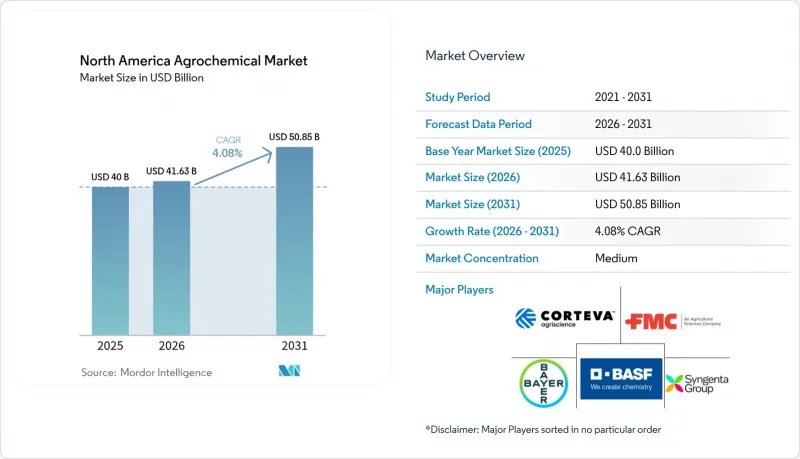
根據 Mordor Intelligence 預測,北美農藥市場規模將從 2025 年的 400 億美元成長到 2026 年的 416.3 億美元,然後在 2031 年達到 508.5 億美元,2026 年至 2031 年的複合年成長率為 4.08%。
本報告按類型(肥料、農藥、助劑、植物生長調節劑)、應用領域(穀物、豆類和油籽、水果和蔬菜、草坪和觀賞植物以及其他應用領域)和地區(美國、加拿大、墨西哥、北美及其他地區)進行分類。市場預測以美元(USD)為單位。
北美農藥市場趨勢與洞察
提高作物產量的需求日益成長
美國農業部預測,到2030年,玉米產量需要每年增加1.2%才能滿足糧食需求。田間試驗表明,植物生長調節劑,特別是Ascend 2,可以使玉米畝產提高3蒲式耳。結合精準噴灑技術,這既能減少養分流失,又能促進農民參與排碳權計畫。美國中西部和加拿大草原地區的農民正在採用這些技術來提高產量,即使產量略有提高,也能帶來可觀的收入成長。這些市場動態促使生產商將研發重點放在能夠帶來可量化增產效果的配方上,而不是僅僅維持現有的產量水準。
政府農藥購買補助計劃
在北美,政府資助正在降低現代農業投入品的普及門檻。 2024年,美國農業部撥款2.36億美元用於擴大國內化肥生產,旨在緩解價格波動並減少對進口的依賴。在墨西哥,政府計畫支持永續農作物保護產品,即使Glyphosate的使用受到限制,也能維持市場需求。加拿大各省正在實施精密農業技術的成本分擔計劃,包括變數噴灑設備和土壤檢測服務。這些補貼有效降低了農民的投入成本,並透過縮短精密農業設備和特殊農藥的投資回收期,加速了先進技術的應用。
美國環保署(EPA)嚴格的重新註冊要求
每年每件產品需繳納4,875美元的維護費,加上更嚴格的生態學評估,導致合規成本上升,對規模小規模的註冊商造成衝擊,並導致產品退出市場。除草劑策略的實施需要對900多種瀕危物種採取緩解措施,包括限制噴灑和設立緩衝區,這將影響產品的使用模式。 2024年10月,由於未繳納維護費,根據《聯邦殺蟲劑、殺菌劑和滅鼠劑法案》第三部分註冊的131項產品和根據第24(c)條註冊的44項產品被撤銷。 2022年《農藥註冊改進法案》強制要求雙語標籤,規定到2025年,高毒性產品的健康和安全資訊必須提供西班牙語版本,到2030年,所有農藥標籤都必須提供西班牙語版本。
細分市場分析
到2025年,化肥將佔北美農藥市場佔有率的45.75%,在玉米、大豆和小麥等主要產區的養分管理中保持至關重要的地位。高效能緩釋化肥因其與排碳權計劃和精準噴灑設備的兼容性,市場佔有率正在不斷擴大。數位土壤測繪技術使供應商能夠提供客製化肥料配方,從而在整體銷售量持平的情況下提高每噸肥料的收益。
在北美農藥市場,噴灑器是成長最快的細分市場,預計到2031年將以6.18%的複合年成長率成長。這一成長主要得益於對噴霧品質增強劑的需求不斷成長,這些增強劑能夠最大限度地減少漂移並提高葉面吸收率。這一成長與無人機和自動噴霧器技術的日益普及密切相關,由於這些設備攜帶的液體量較小,因此需要使用特殊的表面活性劑。儘管市場佔有率較小,但噴灑器的複合年成長率仍達到中個位數,超過了農藥和化肥,這主要得益於監管要求對提高噴灑標靶精度的重視。農藥仍然是第二大產品類型,其中除草劑佔據主導地位,這主要是由於抗除草劑作物的激增以及對雜草控制的需求。植物生長調節劑仍然是一個高度專業化的細分市場,例如WinField United公司的「Ascend 2」產品,每英畝可使玉米增產3蒲式耳,儘管市場滲透率有限,但仍能維持較高的價格。
其他好處:
- Excel格式的市場預測(ME)表
- 3個月的分析師支持
目錄
第1章:引言
- 研究假設和市場定義
- 調查範圍
第2章:調查方法
第3章執行摘要
第4章 市場狀況
- 市場概覽
- 市場促進因素
- 提高作物產量的需求日益成長
- 政府農藥購買補助計劃
- 精密農業正在推動投入材料的最佳化。
- 害蟲抗藥性的日益增強以及對更佳解決方案的需求。
- 與碳權額度掛鉤的高效能殺蟲劑
- 擴大特殊微量營養素混合物的供應
- 市場限制因素
- 美國環保署(EPA)實施的嚴格重新註冊要求
- 研發成本和報名費用不斷上漲
- 消費者呼籲生產不含農藥殘留的農產品。
- 以生物解決方案取代傳統化學品
- 監理情勢
- 技術展望
- 波特五力分析
第5章 市場規模與成長預測
- 依產品類型
- 肥料
- 氮基
- 磷酸鹽基
- 加州
- 其他肥料
- 殺蟲劑
- 除草劑
- 殺蟲劑
- 消毒劑
- 其他農藥
- 佐劑
- 植物生長調節劑
- 肥料
- 透過使用
- 穀物和穀類
- 豆類和油籽
- 水果和蔬菜
- 草坪和觀賞植物
- 其他用途
- 按地區
- 美國
- 加拿大
- 墨西哥
- 其他北美國家
第6章 競爭情勢
- 市場集中度
- 策略趨勢
- 市佔率分析
- 公司簡介
- Syngenta Group
- Bayer AG
- Corteva Agriscience
- BASF SE
- FMC Corporation
- UPL Limited
- Nutrien Ltd.
- The Mosaic Company
- CF Industries Holdings, Inc.
- Yara International ASA
- Sumitomo Chemical America, Inc.
- ICL Group Ltd.
- Nufarm Limited
- Haifa Chemicals Ltd.
- Helena Agri-Enterprises, LLC(Marubeni Corporation)
第7章 市場機會與未來展望
According to Mordor Intelligence, the North America agrochemical market size is expected to grow from USD 40.0 billion in 2025 to USD 41.63 billion in 2026 and is forecast to reach USD 50.85 billion by 2031 at 4.08% CAGR over 2026-2031.
This report is Segmented by Type (Fertilizers, Pesticides, Adjuvants, and Plant Growth Regulators), by Application (Grains and Cereals, Pulses and Oilseeds, Fruits and Vegetables, Turfs and Ornamentals, and Other Applications), and by Geography (United States, Canada, Mexico, and Rest of North America). The Market Forecasts are Provided in Terms of Value (USD).
North America Agrochemical Market Trends and Insights
Rising Demand for Higher Crop Yields
The United States Department of Agriculture projects that corn productivity must increase by 1.2% annually to meet food demand by 2030. Field trials demonstrate that plant-growth regulators, specifically Ascend 2, increase corn yields by 3 bushels per acre. The combination of precision application techniques reduces nutrient losses while facilitating participation in carbon-credit programs. Agricultural producers across the Midwest United States and Canadian Prairies implement these yield-enhancing technologies, as incremental percentage improvements translate to substantial revenue increases. This market dynamic influences manufacturers to focus research and development on formulations that provide quantifiable yield improvements rather than maintaining existing productivity levels.
Government Agrochemicals Purchase Subsidy Programs
Government funding initiatives are reducing barriers to adopting modern agricultural inputs across North America. In 2024, the United States Department of Agriculture allocated USD 236 million to increase domestic fertilizer production, aiming to reduce price volatility and decrease import dependency. In Mexico, government programs support sustainable crop protection products, maintaining demand despite glyphosate limitations. Canadian provinces implement cost-sharing programs for precision agriculture technologies, including variable rate application equipment and soil testing services. These subsidies effectively reduce farmers' input costs and facilitate the adoption of advanced technologies by shortening the return on investment period for precision equipment and specialized agricultural chemicals.
Stringent Environmental Protection Agency (EPA) Re-Registration Requirements
The annual maintenance fees of USD 4,875 per product and enhanced ecological assessments increase compliance costs, affecting smaller registrants and leading to product withdrawals. The implementation of the Herbicide Strategy necessitates mitigation measures for over 900 endangered species, which include application restrictions and buffer zone requirements that impact product usage patterns. In October 2024, 131 Federal Insecticide, Fungicide, and Rodenticide Act section 3 registrations and 44 Federal Insecticide, Fungicide, and Rodenticide Act section 24(c) registrations were cancelled due to non-payment of maintenance fees. The Pesticide Registration Improvement Act of 2022 requires bilingual labeling, with Spanish translations for health and safety sections mandatory by 2025 for high-toxicity products and for all pesticide labels by 2030.
Other drivers and restraints analyzed in the detailed report include:
- Precision Farming Driving Optimized Inputs
- Carbon-Credit Linked Enhanced-Efficiency Agrochemicals
- Consumer Push for Residue-Free Produce
For complete list of drivers and restraints, kindly check the Table Of Contents.
Segment Analysis
Fertilizers hold 45.75% of the North America agrochemical market share in 2025, maintaining their essential position in nutrient management across major corn, soybean, and wheat production areas. Enhanced-efficiency fertilizers, featuring controlled-release mechanisms, gain market share through their compatibility with carbon-credit programs and precision application equipment. Digital soil-mapping enables suppliers to offer customized blends, increasing revenue per metric ton despite stable overall volumes.
Adjuvants represent the fastest-growing segment in the North American agrochemical market, with a 6.18% CAGR through 2031. This growth stems from rising demand for spray-quality enhancers that minimize drift and improve foliar absorption. The growth correlates with increased adoption of drone and autonomous sprayer technologies, which require specialized surface-active agents due to lower carrier volumes. Despite their smaller market share, adjuvants achieve mid-single-digit CAGR, exceeding pesticides and fertilizers, as regulatory requirements emphasize improved spray deposition accuracy. Pesticides maintain their position as the second-largest product category, with herbicides predominant due to widespread herbicide-tolerant crop adoption and weed control needs. Plant growth regulators remain a specialized segment, with products like WinField United's Ascend 2 delivering corn yield increases of 3 bushels per acre, supporting premium pricing despite limited market reach.
Complete Report Scope:
- By Product Type
- Fertilizers
- Nitrogenous
- Phosphatic
- Potassic
- Other Fertilizers
- Pesticides
- Herbicides
- Insecticides
- Fungicides
- Other Pesticides
- Adjuvants
- Plant Growth Regulators
- Fertilizers
- By Application
- Grains and Cereals
- Pulses and Oilseeds
- Fruits and Vegetables
- Turfs and Ornamentals
- Other Applications
- By Geography
- United States
- Canada
- Mexico
- Rest of North America
List of Companies Covered in this Report:
- Syngenta Group
- Bayer AG
- Corteva Agriscience
- BASF SE
- FMC Corporation
- UPL Limited
- Nutrien Ltd.
- The Mosaic Company
- CF Industries Holdings, Inc.
- Yara International ASA
- Sumitomo Chemical America, Inc.
- ICL Group Ltd.
- Nufarm Limited
- Haifa Chemicals Ltd.
- Helena Agri-Enterprises, LLC (Marubeni Corporation)
Additional Benefits:
- The market estimate (ME) sheet in Excel format
- 3 months of analyst support
TABLE OF CONTENTS
1 Introduction
- 1.1 Study Assumptions and Market Definition
- 1.2 Scope of the Study
2 Research Methodology
3 Executive Summary
4 Market Landscape
- 4.1 Market Overview
- 4.2 Market Drivers
- 4.2.1 Rising Demand for Higher Crop Yields
- 4.2.2 Government Agrochemicals Purchase Subsidy Programs
- 4.2.3 Precision Farming Driving Optimized Inputs
- 4.2.4 Rising Pest Resistance and Demand for Modified Solutions
- 4.2.5 Carbon-Credit Linked Enhanced-Efficiency Agrochemicals
- 4.2.6 Expansion of Specialty Micronutrient Blends
- 4.3 Market Restraints
- 4.3.1 Stringent Environmental Protection Agency (EPA) Re-Registration Requirements
- 4.3.2 Escalating Research and Development and Registration Costs
- 4.3.3 Consumer Push for Residue-Free Produce
- 4.3.4 Biological Solutions Displacing Conventional Chemicals
- 4.4 Regulatory Landscape
- 4.5 Technological Outlook
- 4.6 Porter's Five Forces Analysis
- 4.6.1 Bargaining Power of Suppliers
- 4.6.2 Bargaining Power of Buyers
- 4.6.3 Threat of Substitutes
- 4.6.4 Threat of New Entrants
- 4.6.5 Intensity of Competitive Rivalry
5 Market Size and Growth Forecasts (Value)
- 5.1 By Product Type
- 5.1.1 Fertilizers
- 5.1.1.1 Nitrogenous
- 5.1.1.2 Phosphatic
- 5.1.1.3 Potassic
- 5.1.1.4 Other Fertilizers
- 5.1.2 Pesticides
- 5.1.2.1 Herbicides
- 5.1.2.2 Insecticides
- 5.1.2.3 Fungicides
- 5.1.2.4 Other Pesticides
- 5.1.3 Adjuvants
- 5.1.4 Plant Growth Regulators
- 5.1.1 Fertilizers
- 5.2 By Application
- 5.2.1 Grains and Cereals
- 5.2.2 Pulses and Oilseeds
- 5.2.3 Fruits and Vegetables
- 5.2.4 Turfs and Ornamentals
- 5.2.5 Other Applications
- 5.3 By Geography
- 5.3.1 United States
- 5.3.2 Canada
- 5.3.3 Mexico
- 5.3.4 Rest of North America
6 Competitive Landscape
- 6.1 Market Concentration
- 6.2 Strategic Moves
- 6.3 Market Share Analysis
- 6.4 Company Profiles (Includes Global-Level Overview, Market-Level Overview, Core Segments, Financials as Available, Strategic Information, Market Rank/Share for Key Companies, Products and Services, and Recent Developments)
- 6.4.1 Syngenta Group
- 6.4.2 Bayer AG
- 6.4.3 Corteva Agriscience
- 6.4.4 BASF SE
- 6.4.5 FMC Corporation
- 6.4.6 UPL Limited
- 6.4.7 Nutrien Ltd.
- 6.4.8 The Mosaic Company
- 6.4.9 CF Industries Holdings, Inc.
- 6.4.10 Yara International ASA
- 6.4.11 Sumitomo Chemical America, Inc.
- 6.4.12 ICL Group Ltd.
- 6.4.13 Nufarm Limited
- 6.4.14 Haifa Chemicals Ltd.
- 6.4.15 Helena Agri-Enterprises, LLC (Marubeni Corporation)
7 Market Opportunities and Future Outlook

 右旋苯醚菊酯市場規模、佔有率和成長分析:按製劑、應用、目標害蟲、分銷管道和地區分類 - 產業預測,2026-2033年
 農業化學品市場報告:趨勢、預測和競爭分析(至2035年)
 2034年酶基工業化學品市場預測-按酵素類型、原料、生產方法、功能特性、最終用戶和地區分類的全球分析
 作物缺水緩解劑及噴劑的市場機會、成長促進因素、產業趨勢分析及2026-2035年預測
 農藥儲槽市場:全球市場預測,2026-2032年
 南美洲農藥市場:市場佔有率分析、產業趨勢與統計及成長預測(2026-2031 年)印尼農藥市場:市場佔有率分析、產業趨勢與統計及成長預測(2026-2031)非洲農藥:市場佔有率分析、產業趨勢與統計及成長預測(2026-2031 年)印度農業化學品:市場佔有率分析、產業趨勢與統計及成長預測(2026-2031)馬來西亞農藥市場:市場佔有率分析、產業趨勢與統計及成長預測(2026-2031)