


 |
市場調查報告書
商品編碼
2120644
非洲農藥:市場佔有率分析、產業趨勢與統計及成長預測(2026-2031 年)Africa Agrochemicals - Market Share Analysis, Industry Trends & Statistics, Growth Forecasts (2026 - 2031) |
||||||

※ 本網頁內容可能與最新版本有所差異。詳細情況請與我們聯繫。
根據 Mordor Intelligence 預測,非洲農藥市場規模將從 2025 年的 117 億美元成長到 2026 年的 122.1 億美元,到 2031 年將達到 150.8 億美元,2026 年至 2031 年的複合年成長率為 4.32%。
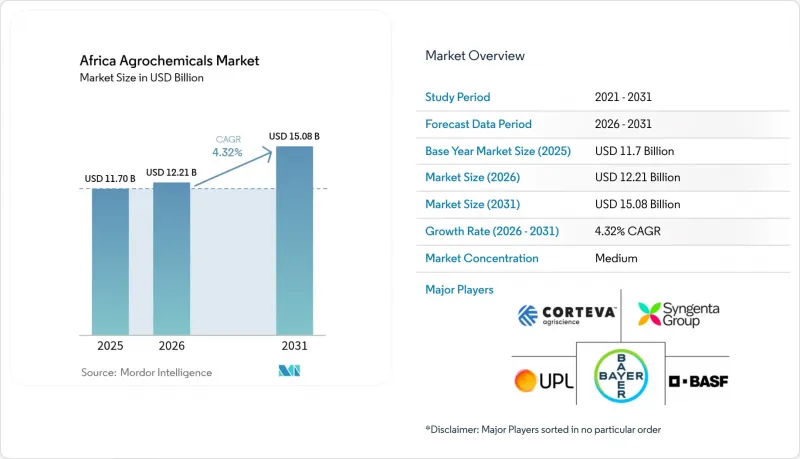
本報告按產品類型(化肥、農藥、助劑、植物生長調節劑)、應用領域(穀物、豆類和油籽、水果和蔬菜、經濟作物)以及地區(埃及、摩洛哥、坦尚尼亞、南非等)進行細分。市場預測以美元計價。
非洲農藥市場趨勢與洞察
氣候變遷導致病蟲害威脅加劇
氣候模式的波動導致非洲多個國家入侵害蟲(例如秋鶯)的爆發加劇,嚴重影響玉米產量。糧食產區的獨腳金雜草爆發持續影響收成,促使農民實施全面化學防治方案。肯亞、加納和衣索比亞已建立緊急應變機制,當地組織負責協調害蟲監測網。農業相關企業正加速研發針對害蟲幼蟲的精準殺蟲劑,數位監測平台則為農民提供即時預警。這些因素推動了非洲農藥市場的持續成長。對種子處理化學品和農民教育計畫的投資進一步促進了市場發展。官民合作關係使農民更容易獲得新的作物保護解決方案。
人口成長加劇了糧食需求缺口。
由於小規模農戶農藥使用量低於建議水平,農業生產力仍受到限制。奈及利亞、衣索比亞和坦尚尼亞面臨著因農業勞動力向都市區遷移而導致的嚴重限制。政府為提高產量,加大了國內化肥生產和灌溉基礎設施的投資。埃塞俄比亞的灌溉擴建計劃著重於提高低地地區的生產力並減少對進口的依賴。不斷成長的糧食需求持續推動非洲農藥市場的發展,包括化學肥料、農藥和植物生長調節劑。擴大農業分銷網路和部署行動諮詢服務,使農民更容易獲得農業物資和知識。為了應對不斷變化的氣候條件,農民擴大採用適應氣候變遷的農藥解決方案。
農藥價格飆升,小規模農戶難以負擔。
在內陸國家,運輸成本佔最終零售價格的50%之多;在衣索比亞,化肥價格近年來大幅上漲。肯亞提案通過2025會計年度法案對農藥徵收16%的增值稅,可能會顯著增加生產成本。奈及利亞在2024年中期遭遇創紀錄的食品通膨,迫使家庭將收入的很大一部分用於食品,從而減少了可用於農業投資的資金。農民往往依賴非正規貸款機構,這些機構每週收取高額利息,導致債務循環,阻礙了非洲農藥市場的成長。這些經濟負擔阻礙了有效農作物保護產品的推廣應用,導致作物產量無法達到最佳水平,糧食安全挑戰仍然嚴峻。
細分市場分析
至2025年,化肥將佔非洲農藥市場50.55%的佔有率。這主要歸功於化肥在解決普遍存在的土壤養分缺乏問題以及支持不同農業生態區域的農業生產力方面發揮的重要作用。氮肥仍然是糧食生產的關鍵,而磷肥和鉀肥則透過均衡的營養方案日益普及。基於數位贈款、電子代金券和倉單的信貸機制正在降低資金門檻,並確保及時施肥。
植物生長調節劑的複合年成長率 (CAGR) 為 6.8%,這主要得益於人們擴大採用能夠提高植物抗逆性、促進根系發育和提升產量潛力的營養物質。農藥在非洲的銷售量仍然可觀,其中除草劑由於勞動力短缺和抗性雜草的出現而佔據市場主導地位。為因應氣候變遷引發的蟲害爆發,殺蟲劑的需求正在成長,而殺菌劑在園藝領域的應用也不斷擴大。儘管助劑市場佔有率較小,但隨著精準噴灑設備的普及,人們對能夠提高葉面覆蓋率和簡化混配的複雜配方的需求日益成長,助劑的重要性也日益凸顯。
其他好處:
- Excel格式的市場預測(ME)表
- 3個月的分析師支持
目錄
第1章:引言
- 研究假設和市場定義
- 調查範圍
第2章:調查方法
第3章執行摘要
第4章 市場狀況
- 市場概覽
- 市場促進因素
- 氣候變遷導致病蟲害威脅加劇
- 人口成長正在擴大糧食需求缺口。
- 政府對引種進化肥料和農藥的補貼計劃
- 機械化和精密農業的引進提高了農藥的使用效率。
- 擴大倉單貸款規模將為生產材料創造營運資金。
- 自有品牌農產品零售連鎖店的興起正在改善最後一公里物流。
- 市場限制因素
- 農藥價格太高,小規模農戶負擔不起。
- 法規核准流程的細分與收緊
- 假冒農藥的氾濫正在損害農民的信譽。
- 有機和無農藥出口作物計劃正在遏制合成農藥的使用。
- 監理情勢
- 技術展望
- 波特五力分析
第5章 市場規模與成長預測
- 依產品類型
- 肥料
- 氮基
- 磷酸鹽基
- 加州
- 殺蟲劑
- 除草劑
- 殺蟲劑
- 消毒劑
- 佐劑
- 植物生長調節劑
- 肥料
- 透過使用
- 穀物和穀類
- 豆類和油籽
- 水果和蔬菜
- 經濟作物(甘蔗、棉花等)
- 按地區
- 埃及
- 摩洛哥
- 阿爾及利亞
- 肯亞
- 坦尚尼亞
- 衣索比亞
- 南非
- 尚比亞
- 辛巴威
- 奈及利亞
- 迦納
- 剛果民主共和國
- 其他非洲國家
第6章 競爭情勢
- 市場集中度
- 策略趨勢
- 市佔率分析
- 公司簡介
- Bayer AG
- Syngenta Group
- Corteva Agriscience
- BASF SE
- FMC Corporation
- UPL Limited
- Yara International ASA
- Sumitomo Chemical Co., Ltd.
- Gowan Company(Isagro Srl)
- Rovensa SA(Partners Group)
- Sasol Limited
- Twiga Chemical Industries Ltd.(AJ Group)
- OCP Group
- Indorama Corporation
- Albaugh LLC
第7章 市場機會與未來展望
According to Mordor Intelligence, the Africa agrochemicals market size is expected to grow from USD 11.7 billion in 2025 to USD 12.21 billion in 2026 and is forecast to reach USD 15.08 billion by 2031 at 4.32% CAGR over 2026-2031.
This report is Segmented by Product Type (Fertilizers, Pesticides, Adjuvants, and Plant Growth Regulators), by Application (Grains and Cereals, Pulses and Oilseeds, Fruits and Vegetables, and Commercial Crops), and by Geography (Egypt, Morocco, Tanzania, South Africa, and More). The Market Forecasts are Provided in Terms of Value (USD).
Africa Agrochemicals Market Trends and Insights
Climate-driven Rise in Pest and Disease Pressure
Variable weather patterns have increased the spread of invasive pests like fall armyworm across multiple African nations, significantly impacting maize yields. Striga weed infestations in cereal-growing regions continue to affect harvests, leading farmers to implement integrated chemical control programs. Kenya, Ghana, and Ethiopia have established emergency response protocols, while regional organizations coordinate pest surveillance networks. Agricultural companies have accelerated the development of precision insecticides targeting pest larvae, and digital monitoring platforms provide real-time alerts to farmers. These factors drive sustained growth in the Africa agrochemicals market. The market gains additional momentum through investments in seed treatment chemicals and farmer education programs. Public-private partnerships are improving farmer access to new crop protection solutions.
Population Growth Accelerating Food-demand Gap
Agricultural productivity remains limited as smallholder farmers use agrochemicals below recommended levels. Nigeria, Ethiopia, and Tanzania experience significant constraints due to urban migration, reducing the agricultural workforce. Government initiatives include investments in domestic fertilizer production and irrigation infrastructure to improve yields. Ethiopia's irrigation expansion program focuses on increasing lowland productivity and decreasing import dependence. Growing food demand continues to drive the African agrochemicals market for fertilizers, pesticides, and plant growth regulator products. The expansion of agricultural dealer networks and mobile advisory services helps improve farmers' access to inputs and knowledge. Farmers increasingly adopt climate-resilient agrochemical solutions to address changing weather conditions.
High Agrochemical Prices Unaffordable to Smallholders
Transport costs in landlocked countries account for up to 50% of final retail prices, while Ethiopia experienced significant increases in fertilizer prices in recent years. Kenya's proposed 16% VAT on agrochemicals through the 2025 Finance Bill may substantially increase production costs. Nigeria's record-high food inflation in mid-2024 forced households to spend most of their income on food, reducing funds available for farm investments. Farmers often turn to informal lenders charging high weekly interest rates, creating debt cycles that limit growth in the Africa agrochemicals market. The resulting affordability issues reduce the adoption of effective crop protection products, leading to suboptimal yields and continued food security challenges.
Other drivers and restraints analyzed in the detailed report include:
- Government Subsidy Programs for Fertilizer and Pesticide Adoption
- Expansion of Warehouse-receipt Financing Unlocking Working-capital for Inputs
- Fragmented and Stringent Regulatory Approval Timelines
For complete list of drivers and restraints, kindly check the Table Of Contents.
Segment Analysis
Fertilizers held 50.55% of the Africa agrochemicals market share in 2025, addressing widespread soil nutrient deficiencies and supporting agricultural productivity across various agroecological zones. Nitrogen-based formulations remain essential for cereal production, while phosphatic and potassic fertilizers gain adoption through balanced nutrition programs. Digital subsidy e-vouchers and warehouse-receipt credit systems reduce financial barriers and enable timely fertilizer application.
Plant growth regulators demonstrate a 6.8% CAGR, driven by increased adoption of nutrients that improve stress tolerance, root development, and yield potential. Pesticides maintain significant volume across Africa, with herbicides dominating due to labor shortages and resistant weed populations. Insecticide demand increases in response to climate-related pest outbreaks, while fungicide use expands in horticultural regions. Adjuvants, though a smaller segment, grow in importance as precision spraying equipment requires advanced formulations for improved leaf coverage and simplified tank mixing.
Complete Report Scope:
- By Product Type
- Fertilizers
- Nitrogenous
- Phosphatic
- Potassic
- Pesticides
- Herbicides
- Insecticides
- Fungicides
- Adjuvants
- Plant Growth Regulators
- Fertilizers
- By Application
- Grains and Cereals
- Pulses and Oilseeds
- Fruits and Vegetables
- Commercial Crops (Sugarcane, Cotton, and Others)
- By Geography
- Egypt
- Morocco
- Algeria
- Kenya
- Tanzania
- Ethiopia
- South Africa
- Zambia
- Zimbabwe
- Nigeria
- Ghana
- DR Congo
- Rest of Africa
List of Companies Covered in this Report:
- Bayer AG
- Syngenta Group
- Corteva Agriscience
- BASF SE
- FMC Corporation
- UPL Limited
- Yara International ASA
- Sumitomo Chemical Co., Ltd.
- Gowan Company (Isagro S.r.l.)
- Rovensa S.A (Partners Group)
- Sasol Limited
- Twiga Chemical Industries Ltd. (AJ Group)
- OCP Group
- Indorama Corporation
- Albaugh LLC
Additional Benefits:
- The market estimate (ME) sheet in Excel format
- 3 months of analyst support
TABLE OF CONTENTS
1 Introduction
- 1.1 Study Assumptions and Market Definition
- 1.2 Scope of the Study
2 Research Methodology
3 Executive Summary
4 Market Landscape
- 4.1 Market Overview
- 4.2 Market Drivers
- 4.2.1 Climate-driven Rise in Pest and Disease Pressure
- 4.2.2 Population Growth Accelerating Food-demand Gap
- 4.2.3 Government Subsidy Programs for Fertilizer and Pesticide Adoption
- 4.2.4 Mechanization and Precision-ag Adoption Boosting Agrochemical Efficiency
- 4.2.5 Expansion of Warehouse-receipt Financing Unlocking Working-capital for Inputs
- 4.2.6 Emergence of Private-label Agro-retail Chains Improving Last-mile Distribution
- 4.3 Market Restraints
- 4.3.1 High Agrochemical Prices Unaffordable to Smallholders
- 4.3.2 Fragmented and Stringent Regulatory Approval Timelines
- 4.3.3 Proliferation of Counterfeit Agrochemicals Eroding Farmer Trust
- 4.3.4 Organic and Residue-free Export Crop Programs Curbing Synthetic Usage
- 4.4 Regulatory Landscape
- 4.5 Technological Outlook
- 4.6 Porter's Five Forces Analysis
- 4.6.1 Threat of New Entrants
- 4.6.2 Bargaining Power of Buyers
- 4.6.3 Bargaining Power of Suppliers
- 4.6.4 Threat of Substitutes
- 4.6.5 Intensity of Competitive Rivalry
5 Market Size and Growth Forecasts (Value)
- 5.1 By Product Type
- 5.1.1 Fertilizers
- 5.1.1.1 Nitrogenous
- 5.1.1.2 Phosphatic
- 5.1.1.3 Potassic
- 5.1.2 Pesticides
- 5.1.2.1 Herbicides
- 5.1.2.2 Insecticides
- 5.1.2.3 Fungicides
- 5.1.3 Adjuvants
- 5.1.4 Plant Growth Regulators
- 5.1.1 Fertilizers
- 5.2 By Application
- 5.2.1 Grains and Cereals
- 5.2.2 Pulses and Oilseeds
- 5.2.3 Fruits and Vegetables
- 5.2.4 Commercial Crops (Sugarcane, Cotton, and Others)
- 5.3 By Geography
- 5.3.1 Egypt
- 5.3.2 Morocco
- 5.3.3 Algeria
- 5.3.4 Kenya
- 5.3.5 Tanzania
- 5.3.6 Ethiopia
- 5.3.7 South Africa
- 5.3.8 Zambia
- 5.3.9 Zimbabwe
- 5.3.10 Nigeria
- 5.3.11 Ghana
- 5.3.12 DR Congo
- 5.3.13 Rest of Africa
6 Competitive Landscape
- 6.1 Market Concentration
- 6.2 Strategic Moves
- 6.3 Market Share Analysis
- 6.4 Company Profiles (Includes Global level Overview, Market Level Overview, Core Segments, Financials as Available, Strategic Information, Market Rank/Share for Key Companies, Products and Services, and Recent Developments)
- 6.4.1 Bayer AG
- 6.4.2 Syngenta Group
- 6.4.3 Corteva Agriscience
- 6.4.4 BASF SE
- 6.4.5 FMC Corporation
- 6.4.6 UPL Limited
- 6.4.7 Yara International ASA
- 6.4.8 Sumitomo Chemical Co., Ltd.
- 6.4.9 Gowan Company (Isagro S.r.l.)
- 6.4.10 Rovensa S.A (Partners Group)
- 6.4.11 Sasol Limited
- 6.4.12 Twiga Chemical Industries Ltd. (AJ Group)
- 6.4.13 OCP Group
- 6.4.14 Indorama Corporation
- 6.4.15 Albaugh LLC
7 Market Opportunities and Future Outlook

 右旋苯醚菊酯市場規模、佔有率和成長分析:按製劑、應用、目標害蟲、分銷管道和地區分類 - 產業預測,2026-2033年
 農業化學品市場報告:趨勢、預測和競爭分析(至2035年)
 2034年酶基工業化學品市場預測-按酵素類型、原料、生產方法、功能特性、最終用戶和地區分類的全球分析
 作物缺水緩解劑及噴劑的市場機會、成長促進因素、產業趨勢分析及2026-2035年預測
 農藥儲槽市場:全球市場預測,2026-2032年
 北美農藥市場:市佔率分析、產業趨勢與統計及成長預測(2026-2031 年)南美洲農藥市場:市場佔有率分析、產業趨勢與統計及成長預測(2026-2031 年)印尼農藥市場:市場佔有率分析、產業趨勢與統計及成長預測(2026-2031)印度農業化學品:市場佔有率分析、產業趨勢與統計及成長預測(2026-2031)馬來西亞農藥市場:市場佔有率分析、產業趨勢與統計及成長預測(2026-2031)