


 |
市場調查報告書
商品編碼
2120544
印度農業化學品:市場佔有率分析、產業趨勢與統計及成長預測(2026-2031)India Agrochemicals Industry - Market Share Analysis, Industry Trends & Statistics, Growth Forecasts (2026 - 2031) |
||||||

※ 本網頁內容可能與最新版本有所差異。詳細情況請與我們聯繫。
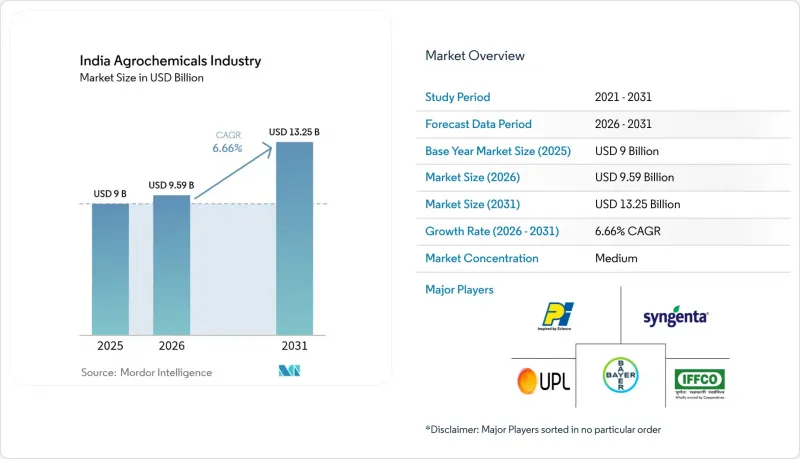
據 Mordor Intelligence 稱,印度農業化學品市場預計到 2026 年價值 95.9 億美元,高於 2025 年的 90 億美元,預計到 2031 年將達到 132.5 億美元。
預計 2026 年至 2031 年的複合年成長率為 6.66%。
本報告按產品類型(肥料、農業化學品、添加劑、植物生長調節劑)和應用領域(穀類、豆類和油籽、水果和蔬菜、經濟作物)進行分類。市場預測以美元計價。
印度農業化學品產業的趨勢與見解
透過檢討政府補貼制度,促進生物材料的引進。
新的補貼框架旨在獎勵那些遏制化肥濫用的邦,並鼓勵為堆肥、生物肥料和奈米營養素溶液提供預算支持。 2025年聯邦預算包含農業撥款,並已累計「總理農業財富計畫」(Prime Minister Dhan-Dhanya Krishi Yojana)。該計劃建立了一個正式機制,用於補償改用經認證的生物產品的農民。此外,諸如「總理農業減量計畫」(PM-PRANAM)等平行項目,會根據化肥減排目標的完成情況提供補助,並鼓勵行政部門迅速實施培訓計畫和實地示範。
透過數位化農業貸款和電子商務網路擴大最後一公里農業貸款的覆蓋範圍。
政府資助的數位基礎設施創建了一個綜合性的農業工人登記系統,該系統整合了土地登記、土壤健康卡和農民信用卡信用額度。這使得農業供應公司能夠在幾分鐘內內核實信用記錄,並透過基於應用程式的平台下訂單。例如,在2024會計年度,印度農民肥料合作社(IFFCO)的電子市場處理了超過20萬筆線上交易,並將產品配送至2.7萬個郵遞區號區域。這種規模在以往大規模農業物資配送領域是難以想像的。在印度的農業化學品市場,這個數位基礎設施正在推動對高品質配方產品需求的成長,尤其是在產品種類長期有限的二線城市地區。
由於依賴中國原料,成本波動加劇。
印度工廠從中國供應商進口大部分工業中間體,例如鉍、碲和石墨,這使得當地製藥企業在地緣政治緊張局勢加劇時極易受到價格波動和運輸延誤的影響。國內生產商被迫維持更高的安全庫存,而當全球運費飆升時,營運資金會被佔用,利潤空間也會受到擠壓。一個政府工作小組已經確定了印度100%依賴進口的10種關鍵礦產,並正在製定優惠政策以加快尋找替代來源。
細分市場分析
化肥佔印度農業化學品市場的54.60%,仍是稻米、小麥和甘蔗生產系統中保障糧食安全的基石。雖然磷酸二銨和尿素仍佔據大部分市場佔有率,但補貼改革的進展正迫使農民轉向使用微量元素混合肥料和奈米液體肥料,以最大限度地減少地下水污染。
儘管農業化學品市場起步規模較小,但預計到2031年,其銷售額將以10.12%的複合年成長率實現近乎相同的成長,這主要得益於堆肥獎勵、與殘留物相關的出口標準以及有機認證面積的擴大。隨著微生物群落和海藻衍生生長促效劑的日益普及,就連傳統的大型化肥生產商也開始建立生物業務部門。那些率先推出延長保存期限、無需冷鏈的包裝以及農業工人培訓計畫的生產商,有望憑藉其先發優勢贏得客戶的忠誠。
其他福利
- Excel格式的市場預測(ME)表
- 3個月的分析師支持
目錄
第1章:引言
- 研究假設和市場定義
- 調查範圍
第2章:調查方法
第3章執行摘要
第4章 市場狀況
- 市場概覽
- 市場促進因素
- 透過檢討政府補貼制度,促進生物材料的引進。
- 透過數位化農業貸款和電子商務網路擴大最後一公里農業貸款的覆蓋範圍。
- 利用無人機進行精準噴灑,刺激尚未開發的小規模農戶的需求。
- 由於專利到期的分子數量增加,出口管道得以擴展。
- 氣候變遷導致害蟲大規模爆發,增加了殺蟲劑的使用。
- 政府採取措施加強國內製造業能力
- 市場限制因素
- 由於依賴中國原料,成本波動加劇。
- 加速各州對高毒性活性成分的禁令實施。
- 仿冒品分銷管道的擴張正在侵蝕品牌商品的銷售。
- 對傳統殺蟲劑的抗藥性增強
- 監理情勢
- 技術展望
- 波特五力分析
第5章 市場規模與成長預測
- 依產品類型
- 肥料
- 氮基
- 磷酸鹽基
- 加州
- 其他肥料
- 殺蟲劑
- 除草劑
- 殺蟲劑
- 消毒劑
- 其他農藥
- 佐劑
- 植物生長調節劑
- 肥料
- 透過使用
- 穀類和穀類食品
- 豆類和油籽
- 水果和蔬菜
- 經濟作物
第6章 競爭情勢
- 市場集中度
- 策略趨勢
- 市佔率分析
- 公司簡介
- Bayer AG
- BASF SE
- Syngenta India Private Limited
- UPL Ltd.
- Corteva Agriscience
- PI Industries Limited
- IFFCO
- Coromandel International Ltd.
- Chambal Fertilisers and Chemicals Limited
- Rallis India Limited
- Deepak Fertilisers and Petrochemicals Corporation Limited(DFPCL)
- Crystal Crop Protection Ltd.
- Sumitomo Chemical India ltd.
- Dhanuka Agritech Ltd.
- Indofil Industries Limited(Modi Enterprises)
第7章 市場機會與未來展望
According to Mordor Intelligence, India agrochemicals market size in 2026 is estimated at USD 9.59 billion, growing from 2025 value of USD 9 billion with 2031 projections showing USD 13.25 billion, growing at 6.66% CAGR over 2026-2031.
This report is Segmented by Product Type (Fertilizers, Pesticides, Adjuvants, Plant Growth Regulators), Application (Cereals and Grains, Pulses and Oilseeds, Fruits and Vegetables, Commercial Crops). The Market Forecasts are Provided in Terms of Value (USD).
India Agrochemicals Industry Trends and Insights
Government Subsidy Rationalization Spurring Bio-inputs Adoption
New subsidy frameworks reward states for curbing blanket fertilizer consumption and channel budgetary support toward compost, biofertilizers, and nano-nutrient liquids. The 2025 Union Budget set aside for agriculture and launched the Prime Minister Dhan-Dhanya Krishi Yojana, creating a formal mechanism to reimburse farmers who switch to certified biologicals . Parallel programs such as PM-PRANAM link disbursements to chemical reduction targets, encouraging administrators to fast-track training modules and field demonstrations.
Digitized Agri-credit and E-commerce Networks Widening Last-mile Reach
Government-funded digital infrastructure now integrates land records, soil health cards, and Kisan Credit Card limits into a unified farmer registry, allowing input companies to vet credit profiles in minutes and dispatch orders through app-based platforms. In 2024, Indian Farmers Fertiliser Cooperative Limited (IFFCO) e-Bazar, for instance, fulfilled more than 200,000 online transactions in the past fiscal year and delivered to 27,000 pin codes, a scale previously unimaginable for bulk inputs. For the India agrochemicals market, these digital rails translate into higher off-take of premium formulations, especially in tier-II districts where assortment depth had long been a constraint.
Disruptive Raw-material Dependence on China Raising Cost Volatility
Indian plants import a bulk of technical intermediates such as bismuth, tellurium, and graphite from Chinese suppliers, leaving local formulators exposed to price swings and shipping delays during geopolitical flashpoints. Domestic producers must carry higher safety stocks, locking working capital and eroding margins when global freight rates spike. Government task forces have identified 10 critical minerals where India is 100% import-dependent and are drafting incentive packages to fast-track alternative sources.
Other drivers and restraints analyzed in the detailed report include:
- Drone-based Precision Spraying Unlocking Smallholder Demand
- Off-patent Molecule Wave Expanding Export Pipeline
- Accelerating State-level Bans on High-toxicity Actives
For complete list of drivers and restraints, kindly check the Table Of Contents.
Segment Analysis
Fertilizers captured 54.60% of the India agrochemicals market size, and continue to anchor food security policies for rice, wheat, and sugarcane systems. Di-ammonium phosphate and urea dominate volumes, yet escalating subsidy reforms are nudging growers toward micronutrient blends and nano-liquids that minimize groundwater contamination.
Pesticides, though starting from a smaller base, are projected to add nearly incremental sales by 2031 at a 10.12% CAGR, underpinned by compost incentives, residue-linked export standards, and expanding organic certification acreage. The rising popularity of microbial consortia and seaweed-based stimulants is encouraging conventional fertilizer majors to launch dedicated bio-divisions. Producers that master shelf-life extension, cold-chain independent packaging, and farmer education stand to capture early mover loyalty.
Complete Report Scope:
- By Product Type
- Fertilizers
- Nitrogenous
- Phosphatic
- Potassic
- Other Fertilizers
- Pesticides
- Herbicides
- Insecticides
- Fungicides
- Other Pesticides
- Adjuvants
- Plant Growth Regulators
- Fertilizers
- By Application
- Cereals and Grains
- Pulses and Oilseeds
- Fruits and Vegetables
- Commercial Crops
List of Companies Covered in this Report:
- Bayer AG
- BASF SE
- Syngenta India Private Limited
- UPL Ltd.
- Corteva Agriscience
- PI Industries Limited
- IFFCO
- Coromandel International Ltd.
- Chambal Fertilisers and Chemicals Limited
- Rallis India Limited
- Deepak Fertilisers and Petrochemicals Corporation Limited (DFPCL)
- Crystal Crop Protection Ltd.
- Sumitomo Chemical India ltd.
- Dhanuka Agritech Ltd.
- Indofil Industries Limited (Modi Enterprises)
Additional Benefits:
- The market estimate (ME) sheet in Excel format
- 3 months of analyst support
TABLE OF CONTENTS
1 Introduction
- 1.1 Study Assumptions and Market Definition
- 1.2 Scope of the Study
2 Research Methodology
3 Executive Summary
4 Market Landscape
- 4.1 Market Overview
- 4.2 Market Drivers
- 4.2.1 Government subsidy rationalisation spurring bio-inputs adoption
- 4.2.2 Digitised agri-credit and e-commerce platforms expanding chemical reach
- 4.2.3 Drone-based precision spraying unlocking untapped smallholder demand
- 4.2.4 Off-patent molecule wave enlarges export pipeline
- 4.2.5 Climate-linked pest outbreaks increasing pesticide intensity
- 4.2.6 Government schemes boosting domestic manufacturing capacity
- 4.3 Market Restraints
- 4.3.1 Disruptive raw-material dependence on China raising cost volatility
- 4.3.2 Accelerating state-level bans on high-toxicity actives
- 4.3.3 Growing counterfeit channel eroding branded volumes
- 4.3.4 Intensifying resistance to legacy insecticides
- 4.4 Regulatory Landscape
- 4.5 Technological Outlook
- 4.6 Porter's Five Forces Analysis
- 4.6.1 Bargaining Power of Suppliers
- 4.6.2 Bargaining Power of Consumers
- 4.6.3 Threat of New Entrants
- 4.6.4 Threat of Substitute Products
- 4.6.5 Intensity of Competitive Rivalry
5 Market Size and Growth Forecasts (Value)
- 5.1 By Product Type
- 5.1.1 Fertilizers
- 5.1.1.1 Nitrogenous
- 5.1.1.2 Phosphatic
- 5.1.1.3 Potassic
- 5.1.1.4 Other Fertilizers
- 5.1.2 Pesticides
- 5.1.2.1 Herbicides
- 5.1.2.2 Insecticides
- 5.1.2.3 Fungicides
- 5.1.2.4 Other Pesticides
- 5.1.3 Adjuvants
- 5.1.4 Plant Growth Regulators
- 5.1.1 Fertilizers
- 5.2 By Application
- 5.2.1 Cereals and Grains
- 5.2.2 Pulses and Oilseeds
- 5.2.3 Fruits and Vegetables
- 5.2.4 Commercial Crops
6 Competitive Landscape
- 6.1 Market Concentration
- 6.2 Strategic Moves
- 6.3 Market Share Analysis
- 6.4 Company Profiles (Includes Global Level Overview, Market Level Overview, Core Segments, Financials as Available, Strategic Information, Market Rank/Share for Key Companies, Products and Services, and Recent Developments)
- 6.4.1 Bayer AG
- 6.4.2 BASF SE
- 6.4.3 Syngenta India Private Limited
- 6.4.4 UPL Ltd.
- 6.4.5 Corteva Agriscience
- 6.4.6 PI Industries Limited
- 6.4.7 IFFCO
- 6.4.8 Coromandel International Ltd.
- 6.4.9 Chambal Fertilisers and Chemicals Limited
- 6.4.10 Rallis India Limited
- 6.4.11 Deepak Fertilisers and Petrochemicals Corporation Limited (DFPCL)
- 6.4.12 Crystal Crop Protection Ltd.
- 6.4.13 Sumitomo Chemical India ltd.
- 6.4.14 Dhanuka Agritech Ltd.
- 6.4.15 Indofil Industries Limited (Modi Enterprises)
7 Market Opportunities and Future Outlook

 右旋苯醚菊酯市場規模、佔有率和成長分析:按製劑、應用、目標害蟲、分銷管道和地區分類 - 產業預測,2026-2033年
 農業化學品市場報告:趨勢、預測和競爭分析(至2035年)
 2034年酶基工業化學品市場預測-按酵素類型、原料、生產方法、功能特性、最終用戶和地區分類的全球分析
 作物缺水緩解劑及噴劑的市場機會、成長促進因素、產業趨勢分析及2026-2035年預測
 農藥儲槽市場:全球市場預測,2026-2032年
 北美農藥市場:市佔率分析、產業趨勢與統計及成長預測(2026-2031 年)南美洲農藥市場:市場佔有率分析、產業趨勢與統計及成長預測(2026-2031 年)印尼農藥市場:市場佔有率分析、產業趨勢與統計及成長預測(2026-2031)非洲農藥:市場佔有率分析、產業趨勢與統計及成長預測(2026-2031 年)馬來西亞農藥市場:市場佔有率分析、產業趨勢與統計及成長預測(2026-2031)