


 |
市場調查報告書
商品編碼
2120625
企業內容管理:市場佔有率分析、產業趨勢與統計、成長預測(2026-2031)Enterprise Content Management - Market Share Analysis, Industry Trends & Statistics, Growth Forecasts (2026 - 2031) |
||||||

※ 本網頁內容可能與最新版本有所差異。詳細情況請與我們聯繫。
根據 Mordor Intelligence 預測,企業內容管理市場規模將從 2025 年的 385.8 億美元成長到 2026 年的 442.9 億美元,到 2031 年將達到 812.2 億美元,2026 年至 2031 年的複合年成長率為 12.89%。
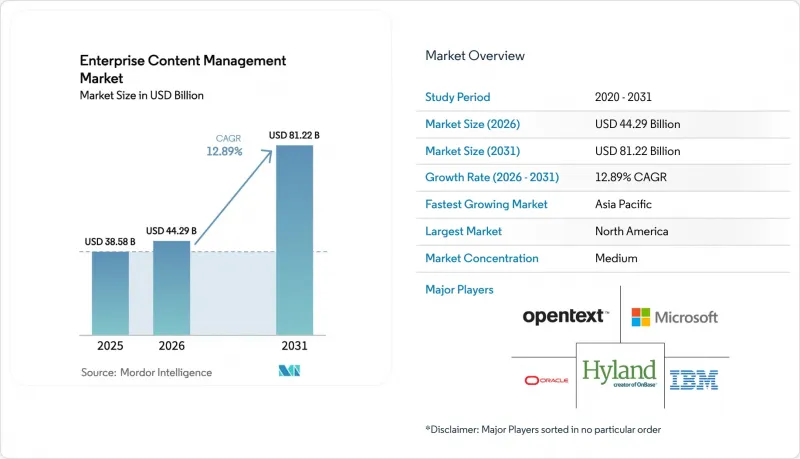
本報告按解決方案類型(內容管理、文件管理、案例管理、工作流程管理等)、部署模式(本地部署、雲端部署)、企業規模(中小企業、大型企業)、最終用戶行業(電信與IT、銀行、金融服務和保險、零售與電子商務等)以及地區進行細分。市場預測以美元計價。
全球企業內容管理市場趨勢與洞察
遵守內容生命週期管治相關法規的義務
諸如GDPR、英國2018年《資料保護法》和印度2023年《數位個人資料保護法》等嚴格法規對資料保留期限、刪除程序和防篡改審計追蹤提出了要求。 2024年5月,Meta公司被處以2.51億歐元(約2.83億美元)的罰款,凸顯了監管機構敢於處以巨額罰款的決心,促使企業採用地域隔離的存儲庫和自動化分類引擎。金融機構面臨巴塞爾協議III和MiFID II之間重疊要求的挑戰,而醫療保健機構則努力協調HIPAA與各州特定的隱私法規,這進一步加劇了企業內容管理市場對整合管治的需求。解決方案藍圖現在包含將區域法規與元資料欄位關聯起來的策略模板,從而實現合法刪除和自動訴訟保留。董事會越來越將違反合規性的內容工作流程視為財務和聲譽風險,而企業內容管理(ECM)的實施被視為降低風險的核心策略。
企業非結構化資料量的爆炸性成長
非結構化文件、電子郵件、CAD 文件和感測器日誌佔企業資料的 80% 以上,其資料量正以每年兩位數的速度成長。手動標記已不足以應對,因此企業正轉向整合自然語言處理 (NLP) 的平台,以便在毫秒內提取相關資訊。微軟的 Copilot for SharePoint Premium 可將搜尋時間縮短高達 70%,而 Adobe 的 AI Agent 可自動產生行銷資產摘要,這標誌著企業正在從被動儲存轉向主動知識發現。即使在預算緊張的情況下,生產力的提升也足以證明投資的合理性,而隨著法務部門利用自動編輯功能簡化電子取證流程,其價值更顯突出。在亞太地區,物聯網的普及進一步加速了資料成長,下一代企業內容管理 (ECM) 系統正逐漸從可選升級轉變為業務必需品。
雲端和行動企業內容管理中的安全和隱私問題
2024年2月,Change Healthcare遭受勒索軟體攻擊,影響超過1億用戶,造成2,200萬美元的贖金損失,並凸顯了雲端儲存庫的漏洞。四個月後,Snowflake資料外洩事件進一步加劇了人們對共用憑證模型的質疑。目前,首席資訊安全(CISO)在批准雲端遷移之前,要求行動存取必須具備不可篡改性、即時異常檢測和設備級加密等功能。這種日益嚴格的問責機制使得資料控制者對第三方事件的責任越來越大,導致銀行和國防等風險規避型產業面臨更高的保險成本和更長的採購週期。儘管供應商正競相取得零信任架構認證,但安全性問題仍將繼續限制企業內容管理(ECM)市場的短期擴張。
細分市場分析
2025年,文件管理在收入方面保持28.19%的領先優勢,因為在高度監管的行業中,合約、政策和提交文件的版本控制至關重要。同時,隨著零售商和媒體公司管理數以千計的全通路圖像和影片,數位資產管理正以13.36%的複合年成長率快速成長。隨著人工智慧驅動的自動裁剪、格式轉換和版權管理成為必備功能,預計到2031年,數位資產管理領域的企業內容管理市場規模將翻倍。 Adobe 2025會計年度238億美元的營收充分展現了其巨大的獲利潛力,這得益於生成模型簡化了資產重用流程。供應商日益整合文件、資產和工作流程功能,模糊了傳統的類別界限,迫使買家遷移到能夠最大限度減少單一解決方案的平台。
內容創作者如今需要即時協作、直覺的搜尋和內建分析工具,以便視覺化資產績效指標。與微軟 Copilot 的整合使行銷人員無需手動標記即可搜尋“藍色背景圖片”,而Oracle簡化了分散代理商的品牌工具包管治。案例管理和工作流程引擎(以前單獨銷售)現在已整合到數位資產模組中,用於引導創新核准流程並建立完善的查核點,以確保品牌一致性。這種整合增加了供應商鎖定風險,促使採購團隊優先考慮開放 API 和元資料互通性標準。隨著解決方案邊界的模糊,平台的擴充性和生態系統的深度將決定企業內容管理市場的佔有率。
銀行、國防相關企業和醫院仍然傾向於使用空氣間隙環境來儲存高度敏感的記錄,因此,到2025年,本地部署仍佔總收入的53.48%。然而,雲端細分市場正以13.91%的複合年成長率快速成長,凸顯了向彈性運算和付費使用制的重大轉變。如果目前的成長動能持續下去,到2029年,與雲端服務相關的企業內容管理市場支出將超過本地部署支出。正如LEK顧問公司的研究強調的那樣,基於使用量的收費模式將供應商收入與客戶使用量掛鉤,從而提高了續訂率和客戶維繫。
OpenText 的 Documentum 服務等級——Express、Premium 和 Ultimate——採用精細化的收費結構,既有助於控制試點部署成本,又能確保提升銷售。這種混合架構透過在本地保留主資料,同時利用雲端分析進行異常檢測和全文索引,從而在不犧牲 AI 功能的前提下,降低了合規性挑戰。然而,Snowflake 資料外洩事件凸顯了加密金鑰所有權和零信任隔離對企業的重要性。隨著網路保險承保標準的日益嚴格,買家可能會優先考慮那些提供符合審計要求的 SOC 2 II 型報告和原生網路保險附加條款的供應商。
區域分析
預計到2025年,北美將佔全球收入的38.73%,這反映出該地區早期採用雲端運算、供應商集中度較高以及嚴格的行業法規推動了企業級平台的發展。銀行和聯邦機構成熟的企業內容管理(ECM)部署強調與合規分析的整合,而一家墨西哥汽車零件供應商正在實施內容工作流程以滿足IATF 16949可追溯性要求。愛爾蘭監管機構對Meta處以2.51億歐元的罰款,該罰款也影響了其在美國的業務,這表明域外執法正在影響企業內容管理(ECM)市場,即使在其本國司法管轄區內也是如此。
預計到2031年,亞太地區將以13.51%的複合年成長率成長,主要得益於中國軟體在地化的政策、印度推進公共服務數位化以及日本人口結構驅動的自動化措施。中國的《資料安全法》要求跨國公司在國內運營其企業內容管理(ECM)系統,從而推動了對模組化設計的需求,這種設計能夠在本地化個人資料的同時,實現元資料的全球同步。印度的《數位個人資料保護法》也強制要求類似的在地化,鼓勵混合雲端,將敏感資料集隔離在國家邊界內。韓國5G的部署正在加速行動ECM的普及,而澳洲的反洗錢改革則為金融領域的投資提供了支持。
歐洲、南美洲以及中東和非洲合計佔據剩餘佔有率,其中,德國、法國和英國的《一般資料保護規則期限和授權框架凸顯了可設定策略引擎的重要性。透過採用由統一控制平面管理的區域實例組成的聯邦架構,企業可以平衡本地合規性和全球協調,並在企業內容管理 (ECM) 市場中開闢一條穩固的道路。
其他好處:
- Excel格式的市場預測(ME)表
- 3個月的分析師支持
目錄
第1章:引言
- 研究假設和市場定義
- 調查範圍
第2章:調查方法
第3章執行摘要
第4章 市場狀況
- 市場概覽
- 市場促進因素
- 內容生命週期管治方面的監理合規要求
- 企業非結構化資料量的爆炸性成長。
- 向雲端原生企業內容管理 (ECM) 的轉型正在加速。
- 人工智慧驅動的內容智慧和超自動化
- 擴大產業專用的預訓練語言模型的應用,以實現特定領域文件處理的自動化。
- 憑證式的消費者定價正在重塑中端市場的普及程度。
- 市場限制因素
- 雲端和行動企業內容管理中的安全和隱私問題
- 併購後遺留儲存庫整合的複雜性;
- 關於跨境資料傳輸的法規(GDPR、DPDPA 等)
- 內容協作平台中不斷上漲的 API 速率限制成本
- 產業價值鏈分析
- 監理情勢
- 技術展望
- 宏觀經濟因素對市場的影響
- 波特五力分析
第5章 市場規模與成長預測
- 按解決方案類型
- 內容管理
- 文件管理
- 個案管理
- 工作流程管理
- 記錄管理
- 數位資產管理
- 其他解決方案類型
- 部署模式
- 現場
- 雲
- 按公司規模
- 中小企業
- 大公司
- 按最終用戶行業分類
- 通訊/IT
- BFSI
- 零售與電子商務
- 教育
- 製造業
- 媒體與娛樂
- 政府/公共部門
- 其他終端用戶產業
- 按地區
- 北美洲
- 美國
- 加拿大
- 墨西哥
- 南美洲
- 巴西
- 阿根廷
- 其他南美國家
- 歐洲
- 英國
- 德國
- 法國
- 其他歐洲國家
- 亞太地區
- 中國
- 日本
- 印度
- 韓國
- 澳洲
- 其他亞太國家
- 中東
- 阿拉伯聯合大公國
- 沙烏地阿拉伯
- 其他中東國家
- 非洲
- 南非
- 肯亞
- 其他非洲國家
- 北美洲
第6章 競爭情勢
- 市場集中度
- 策略趨勢
- 市佔率分析
- 公司簡介
- Microsoft Corporation
- OpenText Corporation
- IBM Corporation
- Hyland Software Inc.
- Oracle Corporation
- Box Inc.
- Adobe Inc.
- Xerox Holdings Corporation
- M-Files Corporation
- Alfresco Software Inc.(Hyland)
- DocuWare GmbH
- Datamatics Global Services Ltd.
- Hewlett Packard Enterprise Company
- Capgemini SE
- Newgen Software Technologies Ltd.
- Laserfiche Inc.
- SER Group
- Fabasoft AG
- Everteam Global Services
- KnowledgeLake Inc.
- iManage LLC
- Egnyte Inc.
第7章 市場機會與未來展望
According to Mordor Intelligence, the enterprise content management market size is expected to grow from USD 38.58 billion in 2025 to USD 44.29 billion in 2026 and is forecast to reach USD 81.22 billion by 2031 at 12.89% CAGR over 2026-2031.
This report is Segmented by Solution Type (Content Management, Document Management, Case Management, Workflow Management, and More), Deployment Mode (On-Premises, and Cloud), Enterprise Size (Small and Medium Enterprises, and Large Enterprises), End-User Industry (Telecom and IT, BFSI, Retail and E-Commerce, and More), and Geography. The Market Forecasts are Provided in Terms of Value (USD).
Global Enterprise Content Management Market Trends and Insights
Regulatory Compliance Mandates for Content Lifecycle Governance
Stringent rules such as GDPR, the UK Data Protection Act 2018, and India's Digital Personal Data Protection Act 2023 impose retention schedules, right-to-erasure protocols, and immutable audit-trail requirements. The May 2024 EUR 251 million (USD 283 million) penalty on Meta highlighted regulators' willingness to levy material fines, driving enterprises toward geo-fenced repositories and auto-classification engines. Financial institutions face overlapping Basel III and MiFID II mandates, while healthcare providers juggle HIPAA with state privacy statutes, reinforcing the need for integrated governance within the Enterprise Content Management market. Solution roadmaps now embed policy templates that map regional statutes to metadata fields, enabling defensible deletion and automated litigation holds. Boards increasingly view non-compliant content workflows as financial and reputational liabilities, elevating ECM adoption to a core risk-mitigation strategy.
Explosion of Enterprise Unstructured Data Volumes
Unstructured documents, emails, CAD files, and sensor logs account for more than 80% of corporate data, growing by double digits annually. Manual tagging cannot scale, so enterprises turn to NLP-infused platforms that surface relevant information in milliseconds. Microsoft's Copilot for SharePoint Premium cuts search time by up to 70%, while Adobe's AI Agents autogenerate summaries for marketing assets, signaling a pivot from passive storage to proactive knowledge discovery. The productivity gains justify investment even during budget tightening, especially as legal teams leverage auto-redaction to streamline e-discovery. In Asia Pacific, data-growth velocity is amplified by IoT rollouts, positioning next-generation ECM as an operational necessity rather than a discretionary upgrade.
Security and Privacy Concerns in Cloud and Mobile ECM
The February 2024 Change Healthcare ransomware attack affecting over 100 million individuals and costing USD 22 million in ransom brought cloud-repository vulnerabilities to the forefront. Snowflake's breach four months later fuelled deeper scepticism toward shared-credential models. Chief information security officers now mandate immutability, real-time anomaly detection, and device-level encryption for mobile access before green-lighting cloud migration. Liability frameworks increasingly hold data controllers accountable for third-party incidents, raising insurance costs and elongating procurement cycles in risk-averse industries such as banking and defense. While vendors race to certify zero-trust architectures, security fears will continue to dilute near-term Enterprise Content Management market expansion.
Other drivers and restraints analyzed in the detailed report include:
- Accelerated Shift to Cloud-Native ECM Deployments
- AI-Driven Content Intelligence and Hyper-Automation
- Cross-Border Data-Transfer Restrictions (GDPR, DPDPA, etc.)
For complete list of drivers and restraints, kindly check the Table Of Contents.
Segment Analysis
Document Management retained a 28.19% revenue lead in 2025 because regulated verticals rely on version control for contracts, policies, and filings. However, Digital Asset Management is scaling at a 13.36% CAGR as retailers and media houses orchestrate thousands of omnichannel images and videos. The Enterprise Content Management market size for Digital Asset Management is projected to double by 2031 as AI-driven auto-cropping, format conversion, and rights management become table stakes. Adobe's fiscal 2025 revenue of USD 23.8 billion illustrates monetization potential as generative models simplify asset reuse. Increasingly, vendors bundle document, asset, and workflow capabilities, dissolving traditional category boundaries and nudging buyers toward platform commitments that minimize point-solution sprawl.
Content creators now demand real-time collaboration, intuitive search, and embedded analytics that surface asset performance metrics. Microsoft's Copilot integration allows marketers to locate "blue-background images" without manual tagging, while Oracle streamlines brand-kit governance across dispersed agencies. Case Management and Workflow engines, once sold separately, are now embedded into Digital Asset modules, routing creative approvals and enforcing brand-consistency checkpoints. This convergence elevates lock-in risk, prompting procurement teams to prioritize open APIs and metadata-interoperability standards. As solution boundaries blur, platform extensibility and ecosystem depth will dictate wallet share within the Enterprise Content Management market.
On-Premises deployments held 53.48% of 2025 revenue because banks, defense contractors, and hospitals still favour air-gapped environments for sensitive records. Yet the cloud sub-segment is advancing at a 13.91% CAGR, underscoring a decisive shift toward elastic compute and pay-as-you-go economics. The Enterprise Content Management market size associated with cloud offerings is set to eclipse on-premises spend by 2029 if current momentum persists. Usage-based pricing, highlighted by L.E.K. Consulting research, aligns vendor revenue with customer consumption, driving higher renewal rates and stickier net-retention metrics.
OpenText's Express, Premium, and Ultimate Documentum tiers demonstrate granular metering that lowers pilot costs while preserving upsell pathways. Hybrid architectures keep master data on-site but use cloud analytics for anomaly detection and full-text indexing, mitigating compliance hurdles without sacrificing AI functionality. Nevertheless, the Snowflake breach reminded enterprises that encryption-key ownership and zero-trust segmentation are non-negotiable. As cyber-underwriting criteria tighten, buyers will favour vendors that furnish audit-ready SOC 2 Type II reports and native cyber-insurance endorsements.
Complete Report Scope:
- By Solution Type
- Content Management
- Document Management
- Case Management
- Workflow Management
- Record Management
- Digital Asset Management
- Other Solution Types
- By Deployment Mode
- On-Premises
- Cloud
- By Enterprise Size
- Small and Medium Enterprises (SME)
- Large Enterprises
- By End-User Industry
- Telecom and IT
- BFSI
- Retail and E-Commerce
- Education
- Manufacturing
- Media and Entertainment
- Government and Public Sector
- Other End-User Industries
- By Geography
- North America
- United States
- Canada
- Mexico
- South America
- Brazil
- Argentina
- Rest of South America
- Europe
- United Kingdom
- Germany
- France
- Rest of Europe
- Asia Pacific
- China
- Japan
- India
- South Korea
- Australia
- Rest of Asia Pacific
- Middle East
- United Arab Emirates
- Saudi Arabia
- Rest of Middle East
- Africa
- South Africa
- Kenya
- Rest of Africa
- North America
Geography Analysis
North America retained 38.73% of 2025 revenue, reflecting early cloud adoption, vendor density, and strict sectoral regulations that favour enterprise-grade platforms. Mature ECM installations in banking and federal agencies emphasize integration with compliance analytics, while Mexico's automotive suppliers deploy content workflows to satisfy IATF 16949 traceability. Meta's EUR 251 million fine, imposed by Ireland's regulator yet impacting U.S. operations, illustrates how extraterritorial enforcement shapes the Enterprise Content Management market even within home jurisdictions.
Asia Pacific is projected to grow at a 13.51% CAGR through 2031, propelled by China's software-localization edicts, India's public-service digitization drives, and Japan's demographic-led automation push. China's Data Security Law compels multinationals to operate in-country ECM stacks, spurring demand for modular designs that synchronize metadata globally while localizing personal data. India's Digital Personal Data Protection Act enforces similar localization, prompting hybrid cloud builds that isolate sensitive datasets inside national borders. South Korea's 5G ubiquity accelerates mobile ECM uptake, while Australia's anti-money-laundering reforms sustain financial-sector investment.
Europe, South America, Middle East and Africa collectively comprise the remaining share, with Europe anchored by GDPR-induced platform refreshes in Germany, France, and the United Kingdom. Brazil's open-banking regulations encourage banks to standardize content pipelines, whereas Saudi Arabia's smart-city ambitions necessitate centralized citizen-service repositories. Divergent retention schedules and consent frameworks across these regions elevate the importance of configurable policy engines. Enterprises that deploy federated architectures as regional instances governed by a unified control plane can reconcile local compliance with global collaboration, carving a defensible path in the Enterprise Content Management market.
- Microsoft Corporation
- OpenText Corporation
- IBM Corporation
- Hyland Software Inc.
- Oracle Corporation
- Box Inc.
- Adobe Inc.
- Xerox Holdings Corporation
- M-Files Corporation
- Alfresco Software Inc. (Hyland)
- DocuWare GmbH
- Datamatics Global Services Ltd.
- Hewlett Packard Enterprise Company
- Capgemini SE
- Newgen Software Technologies Ltd.
- Laserfiche Inc.
- SER Group
- Fabasoft AG
- Everteam Global Services
- KnowledgeLake Inc.
- iManage LLC
- Egnyte Inc.
Additional Benefits:
- The market estimate (ME) sheet in Excel format
- 3 months of analyst support
TABLE OF CONTENTS
1 INTRODUCTION
- 1.1 Study Assumptions and Market Definition
- 1.2 Scope of the Study
2 RESEARCH METHODOLOGY
3 EXECUTIVE SUMMARY
4 MARKET LANDSCAPE
- 4.1 Market Overview
- 4.2 Market Drivers
- 4.2.1 Regulatory Compliance Mandates for Content Lifecycle Governance
- 4.2.2 Explosion of Enterprise Unstructured Data Volumes
- 4.2.3 Accelerated Shift to Cloud-Native ECM Deployments
- 4.2.4 AI-Driven Content Intelligence and Hyper-Automation
- 4.2.5 Rising Adoption of Industry-Specific Pretrained Language Models for Domain Document Automation
- 4.2.6 Token-Based Consumption Pricing Reshaping Mid-Market Adoption
- 4.3 Market Restraints
- 4.3.1 Security and Privacy Concerns in Cloud and Mobile ECM
- 4.3.2 Complexity of Merging Legacy Repositories Post-M&A
- 4.3.3 Cross-Border Data-Transfer Restrictions (GDPR, DPDPA, etc.)
- 4.3.4 Escalating API Rate-Limit Costs in Content Collaboration Platforms
- 4.4 Industry Value-Chain Analysis
- 4.5 Regulatory Landscape
- 4.6 Technological Outlook
- 4.7 Impact of Macroeconomic Factors on the Market
- 4.8 Porter's Five Forces Analysis
- 4.8.1 Threat of New Entrants
- 4.8.2 Bargaining Power of Buyers
- 4.8.3 Bargaining Power of Suppliers
- 4.8.4 Threat of Substitutes
- 4.8.5 Intensity of Competitive Rivalry
5 MARKET SIZE AND GROWTH FORECASTS (VALUE)
- 5.1 By Solution Type
- 5.1.1 Content Management
- 5.1.2 Document Management
- 5.1.3 Case Management
- 5.1.4 Workflow Management
- 5.1.5 Record Management
- 5.1.6 Digital Asset Management
- 5.1.7 Other Solution Types
- 5.2 By Deployment Mode
- 5.2.1 On-Premises
- 5.2.2 Cloud
- 5.3 By Enterprise Size
- 5.3.1 Small and Medium Enterprises (SME)
- 5.3.2 Large Enterprises
- 5.4 By End-User Industry
- 5.4.1 Telecom and IT
- 5.4.2 BFSI
- 5.4.3 Retail and E-Commerce
- 5.4.4 Education
- 5.4.5 Manufacturing
- 5.4.6 Media and Entertainment
- 5.4.7 Government and Public Sector
- 5.4.8 Other End-User Industries
- 5.5 By Geography
- 5.5.1 North America
- 5.5.1.1 United States
- 5.5.1.2 Canada
- 5.5.1.3 Mexico
- 5.5.2 South America
- 5.5.2.1 Brazil
- 5.5.2.2 Argentina
- 5.5.2.3 Rest of South America
- 5.5.3 Europe
- 5.5.3.1 United Kingdom
- 5.5.3.2 Germany
- 5.5.3.3 France
- 5.5.3.4 Rest of Europe
- 5.5.4 Asia Pacific
- 5.5.4.1 China
- 5.5.4.2 Japan
- 5.5.4.3 India
- 5.5.4.4 South Korea
- 5.5.4.5 Australia
- 5.5.4.6 Rest of Asia Pacific
- 5.5.5 Middle East
- 5.5.5.1 United Arab Emirates
- 5.5.5.2 Saudi Arabia
- 5.5.5.3 Rest of Middle East
- 5.5.6 Africa
- 5.5.6.1 South Africa
- 5.5.6.2 Kenya
- 5.5.6.3 Rest of Africa
- 5.5.1 North America
6 COMPETITIVE LANDSCAPE
- 6.1 Market Concentration
- 6.2 Strategic Moves
- 6.3 Market Share Analysis
- 6.4 Company Profiles (includes Global Level Overview, Market Level Overview, Core Segments, Financials as Available, Strategic Information, Market Rank/Share for Key Companies, Products & Services, and Recent Developments)
- 6.4.1 Microsoft Corporation
- 6.4.2 OpenText Corporation
- 6.4.3 IBM Corporation
- 6.4.4 Hyland Software Inc.
- 6.4.5 Oracle Corporation
- 6.4.6 Box Inc.
- 6.4.7 Adobe Inc.
- 6.4.8 Xerox Holdings Corporation
- 6.4.9 M-Files Corporation
- 6.4.10 Alfresco Software Inc. (Hyland)
- 6.4.11 DocuWare GmbH
- 6.4.12 Datamatics Global Services Ltd.
- 6.4.13 Hewlett Packard Enterprise Company
- 6.4.14 Capgemini SE
- 6.4.15 Newgen Software Technologies Ltd.
- 6.4.16 Laserfiche Inc.
- 6.4.17 SER Group
- 6.4.18 Fabasoft AG
- 6.4.19 Everteam Global Services
- 6.4.20 KnowledgeLake Inc.
- 6.4.21 iManage LLC
- 6.4.22 Egnyte Inc.
7 MARKET OPPORTUNITIES AND FUTURE OUTLOOK
- 7.1 White-Space and Unmet-Need Assessment

 企業架構服務市場:全球市場預測,2026-2032年
 中國企業內容管理(ECM):市場佔有率分析、產業趨勢與統計及成長預測(2026-2031)新加坡企業內容管理 (ECM):市佔率分析、產業趨勢與統計及成長預測 (2026-2031)美國企業內容管理 (ECM):市場佔有率分析、行業趨勢和統計數據以及成長預測 (2026-2031)義大利企業內容管理:市場佔有率分析、產業趨勢與統計及成長預測(2026-2031)西班牙企業內容管理:市場佔有率分析、產業趨勢與統計及成長預測(2026-2031)基於雲端的企業內容管理市場-2026年至2032年全球市場預測雲端的企業內容管理:市場佔有率分析、產業趨勢與統計及成長預測(2026-2031 年)
 Frost Radar™:數位媒體內容安全與反派餅服務,2026 年企業內容管理市場-2026-2032年全球市場預測