


 |
市場調查報告書
商品編碼
2118223
西班牙企業內容管理:市場佔有率分析、產業趨勢與統計及成長預測(2026-2031)Spain Enterprise Content Management - Market Share Analysis, Industry Trends & Statistics, Growth Forecasts (2026 - 2031) |
||||||

※ 本網頁內容可能與最新版本有所差異。詳細情況請與我們聯繫。
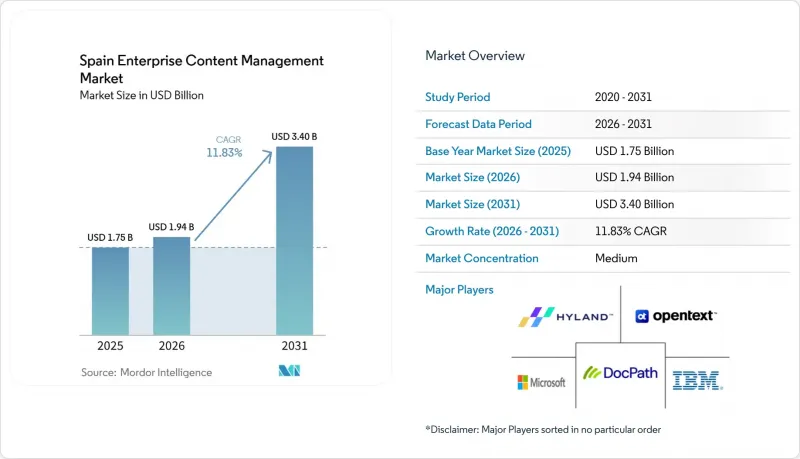
據 Mordor Intelligence 稱,西班牙企業內容管理市場在 2025 年的價值為 17.5 億美元,預計到 2031 年將達到 34 億美元,而 2026 年為 19.4 億美元,預測期(2026-2031 年)的複合年成長率為 11.83%。
本報告按解決方案類型(文件管理、記錄管理、工作流程和業務流程管理等)、部署類型(本地部署等)、企業規模(中小企業和大型企業)以及最終用戶行業(銀行、金融服務和保險業、政府和公共管理部門等)進行分類。市場預測以美元計價。
西班牙企業內容管理市場的趨勢與洞察
人工智慧驅動的內容分類與搜尋加速
人工智慧主導的文檔處理正在重塑西班牙企業內容管理市場的採購重點。這是因為企業現在期望系統能夠近乎即時地對文件進行分類、標記、路由和顯示。許多傳統平台並非為處理這種程度的自動化搜尋而設計,因此在監管嚴格的環境下,系統替換和現代化變得更加緊迫。 2025年第一季,21.1%的西班牙企業報告正在積極使用人工智慧,比去年同期成長8.7個百分點。這一趨勢意義重大,因為許多組織採用人工智慧的速度超過了元資料和分類法的標準化速度,導致內容模型的品質和管治面臨越來越大的壓力。彌合這一差距的是一個能夠將人工智慧驅動的分類與可追溯的記錄管理相結合的平台,而這種需求在西班牙企業內容管理市場變得越來越明顯。
受監管行業對符合審計要求的資訊管治的需求日益成長
隨著隱私法規的日益嚴格和資料處理義務的不斷收緊,審計合規能力正成為西班牙企業內容管理市場中一個更為重要的購買因素。 2025年,西班牙資料保護局(AEPD)共開立299張罰單(總額達4,000萬歐元/4,360萬美元),並收到2,765起資料外洩通知。如果企業仍將內容平台視為低優先順序的儲存工具,且無法快速證明其資料保留規則、存取日誌和文件來源,則將面臨更大的風險。與《西班牙個人資料保護法》(LOPDGDD)相關的管治要求也提高了多個受監管行業對審計日誌、資料保留計劃和存取權管理的需求。這確保了合規主導的系統更新週期,並使現代平台在西班牙企業內容管理市場的營運風險管理中發揮更清晰的作用。
遷移遺留儲存庫的複雜性以及內容的分散性。
遷移的複雜性是西班牙企業內容管理市場的一大障礙,因為許多組織仍然將文件分散在電子郵件存檔、共用驅動器、舊平台和影子SaaS工具中。通常,主要困難不在於購買新平台,而是識別、組織、分類和分配大量非結構化內容的所有權。工業集團、公共產業和公共機構尤其面臨風險,因為它們通常擁有較舊的存檔,並且在過渡期間面臨更嚴格的業務永續營運要求。漫長的引進週期不僅會延遲供應商的獲利,還會導致一些買家使用臨時系統的時間遠遠超出預期。這種情況正在西班牙企業內容主導市場催生一個以服務為導向的切入點,內容髮現、去重和分類是全面平台替換之前的第一步。
細分市場分析
預計到2025年,文件管理將佔西班牙企業內容管理市場28.36%的佔有率,並繼續保持其在收入方面最大的解決方案類別地位。這一成長基礎反映了銀行、製造業和政府機構對資料收集、索引、搜尋和託管儲存的穩定需求。隨著數位化專案和結構化出版的需求不斷成長,記錄管理和網路內容管理也在持續擴展,而數位資產管理在零售、媒體和娛樂產業的重要性日益凸顯。個案管理在保險和法律工作流程中也備受關注,因為這些流程需要按照清晰的管理路徑對大量文件進行集中處理。
預計從2026年到2031年,工作流程和業務流程管理將以13.09%的複合年成長率成長,成為西班牙企業內容管理市場成長最快的解決方案類型。有關發票和雇主合規性的監管要求正推動投資從獨立儲存庫轉向優先考慮自動化的流程設計。這提升了能夠將表單、記錄、核准和審計證據整合到單一、可管理的工作流程中的平台的價值。因此,西班牙企業內容管理產業正在經歷解決方案需求的轉變,即平台不再將文件視為孤立的文件,而是將其視為業務流程的一部分。
預計到2025年,雲端技術將佔據西班牙企業內容管理市場74.18%的佔有率,並將以12.54%的複合年成長率持續成長至2031年。這一組合使得雲端技術成為規模最大且成長最快的採用模式,顯示雲端遷移週期仍有成長空間。許多買家並非從零開始,而是隨著管治和整合管理的改進,將雲端技術的應用擴展到更敏感的流程。 《2026數位十年》的國別報告仍指出,雲端技術的採用仍有進一步提升的空間,這顯示即使經過數年的發展,雲端技術的應用仍有成長潛力。
在政府機構和監管嚴格的金融領域,本地部署環境仍然發揮著至關重要的作用,因為文件主權和隔離網路仍然至關重要。混合模式提供了一種切實可行的折衷方案,使組織能夠將高度敏感儲存庫的管理與基於雲端的擴充性,從而支援更廣泛的工作流程。桑坦德銀行在2025年6月的遷移表明,即使大規模的受監管機構,只要架構和管治協調一致,也能進一步向雲端原生營運轉型。此外,Hyland在2026年擴展的聯合和雲端功能滿足了跨傳統儲存庫管治內容的需求,而無需即時資料遷移。
其他好處:
- Excel格式的市場預測(ME)表
- 3個月的分析師支持
目錄
第1章:引言
- 研究假設和市場定義
- 調查範圍
第2章:調查方法
第3章執行摘要
第4章 市場狀況
- 市場概覽
- 市場促進因素
- 人工智慧驅動的內容分類與搜尋加速
- 受監管行業對符合審計要求的資訊管治的需求日益成長
- 西班牙向雲端原生和混合企業內容管理架構的遷移
- 在整體大量使用文件的流程中,對端到端工作流程自動化的需求日益成長。
- 遠距辦公、行動辦公和分散式辦公模式的擴展。
- 擴大內容智慧在合約和交易分析的應用。
- 市場限制因素
- 遷移遺留儲存庫所涉及的複雜性和內容擴散
- 與 GDPR、行業特定法規和記錄保存相關的合規負擔。
- 多租戶環境中敏感內容的安全問題
- 企業內容管理、分類設計與管治的技能差距
- 產業價值鏈分析
- 監理情勢
- 技術展望
- 宏觀經濟因素對市場的影響
- 波特五力分析
第5章 市場規模與成長預測
- 按解決方案類型
- 文件管理
- 記錄管理
- 工作流程和業務流程管理
- 個案管理
- 數位資產管理
- 網站內容管理
- 其他解決方案
- 部署模式
- 現場
- 雲
- 混合
- 按公司規模
- 小型企業
- 大公司
- 按最終用戶行業分類
- BFSI
- 政府和公共行政
- 醫療保健和生命科學
- 資訊科技/通訊
- 工業製造
- 零售與電子商務
- 媒體與娛樂
- 教育
- 能源公用事業
- 其他終端用戶產業
第6章 競爭情勢
- 市場集中度
- 策略趨勢
- 市佔率分析
- 公司簡介
- OpenText Corporation
- Microsoft Corporation
- IBM Corporation
- DocPath
- Hyland Software, Inc.
- Oracle Corporation
- SAP SE
- Adobe Inc.
- M-Files Corporation
- DocuWare GmbH
- SER Group Holding GmbH
- Newgen Software Technologies Limited
- Alfresco Software, Inc.
- SERES
- Fabasoft AG
- ELO Digital Office GmbH
- Laserfiche, Inc.
- Box, Inc.
- Kyocera Document Solutions Inc.
- Xerox Holdings Corporation
第7章 市場機會與未來展望
According to Mordor Intelligence, the Spain enterprise content management market size was valued at USD 1.75 billion in 2025 and estimated to grow from USD 1.94 billion in 2026 to reach USD 3.40 billion by 2031, at a CAGR of 11.83% during the forecast period (2026-2031).
This report is Segmented by Solution Type (Document Management, Records Management, Workflow and Business Process Management, and More), Deployment Mode (On-Premises, and More), Enterprise Size (Small and Medium Enterprises, and Large Enterprises), and End-User Industry (BFSI, Government and Public Administration, and More). The Market Forecasts are Provided in Terms of Value (USD).
Spain Enterprise Content Management Market Trends and Insights
Accelerating AI-Based Content Classification and Retrieval
AI-led document processing is reshaping buying priorities in the Spain enterprise content management market because enterprises now expect systems to classify, tag, route, and surface documents in near real time. Many legacy platforms were not built for this level of automated retrieval, which makes replacement and modernization more urgent in regulated environments. In the first quarter of 2025, 21.1% of Spanish enterprises reported active AI use, and that was an 8.7 percentage-point increase from the prior year. This pattern matters because AI adoption is moving faster than metadata and taxonomy standardization in many organizations, which raises quality and governance pressure around content models. That gap supports platforms that can combine AI classification with traceable records control, a need that is becoming more visible across the Spain enterprise content management market.
Rising Demand for Audit-Ready Information Governance in Regulated Industries
Audit readiness has become a stronger purchase trigger in the Spain enterprise content management market as privacy enforcement and data handling obligations have tightened. In 2025, the AEPD issued 299 fines totaling EUR 40 million (USD 43.6 million) and received 2,765 data breach notifications. Organizations that still treat content platforms as low-priority storage tools are facing higher exposure when retention rules, access logs, and document lineage cannot be demonstrated quickly. LOPDGDD-related governance requirements are also reinforcing the need for audit logs, retention scheduling, and permission controls across multiple regulated sectors. This keeps compliance-led refresh cycles active and gives modern platforms a clearer role in operational risk control within the Spain enterprise content management market.
Legacy Repository Migration Complexity and Content Sprawl
Migration complexity remains a core drag on the Spain enterprise content management market because many organizations still hold documents across email archives, shared drives, legacy platforms, and shadow SaaS tools. The main difficulty is often not buying a new platform, but finding, cleaning, classifying, and assigning ownership to large volumes of unstructured content. Industrial groups, utilities, and public bodies are especially exposed because they often carry older archives and stricter continuity requirements during transition periods. Long deployment cycles can delay revenue conversion for vendors and keep some buyers on interim systems for much longer than planned. This has also created a service-led entry point where discovery, deduplication, and classification work becomes the first step before broader platform replacement in the Spain enterprise content management market.
Other drivers and restraints analyzed in the detailed report include:
- Shift Toward Cloud-Native, Hybrid ECM Architectures in Spain
- Increased Need for End-To-End Workflow Automation Across Document-Heavy Processes
- Compliance Burden Across GDPR, Sector Rules, and Records Retention
For complete list of drivers and restraints, kindly check the Table Of Contents.
Segment Analysis
Document management accounted for 28.36% of the Spain enterprise content management market size in 2025, which kept it as the largest solution category by revenue. That base reflects steady demand for capture, indexing, retrieval, and controlled storage across banking, manufacturing, and public administration. Records management and web content management continue to add volume through digitization programs and structured publishing needs, while digital asset management is becoming more relevant in retail, media, and entertainment. Case management is also gaining traction in insurance and legal workflows, where many documents need to move together under clear control paths.
Workflow and business process management is forecast to expand at a 13.09% CAGR from 2026 to 2031, which makes it the fastest-growing solution type in the Spain enterprise content management market. Regulatory mandates around invoicing and employer compliance are directing investment toward automation-first process design rather than stand-alone repositories. This is raising the value of platforms that can connect forms, records, approvals, and audit evidence within one governed workflow. The Spain enterprise content management industry is therefore seeing solution demand shift toward platforms that treat documents as part of an operating process instead of isolated files.
Cloud held 74.18% of the Spain enterprise content management market share in 2025 and is projected to expand at a 12.54% CAGR through 2031. That combination made cloud both the largest and the fastest-growing deployment mode, which shows that the migration cycle still has room to run. Many buyers are not starting from zero, but expanding cloud use into more sensitive processes as governance and integration controls improve. The 2026 Digital Decade country report still pointed to further improvement needs in cloud technology uptake, which suggests the runway remains open even after several years of progress.
On-premises environments continue to matter in government and highly regulated financial settings where document sovereignty and isolated networks remain important. Hybrid models are the practical middle path because they let organizations combine control over sensitive repositories with cloud-based scale for wider workflows. Santander's June 2025 migration showed that large regulated institutions can move farther into cloud-native operations when architecture and governance are aligned. Hyland's expanded federation and cloud capabilities in 2026 also addressed the need to govern content across older repositories without forcing immediate data migration.
Complete Report Scope:
- By Solution Type
- Document Management
- Records Management
- Workflow and Business Process Management
- Case Management
- Digital Asset Management
- Web Content Management
- Other Solutions
- By Deployment Mode
- On-Premises
- Cloud
- Hybrid
- By Enterprise Size
- Small and Medium Enterprises
- Large Enterprises
- By End-User Industry
- BFSI
- Government and Public Administration
- Healthcare and Lifesciences
- IT and Telecommunications
- Industrial Manufacturing
- Retail and E-Commerce
- Media and Entertainment
- Education
- Energy and Utilities
- Other End-User Industries
List of Companies Covered in this Report:
- OpenText Corporation
- Microsoft Corporation
- IBM Corporation
- DocPath
- Hyland Software, Inc.
- Oracle Corporation
- SAP SE
- Adobe Inc.
- M-Files Corporation
- DocuWare GmbH
- SER Group Holding GmbH
- Newgen Software Technologies Limited
- Alfresco Software, Inc.
- SERES
- Fabasoft AG
- ELO Digital Office GmbH
- Laserfiche, Inc.
- Box, Inc.
- Kyocera Document Solutions Inc.
- Xerox Holdings Corporation
Additional Benefits:
- The market estimate (ME) sheet in Excel format
- 3 months of analyst support
TABLE OF CONTENTS
1 INTRODUCTION
- 1.1 Study Assumptions and Market Definition
- 1.2 Scope of the Study
2 RESEARCH METHODOLOGY
3 EXECUTIVE SUMMARY
4 MARKET LANDSCAPE
- 4.1 Market Overview
- 4.2 Market Drivers
- 4.2.1 Accelerating AI-Based Content Classification and Retrieval
- 4.2.2 Rising Demand for Audit-Ready Information Governance in Regulated Industries
- 4.2.3 Shift Toward Cloud-Native, Hybrid ECM Architectures in Spain
- 4.2.4 Increased Need for End-to-End Workflow Automation Across Document-Heavy Processes
- 4.2.5 Expansion of Remote, Mobile, and Distributed Work Models
- 4.2.6 Growing Adoption of Content Intelligence for Contract and Case Analytics
- 4.3 Market Restraints
- 4.3.1 Legacy Repository Migration Complexity and Content Sprawl
- 4.3.2 Compliance Burden Across GDPR, Sector Rules, and Records Retention
- 4.3.3 Security Fears Around Sensitive Content in Multi-Tenant Deployments
- 4.3.4 Skill Gaps in ECM Administration, Taxonomy Design, and Governance
- 4.4 Industry Value Chain Analysis
- 4.5 Regulatory Landscape
- 4.6 Technological Outlook
- 4.7 Impact of Macroeconomic Factors on the Market
- 4.8 Porter's Five Forces Analysis
- 4.8.1 Bargaining Power of Suppliers
- 4.8.2 Bargaining Power of Buyers
- 4.8.3 Threat of New Entrants
- 4.8.4 Threat of Substitutes
- 4.8.5 Intensity of Competitive Rivalry
5 MARKET SIZE AND GROWTH FORECASTS (VALUE)
- 5.1 By Solution Type
- 5.1.1 Document Management
- 5.1.2 Records Management
- 5.1.3 Workflow and Business Process Management
- 5.1.4 Case Management
- 5.1.5 Digital Asset Management
- 5.1.6 Web Content Management
- 5.1.7 Other Solutions
- 5.2 By Deployment Mode
- 5.2.1 On-Premises
- 5.2.2 Cloud
- 5.2.3 Hybrid
- 5.3 By Enterprise Size
- 5.3.1 Small and Medium Enterprises
- 5.3.2 Large Enterprises
- 5.4 By End-User Industry
- 5.4.1 BFSI
- 5.4.2 Government and Public Administration
- 5.4.3 Healthcare and Lifesciences
- 5.4.4 IT and Telecommunications
- 5.4.5 Industrial Manufacturing
- 5.4.6 Retail and E-Commerce
- 5.4.7 Media and Entertainment
- 5.4.8 Education
- 5.4.9 Energy and Utilities
- 5.4.10 Other End-User Industries
6 COMPETITIVE LANDSCAPE
- 6.1 Market Concentration
- 6.2 Strategic Moves
- 6.3 Market Share Analysis
- 6.4 Company Profiles (includes Global Level Overview, Market Level Overview, Core Segments, Financials as available, Strategic Information, Market Rank/Share, Products and Services, Recent Developments)
- 6.4.1 OpenText Corporation
- 6.4.2 Microsoft Corporation
- 6.4.3 IBM Corporation
- 6.4.4 DocPath
- 6.4.5 Hyland Software, Inc.
- 6.4.6 Oracle Corporation
- 6.4.7 SAP SE
- 6.4.8 Adobe Inc.
- 6.4.9 M-Files Corporation
- 6.4.10 DocuWare GmbH
- 6.4.11 SER Group Holding GmbH
- 6.4.12 Newgen Software Technologies Limited
- 6.4.13 Alfresco Software, Inc.
- 6.4.14 SERES
- 6.4.15 Fabasoft AG
- 6.4.16 ELO Digital Office GmbH
- 6.4.17 Laserfiche, Inc.
- 6.4.18 Box, Inc.
- 6.4.19 Kyocera Document Solutions Inc.
- 6.4.20 Xerox Holdings Corporation
7 MARKET OPPORTUNITIES AND FUTURE OUTLOOK
- 7.1 White-Space and Unmet-Need Assessment

 企業架構服務市場:全球市場預測,2026-2032年
 中國企業內容管理(ECM):市場佔有率分析、產業趨勢與統計及成長預測(2026-2031)新加坡企業內容管理 (ECM):市佔率分析、產業趨勢與統計及成長預測 (2026-2031)美國企業內容管理 (ECM):市場佔有率分析、行業趨勢和統計數據以及成長預測 (2026-2031)義大利企業內容管理:市場佔有率分析、產業趨勢與統計及成長預測(2026-2031)企業內容管理:市場佔有率分析、產業趨勢與統計、成長預測(2026-2031)基於雲端的企業內容管理市場-2026年至2032年全球市場預測雲端的企業內容管理:市場佔有率分析、產業趨勢與統計及成長預測(2026-2031 年)
 Frost Radar™:數位媒體內容安全與反派餅服務,2026 年企業內容管理市場-2026-2032年全球市場預測