


 |
市場調查報告書
商品編碼
2118225
義大利企業內容管理:市場佔有率分析、產業趨勢與統計及成長預測(2026-2031)Italy Enterprise Content Management - Market Share Analysis, Industry Trends & Statistics, Growth Forecasts (2026 - 2031) |
||||||

※ 本網頁內容可能與最新版本有所差異。詳細情況請與我們聯繫。
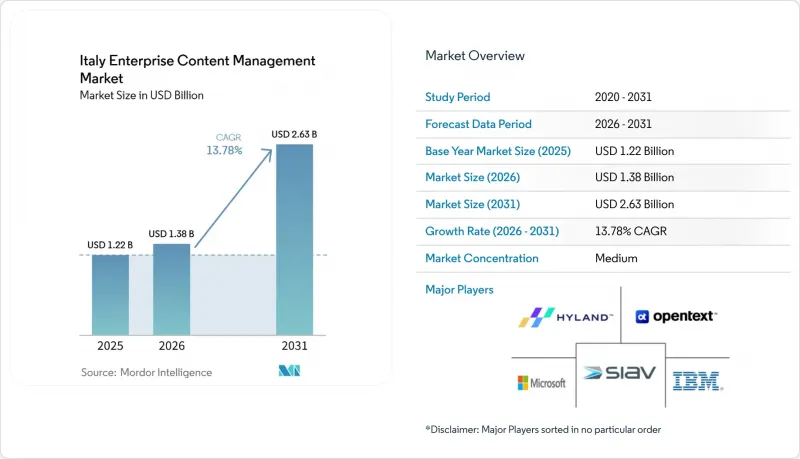
據 Mordor Intelligence 稱,義大利企業內容管理市場預計將從 2025 年的 12.2 億美元成長到 2026 年的 13.8 億美元,到 2031 年達到 26.3 億美元,預計 2026 年至 2031 年的複合年成長率為 13.78%。
本報告按解決方案類型(文件管理、記錄管理、工作流程和業務流程管理等)、部署類型(本地部署等)、企業規模(中小企業和大型企業)以及最終用戶行業(銀行、金融服務和保險業、政府和公共管理部門等)進行分類。市場預測以美元計價。
義大利企業內容管理市場的趨勢與洞察
在義大利加快無紙化工作流程,這受到相關法規的約束。
義大利企業內容管理市場直接受益於公共行政部門和受監管工作流程中有關數位文件的法律約束性法規。義大利《數位行政法》(Codice dell'Amministrazione Digitale)和義大利數位資訊署(AgID)的指導意見要求公共機構正式建立文件管理流程,任命檔案管理員,並維護符合規定的數位記錄儲存方法。 AgID的2024-2026年規劃架構旨在到2025年實現公共行政部門全面實施文件管理手冊並任命檔案管理員,從而引導各機構投資於系統化平台而非孤立的工具。 AgID在2025年下半年進行的正式問卷調查監測,使合規壓力更加緊迫,並更清晰地展現了公共部門的準備情況。這一點至關重要,因為義大利企業內容管理(ECM)市場的負責人不僅要關注內部效率目標,還要應對截止日期和監管要求。這種組合使得採購活動即使在更廣泛的IT預算分配更加謹慎的情況下也能繼續進行。
對人工智慧驅動的搜尋和檢索功能的需求日益成長。
義大利企業內容管理市場也正受惠於對更快速的非結構化內容搜尋、檢索和解讀的需求而蓬勃發展。預計到2025年,義大利企業的AI採用率將達到16.4%,高於2024年的8%,這顯示企業已迅速準備好使用AI驅動的商業工具。 AI的吸引力在於其在文件密集型環境中的實用性,因為員工需要快速存取合約、記錄和存檔文件,而無需依賴多年的手動標記工作。這也正在改變義大利企業內容管理市場的評估標準,因為搜尋品質和管治的自動化管理如今與儲存和歸檔功能一樣,對採購決策產生著重要影響。買家要求在同一環境中內建稽核和監控功能,這使得將AI整合到受管工作流程中的供應商比提供獨立工具的供應商更具優勢。因此,市場正在從單純的可選增強功能轉變為平台更新的核心原因。
公共機構和中型企業遷移遺留檔案的複雜性。
由於難以將大規模紙本檔案和專有數位記錄遷移到現代系統,義大利企業內容管理市場仍面臨許多挑戰。許多公共機構和中型企業持有基於不一致元資料的分散記錄,導致分類和遷移工作延誤。這個過程遠不止掃描;機構還需要檢驗、格式化以及證明數位化記錄具有法律效力。 AgID 的保存框架進一步提高了標準,要求合規的數位保存必須遵循正式法規,而非臨時性的保存做法。這延緩了新平台全面發揮營運價值的時間。此外,由於買家通常要求在進行大規模部署之前明確遷移計劃,因此義大利企業內容管理市場的決策週期也因此延長。
細分市場分析
到2025年,文件管理將在義大利企業內容管理市場佔據最大的市場佔有率,達到28.27%,佔當年總市場佔有率的28.27%。這一領先地位歸功於銀行、金融和保險(BFSI)、製造業和政府機構長期以來開展的數位化和歸檔活動,這些行業龐大的文件量為文件管理的普及應用奠定了堅實的基礎。由於許多買家在轉向更高級的自動化之前,仍然需要對文件分類、保留期限和搜尋進行更嚴格的控制,因此文件管理仍然是核心領域。記錄管理也持續佔據重要地位,因為審計風險、法律規定的保留期限以及資訊管治需求,都促使市場對嚴格的生命週期管理產生需求。 Web內容管理及相關儲存庫工具將繼續為需要在單一管理環境中協調內部和外部內容的組織提供支援。
預計到2031年,工作流程和業務流程管理(BPM)將以15.03%的複合年成長率成長,成為義大利企業內容管理市場中最具活力的解決方案領域。這一成長率表明,企業內容管理正從被動儲存向主動處理(例如核准、監管報告、合約流程和服務工作流程)發生顯著轉變。在義大利企業內容管理產業,這正在改變平台價值的評估方式,因為買家不僅越來越關注文件的存檔保留期限,還關注圍繞文件的營運流程。個案管理在法律、保險和公共管理等涉及多方相關人員和基於規則的操作流程中日益重要。在管理跨商業管道的大型內容庫的行業中,數位資產管理的需求也在不斷成長。總而言之,這些變化表明,義大利企業內容管理市場正從以儲存庫為中心的模式向以工作流程為中心的模式擴展。
2025年,雲端技術將佔據主導地位,佔義大利企業內容管理市場規模的73.14%。這一領先優勢反映了義大利企業正迅速將其內容基礎設施從專用本地硬體遷移到更靈活的服務環境。數位化營運能力強的企業現在將雲端交付視為新型文件工作流程、協作存取和跨站點管治的預設選項。對於需要更快部署、更簡單更新和更輕基礎設施管理負擔的企業而言,這一點尤其明顯。雲端模式也符合訂閱主導採購和更快的功能擴展等更廣泛的趨勢。
預計到2031年,混合部署將以15.68%的複合年成長率成長,成為義大利企業內容管理市場成長最快的部署模式。原因顯而易見:許多企業無法在雲端環境中啟動新的數位化流程的同時,立即棄用大規模的本地存檔。因此,一種新的遷移模式應運而生:首先遷移活躍內容和工作流程層,而歷史和敏感記錄則保留在託管儲存庫中。在義大利企業內容管理產業,這種混合架構對於那些專注於法律證據價值、資料保留義務或內部資料處理法規的買家尤其重要。因此,本地系統不會完全消失,而是會繼續發揮其選擇性作用。能夠管理這種共存模式的供應商,在需要分階段變更的複雜交易中更具優勢。
其他好處:
- Excel格式的市場預測(ME)表
- 3個月的分析師支持
目錄
第1章:引言
- 研究假設和市場定義
- 調查範圍
第2章:調查方法
第3章執行摘要
第4章 市場狀況
- 市場概覽
- 市場促進因素
- 加速義大利受監管工作流程中的無紙化操作
- 對人工智慧驅動的搜尋和資訊檢索的需求日益成長。
- 雲端原生內容管治的擴展
- 公共部門和醫療記錄的現代化
- 主權雲端和資料儲存位置偏好
- 在合約頻繁簽訂的行業中,越來越需要納入合規證據記錄。
- 市場限制因素
- 公共部門和中型企業遷移遺留檔案的複雜性。
- 整合 ERP、ERP相關系統和傳統業務系統的成本相對較高。
- 混合環境中非結構化內容的安全性和隱私問題
- 缺乏精通企業內容管理(ECM)的管理員與內容管治專家
- 產業價值鏈分析
- 監理情勢
- 技術展望
- 宏觀經濟因素對市場的影響
- 波特五力分析
第5章 市場規模與成長預測
- 按解決方案類型
- 文件管理
- 記錄管理
- 工作流程和業務流程管理
- 個案管理
- 數位資產管理
- 網站內容管理
- 其他解決方案
- 部署模式
- 現場
- 雲
- 混合
- 按公司規模
- 小型企業
- 大公司
- 按最終用戶行業分類
- BFSI
- 政府和公共行政
- 醫療保健和生命科學
- 資訊科技/通訊
- 工業製造
- 零售與電子商務
- 媒體與娛樂
- 教育
- 能源公用事業
- 其他終端用戶產業
第6章 競爭情勢
- 市場集中度
- 策略趨勢
- 市佔率分析
- 公司簡介
- OpenText Corporation
- Hyland Software, Inc.
- Microsoft Corporation
- Siav SpA
- IBM Corporation
- Able Tech Srl(ARXivar)
- Oracle Corporation
- SAP SE
- Adobe Inc.
- M-Files Corporation
- DocuWare GmbH
- SER Group Holding GmbH
- ELO Digital Office GmbH
- Fabasoft AG
- d.velop AG
- Therefore Corporation
- Laserfiche, Inc.
- Alfresco Software, LLC
- Newgen Software Technologies Limited
- Box, Inc.
第7章 市場機會與未來展望
According to Mordor Intelligence, the Italy enterprise content management market size is expected to increase from USD 1.22 billion in 2025 to USD 1.38 billion in 2026 and reach USD 2.63 billion by 2031, growing at a CAGR of 13.78% over 2026-2031.
This report is Segmented by Solution Type (Document Management, Records Management, Workflow and Business Process Management, and More), Deployment Mode (On-Premises, and More), Enterprise Size (Small and Medium Enterprises, and Large Enterprises), and End-User Industry (BFSI, Government and Public Administration, and More). The Market Forecasts are Provided in Terms of Value (USD).
Italy Enterprise Content Management Market Trends and Insights
Accelerated Paperless Compliance in Regulated Italian Workflows
The Italy enterprise content management market is receiving direct support from binding rules on digital documents across public administration and regulated workflows. Italy's Codice dell'Amministrazione Digitale and AgID guidance require public entities to formalize document management processes, assign records responsibility, and maintain compliant preservation methods for digital records. AgID's 2024-2026 planning framework set a target for full adoption of document management manuals and designated records officers across public administration by 2025, which pushed organizations toward structured platform investments rather than isolated tools. The compliance burden became more immediate when AgID carried out a formal questionnaire-based monitoring exercise in late 2025, making the state of readiness more visible across the public sector. This matters because buyers in the Italy enterprise content management market are not only reacting to internal efficiency goals, they are also responding to deadlines and oversight. That combination keeps procurement moving even when broader IT budgets remain selective.
Rising Demand For AI-Assisted Search and Retrieval
The Italy enterprise content management market is also gaining momentum from demand for faster search, retrieval, and interpretation of unstructured content. AI adoption among Italian enterprises reached 16.4% in 2025, up from 8% in 2024, which shows that readiness for AI-enabled business tools is building quickly. In document-heavy environments, the appeal of AI is practical because staff need quicker access to contracts, records, and archived files without depending on years of manual tagging. This is changing how the Italy enterprise content management market is evaluated, because search quality and governed automation now influence buying decisions as much as storage and archive features. Vendors that place AI inside controlled workflows are in a better position than those offering separate tools, since buyers want auditability and oversight built into the same environment. The result is a market where AI is moving from an optional enhancement to a core reason for platform renewal.
Legacy Archive Migration Complexity in Public and Mid-Market Enterprises
The Italy enterprise content management market still faces a major drag from the difficulty of moving large paper archives and proprietary digital records into modern systems. Many public bodies and mid-sized firms hold decentralized records that were created without consistent metadata, which makes classification and migration slow. The work is not limited to scanning, because organizations also need validation, format handling, and proof that digitized records remain legally reliable. AgID's preservation framework adds another layer of rigor, since compliant digital conservation must follow formal rules rather than ad hoc storage practices. This delays the point at which a new platform starts generating full operational value. It also extends decision cycles in the Italy enterprise content management market because buyers often need migration clarity before they commit to a larger rollout.
Other drivers and restraints analyzed in the detailed report include:
- Expansion of Cloud-Native Content Governance
- Modernization of Public Sector and Healthcare Records
- High Integration Cost With ERP, ERP-Adjacent, And Legacy Line-Of-Business Systems
For complete list of drivers and restraints, kindly check the Table Of Contents.
Segment Analysis
Document management held the largest share of the Italy enterprise content management market at 28.27% in 2025, and it accounted for 28.27% of the Italy enterprise content management market share in that year. Its lead came from long-running digitization and archiving activity across BFSI, manufacturing, and public administration, where large document volumes built a steady installed base. The segment remains central because many buyers still need stronger control over classification, retention, and retrieval before they extend into more advanced automation. Records management also remains important, since audit exposure, legal retention rules, and information governance needs keep demand tied to disciplined lifecycle control. Web content management and adjacent repository tools continue to support organizations that need to coordinate internal and external content from one governed environment.
Workflow and BPM is projected to grow at 15.03% CAGR through 2031, which makes it the most dynamic solution area in the Italy enterprise content management market. That pace shows a clear shift from passive storage toward active handling of approvals, regulatory reporting, contract routing, and service workflows. In the Italy enterprise content management industry, this changes the way platform value is judged because buyers increasingly want operational movement around documents, not only archive depth. Case management is gaining relevance in legal, insurance, and public administration settings where processes involve multiple participants and rule-based actions. Digital asset management is also finding room in sectors that manage broad content libraries across commercial channels. Together, these changes show that the Italy enterprise content management market is broadening from a repository-centered model into a workflow-centered one.
Cloud deployment dominated with a 73.14% share in 2025, and it represented 73.14% share of the Italy enterprise content management market size in that year. That lead reflects the speed at which Italian organizations moved content infrastructure away from dedicated on-premises hardware and into more flexible service environments. Enterprises with strong digital operations now treat cloud delivery as the default option for new document workflows, collaborative access, and cross-site governance. This is especially visible where organizations need faster deployment, simpler updates, and lower infrastructure management burdens. The cloud model also fits the wider move toward subscription-led procurement and faster functional expansion.
Hybrid deployment is forecast to grow at 15.68% CAGR through 2031, which makes it the highest-growth deployment model in the Italy enterprise content management market. The reason is practical, since many organizations cannot retire large on-premises archives immediately, even while they launch new digital processes in cloud environments. This creates a transition model where active content and workflow layers move first, while historical or highly sensitive records remain in controlled repositories. In the Italy enterprise content management industry, that blended architecture is particularly relevant for buyers with legal admissibility concerns, retention obligations, or internal data handling rules. On-premises systems, therefore, continue to play a selective role instead of disappearing outright. Vendors that can manage this coexistence are better placed to win complex accounts where change must happen in stages.
Complete Report Scope:
- By Solution Type
- Document Management
- Records Management
- Workflow and Business Process Management
- Case Management
- Digital Asset Management
- Web Content Management
- Other Solutions
- By Deployment Mode
- On-Premises
- Cloud
- Hybrid
- By Enterprise Size
- Small and Medium Enterprises
- Large Enterprises
- By End-User Industry
- BFSI
- Government and Public Administration
- Healthcare and Lifesciences
- IT and Telecommunications
- Industrial Manufacturing
- Retail and E-Commerce
- Media and Entertainment
- Education
- Energy and Utilities
- Other End-User Industries
List of Companies Covered in this Report:
- OpenText Corporation
- Hyland Software, Inc.
- Microsoft Corporation
- Siav S.p.A.
- IBM Corporation
- Able Tech S.r.l. (ARXivar)
- Oracle Corporation
- SAP SE
- Adobe Inc.
- M-Files Corporation
- DocuWare GmbH
- SER Group Holding GmbH
- ELO Digital Office GmbH
- Fabasoft AG
- d.velop AG
- Therefore Corporation
- Laserfiche, Inc.
- Alfresco Software, LLC
- Newgen Software Technologies Limited
- Box, Inc.
Additional Benefits:
- The market estimate (ME) sheet in Excel format
- 3 months of analyst support
TABLE OF CONTENTS
1 INTRODUCTION
- 1.1 Study Assumptions And Market Definition
- 1.2 Scope Of The Study
2 RESEARCH METHODOLOGY
3 EXECUTIVE SUMMARY
4 MARKET LANDSCAPE
- 4.1 Market Overview
- 4.2 Market Drivers
- 4.2.1 Accelerated Paperless Compliance in Regulated Italian Workflows
- 4.2.2 Rising Demand for AI-Assisted Search and Retrieval
- 4.2.3 Expansion of Cloud-Native Content Governance
- 4.2.4 Modernization of Public Sector and Healthcare Records
- 4.2.5 Sovereign Cloud and Data Residency Preference
- 4.2.6 Rising Need for Embedded Compliance Evidence Trails in Contract-Heavy Industries
- 4.3 Market Restraints
- 4.3.1 Legacy Archive Migration Complexity in Public and Mid-Market Enterprises
- 4.3.2 High Integration Cost With ERP, ERP-Adjacent, and Legacy Line-of-Business Systems
- 4.3.3 Security and Privacy Concerns Around Unstructured Content in Hybrid Environments
- 4.3.4 Shortage of ECM-Skilled Administrators and Content Governance Specialists
- 4.4 Industry Value Chain Analysis
- 4.5 Regulatory Landscape
- 4.6 Technological Outlook
- 4.7 Impact of Macroeconomic Factors on the Market
- 4.8 Porter's Five Forces Analysis
- 4.8.1 Bargaining Power of Suppliers
- 4.8.2 Bargaining Power of Buyers
- 4.8.3 Threat of New Entrants
- 4.8.4 Threat of Substitutes
- 4.8.5 Intensity of Competitive Rivalry
5 MARKET SIZE AND GROWTH FORECASTS (VALUE)
- 5.1 By Solution Type
- 5.1.1 Document Management
- 5.1.2 Records Management
- 5.1.3 Workflow and Business Process Management
- 5.1.4 Case Management
- 5.1.5 Digital Asset Management
- 5.1.6 Web Content Management
- 5.1.7 Other Solutions
- 5.2 By Deployment Mode
- 5.2.1 On-Premises
- 5.2.2 Cloud
- 5.2.3 Hybrid
- 5.3 By Enterprise Size
- 5.3.1 Small and Medium Enterprises
- 5.3.2 Large Enterprises
- 5.4 By End-User Industry
- 5.4.1 BFSI
- 5.4.2 Government and Public Administration
- 5.4.3 Healthcare and Lifesciences
- 5.4.4 IT and Telecommunications
- 5.4.5 Industrial Manufacturing
- 5.4.6 Retail and E-Commerce
- 5.4.7 Media and Entertainment
- 5.4.8 Education
- 5.4.9 Energy and Utilities
- 5.4.10 Other End-User Industries
6 COMPETITIVE LANDSCAPE
- 6.1 Market Concentration
- 6.2 Strategic Moves
- 6.3 Market Share Analysis
- 6.4 Company Profiles (includes Global Level Overview, Market Level Overview, Core Segments, Financials as available, Strategic Information, Market Rank/Share, Products and Services, Recent Developments)
- 6.4.1 OpenText Corporation
- 6.4.2 Hyland Software, Inc.
- 6.4.3 Microsoft Corporation
- 6.4.4 Siav S.p.A.
- 6.4.5 IBM Corporation
- 6.4.6 Able Tech S.r.l. (ARXivar)
- 6.4.7 Oracle Corporation
- 6.4.8 SAP SE
- 6.4.9 Adobe Inc.
- 6.4.10 M-Files Corporation
- 6.4.11 DocuWare GmbH
- 6.4.12 SER Group Holding GmbH
- 6.4.13 ELO Digital Office GmbH
- 6.4.14 Fabasoft AG
- 6.4.15 d.velop AG
- 6.4.16 Therefore Corporation
- 6.4.17 Laserfiche, Inc.
- 6.4.18 Alfresco Software, LLC
- 6.4.19 Newgen Software Technologies Limited
- 6.4.20 Box, Inc.
7 MARKET OPPORTUNITIES AND FUTURE OUTLOOK
- 7.1 White-Space And Unmet-Need Assessment

 企業架構服務市場:全球市場預測,2026-2032年
 中國企業內容管理(ECM):市場佔有率分析、產業趨勢與統計及成長預測(2026-2031)新加坡企業內容管理 (ECM):市佔率分析、產業趨勢與統計及成長預測 (2026-2031)美國企業內容管理 (ECM):市場佔有率分析、行業趨勢和統計數據以及成長預測 (2026-2031)西班牙企業內容管理:市場佔有率分析、產業趨勢與統計及成長預測(2026-2031)企業內容管理:市場佔有率分析、產業趨勢與統計、成長預測(2026-2031)基於雲端的企業內容管理市場-2026年至2032年全球市場預測雲端的企業內容管理:市場佔有率分析、產業趨勢與統計及成長預測(2026-2031 年)
 Frost Radar™:數位媒體內容安全與反派餅服務,2026 年企業內容管理市場-2026-2032年全球市場預測