


 |
市場調查報告書
商品編碼
2113309
雲端的企業內容管理:市場佔有率分析、產業趨勢與統計及成長預測(2026-2031 年)Cloud Enterprise Content Management - Market Share Analysis, Industry Trends & Statistics, Growth Forecasts (2026 - 2031) |
||||||

※ 本網頁內容可能與最新版本有所差異。詳細情況請與我們聯繫。
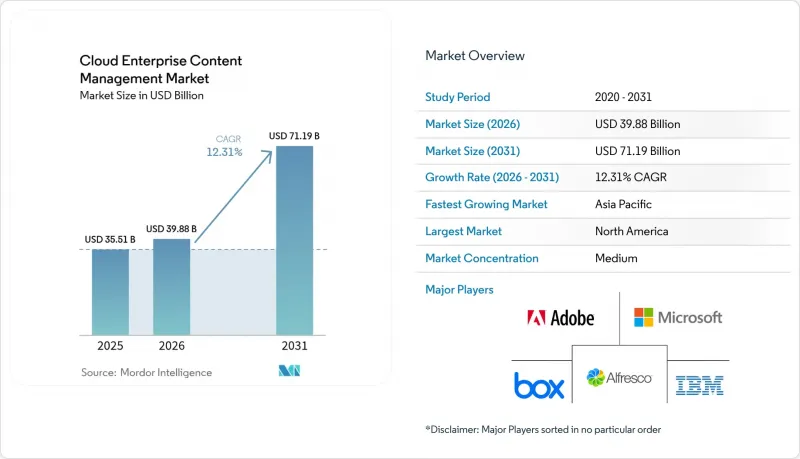
據 Mordor Intelligence 稱,2025 年基於雲端的企業內容管理市場價值為 355.1 億美元,預計到 2031 年將達到 711.9 億美元,而 2026 年為 398.8 億美元,預測期(2026-2031 年)的複合成長率為 12.31%。
本報告按解決方案(內容管理、案例管理等)、部署模式(公共雲端、私有雲端、混合雲端)、最終用戶行業(銀行、金融服務和保險、能源電力等)、服務(專業服務、託管服務)、組織規模(中小企業、大型企業)和地區(北美等)進行分類。市場預測以美元計價。
全球雲端企業內容管理市場趨勢與洞察
人工智慧驅動的內容自動化輔助管治與合規
生成式人工智慧透過自動化分類、元資料標記和保留合規性,將內容管治週期縮短了數週。 SharePoint Premium 中的 Microsoft Copilot 可自動建立摘要、擷取條款和套用敏感度標籤,進而加快稽核準備。早期採用者,尤其是在嚴格監管的行業,報告稱積壓工作顯著減少,監管檢查後的補救成本也降低。 OpenText Aviator 支援跨舊版存檔進行自然語言搜尋,使法務團隊能夠在監管機構之前識別違規。除了提高效率外,自動化策略執行還降低了可能高達全球收入 4% 的違規處罰風險。隨著工具的日趨成熟,人工智慧主導的管治有望滲透到中型企業,並在雲端企業內容管理市場中鞏固其影響力。
受監管產業的數位轉型進展
新的法規正迫使銀行、金融和保險(BFSI)機構以及醫療保健提供者對其內容工作流程進行現代化改造,不遵守規定將面臨制裁。歐洲的《數位營運彈性法案》強制要求銀行保留供應商互動的防篡改日誌,而美國的《21世紀治癒法案》則禁止醫療保健提供者收集此類資訊。印度的《數位個人資料保護法案》強制要求詳細記錄資料存取和刪除事件。由於無法及時維修幾十年前建立的儲存庫,各機構正快速遷移到雲端,包括預先配置保留期限和防篡改日誌記錄。供應商現在提供行業特定的模板,可以將引進週期縮短一半,而做好合規準備已成為雲端企業內容管理市場的關鍵購買動機。
從傳統企業內容管理 (ECM) 系統到雲端原生平台的複雜遷移。
數十年來,客製化的元資料、自訂工作流程和專有文件格式使雲端採用變得複雜。文件連結失效、審計追蹤缺失以及不相容的保留策略導致專案停滯和預算超支,迫使企業並行維護多個系統。由於證券法規要求保留原始格式文件七年,金融機構面臨更大的挑戰,這延緩了系統退役計畫的實施。能夠同時處理舊有系統和雲端環境的熟練整合商短缺,推高了成本,並減緩了雲端企業內容管理市場的短期發展勢頭。
細分市場分析
內容管理將在2025年佔總收入的33.62%,這反映了其作為政策、標準作業程式(SOP) 和合約證據官方儲存庫的地位。隨著行銷和培訓團隊產生Terabyte的影片和高解析度影像,數位資產管理正以15.18%的複合年成長率成長。管理超過一百萬個資產的公司報告稱,由於他們用自動標記和版本控制取代了專案文件共用,宣傳活動推出時間縮短了40%。個案管理和工作流程引擎廣泛應用於保險索賠和授權業務。這些業務需要在多階段核准流程中平衡法律規定的截止日期和客戶服務等級協定 (SLA)。記錄保存對於受ISO 15489保留義務約束的行業仍然具有戰略意義,它確保了合理刪除和有效管理法律保留義務。總而言之,這些模組支援基於雲端的企業內容管理市場的交叉銷售機會,從而增加客戶收入並加深供應商鎖定。
隨著無程式碼工具的出現,工作流程編配正重新受到關注。這些工具使業務用戶無需開發人員干預即可自動執行常見的核准流程。 Microsoft Power Automate 和 OpenText AppWorks 提供拖放式設計畫布,進而減少 IT 積壓工作並加快投資報酬率。 Hyland OnBase 等案例管理套件可協助政府機構追蹤公民請願書,並在法律期限臨近時發出提醒。記錄管理功能正在擴展,涵蓋協作會議記錄和社交媒體帖子,這些內容現在已被多個監管機構視為業務記錄。這些功能的整合正促使供應商轉向內容服務平台,這些平台將捕獲、管理、儲存、保存和分發功能整合到單一授權功能中,從而鞏固了其作為「一站式服務」的地位。
混合架構正以16.52%的複合年成長率快速擴張,超過了純公共雲端和私有雲端的成長速度。企業擴大將客戶財務記錄和智慧財產權(IP)保存在私有雲端節點上,同時將風險較低的資產整合到公有SaaS平台,用於彈性搜尋和基於人工智慧的分析。在歐盟,73%的受訪銀行已採用混合架構框架以符合GDPR在地化法規的要求,這一趨勢也反映在當地《個人資訊保護法》下的託管政策中。儘管預計到2025年,公共雲端將佔據企業雲端內容管理市場63.54%的佔有率,但對資料傳輸成本和多租戶環境的擔憂正促使大規模買家轉向混合環境以規避監管風險。
對於需要實體隔離的國防相關企業和製藥實驗室而言,私有雲端服務仍然至關重要,但其成長受到高額資本投入和專業人員需求的限制。 AWS Outposts 和 Microsoft Azure Stack 等裝置透過在客戶內部提供 SaaS API 來模糊傳統界線。災害復原(DR) 設計是推動混合雲的另一個因素。不可變的異地備份增強了抵禦勒索軟體攻擊的能力,同時又不違反資料儲存位置的相關法規。因此,架構的柔軟性得以保證,平台選擇範圍得以擴大,並且整個雲端企業內容管理市場的多廠商競爭和創新步伐得以維持。
區域分析
預計到2025年,北美將佔全球收入的37.56%。這主要歸功於美國證券交易委員會(SEC)、美國食品藥物管理局(FDA)以及各州隱私法對記錄保存不完善的行為施加的嚴厲處罰。總部位於該地區的跨國公司正在利用精細的內容分類引擎來區分受《加州消費者隱私法案》(CCPA)監管的個人資料和一般公司文件,從而降低訴訟風險。領先的美國科技公司也在製定可在全球推廣的架構藍圖,這將加速整個雲端企業內容管理市場的創新週期。
在歐洲,受《一般資料保護規則》(GDPR) 和《數位營運彈性法案》的影響,數位化格局正朝著「合規優先」的方向發展。金融機構正投資建置能夠經受監管機構審查的不可竄改的存檔層,而政府機構則在資助需要強大版本控制的電子政府入口網站。供應商對資料居住的保證以及符合 Schrems II 標準的合約條款,如今已成為提案書 (RFP) 中的標準要求。在中東和非洲,諸如杜拜舉措計畫等國家主導的數位化策略正在推動數位化應用,但撒哈拉以南非洲地區不可靠的通訊環境阻礙了即時協作,並限制了市場的即時擴張。
在亞太地區,預計複合年成長率將達到16.05%,印度、中國和日本等國政府推行的強制性電子採購、稅務和許可證記錄等高優先級項目正為其發展提供強勁動力。各國的雲端巨頭正與全球供應商合作,部署本地最佳化的SaaS服務,在滿足資料居住需求的同時,提供世界級的功能。在南美洲,由於頻寬較低以及稅務機關轉向數位化報告,雲端技術的應用正在謹慎推進,但外匯波動可能會影響購買決策。總體而言,預計到2031年,監管政策的澄清和基礎設施的升級將拓寬區域應用路徑,從而支持基於雲端的企業內容管理市場的持續成長。
其他好處:
- Excel格式的市場預測(ME)表
- 3個月的分析師支持
目錄
第1章:引言
- 研究假設和市場定義
- 調查範圍
第2章:調查方法
第3章執行摘要
第4章 市場狀況
- 市場概覽
- 市場促進因素
- 雲端運算的廣泛應用
- 企業行動化程度的提高和自帶設備辦公室 (BYOD) 政策的推廣
- 受監管產業的數位轉型進展
- 向遠距辦公和混合辦公模式過渡
- 人工智慧驅動的內容自動化輔助管治與合規
- 透過保密運算和令牌化實現高度安全的雲端企業內容管理。
- 市場限制因素
- 發展中地區的頻寬限制
- 多租戶環境下的安全性和合規性問題
- 從傳統企業內容管理 (ECM) 系統到雲端原生平台的複雜遷移。
- 供應商鎖定風險限制了策略柔軟性。
- 產業價值鏈分析
- 監理情勢
- 技術展望
- 宏觀經濟因素對市場的影響
- 波特五力分析
第5章 市場規模與成長預測
- 透過解決方案
- 內容管理
- 個案管理
- 工作流程管理
- 記錄管理
- 數位資產管理
- 其他解決方案
- 按部署模式
- 公共雲端
- 私有雲端
- 混合雲端
- 按最終用戶行業分類
- 銀行、金融服務和保險(BFSI)
- 能源與電力
- 醫療保健
- 製造業
- 零售
- IT/通訊
- 其他終端用戶產業
- 按服務
- 專業的
- 管理
- 按組織規模
- 小型企業
- 大公司
- 按地區
- 北美洲
- 美國
- 加拿大
- 墨西哥
- 南美洲
- 巴西
- 阿根廷
- 其他南美國家
- 歐洲
- 英國
- 德國
- 法國
- 義大利
- 西班牙
- 俄羅斯
- 其他歐洲國家
- 亞太地區
- 中國
- 日本
- 印度
- 韓國
- 澳洲
- 其他亞太國家
- 中東
- 沙烏地阿拉伯
- 阿拉伯聯合大公國
- 土耳其
- 其他中東國家
- 非洲
- 南非
- 奈及利亞
- 埃及
- 其他非洲國家
- 北美洲
第6章 競爭情勢
- 市場集中度
- 策略趨勢
- 市佔率分析
- 公司簡介
- Adobe Inc.
- Alfresco Software Inc.
- Box Inc.
- Hyland Software Inc.
- IBM Corporation
- Microsoft Corporation
- OpenText Corporation
- Oracle Corporation
- Xerox Holdings Corporation
- Newgen Software Technologies Limited
- DocuWare GmbH
- Laserfiche
- M-Files Corporation
- Fabasoft AG
- Everteam SAS
- SERgroup Holding International GmbH
- KnowledgeLake Inc.
- Objective Corporation Limited
- Kiteworks Inc.
- Veeva Systems Inc.
- Micro Focus International plc
- Epicor Software Corporation
- Nuxeo SA
- KYOCERA Document Solutions Inc.
- Systemware Inc.
第7章 市場機會與未來展望
According to Mordor Intelligence, the cloud enterprise content management market size was valued at USD 35.51 billion in 2025 and estimated to grow from USD 39.88 billion in 2026 to reach USD 71.19 billion by 2031, at a CAGR of 12.31% during the forecast period (2026-2031).
This report is Segmented by Solution (Content Management, Case Management, and More), Deployment Model (Public Cloud, Private Cloud, and Hybrid Cloud), End-User Industry (BFSI, Energy and Power, and More), Service (Professional, and Managed), Organization Size (SMEs, and Large Enterprises), and Geography (North America, and More). The Market Forecasts are Provided in Terms of Value (USD).
Global Cloud Enterprise Content Management Market Trends and Insights
AI-Powered Content Automation for Governance and Compliance
Generative AI is trimming weeks from content-governance cycles by automating classification, metadata tagging, and retention enforcement. Microsoft Copilot in SharePoint Premium now automatically drafts summaries, extracts clauses, and applies sensitivity labels, accelerating audit readiness. Early adopters, particularly in regulated verticals, report steep reductions in review backlogs and lower remediation costs after supervisory exams. OpenText Aviator enables natural-language search across legacy archives, allowing legal teams to surface non-compliant records before regulators do. Beyond efficiency, automated policy application lowers breach exposure under penalties that can reach 4% of global turnover. As tooling matures, AI-driven governance is expected to permeate mid-market deployments, solidifying its influence on the cloud enterprise content management market.
Growing Digital Transformation in Regulated Industries
New statutes are forcing BFSI and healthcare operators to modernize content workflows or risk sanctions. Europe's Digital Operational Resilience Act obliges banks to store immutable vendor-interaction logs, while the U.S. 21st Century Cures Act blocks information hoarding by providers. India's Digital Personal Data Protection Act mandates granular logs of data-access and erasure events. Unable to retrofit decades-old repositories in time, institutions are fast-tracking cloud migrations that include pre-configured retention schedules and tamper-evident logging. Vendors now ship sector templates that cut implementation cycles in half, making compliance readiness a key purchase trigger for the cloud enterprise content management market.
Complex Migration From Legacy ECM to Cloud-Native Platforms
Decades of bespoke metadata, custom workflows, and proprietary file formats complicate cloud rollouts. Broken document links, missing audit trails, and incompatible retention codes stall projects, inflate budgets, and force parallel system upkeep. Financial institutions face additional hurdles because securities rules require original-format access for seven years, which slows down decommissioning plans. Skilled integrators who can navigate both legacy and cloud stacks are scarce, which pushes costs higher and dampens near-term momentum in the cloud enterprise content management market.
Other drivers and restraints analyzed in the detailed report include:
- Increasing Adoption of Cloud Computing
- Shift Toward Remote and Hybrid Work Models
- Multi-Tenant Security and Compliance Concerns
For complete list of drivers and restraints, kindly check the Table Of Contents.
Segment Analysis
Content management accounted for 33.62% of 2025 revenue, reflecting its stature as the repository of record for policies, SOPs, and contractual evidence. Digital asset management is growing at a 15.18% CAGR as marketing and training teams generate terabytes of video and high-resolution imagery. Enterprises running more than 1 million assets report campaign launch times 40% faster once automated tagging and version control replace ad-hoc file shares. Case management and workflow engines are popular in insurance claims and permitting offices, where multistep approvals must reconcile statutory clocks with customer SLAs. Record management retains strategic relevance for industries subject to ISO 15489 retention mandates, ensuring defensible deletion and effective management of legal holds. Collectively, these modules anchor cross-sell opportunities that raise account revenue and deepen vendor lock-in within the cloud enterprise content management market.
Workflow orchestration is reclaiming attention as no-code tooling empowers business users to automate common approvals without developer intervention. Microsoft Power Automate and OpenText AppWorks now offer drag-and-drop design canvases, reducing IT backlog and accelerating ROI. Case-management suites, such as Hyland OnBase, support government agencies in tracking citizen petitions and triggering alerts when statutory deadlines approach. Record-management features have expanded to encompass collaboration transcripts and social posts, which are now considered business records by several regulators. The convergence of these capabilities is nudging vendors toward content-services platforms that bundle capture, management, storage, preservation, and delivery functions under a single license, reinforcing a one-stop-shop positioning.
Hybrid architectures are expanding at 16.52% CAGR, eclipsing both pure public and private segments. Enterprises routinely retain customer financial records and IP on private cloud nodes while funneling lower-risk assets to public SaaS for elastic search and AI-based analytics. In the European Union, 73% of surveyed banks adopted hybrid frameworks to comply with GDPR localization rules, a pattern also reflected in China's PIPL-driven mainland hosting policies. Although the public cloud held a 63.54% share of the cloud enterprise content management market in 2025, egress fees and shared-tenant concerns are steering larger buyers toward mixed estates that hedge regulatory exposure.
Private-cloud offerings remain vital for defense contractors and pharmaceutical labs that stipulate physical isolation, yet their growth is constrained by high capex and the need for specialized staff. Appliances such as AWS Outposts and Microsoft Azure Stack blur boundaries by delivering SaaS APIs on customer premises. Disaster-recovery design is another hybrid driver: immutable off-site backups harden ransomware resilience without breaching residency rules. The resulting architectural flexibility keeps platform selection fluid, sustaining multi-vendor competition and innovation cadence across the cloud enterprise content management market.
Complete Report Scope:
- By Solution
- Content Management
- Case Management
- Workflow Management
- Record Management
- Digital Asset Management
- Other Solutions
- By Deployment Model
- Public Cloud
- Private Cloud
- Hybrid Cloud
- By End-User Industry
- Banking, Financial Services and Insurance (BFSI)
- Energy and Power
- Medical and Healthcare
- Manufacturing
- Retail
- Information Technology and Telecom
- Other End-User Industries
- By Service
- Professional
- Managed
- By Organization Size
- Small and Medium Enterprises
- Large Enterprises
- By Geography
- North America
- United States
- Canada
- Mexico
- South America
- Brazil
- Argentina
- Rest of South America
- Europe
- United Kingdom
- Germany
- France
- Italy
- Spain
- Russia
- Rest of Europe
- Asia Pacific
- China
- Japan
- India
- South Korea
- Australia
- Rest of Asia Pacific
- Middle East
- Saudi Arabia
- United Arab Emirates
- Turkey
- Rest of Middle East
- Africa
- South Africa
- Nigeria
- Egypt
- Rest of Africa
- North America
Geography Analysis
North America generated 37.56% of 2025 revenue as the Securities and Exchange Commission, the Food and Drug Administration, and state privacy acts enforced stiff penalties for lapses in record retention. Multinationals headquartered in the region utilize granular content-classification engines to distinguish between personal data subject to California Consumer Privacy Act rules and general corporate documents, thereby reducing litigation exposure. U.S.-based tech giants also set architectural blueprints that ripple worldwide, accelerating innovation cycles across the cloud enterprise content management market.
Europe follows a compliance-first trajectory shaped by GDPR and the Digital Operational Resilience Act. Financial institutions invest in immutable archival layers that withstand supervisory scrutiny, while public administrations fund e-governance portals that demand robust version control. Vendor data residency commitments and Schrems-II-compliant contractual clauses are now standard requirements in RFPs. In the Middle East and Africa, sovereign digitization strategies, such as the Dubai Paperless Initiative, stimulate adoption; however, sporadic connectivity in Sub-Saharan regions hinders real-time collaboration and tempers immediate market size gains.
Asia Pacific, forecast to grow at 16.05% CAGR, benefits from high-priority government programs in India, China, and Japan that mandate electronic procurement, tax, and licensing records. Domestic cloud champions partner with global vendors to launch localized SaaS offerings that satisfy residency rules while offering global-class features. South America exhibits a cautious uptake as bandwidth prices decline and tax authorities transition to digital reporting, yet currency volatility can hinder purchase decisions. Overall, regulatory clarity and infrastructure upgrades are expected to expand regional adoption channels through 2031, supporting sustained growth for the cloud-based enterprise content management market.
- Adobe Inc.
- Alfresco Software Inc.
- Box Inc.
- Hyland Software Inc.
- IBM Corporation
- Microsoft Corporation
- OpenText Corporation
- Oracle Corporation
- Xerox Holdings Corporation
- Newgen Software Technologies Limited
- DocuWare GmbH
- Laserfiche
- M-Files Corporation
- Fabasoft AG
- Everteam SAS
- SERgroup Holding International GmbH
- KnowledgeLake Inc.
- Objective Corporation Limited
- Kiteworks Inc.
- Veeva Systems Inc.
- Micro Focus International plc
- Epicor Software Corporation
- Nuxeo SA
- KYOCERA Document Solutions Inc.
- Systemware Inc.
Additional Benefits:
- The market estimate (ME) sheet in Excel format
- 3 months of analyst support
TABLE OF CONTENTS
1 INTRODUCTION
- 1.1 Study Assumptions and Market Definition
- 1.2 Scope of the Study
2 RESEARCH METHODOLOGY
3 EXECUTIVE SUMMARY
4 MARKET LANDSCAPE
- 4.1 Market Overview
- 4.2 Market Drivers
- 4.2.1 Increasing Adoption of Cloud Computing
- 4.2.2 Rising Enterprise Mobility and BYOD Policies
- 4.2.3 Growing Digital Transformation in Regulated Industries
- 4.2.4 Shift Toward Remote and Hybrid Work Models
- 4.2.5 AI-Powered Content Automation for Governance and Compliance
- 4.2.6 Confidential Computing and Tokenization Enabling Highly Secure Cloud ECM
- 4.3 Market Restraints
- 4.3.1 Bandwidth Limitations in Developing Regions
- 4.3.2 Multi-Tenant Security and Compliance Concerns
- 4.3.3 Complex Migration From Legacy ECM to Cloud-Native Platforms
- 4.3.4 Vendor Lock-In Risks Limiting Strategic Flexibility
- 4.4 Industry Value Chain Analysis
- 4.5 Regulatory Landscape
- 4.6 Technological Outlook
- 4.7 Impact of Macroeconomic Factors on the Market
- 4.8 Porter's Five Forces Analysis
- 4.8.1 Bargaining Power of Suppliers
- 4.8.2 Bargaining Power of Buyers
- 4.8.3 Threat of New Entrants
- 4.8.4 Threat of Substitute Products
- 4.8.5 Intensity of Competitive Rivalry
5 MARKET SIZE AND GROWTH FORECASTS (VALUE)
- 5.1 By Solution
- 5.1.1 Content Management
- 5.1.2 Case Management
- 5.1.3 Workflow Management
- 5.1.4 Record Management
- 5.1.5 Digital Asset Management
- 5.1.6 Other Solutions
- 5.2 By Deployment Model
- 5.2.1 Public Cloud
- 5.2.2 Private Cloud
- 5.2.3 Hybrid Cloud
- 5.3 By End-User Industry
- 5.3.1 Banking, Financial Services and Insurance (BFSI)
- 5.3.2 Energy and Power
- 5.3.3 Medical and Healthcare
- 5.3.4 Manufacturing
- 5.3.5 Retail
- 5.3.6 Information Technology and Telecom
- 5.3.7 Other End-User Industries
- 5.4 By Service
- 5.4.1 Professional
- 5.4.2 Managed
- 5.5 By Organization Size
- 5.5.1 Small and Medium Enterprises
- 5.5.2 Large Enterprises
- 5.6 By Geography
- 5.6.1 North America
- 5.6.1.1 United States
- 5.6.1.2 Canada
- 5.6.1.3 Mexico
- 5.6.2 South America
- 5.6.2.1 Brazil
- 5.6.2.2 Argentina
- 5.6.2.3 Rest of South America
- 5.6.3 Europe
- 5.6.3.1 United Kingdom
- 5.6.3.2 Germany
- 5.6.3.3 France
- 5.6.3.4 Italy
- 5.6.3.5 Spain
- 5.6.3.6 Russia
- 5.6.3.7 Rest of Europe
- 5.6.4 Asia Pacific
- 5.6.4.1 China
- 5.6.4.2 Japan
- 5.6.4.3 India
- 5.6.4.4 South Korea
- 5.6.4.5 Australia
- 5.6.4.6 Rest of Asia Pacific
- 5.6.5 Middle East
- 5.6.5.1 Saudi Arabia
- 5.6.5.2 United Arab Emirates
- 5.6.5.3 Turkey
- 5.6.5.4 Rest of Middle East
- 5.6.6 Africa
- 5.6.6.1 South Africa
- 5.6.6.2 Nigeria
- 5.6.6.3 Egypt
- 5.6.6.4 Rest of Africa
- 5.6.1 North America
6 COMPETITIVE LANDSCAPE
- 6.1 Market Concentration
- 6.2 Strategic Moves
- 6.3 Market Share Analysis
- 6.4 Company Profiles (includes Global level Overview, Market level overview, Core Segments, Financials as available, Strategic Information, Market Rank/Share for key companies, Products and Services, and Recent Developments)
- 6.4.1 Adobe Inc.
- 6.4.2 Alfresco Software Inc.
- 6.4.3 Box Inc.
- 6.4.4 Hyland Software Inc.
- 6.4.5 IBM Corporation
- 6.4.6 Microsoft Corporation
- 6.4.7 OpenText Corporation
- 6.4.8 Oracle Corporation
- 6.4.9 Xerox Holdings Corporation
- 6.4.10 Newgen Software Technologies Limited
- 6.4.11 DocuWare GmbH
- 6.4.12 Laserfiche
- 6.4.13 M-Files Corporation
- 6.4.14 Fabasoft AG
- 6.4.15 Everteam SAS
- 6.4.16 SERgroup Holding International GmbH
- 6.4.17 KnowledgeLake Inc.
- 6.4.18 Objective Corporation Limited
- 6.4.19 Kiteworks Inc.
- 6.4.20 Veeva Systems Inc.
- 6.4.21 Micro Focus International plc
- 6.4.22 Epicor Software Corporation
- 6.4.23 Nuxeo SA
- 6.4.24 KYOCERA Document Solutions Inc.
- 6.4.25 Systemware Inc.
7 MARKET OPPORTUNITIES AND FUTURE OUTLOOK
- 7.1 White-space and Unmet-Need Assessment

 企業架構服務市場:全球市場預測,2026-2032年
 中國企業內容管理(ECM):市場佔有率分析、產業趨勢與統計及成長預測(2026-2031)新加坡企業內容管理 (ECM):市佔率分析、產業趨勢與統計及成長預測 (2026-2031)美國企業內容管理 (ECM):市場佔有率分析、行業趨勢和統計數據以及成長預測 (2026-2031)義大利企業內容管理:市場佔有率分析、產業趨勢與統計及成長預測(2026-2031)西班牙企業內容管理:市場佔有率分析、產業趨勢與統計及成長預測(2026-2031)企業內容管理:市場佔有率分析、產業趨勢與統計、成長預測(2026-2031)基於雲端的企業內容管理市場-2026年至2032年全球市場預測
 Frost Radar™:數位媒體內容安全與反派餅服務,2026 年企業內容管理市場-2026-2032年全球市場預測