


 |
市場調查報告書
商品編碼
2119179
商用壁紙:市場佔有率分析、產業趨勢與統計、成長預測(2026-2031)Commercial Wallpaper - Market Share Analysis, Industry Trends & Statistics, Growth Forecasts (2026 - 2031) |
||||||

※ 本網頁內容可能與最新版本有所差異。詳細情況請與我們聯繫。
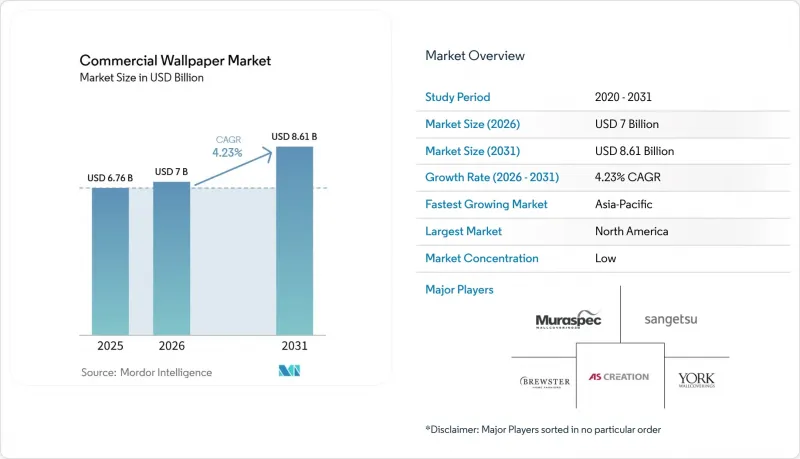
根據 Mordor Intelligence 估計,2025 年商業壁紙市值為 67.6 億美元,2026 年將擴大到 70 億美元,預計到 2031 年將達到 86.1 億美元。
預計從 2026 年到 2031 年,其複合年成長率將達到 4.2%。
本報告按材料類型(實心乙烯基、乙烯塗層紙、乙烯布、不織布乙烯基等)、應用領域(新建建築等)、最終用戶(酒店、醫療保健、辦公、零售、教育等)、配銷通路(直接銷售和間接銷售)以及地區進行分類。預測值以美元計價。
全球商用壁紙市場趨勢與洞察
對酒店業整修和品牌體驗的投資
商業壁紙市場主要受飯店業翻新需求的驅動,飯店業者為了維持品牌標準,會更頻繁地翻新室內裝潢。豪華飯店業者的翻新週期已從10年縮短至5-7年。截至2025年第二季度,海灣合作理事會(GCC)國家的酒店開發平臺包括650個在建項目,共計161,574間客房,其中沙烏地阿拉伯擁有超過340家酒店和92,000多間客房。截至2025年第四季末,美國飯店整修和品牌重塑項目總數為2,118個。物業維修計劃通常會明確規定壁材類型、防火等級和耐洗性。這使得獲批產品不易受到僅基於初始購買價格的競標的影響。
數位印刷和客製化商業室內設計
數位印刷技術透過降低最低訂購量和縮短專案前置作業時間,正在推動商業壁紙市場的發展。 Wallquest公司在2026年4月部署了四台HP Latex FS70 W印表機後,整體生產效率提升了30%。 Newmor公司則添置了佳能Colorado M5W印表機和Neolt印後加工設備,以滿足客製化商業專案的需求。這些投資使得建築師能夠為接待區和裝飾牆面指定少量客製化產品。小批量生產也減少了供應商和企劃團隊的庫存需求。 Muraspec公司的「壁畫冊」採用GREENGUARD Gold認證的無VOC UV油墨,顯示客製化產品也能滿足室內空氣品質要求。
油漆、裝飾板和建築薄膜的替代品。
在商業壁紙市場,塗料、裝飾板和建築薄膜仍然是重要的替代方案。塗料約佔全球室內表面材料支出的75%,且通常具有更低的材料和人事費用。當專案預算中對速度和前期成本要求較高時,塗料飾面尤其具有競爭力。建築薄膜也常用於零售店翻新,因為這類翻新需要快速安裝和易於移除。壁紙供應商正積極回應市場需求,推出自黏型、紋理印花和生物基材等產品。價格差異仍然是南美和對價格敏感的亞洲地區商業項目的阻礙因素。
細分市場分析
到2025年,實心乙烯基將佔商業壁紙市場需求的46.8%,成為該市場最大的材料類別。它在人流量大的飯店走廊、醫療機構和需要II級耐磨性和A級防火性能的企業內部空間中仍然佔據主導地位。乙烯基塗層紙在需要兼顧成本和性能的維修項目中繼續發揮重要作用。乙烯布是豪華酒店大廳和企業設施的理想之選,這些場所對耐用性和隔音性能要求較高。預計到2031年,不織布乙烯基將以4.9%的複合年成長率成長。其直接黏貼式施工方法可減少安裝時間和準備工作,使其在難以找到承包商的場所非常實用。
儘管目前PVC含量較低,但不含PVC、生物基和天然纖維的產品在注重材料健康的專案規範中越來越受到關注。因此,商業壁紙行業正在努力兼顧傳統的性能需求和對永續性的要求。 2025年,Ahlström推出了數位印刷的「WallStar Digital Advance」和「WallStar Digital Essential」系列產品。這些產品包括不含PVC的II型選項,以及採用FSC認證紙漿和再生材料的產品。這些產品展現了材料供應商如何兼顧性能和環境認證。不織布乙烯基市場受益於安裝人工成本的降低,而實心乙烯基在高磨損區域的需求仍然旺盛。這種平衡使供應商能夠滿足更廣泛的建築規範要求。實際上,設計團隊在選擇基材之前,會比較飾面外觀、清潔要求、防火性能、安裝方法和相關文件。對於已居住的建築而言,能夠減少現場人工的產品尤其重要,因為專案經理需要盡可能減少噪音、灰塵和運作。此外,供應商需要提供樣品和技術支持,以便設計師能夠就材料選擇做出明智的決定。
2025年,新建案佔商業壁紙需求的53.5%,成為該市場最大的應用領域。亞太地區的酒店開業、海灣合作理事會(GCC)國家的開發和建設以及北美地區的醫療設施項目,都為開業前採購壁紙創造了機會。儘管2026年計劃飯店建築項目和240萬間客房,但壁紙規格通常集中在大型承包商和認證供應商手中。因此,新建專案的需求仍然與商業建設的啟動密切相關,並且更容易受到專案資金籌措和工期延誤的影響。大型項目仍然有可能為傳統供應商帶來大量訂單。這些訂單通常需要供應商提前介入,因為在最終室內設計方案獲得批准之前,需要審核樣品、模型和性能資訊。供應商名單可能會縮小新計畫的選擇範圍,但也會為已經符合所需技術標準的產品創造可預測的供應管道。這種對預先核准的重視有利於那些在規格方面建立了牢固關係的公司。
預計到2031年,維修改造市場將以4.6%的複合年成長率成長,超過新建市場。品牌重塑、資產搬遷和辦公室重新配置將擴展到眾多小規模專案。北美和歐洲成熟的物業存量需要定期維修,這支撐了商業壁紙維修市場的規模。即使在新建市場達到頂峰之後,維修活動仍可能持續。隨著租戶調整佈局、會議室和共用空間,混合辦公空間設計正在成為新的需求來源。擁有分銷網路和處理小訂單能力的供應商在執行這些項目方面具有優勢。維修買家通常需要替換材料、特定區域的設計或少量材料,這些材料不足以構成大規模直接訂單。這項工作有可能在廣泛的物業範圍內產生持續的銷售,而不是僅限於單一的施工週期。此外,庫存管理和快速的客戶回應對於通路合作夥伴來說變得越來越重要。
區域分析
2025年,北美將佔全球需求的36.3%,並繼續保持其作為商業壁紙市場最大區域組成部分的地位。 2026年第一季,美國豪華飯店的規劃數量達到102家,較去年同期成長16%。醫療設施的維修也推動了對具有合格證書的室內裝飾材料的需求。加州的VOC法規和CDPH v1.2的要求凸顯了合格證書在美國西部商業項目中的重要性。由於醫療和教育設施的維修,加拿大的需求也在成長;而在墨西哥,度假村和零售設施的建設則推動了需求。北美專案通常要求供應商在規範制定階段提交有關排放、防火和耐久性的文件。完善的測試記錄可以消除建築師和業主的疑慮。這項要求進一步提升了能夠提供跨多種產品類型一致產品的供應商的價值。
預計到2031年,歐洲市場將顯著擴張。維修、材料的法規合規性以及高階建築規格仍然是全部區域重要的需求來源。 REACH法規和永續性要求正在影響關鍵建築類別中的材料選擇。德國的節能維修正在推動更廣泛的室內維修活動。在法國,強調歷史傳承和圖案的壁紙需求依然強勁,而在西班牙和義大利,飯店業的投資也帶來了利多。北歐國家的買家尤其關注不含PVC和生物基的產品。在歐洲商業壁紙市場,供應商可以透過將壁紙的設計經驗與清晰的法規文件相結合來獲得優勢。該地區的買家在維修和永續主導項目中既重視視覺效果,也重視材料的合格。因此,除了傳統的商業產品外,提供不含PVC和生物基選項的產品系列將更具優勢。供應商還需要提交相關文件,以便建築師在專案核准過程中進行審核。
亞太地區是成長最快的地區,預計到2031年複合年成長率將達到4.7%。中國仍然是該地區最大的生產和消費中心,但需求正轉向維修和高階開發。印度的商業基礎設施項目正在支撐酒店、零售和公共設施的需求。在東南亞,越南、印尼和菲律賓的飯店和綜合用途設施建設備受關注。中東和非洲的國內需求成長強勁,這得益於海灣合作理事會(GCC)國家活躍的飯店建築項目。在南美洲,由於飯店維修和商業設施建設,市場正在擴張,但外匯波動可能會延遲進口產品的採購。在海灣合作理事會國家,大規模酒店項目正在創造對滿足高階設計和商業性性能要求的產品的需求。亞洲的供應商和買家也越來越關注翻新項目,這有可能支持新項目初始安裝之外的更高附加價值用途。因此,儘管耐用性和設計柔軟性等要求是通用的,但商業壁紙市場仍呈現出因地區而異的獨特需求模式。
其他好處:
- Excel格式的市場預測(ME)表
- 3個月的分析師支持
目錄
第1章:引言
- 研究假設和市場定義
- 調查範圍
第2章:調查方法
第3章執行摘要
第4章 市場狀況
- 市場概覽
- 市場促進因素
- 對酒店業整修和品牌體驗的投資
- 數位印刷和定製商業室內設計的發展。
- 對耐用、可水洗、防火的壁紙。
- 擴大醫療保健和零售業的維修,以及靈活職場環境的建設。
- 受規格要求主導,聲學和生物基壁紙的普及。
- 按需生產可以縮短從概念到安裝的周期。
- 市場限制因素
- 油漆、裝飾板和建築薄膜的替代品。
- PVC、不織布基材和黏合劑的成本波動。
- 安裝、基板準備以及對熟練勞動力的限制。
- 多層壁紙認證和廢舊產品處理的複雜性。
- 產業價值鏈分析
- 波特五力分析
- 深入了解產業最新趨勢與創新
- 近期產業趨勢分析(新產品發布、策略性舉措、投資、合作、合資、業務擴張、併購等)
- 商業壁紙技術趨勢的研究(數位印刷、低VOC油墨、生物基基材、抗菌處理、剝離式黏合劑和AR視覺化)。
第5章 市場規模與成長預測
- 按材料類型/依結構類型
- 實心乙烯基
- 乙烯基塗佈紙
- 乙烯布
- 不織布乙烯基
- 其他材料類型(不含PVC、生物基等)
- 透過使用
- 新建工程
- 維修和改造
- 最終用戶
- 飯店業
- 衛生保健
- 企業辦公室與共享辦公空間
- 零售和購物中心
- 教育和公共設施
- 運輸和船舶內飾
- 其他最終使用者(公共建築和政府設施、休閒設施和其他商業設施)
- 透過分銷管道
- 廠商直銷
- 間接銷售(批發商、零售商、經銷商、承包商)
- 按地區
- 北美洲
- 加拿大
- 美國
- 墨西哥
- 南美洲
- 巴西
- 秘魯
- 智利
- 阿根廷
- 其他南美國家
- 歐洲
- 英國
- 德國
- 法國
- 西班牙
- 義大利
- 比荷盧經濟聯盟(比利時、荷蘭、盧森堡)
- 北歐國家(丹麥、芬蘭、冰島、挪威、瑞典)
- 其他歐洲國家
- 亞太地區
- 印度
- 中國
- 日本
- 澳洲
- 韓國
- 東南亞
- 其他亞太國家
- 中東和非洲
- 阿拉伯聯合大公國
- 沙烏地阿拉伯
- 南非
- 奈及利亞
- 其他中東和非洲國家
- 北美洲
第6章 競爭情勢
- 市場集中度概述
- 策略趨勢
- 市佔率分析
- 公司簡介
- AS Creation Tapeten AG
- Asian Paints Limited
- Arte International BV
- Brewster Home Fashions LLC
- F. Schumacher and Co.
- Graham and Brown Limited
- Grandeco Wallfashion Group Belgium NV
- Komar Products GmbH
- Koroseal Interior Products LLC
- Muraspec Group
- Newmor Wallcoverings Limited
- Omexco NV
- Osborne and Little Limited
- Rasch GmbH and Co. KG
- Sangetsu Corporation
- Sanderson Design Group plc
- The Romo Group
- Versa Designed Surfaces
- Wallquest Inc.
- York Wallcoverings Inc.
第7章 市場機會與未來展望
According to Mordor Intelligence, the commercial wallpaper market size was valued at USD 6.76 billion in 2025, is estimated to grow to USD 7.0 billion in 2026, and is forecast to reach USD 8.61 billion by 2031, growing at a CAGR of 4.2% over 2026-2031.
This report is Segmented by Material Type (Solid Vinyl, Vinyl Coated Paper, Fabric Backed Vinyl, Non-Woven Vinyl, and Others), Application (New Construction and More), End User (Hospitality, Healthcare, Offices, Retail, Education, and Others), Distribution Channel (Direct Sales and Indirect Sales), and Geography. Forecasts are in Terms of Value (USD).
Global Commercial Wallpaper Market Trends and Insights
Hospitality Renovation and Brand-Experience Investment
The commercial wallpaper market is supported by hospitality refurbishment, where operators refresh interiors more often to maintain brand standards. Luxury operators have moved toward 5-7-year refresh cycles, compared with 10-year cycles used a decade earlier. The GCC hotel pipeline included 161,574 rooms across 650 active projects in Q2 2025, with Saudi Arabia accounting for more than 340 hotels and over 92,000 rooms. United States hotel renovation and brand conversion activity totaled 2,118 projects at the end of Q4 2025. Property improvement plans commonly specify wallcovering type, fire rating, and scrub resistance. This makes approved products less exposed to bids based only on initial purchase price.
Digitally Printed and Customized Commercial Interiors
Digital printing supports the commercial wallpaper market by reducing minimum order quantities and shortening project lead times. Wallquest installed 4 HP Latex FS70 W printers in April 2026 and reported a 30% improvement in overall production performance . Newmor added a Canon Colorado M5W printer and Neolt finishing equipment to support bespoke commercial work. These investments allow architects to specify small custom runs for reception areas and feature walls. Shorter runs also reduce inventory needs for suppliers and project teams. Muraspec's Mural Book used GREENGUARD Gold-certified, VOC-free UV inks, demonstrating that customized products can also meet indoor air quality requirements.
Substitution from Paint, Decorative Panels, and Architectural Films
Paint, decorative panels, and architectural films remain important substitutes for the commercial wallpaper market. Paint keeps an estimated 75% of global interior-surface spending and generally has lower installed material and labor costs. Painted finishes are especially competitive where project budgets favor speed and low upfront costs. Architectural films are also used in retail refurbishments that require quick installation and easy removal. Wallcovering suppliers are responding with peel-and-stick formats, textured printing, and biobased substrates. The price gap remains a constraint in South America and price-sensitive Asian commercial projects.
Other drivers and restraints analyzed in the detailed report include:
- Durable, Scrubbable, and Fire-Rated Wallcoverings
- Healthcare, Retail, and Flexible Workplace Refurbishment
- PVC, Non-Woven Substrate, And Adhesive Cost Volatility
For complete list of drivers and restraints, kindly check the Table Of Contents.
Segment Analysis
Solid vinyl held 46.8% of 2025 demand, making it the largest material category in the commercial wallpaper market. It remains established in high-traffic hospitality corridors, clinical settings, and corporate interiors that require Type II scrub performance and Class A fire characteristics. Vinyl-coated paper remains relevant for renovation projects that need a balance between cost and functional performance. Fabric-backed vinyl is well-suited to premium hospitality lobbies and corporate settings where durability and acoustic properties are valued. Non-woven vinyl is forecast to expand at a 4.9% CAGR through 2031. Its paste-the-wall application reduces installation time and preparation requirements, which is useful where installer availability is limited.
PVC-free, biobased, and natural-fiber formats remain smaller in volume but receive greater attention in project specifications that pursue material-health objectives. The commercial wallpaper industry is therefore serving both conventional performance needs and projects with sustainability requirements. Ahlstrom introduced WallStar Digital Advance and WallStar Digital Essential in 2025 for digital-printing applications, including a PVC-free Type II option and a product using FSC-certified pulp and recycled components. These offerings show how material suppliers are addressing both performance and environmental documentation. The market for non-woven vinyl benefits from labor-saving installation, while solid vinyl keeps demand in locations with intensive wear. This balance allows suppliers to serve a wider range of building specifications. In practice, design teams compare the appearance of finishes, cleaning requirements, fire performance, installation methods, and documentation before selecting a substrate. Products that reduce site labor can be particularly useful for occupied buildings, where project managers seek to limit noise, dust, and downtime. Suppliers also need to provide samples and technical support to help designers distinguish among material options.
New construction accounted for 53.5% of 2025 application demand and was the largest application in the commercial wallpaper market. Hotel openings in Asia-Pacific, GCC developments, and North American healthcare projects create a pre-opening purchasing window for wallcoverings. The 2026 hotel pipeline included 15,900 projects and 2.4 million rooms, although wallcovering specifications are often concentrated among major contractors and approved suppliers. New-build demand, therefore, remains closely linked to commercial construction starts. It is also more sensitive to delays in project financing and completion schedules. Large projects can still create meaningful order volumes for established suppliers. These orders often require early engagement because samples, mock-ups, and performance information are considered before the final interior package is approved. Supplier panels may narrow options for new projects, but they can also create a predictable route for products that have already met the required technical criteria. This emphasis on prior approval favors firms with established specification relationships.
Renovation and remodeling are forecast to grow at a 4.6% CAGR through 2031, faster than new construction. Brand refreshes, asset repositioning, and office reconfiguration distribute this work across many smaller projects. The commercial wallpaper market size for renovation is supported by mature North American and European property bases that require recurring upgrades. Refurbishment activity can continue even when new construction peaks decline. Hybrid workplace design adds another source of demand as tenants adapt layouts, meeting rooms, and shared spaces. Suppliers with distributor coverage and the ability to handle smaller orders are well-positioned to complete these projects. Renovation buyers commonly need replacement materials, localized designs, or limited quantities that do not justify a large direct order. This work can generate recurring sales across a broad property base rather than a single construction cycle. It also makes stock availability and responsive customer service more important for channel partners.
Complete Report Scope:
- By Material Type/Construction Type
- Solid Vinyl
- Vinyl Coated Paper
- Fabric Backed Vinyl
- Non-Woven Vinyl
- Other Material Types (PVC-free, bio-based, etc.)
- By Application
- New Construction
- Renovation and Remodeling
- By End User
- Hospitality
- Healthcare
- Corporate Offices and Co-Working Spaces
- Retail and Shopping Centers
- Education and Institutional Buildings
- Transportation and Marine Interiors
- Other End Users (Public Buildings and Government Facilities, Leisure and Other Commercial Facilities)
- By Distribution Channel
- Direct Sales from Manufacturers
- Indirect Sales (Distributors, Retailers, Dealers, Contractors)
- By Geography
- North America
- Canada
- United States
- Mexico
- South America
- Brazil
- Peru
- Chile
- Argentina
- Rest of South America
- Europe
- United Kingdom
- Germany
- France
- Spain
- Italy
- BENELUX (Belgium, Netherlands, Luxembourg)
- NORDICS (Denmark, Finland, Iceland, Norway, Sweden)
- Rest of Europe
- Asia-Pacific
- India
- China
- Japan
- Australia
- South Korea
- South-East Asia
- Rest of Asia-Pacific
- Middle East & Africa
- United Arab Emirates
- Saudi Arabia
- South Africa
- Nigeria
- Rest of Middle East & Africa
- North America
Geography Analysis
North America accounted for 36.3% of 2025 demand and remained the largest regional component of the commercial wallpaper market. The United States luxury hotel pipeline had 102 projects in Q1 2026, up 16% year over year. Healthcare refurbishment also supports demand for documented interior materials. California VOC limits and CDPH v1.2 requirements underscore the importance of available compliance documentation in commercial projects in the western United States. Canada adds demand through healthcare and education upgrades, while Mexico contributes through resort and retail construction. North American projects often require suppliers to provide documentation on emissions, fire, and durability at the specification stage. Established test records can reduce uncertainty for architects and facility owners. This requirement reinforces the value of suppliers that can provide consistent product information across several project types.
Europe is forecast to expand significantly through 2031. Renovation, material compliance, and premium architectural specification remain important sources of demand across the region. REACH restrictions and sustainability requirements influence material selection in major building categories. Germany's energy-efficiency upgrades support broader interior renovation activity. France retains demand for heritage-oriented and pattern-led wallcoverings, while Spain and Italy benefit from hospitality investment. Nordic buyers show particular interest in PVC-free and biobased products. The commercial wallpaper market benefits in Europe when suppliers can combine design credentials with clear regulatory documentation. Buyers in the region assess both visual suitability and material eligibility for renovation and sustainability-led projects. This favors portfolios that include PVC-free and biobased options alongside traditional commercial products. Suppliers must also provide architects with documentation for review during project approval.
Asia-Pacific is the fastest-growing region, with a projected 4.7% CAGR through 2031. China remains the largest regional production and consumption base, though demand is moving toward renovation and premium upgrades. India's commercial infrastructure programs support demand across hospitality, retail, and institutional buildings. Southeast Asia is gaining attention through hotel and mixed-use construction in Vietnam, Indonesia, and the Philippines. The Middle East and Africa have a strong internal growth profile, supported by the GCC's active hotel pipeline. South America grows through hotel refurbishment and commercial construction, although currency volatility can delay purchases of imported products. In the GCC, large hospitality programs create demand for products that meet premium design and commercial performance needs. Asian suppliers and buyers are also increasingly focused on renovation, which can support higher-value applications beyond initial new-build installation. The commercial wallpaper market, therefore, has distinct regional demand patterns despite shared requirements for durability and design flexibility.
- A.S. Creation Tapeten AG
- Asian Paints Limited
- Arte International B.V.
- Brewster Home Fashions LLC
- F. Schumacher and Co.
- Graham and Brown Limited
- Grandeco Wallfashion Group Belgium NV
- Komar Products GmbH
- Koroseal Interior Products LLC
- Muraspec Group
- Newmor Wallcoverings Limited
- Omexco NV
- Osborne and Little Limited
- Rasch GmbH and Co. KG
- Sangetsu Corporation
- Sanderson Design Group plc
- The Romo Group
- Versa Designed Surfaces
- Wallquest Inc.
- York Wallcoverings Inc.
Additional Benefits:
- The market estimate (ME) sheet in Excel format
- 3 months of analyst support
TABLE OF CONTENTS
1 Introduction
- 1.1 Study Assumptions & Market Definition
- 1.2 Scope of the Study
2 Research Methodology
3 Executive Summary
4 Market Landscape
- 4.1 Market Overview
- 4.2 Market Drivers
- 4.2.1 Hospitality Renovation and Brand-Experience Investment
- 4.2.2 Growth of Digitally Printed and Customized Commercial Interiors
- 4.2.3 Demand for Durable, Scrubbable and Fire-Rated Wallcoverings
- 4.2.4 Expansion of Healthcare, Retail and Flexible Workplace Refurbishment
- 4.2.5 Specification-Led Adoption of Acoustic and Biobased Wallcoverings
- 4.2.6 Shorter Concept-to-Installation Cycles Enabled by Print-on-Demand Production
- 4.3 Market Restraints
- 4.3.1 Substitution from Paint, Decorative Panels and Architectural Films
- 4.3.2 Volatility in PVC, Nonwoven Substrate and Adhesive Costs
- 4.3.3 Installation, Substrate Preparation and Skilled-Labor Constraints
- 4.3.4 Certification and End-of-Life Complexity for Multilayer Wallcoverings
- 4.4 Industry Value Chain Analysis
- 4.5 Porter's Five Forces Analysis
- 4.5.1 Threat of New Entrants
- 4.5.2 Bargaining Power of Suppliers
- 4.5.3 Bargaining Power of Buyers
- 4.5.4 Threat of Substitutes
- 4.5.5 Competitive Rivalry
- 4.6 Insights into the Latest Trends and Innovations in the Industry
- 4.7 Insights into the Recent Developments (New Product Launches, Strategic Initiatives, Investments, Partnerships, JVs, Expansion, M&As, etc.) in the Industry
- 4.8 Insights into the Technological Landscape for Commercial Wallpapers (Digital Printing, Low-VOC Inks, Bio-Based Substrates, Antimicrobial Finishes, Peel-and-Stick Adhesives, AR Visualization)
5 Market Size & Growth Forecasts
- 5.1 By Material Type/Construction Type
- 5.1.1 Solid Vinyl
- 5.1.2 Vinyl Coated Paper
- 5.1.3 Fabric Backed Vinyl
- 5.1.4 Non-Woven Vinyl
- 5.1.5 Other Material Types (PVC-free, bio-based, etc.)
- 5.2 By Application
- 5.2.1 New Construction
- 5.2.2 Renovation and Remodeling
- 5.3 By End User
- 5.3.1 Hospitality
- 5.3.2 Healthcare
- 5.3.3 Corporate Offices and Co-Working Spaces
- 5.3.4 Retail and Shopping Centers
- 5.3.5 Education and Institutional Buildings
- 5.3.6 Transportation and Marine Interiors
- 5.3.7 Other End Users (Public Buildings and Government Facilities, Leisure and Other Commercial Facilities)
- 5.4 By Distribution Channel
- 5.4.1 Direct Sales from Manufacturers
- 5.4.2 Indirect Sales (Distributors, Retailers, Dealers, Contractors)
- 5.5 By Geography
- 5.5.1 North America
- 5.5.1.1 Canada
- 5.5.1.2 United States
- 5.5.1.3 Mexico
- 5.5.2 South America
- 5.5.2.1 Brazil
- 5.5.2.2 Peru
- 5.5.2.3 Chile
- 5.5.2.4 Argentina
- 5.5.2.5 Rest of South America
- 5.5.3 Europe
- 5.5.3.1 United Kingdom
- 5.5.3.2 Germany
- 5.5.3.3 France
- 5.5.3.4 Spain
- 5.5.3.5 Italy
- 5.5.3.6 BENELUX (Belgium, Netherlands, Luxembourg)
- 5.5.3.7 NORDICS (Denmark, Finland, Iceland, Norway, Sweden)
- 5.5.3.8 Rest of Europe
- 5.5.4 Asia-Pacific
- 5.5.4.1 India
- 5.5.4.2 China
- 5.5.4.3 Japan
- 5.5.4.4 Australia
- 5.5.4.5 South Korea
- 5.5.4.6 South-East Asia
- 5.5.4.7 Rest of Asia-Pacific
- 5.5.5 Middle East & Africa
- 5.5.5.1 United Arab Emirates
- 5.5.5.2 Saudi Arabia
- 5.5.5.3 South Africa
- 5.5.5.4 Nigeria
- 5.5.5.5 Rest of Middle East & Africa
- 5.5.1 North America
6 Competitive Landscape
- 6.1 Market Concentration Overview
- 6.2 Strategic Moves
- 6.3 Market Share Analysis
- 6.4 Company Profiles (includes Global level Overview, Market level overview, Core Segments, Financials as available, Strategic Information, Market Rank/Share for key companies, Products & Services, and Recent Developments)
- 6.4.1 A.S. Creation Tapeten AG
- 6.4.2 Asian Paints Limited
- 6.4.3 Arte International B.V.
- 6.4.4 Brewster Home Fashions LLC
- 6.4.5 F. Schumacher and Co.
- 6.4.6 Graham and Brown Limited
- 6.4.7 Grandeco Wallfashion Group Belgium NV
- 6.4.8 Komar Products GmbH
- 6.4.9 Koroseal Interior Products LLC
- 6.4.10 Muraspec Group
- 6.4.11 Newmor Wallcoverings Limited
- 6.4.12 Omexco NV
- 6.4.13 Osborne and Little Limited
- 6.4.14 Rasch GmbH and Co. KG
- 6.4.15 Sangetsu Corporation
- 6.4.16 Sanderson Design Group plc
- 6.4.17 The Romo Group
- 6.4.18 Versa Designed Surfaces
- 6.4.19 Wallquest Inc.
- 6.4.20 York Wallcoverings Inc.
7 Market Opportunities & Future Outlook
- 7.1 PVC-Free Contract Wallcoverings for High-Traffic Environments
- 7.2 Antimicrobial and Cleanable Solutions for Healthcare

 布藝壁紙:市場佔有率分析、產業趨勢與統計、成長預測(2026-2031)不織布壁紙:市場佔有率分析、產業趨勢及統計、成長預測(2026-2031)印度壁紙:市場佔有率分析、產業趨勢與統計、成長預測(2025-2030)乙烯基壁紙:市場佔有率分析、行業趨勢和統計數據、成長預測(2026-2031)
 乙烯基壁紙市場規模、佔有率和成長分析:按產品類型、設計/圖案、價格範圍、應用、最終用戶細分市場、分銷管道和地區分類-2026-2033年產業預測
 壁紙市場:按產品類型、應用、銷售管道和地區分類壁紙:市場佔有率分析、產業趨勢與統計、成長預測(2026-2031)
 2026-2034年全球壁紙市場規模、佔有率、趨勢和成長分析報告
 日本壁紙市場規模、佔有率、趨勢及預測(按壁紙類型、通路、最終用戶和地區分類),2026-2034年
 壁紙市場 - 全球產業規模、佔有率、趨勢、機會及預測(按產品類型、最終用途、分銷管道、地區和競爭格局分類,2021-2031年)