


 |
市場調查報告書
商品編碼
2098597
乙烯基壁紙:市場佔有率分析、行業趨勢和統計數據、成長預測(2026-2031)Vinyl Wallpaper - Market Share Analysis, Industry Trends & Statistics, Growth Forecasts (2026 - 2031) |
||||||

※ 本網頁內容可能與最新版本有所差異。詳細情況請與我們聯繫。
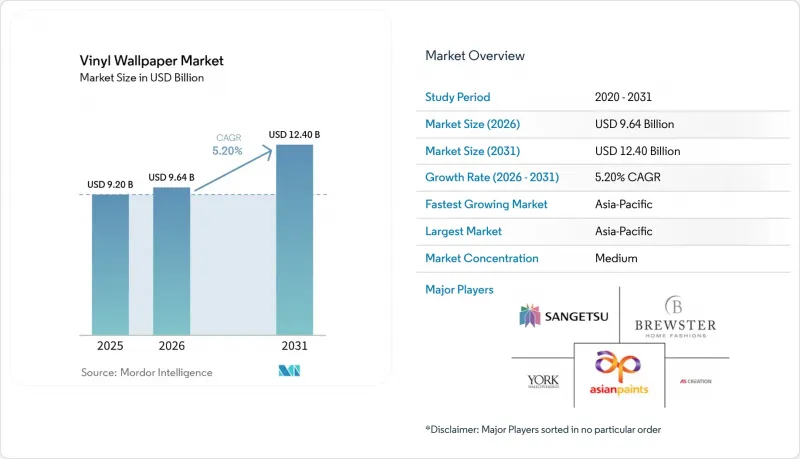
據 Mordor Intelligence 稱,2025 年乙烯基壁紙市場價值為 92 億美元,預計到 2031 年將達到 124 億美元,而 2026 年為 96 億美元,預測期(2026-2031 年)的複合年成長率為 5.2%。
本報告按產品類型(實心乙烯基、乙烯塗層紙、乙烯布、不織布)、安裝方式(傳統安裝、自粘安裝)、應用領域(新建、維修/改造)、最終用戶(住宅、商業)、配銷通路(B2C、B2B)和地區(北美、南美、歐洲、亞太、中東和非洲)進行細分。市場預測以美元計價。
全球乙烯基壁紙市場趨勢及洞察
對耐用、可水洗的內部裝潢建材。
在醫療機構、教育機構和餐飲服務業,易於清潔對於感染控制至關重要,這促使乙烯基壁紙的普及。 NSF/ANSI 342 標準為規範制定團隊提供了一套完善的框架,涵蓋產品設計、製造、永續性和使用後處置等方面的考量。這也影響了乙烯基壁紙市場的高階住宅領域,最初為公共設施開發的抗菌和可清洗產品如今正擴展到消費品領域。因此,一些買家正從標準乳膠漆轉向兼具裝飾性和衛生性的乙烯基牆壁材料。這使得商用級產品的應用範圍從商業項目擴展到私人住宅。已滿足認證要求的製造商不僅在價格上具有優勢,而且在合規性和性能方面也更具優勢。
延長豪華住宅的翻新週期
在歐洲和北美,豪華住宅翻新支出在許多方面持續超過新建住宅支出,支撐了對高階室內裝飾材料的需求。在乙烯基壁紙市場,這一趨勢推動了數位印刷壁畫、壓紋紋理和其他裝飾性產品的發展,這些產品的價格高於普通卷材壁紙。根據三月株式會社的報告,儘管2026年日本壁紙出貨量年減3.1%,但壁紙銷售額卻成長了1.7%,達到799.4億日圓(約5.33億美元)。這主要歸功於價格的提升和產品組合的最佳化。這一趨勢表明,儘管總出貨量下降,但每米壁紙的銷售額卻在成長。德國、法國和北歐國家仍然是活躍的住宅翻新市場,對紋理和立體牆面材料的需求持續強勁。由於乙烯基壁紙相比傳統的紙基壁紙具有更優異的可塑性,因此在這種市場環境下表現出色。
其他牆面裝飾材料,例如油漆,仍然很容易買到。
乳膠漆因其在建材超市、大賣場和其他零售店廣泛銷售,且無需專業安裝,而保持顯著的分銷優勢。這導致在對成本敏感的住宅市場,尤其是在南美和亞太地區,乙烯基壁紙的價格長期受到限制。在這些市場,預裝乙烯基壁紙的每平方公尺成本可能是塗漆飾面的3到5倍。亞洲塗料公司的案例便反映了這個挑戰。儘管該公司透過成熟的零售網路同時銷售裝飾塗料和壁紙產品,但在印度農村地區,消費者從購買塗料轉向購買壁紙的趨勢仍然有限。此外,由於塗料安裝極為簡便,因此更容易促銷。對於供應商而言,這意味著從塗料轉向壁紙不僅取決於產品質量,還取決於安裝人員培訓的改進以及零售商的經濟效益。
細分市場分析
預計到2025年,乙烯基塗佈紙將佔乙烯基壁紙市場41.72%的銷售額,成為該市場最大的產品類型。其面積仍適用於一般住宅用途和中檔商業項目。此外,其輕質紙基便於運輸,並支援直接貼在牆面上。這種黏貼方法在歐洲和亞太地區仍然很常見,並且被專業安裝人員廣泛使用。不織布乙烯基壁紙也因其尺寸穩定性好、易於施工而受到住宅市場的關注,降低了DIY用戶的施工門檻。
雖然實心乙烯基壁紙在乙烯基壁紙市場中所佔佔有率較小,但在走廊和公共設施等場所,耐磨性比裝飾性更為重要,因此乙烯布襯乙烯基壁紙的複合年成長率將達到6.2%。這一趨勢正在推動乙烯基壁紙行業單位銷量的成長,因為乙烯布乙烯基壁紙的價格通常比同類乙烯基塗層紙製品高出20%至35%。
2026年,傳統非自黏式安裝方式佔總銷售額的68.93%,顯示這種安裝方式在乙烯基壁紙市場仍佔據主導地位。專業安裝人員在商業項目中仍然更傾向於使用自黏式安裝,因為它便於對齊、調整和去除氣泡。這也反映出,厚重的商用壁紙並不適合面向一般消費者的自黏式系統。因此,傳統安裝方式的持續優勢源自於產品效能和商業通路的結構。
自黏式和剝離式乙烯基壁紙是成長最快的應用方式,預計到2031年將以6.44%的複合年成長率成長。這項需求主要由北美和歐洲的租屋者推動,他們尋求可移除的裝飾方案,而不是永久改變牆面。線上視覺化工具也降低了消費者的購買焦慮,並促進了剝離式壁紙電商銷售的成長。與許多紙質和織物替代品相比,乙烯基具有更優異的尺寸穩定性、防潮性和極少的殘留物,因此仍然是剝離式產品的主要材料。因此,儘管專業安裝仍然是大規模專案的主要選擇,但乙烯基壁紙市場的這一細分領域成長速度超過了更成熟的專業應用領域。
區域分析
亞太地區預計到2025年將佔全球銷售額的42.3%,並將在2031年之前保持6.72%的最高區域複合年成長率,成為乙烯基壁紙市場的主導地區。中國、印度、日本和東南亞的需求模式各不相同,部分地區受不斷成長的建築需求驅動,而其他地區則受設計主導的翻新改造所推動。印度是成長最快的國家之一,馬哈拉斯特拉邦、古吉拉突邦和卡納塔克邦的住宅開發商在新建築中採用乙烯基壁紙,同時資訊科技園區、聯合辦公園區和豪華酒店專案也在不斷擴張。日本仍然是一個成熟的設計市場,Sangetsu公司報告稱,其2026會計年度的海外銷售額將達到350.2億日元(2.34億美元),同比成長17.6%,其中北美和東南亞是主要的成長動力。
歐洲是乙烯基壁紙的第二大區域市場,主要市場包括德國、英國、法國、北歐國家以及比荷盧經濟聯盟(包括比利時、荷蘭和盧森堡)。在德國和北歐國家,兼具耐用性和裝飾性的牆面材料需求穩定,這得益於高階裝修的持續需求。此外,歐洲合規標準仍然是一個重要因素,因為歐盟第305/2011號法規(EN 15102)規定,投放市場的壁材必須加貼CE標誌並提交性能聲明。根據AS Creation預測,到2025年,銷售額將下降5.6%至1.051億歐元,但毛利率預計將上升至53.9%,這表明成本結構的調整有助於抵消需求疲軟的影響。南美洲的情況則有所不同,由於高度依賴從中國進口,價格一直保持在較低水準。另一方面,由於都市區中產階級的壯大和DIY家居裝修文化的興起,銷售量持續成長。
北美地區在乙烯基壁紙市場依然商業性,住宅購買和以規格主導的商業需求之間存在明顯的差異。飯店整修尤其重要,大規模的物業改善計畫 (PIP) 專案推動了設計公司和採購團隊而非零售通路的訂單成長。墨西哥和加拿大也對住宅需求有補充作用,墨西哥建設活動的活性化促進了住宅規格的發展。中東和非洲的市場規模仍然較小。儘管如此,阿拉伯聯合大公國和沙烏地阿拉伯透過建造豪華酒店、零售設施以及與大型基礎設施項目相關的醫療設施,持續產生對高階 II 型產品的集中需求。
其他好處:
- Excel格式的市場預測(ME)表
- 3個月的分析師支持
目錄
第1章:引言
- 研究假設和市場定義
- 調查範圍
第2章:調查方法
第3章執行摘要
第4章 市場狀況
- 市場概覽
- 市場促進因素
- 對耐用、可水洗的內部裝潢建材。
- 豪華住宅翻新週期延長
- 商業設施的翻新擴建和飯店設施的室內裝修工程。
- 透過數位印刷進行小批量客製化設計的趨勢正在加速發展。
- 與重新噴漆相比,減少了安裝停機時間。
- 公共設施項目中更多地使用低揮發性有機化合物(VOC)乙烯基壁紙
- 市場限制因素
- 其他牆壁材料,例如油漆,仍然很容易買到。
- 乙烯基樹脂和添加劑的價格波動給利潤率帶來了壓力。
- 對室內空氣品質的擔憂可能會推遲某些項目中高級產品的引入。
- 對廢棄物處理和收集的更嚴格規定增加了合規成本。
- 產業價值鏈分析
- 波特五力分析
- 深入了解產業最新趨勢與創新
- 近期產業趨勢分析(新產品發布、策略性舉措、投資、合作、合資、業務擴張、併購等)
第5章 市場規模與成長預測
- 按產品類型/依結構類型
- 實心乙烯基壁紙
- 乙烯基塗佈紙
- 帶襯裡的乙烯基
- 不織布乙烯基壁紙
- 按安裝類型
- 常規/非黏合型
- 自黏/剝離式乙烯基壁紙
- 透過使用
- 新建工程
- 維修和改造
- 最終用戶
- 住宅
- 客廳
- 廚房
- 臥室
- 浴室
- 兒童房
- 商業的
- 住宅
- 透過分銷管道
- B2C通路
- 大賣場和超級市場
- 壁紙專賣店
- 家居建材商店
- 線上
- 本地零售商(非正規通路)
- 其他分銷管道
- B2B通路(承包商、建築商、室內設計師、建築師、專案採購和機構銷售)
- B2C通路
- 按地區
- 北美洲
- 加拿大
- 美國
- 墨西哥
- 南美洲
- 巴西
- 秘魯
- 智利
- 阿根廷
- 其他南美國家
- 歐洲
- 英國
- 德國
- 法國
- 西班牙
- 義大利
- 比荷盧經濟聯盟(比利時、荷蘭、盧森堡)
- 北歐國家(丹麥、芬蘭、冰島、挪威、瑞典)
- 其他歐洲國家
- 亞太地區
- 印度
- 中國
- 日本
- 澳洲
- 韓國
- 東南亞
- 其他亞太國家
- 中東和非洲
- 阿拉伯聯合大公國
- 沙烏地阿拉伯
- 南非
- 奈及利亞
- 其他中東和非洲國家
- 北美洲
第6章 競爭情勢
- 市場集中度概述
- 策略趨勢
- 市佔率分析
- 公司簡介
- Sangetsu Corporation
- AS Creation Tapeten AG
- York Wall Coverings Inc.
- Brewster Home Fashions LLC
- Asian Paints Ltd.
- F. Schumacher & Co.
- Grandeco Wallfashion Group NV
- Erismann and Cie. GmbH
- Sanderson Design Group plc
- Tapetenfabrik Gebr. Rasch GmbH and Co. KG
- Graham and Brown Ltd
- Wallquest Inc.
- Arte International
- Komar Products GmbH
- Osborne and Little
- 4walls
- Marburger Tapetenfabrik JB Schaefer GmbH and Co. KG
- Muraspec
- Koroseal Interior Products
- Wall and Deco Srl
第7章 市場機會與未來展望
According to Mordor Intelligence, the vinyl wallpaper market size was valued at USD 9.2 billion in 2025 and estimated to grow from USD 9.6 billion in 2026 to reach USD 12.4 billion by 2031, at a CAGR of 5.2% during the forecast period (2026-2031).
This report is Segmented by Product Type (Solid Vinyl, Vinyl Coated Paper, Fabric Backed Vinyl, Non-Woven), Installation Type (Traditional, Self-Adhesive), Application (New Construction, Renovation & Remodeling), End User (Residential, Commercial), Distribution (B2C, B2B), Geography (North America, South America, Europe, Asia-Pacific, MEA). The Market Forecasts are Provided in Terms of Value (USD).
Global Vinyl Wallpaper Market Trends and Insights
Rising Demand for Durable, Washable Interior Surfaces
Healthcare facilities, educational institutions, and food-service operators are specifying vinyl wallcoverings more often because cleanability is essential in infection-control settings. The NSF/ANSI 342 standard provides specification teams with a documented framework covering product design, manufacturing, sustainability, and end-of-life considerations. This is also shaping the premium residential side of the vinyl wallpaper market, where antibacterial and washable formats first developed for institutional settings are now moving into consumer-facing product lines. As a result, some buyers are shifting from standard emulsion paint to vinyl surfaces that combine decorative value with hygiene performance. This broadens the use case for contract-grade products beyond commercial projects and into homes. Manufacturers that already meet certification requirements have an advantage because they can compete on compliance and performance rather than solely on price.
Expansion of Premium Residential Renovation Cycles
Premium renovation spending in Europe and North America has remained stronger than new residential construction across many categories, supporting demand for higher-grade interior finishes. In the vinyl wallpaper market, this favors digitally printed murals, embossed textures, and other decorative formats that carry higher selling prices than basic rolls. Sangetsu Corporation reported that wallcovering shipment volumes in Japan declined 3.1% year over year in fiscal year 2026, yet its wallcovering unit revenue rose to JPY 79.94 billion, or USD 533 million, up 1.7%, pointing to better pricing and a portfolio mix. That pattern suggests revenue per linear meter is rising even when overall volume softens. Germany, France, and the Nordic countries remain active renovation markets where textured and structural wall surfaces continue to attract demand. Vinyl performs well in these settings because its molding capabilities are stronger than those of standard paper-based alternatives.
Substitute Wall Finishes Such as Paint Remain Easy to Source
Emulsion paint still holds a major distribution advantage because it is stocked across hardware stores, hypermarkets, and home centers, and it does not require specialist installation. That creates a persistent price ceiling for the vinyl wallpaper market in cost-sensitive residential settings, especially in South America and parts of the Asia-Pacific. The installed vinyl wallcovering costs can be 3 to 5 times higher per square meter than painted finishes in these markets. Asian Paints clearly shows the challenge: the company sells both decorative paint and wallcovering products through an established retail network, yet conversion from paint buyers to wallcovering buyers remains limited in smaller Indian cities. Paint also remains easier for channel partners to promote because it involves very low installation complexity. For suppliers, this means the shift from paint to wallcovering depends not only on product quality but also on installer training and stronger retailer economics.
Other drivers and restraints analyzed in the detailed report include:
- Growth in Commercial Refresh and Hospitality Fit-Outs
- Faster Digital Print Customization for Short-Run Designs
- Vinyl Resin and Additive Price Volatility Pressures Margins
For complete list of drivers and restraints, kindly check the Table Of Contents.
Segment Analysis
Vinyl-coated paper accounted for 41.72% of 2025 revenue, making it the largest product type in the vinyl wallpaper market. Its cost-to-coverage profile continues to fit mainstream residential demand and mid-market commercial projects. The lighter paper substrate also supports easier logistics and paste-the-wall installation, which remains common across Europe and Asia-Pacific, where professional installers are widely used. Non-Woven Vinyl is also gaining traction in residential refurbishment because its dimensional stability and simpler application reduce the skill barrier for do-it-yourself users.
Solid vinyl serves a smaller share of the vinyl wallpaper market, but it remains relevant in corridors and institutional spaces where abrasion resistance matters more than decorative variation. Fabric-backed vinyl is forecast to expand at a 6.2% CAGR through 2031 as healthcare and hospitality buyers continue to standardize around Type II specifications under ASTM F793 and Federal Specification CCC-W-408D. This shift supports higher revenue per unit in the vinyl wallpaper industry, as fabric-backed vinyl typically carries a 20% to 35% price premium over comparable vinyl-coated paper formats.
Traditional and non-self-adhesive installations accounted for 68.93% of 2026 revenue, keeping this format clearly ahead in the vinyl wallpaper market. Professional contractors still prefer paste-applied systems for commercial projects because they allow better seam alignment, repositioning, and air-bubble correction. This also reflects the fact that heavier commercial wallcoverings are not well-suited to consumer-grade pre-applied adhesive systems. The continued strength of traditional installation is therefore tied to both product performance and the structure of the commercial channel.
Self-adhesive and peel-and-stick vinyl wallpaper is the fastest-growing installation format, with a 6.44% CAGR through 2031. Demand is being supported by renter households in North America and Europe that want removable decorative options rather than permanent wall changes. Online visualization tools are also reducing purchase uncertainty, helping removable-format e-commerce sales gain traction. Vinyl remains the leading material within peel-and-stick products because it offers stronger dimensional stability, better moisture resistance, and cleaner removal than many paper or fabric alternatives. That is helping this part of the vinyl wallpaper market grow faster than the mature professional installation category, even though contractors still dominate larger projects.
Complete Report Scope:
- By Product Type/Construction Type
- Solid Vinyl Wallpaper
- Vinyl Coated Paper
- Fabric Backed Vinyl
- Non-Woven Vinyl Wallpapers
- By Installation Type
- Traditional/Non Self-Adhesive
- Self-Adhesive / Peel-and-Stick Vinyl Wallpaper
- By Application
- New Construction
- Renovation and Remodeling
- By End User
- Residential
- Living Room
- Kitchen
- Bedroom
- Bathroom
- Kids Room
- Commercial
- Residential
- By Distribution Channel
- B2C Channels
- Hypermarkets and Supermarkets
- Specialty Wallpaper Stores
- Home Centers
- Online
- Local Shops (unorganized channels)
- Other Distribution Channels
- B2B Channels (Contractors and Installers, Interior Designers and Architects, Project Procurement and Institutional Sales)
- B2C Channels
- By Geography
- North America
- Canada
- United States
- Mexico
- South America
- Brazil
- Peru
- Chile
- Argentina
- Rest of South America
- Europe
- United Kingdom
- Germany
- France
- Spain
- Italy
- BENELUX (Belgium, Netherlands, Luxembourg)
- NORDICS (Denmark, Finland, Iceland, Norway, Sweden)
- Rest of Europe
- Asia-Pacific
- India
- China
- Japan
- Australia
- South Korea
- South-East Asia
- Rest of Asia-Pacific
- Middle East & Africa
- United Arab Emirates
- Saudi Arabia
- South Africa
- Nigeria
- Rest of Middle East & Africa
- North America
Geography Analysis
Asia-Pacific accounted for 42.3% of 2025 global revenue and recorded the fastest regional CAGR of 6.72% through 2031, making it the leading region in the vinyl wallpaper market. China, India, Japan, and Southeast Asia each exhibit distinct demand patterns, with some driven more by construction growth and others by design-led renovation. India is one of the fastest-growing countries, with residential developers in Maharashtra, Gujarat, and Karnataka specifying vinyl wallcoverings in new units alongside expansion in information technology parks, co-working campuses, and premium hospitality projects. Japan remains a sophisticated design market, and Sangetsu reported overseas segment revenue of JPY 35.02 billion, or USD 234 million, up 17.6% year over year in fiscal year 2026, with North America and Southeast Asia as the main growth vectors.
Europe is the second-largest regional market for vinyl wallpaper, supported by Germany, the United Kingdom, France, the Nordic countries, and the BENELUX region, which includes Belgium, the Netherlands, and Luxembourg. Germany and the Nordic countries continue to support premium renovation activity where durable and decorative wall finishes attract steady demand. European compliance standards also remain important, as Regulation (EU) No. 305/2011, under EN 15102, requires CE marking and a Declaration of Performance for wallcoverings placed on the market. A.S. Creation confirmed that revenue fell 5.6% to EUR 105.1 million in 2025, while gross margin rose to 53.9%, indicating that cost restructuring is helping offset weak demand conditions. South America follows a different pattern, as heavy dependence on Chinese imports keeps prices lower. At the same time, a growing urban middle class and a stronger do-it-yourself renovation culture continue to add incremental volume.
North America remains a commercially active part of the vinyl wallpaper market with a clear split between residential purchases and specification-led commercial demand. Hotel renovation activity is particularly important, and large Property Improvement Plan programs are sending more orders through design firms and procurement teams rather than through retail channels. Mexico and Canada add complementary residential demand, while improving construction activity in Mexico also supports new-housing specification. The Middle East and Africa remain smaller in total size. Still, the United Arab Emirates and Saudi Arabia continue to create concentrated demand for premium Type II products through luxury hospitality, retail, and healthcare construction tied to major infrastructure programs.
- Sangetsu Corporation
- A.S. Creation Tapeten AG
- York Wall Coverings Inc.
- Brewster Home Fashions LLC
- Asian Paints Ltd.
- F. Schumacher & Co.
- Grandeco Wallfashion Group NV
- Erismann and Cie. GmbH
- Sanderson Design Group plc
- Tapetenfabrik Gebr. Rasch GmbH and Co. KG
- Graham and Brown Ltd
- Wallquest Inc.
- Arte International
- Komar Products GmbH
- Osborne and Little
- 4walls
- Marburger Tapetenfabrik J. B. Schaefer GmbH and Co. KG
- Muraspec
- Koroseal Interior Products
- Wall and Deco Srl
Additional Benefits:
- The market estimate (ME) sheet in Excel format
- 3 months of analyst support
TABLE OF CONTENTS
1 Introduction
- 1.1 Study Assumptions & Market Definition
- 1.2 Scope of the Study
2 Research Methodology
3 Executive Summary
4 Market Landscape
- 4.1 Market Overview
- 4.2 Market Drivers
- 4.2.1 Rising Demand for Durable, Washable Interior Surfaces
- 4.2.2 Expansion of Premium Residential Renovation Cycles
- 4.2.3 Growth in Commercial Refresh and Hospitality Fit-Outs
- 4.2.4 Faster Digital Print Customization for Short-Run Designs
- 4.2.5 Lower Installation Downtime Versus Painted Rework Cycles
- 4.2.6 Rising Specification of Low-VOC Vinyl Wallcoverings in Institutional Projects
- 4.3 Market Restraints
- 4.3.1 Substitute Wall Finishes Such as Paint Remain Easy to Source
- 4.3.2 Vinyl Resin and Additive Price Volatility Pressures Margins
- 4.3.3 Indoor Air Quality Concerns Can Slow Premium Adoption in Some Projects
- 4.3.4 Stricter Waste Handling and Take-Back Expectations Raise Compliance Costs
- 4.4 Industry Value Chain Analysis
- 4.5 Porter's Five Forces Analysis
- 4.5.1 Threat of New Entrants
- 4.5.2 Bargaining Power of Suppliers
- 4.5.3 Bargaining Power of Buyers
- 4.5.4 Threat of Substitutes
- 4.5.5 Competitive Rivalry
- 4.6 Insights into the Latest Trends and Innovations in the Industry
- 4.7 Insights into the Recent Developments (New Product Launches, Strategic Initiatives, Investments, Partnerships, JVs, Expansion, M&As, etc.) in the Industry
5 Market Size & Growth Forecasts (Value in USD Billion)
- 5.1 By Product Type/Construction Type
- 5.1.1 Solid Vinyl Wallpaper
- 5.1.2 Vinyl Coated Paper
- 5.1.3 Fabric Backed Vinyl
- 5.1.4 Non-Woven Vinyl Wallpapers
- 5.2 By Installation Type
- 5.2.1 Traditional/Non Self-Adhesive
- 5.2.2 Self-Adhesive / Peel-and-Stick Vinyl Wallpaper
- 5.3 By Application
- 5.3.1 New Construction
- 5.3.2 Renovation and Remodeling
- 5.4 By End User
- 5.4.1 Residential
- 5.4.1.1 Living Room
- 5.4.1.2 Kitchen
- 5.4.1.3 Bedroom
- 5.4.1.4 Bathroom
- 5.4.1.5 Kids Room
- 5.4.2 Commercial
- 5.4.1 Residential
- 5.5 By Distribution Channel
- 5.5.1 B2C Channels
- 5.5.1.1 Hypermarkets and Supermarkets
- 5.5.1.2 Specialty Wallpaper Stores
- 5.5.1.3 Home Centers
- 5.5.1.4 Online
- 5.5.1.5 Local Shops (unorganized channels)
- 5.5.1.6 Other Distribution Channels
- 5.5.2 B2B Channels (Contractors and Installers, Interior Designers and Architects, Project Procurement and Institutional Sales)
- 5.5.1 B2C Channels
- 5.6 By Geography
- 5.6.1 North America
- 5.6.1.1 Canada
- 5.6.1.2 United States
- 5.6.1.3 Mexico
- 5.6.2 South America
- 5.6.2.1 Brazil
- 5.6.2.2 Peru
- 5.6.2.3 Chile
- 5.6.2.4 Argentina
- 5.6.2.5 Rest of South America
- 5.6.3 Europe
- 5.6.3.1 United Kingdom
- 5.6.3.2 Germany
- 5.6.3.3 France
- 5.6.3.4 Spain
- 5.6.3.5 Italy
- 5.6.3.6 BENELUX (Belgium, Netherlands, Luxembourg)
- 5.6.3.7 NORDICS (Denmark, Finland, Iceland, Norway, Sweden)
- 5.6.3.8 Rest of Europe
- 5.6.4 Asia-Pacific
- 5.6.4.1 India
- 5.6.4.2 China
- 5.6.4.3 Japan
- 5.6.4.4 Australia
- 5.6.4.5 South Korea
- 5.6.4.6 South-East Asia
- 5.6.4.7 Rest of Asia-Pacific
- 5.6.5 Middle East & Africa
- 5.6.5.1 United Arab Emirates
- 5.6.5.2 Saudi Arabia
- 5.6.5.3 South Africa
- 5.6.5.4 Nigeria
- 5.6.5.5 Rest of Middle East & Africa
- 5.6.1 North America
6 Competitive Landscape
- 6.1 Market Concentration Overview
- 6.2 Strategic Moves
- 6.3 Market Share Analysis
- 6.4 Company Profiles (includes Global level Overview, Market level overview, Core Segments, Financials as available, Strategic Information, Market Rank/Share for key companies, Products & Services, and Recent Developments)
- 6.4.1 Sangetsu Corporation
- 6.4.2 A.S. Creation Tapeten AG
- 6.4.3 York Wall Coverings Inc.
- 6.4.4 Brewster Home Fashions LLC
- 6.4.5 Asian Paints Ltd.
- 6.4.6 F. Schumacher & Co.
- 6.4.7 Grandeco Wallfashion Group NV
- 6.4.8 Erismann and Cie. GmbH
- 6.4.9 Sanderson Design Group plc
- 6.4.10 Tapetenfabrik Gebr. Rasch GmbH and Co. KG
- 6.4.11 Graham and Brown Ltd
- 6.4.12 Wallquest Inc.
- 6.4.13 Arte International
- 6.4.14 Komar Products GmbH
- 6.4.15 Osborne and Little
- 6.4.16 4walls
- 6.4.17 Marburger Tapetenfabrik J. B. Schaefer GmbH and Co. KG
- 6.4.18 Muraspec
- 6.4.19 Koroseal Interior Products
- 6.4.20 Wall and Deco Srl
7 Market Opportunities & Future Outlook
- 7.1 Contract-Grade, Low-VOC Vinyl Solutions for Healthcare and Hospitality
- 7.2 Short-Run Custom Digital Vinyl Wallcoverings for Renovation-Led Demand

 商用壁紙:市場佔有率分析、產業趨勢與統計、成長預測(2026-2031)布藝壁紙:市場佔有率分析、產業趨勢與統計、成長預測(2026-2031)不織布壁紙:市場佔有率分析、產業趨勢及統計、成長預測(2026-2031)印度壁紙:市場佔有率分析、產業趨勢與統計、成長預測(2025-2030)
 乙烯基壁紙市場規模、佔有率和成長分析:按產品類型、設計/圖案、價格範圍、應用、最終用戶細分市場、分銷管道和地區分類-2026-2033年產業預測
 壁紙市場:按產品類型、應用、銷售管道和地區分類壁紙:市場佔有率分析、產業趨勢與統計、成長預測(2026-2031)
 2026-2034年全球壁紙市場規模、佔有率、趨勢和成長分析報告
 日本壁紙市場規模、佔有率、趨勢及預測(按壁紙類型、通路、最終用戶和地區分類),2026-2034年
 壁紙市場 - 全球產業規模、佔有率、趨勢、機會及預測(按產品類型、最終用途、分銷管道、地區和競爭格局分類,2021-2031年)