


 |
市場調查報告書
商品編碼
1940606
壁紙:市場佔有率分析、產業趨勢與統計、成長預測(2026-2031)Wallpaper - Market Share Analysis, Industry Trends & Statistics, Growth Forecasts (2026 - 2031) |
||||||

※ 本網頁內容可能與最新版本有所差異。詳細情況請與我們聯繫。
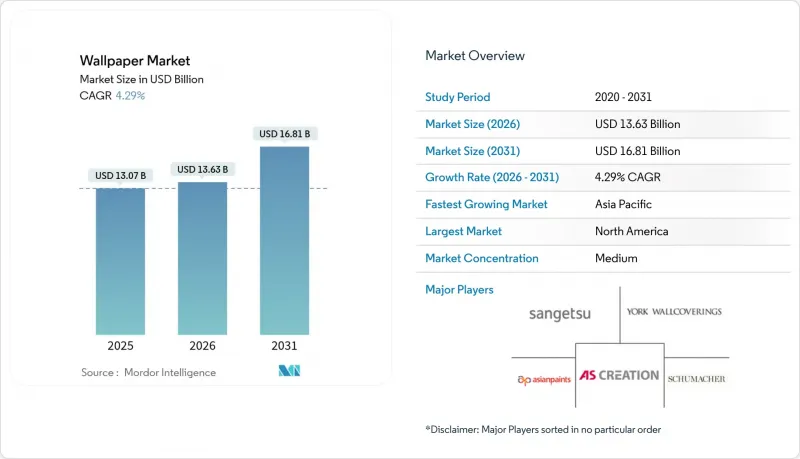
預計到 2026 年,壁紙市場價值將達到 136.3 億美元,高於 2025 年的 130.7 億美元。
預計到 2031 年將達到 168.1 億美元,2026 年至 2031 年的複合年成長率為 4.29%。
需求成長主要受以下因素驅動:數位印刷技術、抗菌塗層和自黏基材的日益普及,以及住宅維修熱潮、飯店翻新週期加快和中等收入消費者美學意識的提升。目前,商業應用佔據主導地位,海灣合作理事會 (GCC) 地區和東協 (ASEAN) 的飯店建築計劃持續指定使用能夠承受高強度維護的高品質耐用壁材。隨著東南亞國家津貼經濟適用住宅項目,以及北美住宅傾向於選擇獨特的裝飾而非定期重新粉刷,住宅應用正在加速成長。儘管PVC價格波動和關稅上漲影響著供應鏈,但製造商正透過垂直整合、長期樹脂合約以及非PVC基材的創新來保護利潤率。如今,競爭優勢主要體現在全通路分銷、永續性以及客製印刷將設計概念快速轉化為成品捲材的能力上。
全球壁紙市場趨勢與洞察
北美和歐洲對採用數位印刷技術進行個人化裝飾的需求激增。
按需數位印刷使設計師擺脫了製版和最低訂購量的限制,能夠實現連續圖案、厚度達2毫米的3D紋理以及快速原型製作,從而縮短了從設計到施工的周期。 Roland DG和Panasonic房屋解決方案公司聯合推出了DIMENSE技術,無需額外的壓紋製作流程即可製作3D表面,拓展了創意空間並提高了成本效益。高階塗料製造商Benjamin Moore與Alpha 研討會合作開發了一款手繪壁紙,售價為每碼125美元,這表明客製化產品能夠帶來40%至60%的溢價。歐洲知名設計公司Sanderson Design Group也推出了融合傳統與數位元素的新產品(每卷售價13,900日圓至35,100日圓),印證了富裕消費者願意為獨特的品牌故事買單。電子商務加速了數位轉型:Graham & Brown 的 B2B 入口網站在短短 12 週內就實現了 90% 的客戶採用率,有效降低了訂購流程的繁瑣和庫存風險。這些成果提高了製造商的利潤率,並使數位化工作流程成為住宅客製化和小規模商業計劃的標準方法。
東南亞中等收入城市住宅快速成長
印尼2024年第一季的建設活動相當於GDP的10.23%,而越南在2025年上半年動工興建了超過60萬套社會住宅。這為兼具美觀性和經濟性的中價位壁材創造了長期需求曲線。印尼的「百萬住宅計畫」等政府計畫以及卡達支持的融資管道正在提升首次住宅者的購買力,鼓勵他們選擇品牌化且成本績效合理的裝飾材料。亞洲開發銀行預測,2025年區域GDP成長率將達到4.5%,這將支持有選擇的裝修支出。國際生產商正在區域內設立工廠以規避關稅並縮短前置作業時間,而本土品牌則在利用進口替代激勵措施。千禧世代的線上購物習慣正在推動數位化客製化平台的發展,進一步刺激了對數位印刷產品的需求。
市面上有許多替代品可供選擇
儘管塗料、裝飾面板和數位顯示器的價值提案不斷提升,但在易於維護和互動內容至關重要的領域,壁紙佔有率卻逐漸萎縮。剪切機司的PaintShield塗料直接將抗菌性能融入其中,可在兩小時內殺死99.9%的細菌,從而佔據了以往用於特殊牆壁材料的預算。紋理塗料、牆貼和植物牆滿足了親生物設計的要求,而模組化面板系統則使得辦公空間能夠在一夜之間重新配置。這些多樣化的選擇迫使壁紙製造商更加重視觸感深度、材料循環利用和安裝效率。
細分市場分析
預計到2026年,不織布產品將以5.88%的複合年成長率推動市場成長,其成長速度將超過壁紙市場整體成長,這主要得益於其透氣性和尺寸穩定性,簡化了施工和移除流程。高階安裝商青睞此類產品,因為其乾式釋放特性可減少高達30%的人力成本。乙烯基壁紙預計到2025年將保持32.03%的市場佔有率,這得益於其醫用級的耐用性和成本競爭力。然而,日益嚴格的環保法規正在推動對生物基PVC、再生PET和無溶劑油墨的需求。紙基產品線正在萎縮,主要保留在注重真實性而非易於維護性的傳統住宅中。織物表面觸感溫暖,並具有內建吸音功能,常用於高階小眾空間。博拉斯特佩塔(Borastapeta)位於維亞萊德(Vialed)的工廠展現了其技術上的多樣性,將表面印刷、凹版印刷、絲網印刷和數位印刷機整合於同一屋簷下,從而能夠根據每種材料的印刷特性進行客製化生產。
不織布產業的蓬勃發展與永續性法規相輔相成,推動市場轉向FSC認證纖維和水性黏合劑。該行業的敏捷性使得抗菌化學處理和剝離式黏合劑得以迅速應用,其應用範圍也從出租公寓擴展到小兒科診所。乙烯基創新者正透過不含鄰苯二甲酸酯的配方和節能壓花技術來捍衛其市場佔有率。金屬箔和玻璃纖維增強片材等新興複合複合材料則瞄準了需要阻燃和電磁屏蔽等性能的細分市場。
到2025年,數位科技將佔壁紙產量的58.12%,並以每年7.15%的速度持續成長,將壁紙市場轉變為訂單客製化的模式。噴墨印表機頭與UV固化化學技術的結合,可在各種基材上達到即時固化和鮮豔色彩,而乳膠系統則符合低VOC排放標準。Canon指出,數位技術無需製版,即可實現從單卷定製到中型酒店訂單的生產,且無需增加設置成本。網版印刷在油墨沉積豐富和特殊效果方面仍保持領先地位,尤其是在傳統錦緞圖案方面。柔版印刷在大尺寸商業印刷領域也佔有一席之地,其精確的重複性使得滾筒投資物有所值。混合生產線正在興起,在傳統工藝之前整合單一途徑數位單元,從而可以在批量印刷的底布上疊加定製圖案。
快速打樣流程和人工智慧色彩匹配軟體將從概念到上市的時間從數月縮短至數天,使設計師能夠即時響應潮流趨勢。成本優勢不僅限於庫存管理,數位化小批量生產能力還能降低營運資金,減少報廢庫存的損失;同時,高效率的UV- LED燈降低了能源成本,幫助印刷企業實現碳中和目標。 Octink 50年的發展歷程表明,傳統印刷廠可以在不損害其傳統印刷過程的前提下,成功轉型數位化。
區域分析
北美地區在2024年引領了出貨量成長,這得益於其成熟的維修文化和對數位印刷工作流程的早期應用。美國自黏壁紙市場的蓬勃發展,得益於靈活的零售模式,即使原料成本波動,也支撐了預期需求。加拿大建材市場預計2026年將成長4.5%至5.5%,公共工程計劃也成為其目標市場之一。墨西哥正在崛起為近岸外包中心,為尋求降低亞洲運輸成本波動的美國高階品牌提供成本效益高的生產方案。約克壁紙公司收購了一家獨立的表面印刷企業,鞏固了其區域領先地位並強化了其本地供應鏈。
歐洲的設計傳統和嚴格的環保法規維持其產品的高溢價。德國和義大利正在強制推行無溶劑印刷,加速水性油墨的普及。英國室內裝潢產業正經歷一場手工技藝的復興,桑德森(Sanderson)以羊毛為靈感的「奧威爾編織」(Orwell Weave)系列和新款「鄉村森林」(Country Woodland)系列產品便是例證。西班牙等南歐市場正專注於開發抗紫外線的外牆覆層,以完善旅館業的露台空間。東歐的需求隨匯率波動而波動,但波蘭和捷克共和國的維修補貼政策正在緩解銷售下滑。循環經濟指南正推動製造商試點「從搖籃到搖籃」的基材認證和回收計畫。
亞太地區銷售成長最快。印尼計劃每年供應300萬套住宅,越南的社會住宅目標預計將增加數十萬套。中國國內需求與出口生產同步成長,維持大規模生產線,從而發揮了規模經濟效益。印度主要裝飾塗料製造商亞洲塗料公司利用其全通路佈局,在服務業推廣壁紙套裝的交叉銷售。高性能產品在日本和韓國等成熟市場更受歡迎。三月公司的再生PET玻璃薄膜符合低碳建築標準,同時提供紫外線和隔熱保護。澳洲在易發山火地區推廣使用阻燃牆面織物,正在擴大此一功能性細分市場。該地區計劃在2025年第一季啟動2074個酒店計劃,確保了合約量的持續成長。
其他福利:
- Excel格式的市場預測(ME)表
- 分析師支持(3個月)
目錄
第1章 引言
- 研究假設和市場定義
- 調查範圍
第2章調查方法
第3章執行摘要
第4章 市場情勢
- 市場概覽
- 市場促進因素
- 北美和歐洲對個人化數位印刷的需求激增
- 東南亞中等收入家庭城市住宅快速成長
- 酒店業更新周期推動海灣合作理事會和東協地區豪華商業壁紙的發展
- 美國零售視覺商品行銷轉向自黏乙烯基材料
- 醫療設施維修採用抗菌壁紙
- 市場限制
- 市面上有許多替代品可供選擇
- 氯乙烯價格波動導致利潤率下降
- 在高溫高濕環境下使用壽命縮短
- 供應鏈分析
- 波特五力模型
- 新進入者的威脅
- 買方的議價能力
- 供應商的議價能力
- 替代品的威脅
- 競爭對手之間的競爭
第5章 市場規模與成長預測
- 壁紙類型
- 乙烯基塑膠
- 不織布
- 紙本
- 織物(絲綢、亞麻布等)
- 其他壁紙類型
- 透過印刷技術
- 數位(噴墨/EP)
- 螢幕
- 柔版印刷
- 其他印刷技術
- 最終用戶
- 住宅
- 商業
- -飯店業
- 企業辦公空間
- -美容美髮沙龍和水療中心
- - 醫院
- 其他最終用戶
- 透過分銷管道
- 直銷
- 間接銷售
- 按地區
- 北美洲
- 美國
- 加拿大
- 墨西哥
- 歐洲
- 德國
- 英國
- 法國
- 義大利
- 西班牙
- 俄羅斯
- 其他歐洲地區
- 亞太地區
- 中國
- 印度
- 日本
- 韓國
- 澳洲和紐西蘭
- 亞太其他地區
- 中東和非洲
- 中東
- 阿拉伯聯合大公國
- 沙烏地阿拉伯
- 土耳其
- 其他中東地區
- 非洲
- 南非
- 奈及利亞
- 埃及
- 其他非洲地區
- 中東
- 南美洲
- 巴西
- 阿根廷
- 南美洲其他地區
- 北美洲
第6章 競爭情勢
- 市場集中度
- 策略趨勢
- 市佔率分析
- 公司簡介
- Sangetsu Corporation
- York Wall Coverings Inc.
- AS Creation Tapeten AG
- Brewster Home Fashion LLC
- Grandeco Wallfashion Group
- Erismann & Cie. GmbH
- Sanderson Design Group PLC
- Tapetenfabrik Gebr. Rasch GmbH & Co. KG
- Marshalls Wallcoverings
- Asian Paints Ltd(Nilaya)
- Eximus Wallpaper
- Gratex Industries Ltd
- Graham & Brown Ltd
- Wallquest Inc.
- Adornis Wallpapers
- Arte International
- 4walls
- Omexco NV
- Life n Colors Private Limited
- Komar Products GmbH
- Houfling GmbH(Hohenberger)
第7章 市場機會與未來展望
Wallpaper market size in 2026 is estimated at USD 13.63 billion, growing from 2025 value of USD 13.07 billion with 2031 projections showing USD 16.81 billion, growing at 4.29% CAGR over 2026-2031.
Demand expands as digital printing, antimicrobial coatings, and peel-and-stick substrates converge with surging residential renovation activity, intensified hospitality refresh cycles, and rising interior-aesthetic expectations among mid-income households. Commercial installations currently lead because hotel construction pipelines in the GCC and ASEAN continue to specify premium, durable wallcoverings that withstand rigorous maintenance schedules. Residential adoption accelerates as Southeast Asian governments subsidize affordable housing programs and North American homeowners opt for personalized decor over routine repainting. Supply chains face vinyl-chloride price swings and tariff hikes, yet manufacturers defend margins through vertical integration, long-term resin contracts, and innovation in non-vinyl substrates. Competitive differentiation now hinges on omnichannel distribution, sustainability credentials, and the speed with which on-demand printing can translate design concepts into finished rolls.
Global Wallpaper Market Trends and Insights
Surge in Demand for Digitally-Printed Personalised Decor in North America and Europe
On-demand digital printing liberates designers from plate-making and minimum-run constraints, enabling serialized patterns, tactile 3D textures up to 2 mm, and fast prototyping that shortens design-to-installation cycles. Roland DG and Panasonic Housing Solutions unveiled DIMENSE technology that produces sculpted surfaces without extra embossing passes, widening creative scope and cost efficiency. Luxury paint maker Benjamin Moore collaborated with The Alpha Workshops to hand-paint wallpapers retailing at USD 125 per yard, proof that customization supports 40-60% price premiums. European stalwarts such as Sanderson Design Group chase this segment with heritage-meets-digital launches that sell for ¥13,900-¥35,100 per roll, validating affluent willingness to pay for unique stories Sanderson. Ecommerce accelerates uptake: Graham & Brown's B2B portal reached 90% client adoption in just 12 weeks, cutting order friction and inventory risk. These gains lift manufacturer margins and position digital workflows as the default mode for bespoke residential and boutique commercial projects.
Rapid Mid-Income Urban Housing Boom in Southeast Asia
Indonesia reported construction representing 10.23% of GDP in Q1 2024 while Vietnam initiated over 600,000 social housing units during H1 2025, setting a long-tail demand curve for mid-priced wallcoverings that balance aesthetics with affordability. Government programs such as Indonesia's One Million House plan and Qatar-backed financing channels lift first-time buyers' purchasing power, steering them toward branded yet cost-effective decor choices. Asian Development Bank forecasts 4.5% regional GDP growth for 2025, underpinning discretionary renovation spending. International producers answer with regional plants that dodge tariffs and shorten lead times, while local brands exploit import substitution incentives. Millennials' online buying habits drive traffic to digital customization platforms, further intensifying the pull on digitally printed offerings.
Easy Availability of Substitutes in the Market
Paints, decorative panels, and digital displays constantly upgrade value propositions, eroding wallpaper's share where maintenance simplicity or interactive content holds sway. Sherwin-Williams Paint Shield introduces microbicidal functions directly into paint, killing 99.9% of bacteria in 2 hours and capturing budgets once reserved for specialty wallcoverings. Textured paints, wall decals, and living-plant walls fulfil biophilic design briefs, while modular panel systems allow offices to reconfigure spaces overnight. The broadening substitute set compels wallpaper producers to stress tactile depth, material circularity, and installation efficiency.
Other drivers and restraints analyzed in the detailed report include:
- Hospitality Refresh Cycles Driving Premium Commercial Wallpaper in GCC and ASEAN
- Retail Visual-Merchandising Shift to Peel-and-Stick Vinyl in the U.S.
- Vinyl-Chloride Price Volatility Compressing Margins
For complete list of drivers and restraints, kindly check the Table Of Contents.
Segment Analysis
Non-woven products opened 2026 with a 5.88% CAGR outlook, eclipsing overall wallpaper market growth as breathable, dimensionally stable substrates simplify installation and removal tasks. Premium installers champion the category because dry-strippable properties cut labour by up to 30%. Vinyl retained 32.03% wallpaper market share in 2025 thanks to hospital-grade durability and cost competitiveness, yet environmental scrutiny intensifies calls for bio-PVC, recycled PET, and solvent-free inks. Paper-based lines contract, surviving mostly in heritage residences where authenticity tops maintenance ease. Fabric surface coverings serve niche luxury spaces, offering tactile warmth and built-in acoustic dampening. Borastapeter's Viared facility illustrates technical diversity, running surface, gravure, screen, and digital presses under one roof to match each material's printability.
Non-woven momentum intersects sustainability regulation, prompting marketing pivots toward FSC-certified fibres and water-based adhesives. The segment's agility allows quick adoption of antimicrobial chemistries or peel-and-stick adhesives, widening end-use scope from rental apartments to pediatric clinics. Vinyl innovators respond with phthalate-free formulations and energy-saving emboss cures to defend share. Emerging composites such as metallic foils or glass fibre reinforced sheets target functional niches demanding fire retardancy or electromagnetic shielding.
Digital technologies captured 58.12% of production in 2025 and are adding 7.15% annually, transforming the wallpaper market into a make-to-order paradigm. Inkjet heads paired with UV-curable chemistries deliver immediate curing and vibrant colour saturation on diverse substrates, while latex systems comply with low-VOC codes. Canon's guidance confirms that digital eliminates plates, enabling batch sizes from a single customised roll to mid-volume hospitality orders without setup penalties. Screen printing retains pockets where rich ink laydown and special effects are still unrivalled, particularly for heritage damasks. Flexography holds ground in long-run commercial corridors where precision repeatability justifies cylinder investments. Hybrid lines emerge, integrating single-pass digital units ahead of conventional stations so bespoke motifs overlay mass-printed bases.
Rapid proofing loops and AI colour-matching software compress concept-to-market timelines from months to days, letting designers react to viral trends. Cost advantages extend beyond inventory: digital short-run capabilities reduce working capital and shrink obsolete stock write-offs. Meanwhile, UV-LED lamp efficiencies drop energy bills, helping printers meet carbon-neutral targets. Octink's 50-year trajectory shows legacy shops can retrofit for digital without surrendering printcraft heritage.
The Wallpaper Market Report is Segmented by Wallpaper Type (Vinyl, Non-Woven, Paper-Based, Fabric, Other), Printing Technology (Digital, Screen, Flexographic, Other), End User (Residential, Commercial), Distribution Channel (Direct Sales, Indirect Sales), and Geography (North America, Europe, Asia-Pacific, Middle East and Africa, South America). The Market Forecasts are Provided in Terms of Value (USD).
Geography Analysis
North America led 2024 shipments on the back of established renovation culture and early adoption of digital-print workflows. The U.S. peel-and-stick craze, fuelled by flexible retail concepts, bolsters forecast demand despite raw-material cost swings. Canada's construction-materials market expects 4.5-5.5% growth through 2026, adding institutional projects to the addressable base. Mexico emerges as a near-shoring hub, providing cost-efficient production for premium U.S. brands looking to mitigate Asian freight volatility. York Wallcoverings consolidates regional leadership after acquiring independent surface-print operations, strengthening local supply chains.
Europe preserves a strong pricing premium through design heritage and stringent eco-regulation. Germany and Italy push solvent-free print mandates, prompting accelerated adoption of water-based inks. United Kingdom interiors celebrate artisanal revival, evident in Sanderson's wool-inspired Orwell Weaves and Country Woodland launches. Southern markets such as Spain emphasise UV-stable outdoor wall applications to complement hospitality terraces. Eastern Europe's demand fluctuates with currency swings, though renovation subsidies in Poland and Czechia cushion volume declines. Circular-economy directives drive producers to certify cradle-to-cradle substrates and pilot take-back schemes.
Asia-Pacific records the steepest volume climb; Indonesia plans to deliver three million homes yearly while Vietnam's social housing targets add hundreds of thousands of units. China's domestic appetite strengthens alongside export output, sustaining mega-scale lines that benefit from economies of scope. India's decorative coatings leader Asian Paints leverages omnichannel reach to cross-sell wallpaper bundles under its services arm. Mature markets Japan and South Korea favour high-function products: Sangetsu's recycled-PET glass films meet low-carbon building codes while offering UV heat-shielding. Australia pivots to fire-retardant wall fabrics for bushfire-vulnerable regions, enriching the functional niche. Collectively, the region's 2,074-project hospitality pipeline through Q1 2025 guarantees sustained contract volumes.
- Sangetsu Corporation
- York Wall Coverings Inc.
- A.S. Creation Tapeten AG
- Brewster Home Fashion LLC
- Grandeco Wallfashion Group
- Erismann & Cie. GmbH
- Sanderson Design Group PLC
- Tapetenfabrik Gebr. Rasch GmbH & Co. KG
- Marshalls Wallcoverings
- Asian Paints Ltd (Nilaya)
- Eximus Wallpaper
- Gratex Industries Ltd
- Graham & Brown Ltd
- Wallquest Inc.
- Adornis Wallpapers
- Arte International
- 4walls
- Omexco NV
- Life n Colors Private Limited
- Komar Products GmbH
- Houfling GmbH (Hohenberger)
Additional Benefits:
- The market estimate (ME) sheet in Excel format
- 3 months of analyst support
TABLE OF CONTENTS
1 INTRODUCTION
- 1.1 Study Assumptions and Market Definition
- 1.2 Scope of the Study
2 RESEARCH METHODOLOGY
3 EXECUTIVE SUMMARY
4 MARKET LANDSCAPE
- 4.1 Market Overview
- 4.2 Market Drivers
- 4.2.1 Surge in Demand for Digitally-Printed Personalised Decor in North America and Europe
- 4.2.2 Rapid Mid-Income Urban Housing Boom in Southeast Asia
- 4.2.3 Hospitality Refresh Cycles Driving Premium Commercial Wallpaper in GCC and ASEAN
- 4.2.4 Retail Visual-Merchandising Shift to Peel-and-Stick Vinyl in the U.S.
- 4.2.5 Adoption of Antimicrobial Coated Wallcoverings in Healthcare Renovations
- 4.3 Market Restraints
- 4.3.1 Easy Availability of Substitues in the Market
- 4.3.2 Vinyl-Chloride Price Volatility Compressing Margins
- 4.3.3 Shorter Life-span on Exposure to Heat and Moisture
- 4.4 Supply-Chain Analysis
- 4.5 Porter's Five Forces
- 4.5.1 Threat of New Entrants
- 4.5.2 Bargaining Power of Buyers
- 4.5.3 Bargaining Power of Suppliers
- 4.5.4 Threat of Substitutes
- 4.5.5 Intensity of Competitive Rivalry
5 MARKET SIZE AND GROWTH FORECASTS (VALUE)
- 5.1 By Wallpaper Type
- 5.1.1 Vinyl
- 5.1.2 Non-woven
- 5.1.3 Paper-based
- 5.1.4 Fabric (Silk, Linen, etc.)
- 5.1.5 Other wallapaper Type
- 5.2 By Printing Technology
- 5.2.1 Digital (Inkjet/EP)
- 5.2.2 Screen
- 5.2.3 Flexographic
- 5.2.4 Other Printing Technology
- 5.3 By End User
- 5.3.1 Residential
- 5.3.2 Commercial
- 5.3.3 -Hospitality
- 5.3.4 - Corporate Office Space
- 5.3.5 -Salons and Spas
- 5.3.6 - Hospitals
- 5.3.7 -Other End User
- 5.4 By Distribution Channel
- 5.4.1 Direct Sales
- 5.4.2 Indirect Sales
- 5.5 By Geography
- 5.5.1 North America
- 5.5.1.1 United States
- 5.5.1.2 Canada
- 5.5.1.3 Mexico
- 5.5.2 Europe
- 5.5.2.1 Germany
- 5.5.2.2 United Kingdom
- 5.5.2.3 France
- 5.5.2.4 Italy
- 5.5.2.5 Spain
- 5.5.2.6 Russia
- 5.5.2.7 Rest of Europe
- 5.5.3 Asia-Pacific
- 5.5.3.1 China
- 5.5.3.2 India
- 5.5.3.3 Japan
- 5.5.3.4 South Korea
- 5.5.3.5 Australia and New Zealand
- 5.5.3.6 Rest of Asia-Pacific
- 5.5.4 Middle East and Africa
- 5.5.4.1 Middle East
- 5.5.4.1.1 United Arab Emirates
- 5.5.4.1.2 Saudi Arabia
- 5.5.4.1.3 Turkey
- 5.5.4.1.4 Rest of Middle East
- 5.5.4.2 Africa
- 5.5.4.2.1 South Africa
- 5.5.4.2.2 Nigeria
- 5.5.4.2.3 Egypt
- 5.5.4.2.4 Rest of Africa
- 5.5.4.1 Middle East
- 5.5.5 South America
- 5.5.5.1 Brazil
- 5.5.5.2 Argentina
- 5.5.5.3 Rest of South America
- 5.5.1 North America
6 COMPETITIVE LANDSCAPE
- 6.1 Market Concentration
- 6.2 Strategic Moves
- 6.3 Market Share Analysis
- 6.4 Company Profiles {(includes Global level Overview, Market level overview, Core Segments, Financials as available, Strategic Information, Market Rank/Share for key companies, Products and Services, and Recent Developments)}
- 6.4.1 Sangetsu Corporation
- 6.4.2 York Wall Coverings Inc.
- 6.4.3 A.S. Creation Tapeten AG
- 6.4.4 Brewster Home Fashion LLC
- 6.4.5 Grandeco Wallfashion Group
- 6.4.6 Erismann & Cie. GmbH
- 6.4.7 Sanderson Design Group PLC
- 6.4.8 Tapetenfabrik Gebr. Rasch GmbH & Co. KG
- 6.4.9 Marshalls Wallcoverings
- 6.4.10 Asian Paints Ltd (Nilaya)
- 6.4.11 Eximus Wallpaper
- 6.4.12 Gratex Industries Ltd
- 6.4.13 Graham & Brown Ltd
- 6.4.14 Wallquest Inc.
- 6.4.15 Adornis Wallpapers
- 6.4.16 Arte International
- 6.4.17 4walls
- 6.4.18 Omexco NV
- 6.4.19 Life n Colors Private Limited
- 6.4.20 Komar Products GmbH
- 6.4.21 Houfling GmbH (Hohenberger)
7 MARKET OPPORTUNITIES AND FUTURE OUTLOOK
- 7.1 White-Space and Unmet-Need Assessment

 商用壁紙:市場佔有率分析、產業趨勢與統計、成長預測(2026-2031)布藝壁紙:市場佔有率分析、產業趨勢與統計、成長預測(2026-2031)不織布壁紙:市場佔有率分析、產業趨勢及統計、成長預測(2026-2031)印度壁紙:市場佔有率分析、產業趨勢與統計、成長預測(2025-2030)乙烯基壁紙:市場佔有率分析、行業趨勢和統計數據、成長預測(2026-2031)
 乙烯基壁紙市場規模、佔有率和成長分析:按產品類型、設計/圖案、價格範圍、應用、最終用戶細分市場、分銷管道和地區分類-2026-2033年產業預測
 壁紙市場:按產品類型、應用、銷售管道和地區分類
 2026-2034年全球壁紙市場規模、佔有率、趨勢和成長分析報告
 日本壁紙市場規模、佔有率、趨勢及預測(按壁紙類型、通路、最終用戶和地區分類),2026-2034年
 壁紙市場 - 全球產業規模、佔有率、趨勢、機會及預測(按產品類型、最終用途、分銷管道、地區和競爭格局分類,2021-2031年)