


 |
市場調查報告書
商品編碼
2119178
布藝壁紙:市場佔有率分析、產業趨勢與統計、成長預測(2026-2031)Fabric Wallpaper - Market Share Analysis, Industry Trends & Statistics, Growth Forecasts (2026 - 2031) |
||||||

※ 本網頁內容可能與最新版本有所差異。詳細情況請與我們聯繫。
據 Mordor Intelligence 稱,2025 年織物壁紙市場價值 10.6 億美元,預計到 2031 年將從 2026 年的 10.9 億美元成長到 13.1 億美元,預測期(2026-2031 年)的複合年成長率為 3.72%。
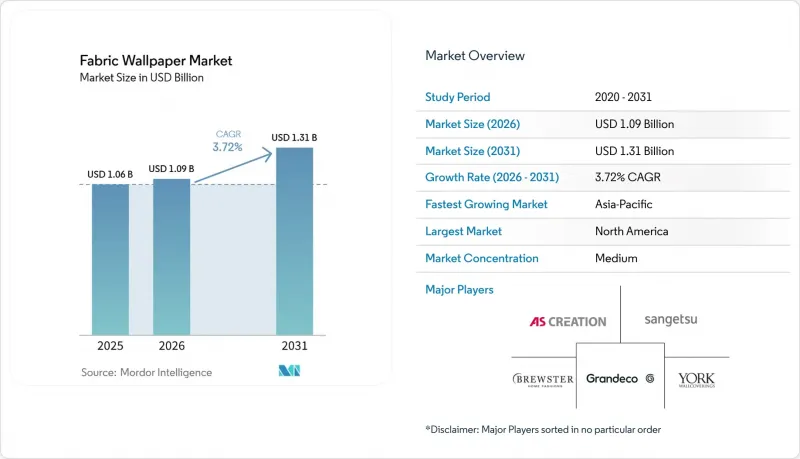
本報告按織物/材料類型(天然纖維、合成纖維)、應用領域(新建、維修/改造)、最終用戶(住宅、商業)、分銷管道(B2C、B2B)和地區進行細分。市場預測以美元計價。
全球織物壁紙市場趨勢與洞察
高階室內設計和豪華裝飾的需求正在推動規格的改進。
在高階室內設計專案中,織物壁紙的應用越來越廣泛,不再局限於單面牆的裝飾,而是鋪滿整個房間。根據2026年「Houzz & Home Study」報告,54%的美國住宅在2025年進行維修,中位支出為2萬美元,而支出最高的10%的項目將花費15萬美元,同比成長7%。這一消費趨勢凸顯了高價值維修中對個人化裝飾的需求。此外,壁紙的選擇在設計流程中也更加早期,表面材料對家具、照明和色彩的選擇產生了更大的影響。超過5萬美元的專案通常會聘請專業承包商,而專業承包商在高階專案中仍然扮演著至關重要的角色。像F. Schumacher、The Romo Group和Osborne & Little這樣的公司受益於室內設計師在選擇材料時不僅考慮價格,也考慮設計。因此,隨著維修越來越注重視覺差異化和專業安裝,織物壁紙市場獲得了支持。
酒店、辦公室、零售和醫療保健行業的商業維修正在推動需求成長。
飯店會定期翻新客房內部,其週期通常比建築物的壽命更短。這種趨勢催生了對壁材材料規格的需求,使其與新建築有所不同。在飯店專案中,客房、走廊和公共區域都開始使用織物材料,以滿足設計一致性、耐用性和聲學舒適性等多重需求。隨著混合辦公模式的興起,會議室和共用工作空間的聲學隱私性在辦公室整修中也變得愈發重要。醫療設施項目進一步催生了對符合抗菌、防黴和可洗滌要求的紡織品的需求。 AATCC 147抗菌測試和ASTM G21防黴測試對於患者接觸區域的材料選擇至關重要。雖然這些應用並不能完全取代乙烯基材料,但它們支持採用多種材料組合的規範方法。 Momentum Textiles & Wallcovering指出,數位遊民住宿設施和專為視訊會議設計的飯店設施的室內設計是目前商業設計中需要考慮的因素。紋理表面有時被選為視訊背景,這在先前的商業維修週期中並不常見。這將擴大織物壁紙市場的目標規格範圍,涵蓋酒店、職場、零售和醫療保健等領域。
高昂的施工技術要求限制了其在中端市場的滲透。
安裝布藝壁紙需要精細的牆面修補、底漆選擇、接縫對齊和表面處理。這些要求比油漆或許多「黏貼式」不織布壁紙更為嚴格。因此,安裝成本仍然佔專案總成本的很大一部分。這些限制使得DIY應用受到限制,需求主要集中在專業承包商的維修工程。北美和歐洲熟練建築工人的短缺進一步加劇了這些限制。這是一個結構性問題,因為布藝壁紙的安裝技能需要培訓和實踐,而勞動力供應無法在短期內進行調整。雖然專業承包商可能能夠保持較高的利潤率,但有限的承包商網路可能會阻礙新領域的推廣。直接貼牆式和模組化面板系統減輕了部分負擔。然而,它們的出現並未完全彌合紡織品飾面需求與合格承包商供應之間的差距。布藝壁紙產業必須在產品設計和實際安裝支援之間取得平衡,力求將其應用範圍從高階維修項目擴展到更廣泛的領域。
細分市場分析
2025年,合成纖維織物壁紙佔據了織物壁紙市場42.28%的佔有率。聚酯纖維、黏膠纖維和聚丙烯基材具有良好的印刷性、尺寸穩定性和耐磨性,適用整體住宅和商業項目。這些材料與各種背襯系統具有廣泛的兼容性,使製造商不僅可以提供「直接貼在牆面」的產品,還可以提供II型商業產品。此外,合成材料無需針對每種產品設計進行額外的化學處理即可滿足防火要求。這些特性使得該細分市場能夠滿足各種價位的需求。預計到2031年,天然纖維織物壁紙的複合年成長率將達到4.8%,是所有材料類型中成長率最高的。這一成長反映了符合LEED v4.1、WELL或搖籃到搖籃認證要求的項目對檢驗的生物基成分和環境產品聲明(EPD)的需求。卡內基織品公司(Carnegie Fabrics)表示,其「Xorel」材料含有高達91%的甘蔗衍生生物基成分,並已獲得「從搖籃到搖籃」金級認證。 2026年5月,法維尼公司(Favini)在米蘭對其「Refit」基材進行了升級,將再生纖維含量提高至40%,總再生含量提高至50%,同時也獲得了FSC和全球回收標準(GRS)認證。這些趨勢進一步凸顯了背襯層在產品環保定位中的重要性。採用永續材料的織物壁紙的市場規模不僅取決於其表面外觀,還取決於成分和可追溯性的文件記錄。
天然纖維產品包括棉、麻、絲、黃麻、草編和羊毛。這些產品在高檔住宅和酒店項目中佔據重要地位,產地和質地是選擇的關鍵因素。它們的目標市場受合成纖維產品價格波動的影響較小。混紡纖維產品兼具天然纖維的外觀和合成紗線的穩定性,使其適用於需要符合ASTM標準且性能穩定的商用。植絨和壓花紡織壁紙常用於小規模、設計感強的住宅,在這些住宅中,3D紋理是設計的核心要求。歐盟REACH法規和加州65號提案也影響纖維、整理劑和化學成分的選擇。健康產品聲明(HPD)在公共設施和綠色建築項目中具有更多優勢。因此,製造商更加重視可追溯的原料和有據可查的產品化學成分。織物壁紙產業既有大規模生產的合成產品市場,也有由優質天然和再生材料製成的產品市場。
到2025年,維修和改造將佔織物壁紙市場規模的60.06%,預計到2031年將以4.3%的複合年成長率成長。這一細分市場擁有最大的市場佔有率和最高的成長率。這種情況不僅反映了維修支出的短期成長,也反映了維修的持續需求。在高價值的維修項目中,通常透過牆面裝飾來改變房間的氛圍,而無需改變建築結構。大規模專案可以將預算分配給專業的牆面裝飾,並考慮其耐用性、設計獨特性和工藝水平。飯店整修週期也產生了類似的持續需求,尤其是在客房升級需要統一的裝飾效果時。在與混合辦公相關的辦公室整修中,當聲學性能成為關鍵因素時,紡織材料的採用也推動了紡織材料的普及。
2025年剩餘的39.94%需求中,新建案佔了剩餘部分。這一細分市場與海灣合作理事會(GCC)、印度和東南亞的豪華住宅開發和商業項目最為相關。國際設計顧問公司通常會在豪華飯店專案的設計意向階段指定使用織物壁紙。這項流程可能使織物表面成為高階客房的預設選擇。教育和醫療設施是新建項目中的另一個應用場景。這些項目可以整合具有聲學功能的織物牆面系統,以滿足對低揮發性有機化合物(VOC)和無聚氯乙烯(PVC)材料以及聲學目標的偏好。這項應用場景的發展與維修需求截然不同。這將使織物壁紙市場擴展到那些在入住前就已確定材料規格的項目。預計維修和新建項目之間的相對平衡仍將是製造商產品規劃的關鍵因素。
區域分析
到2025年,北美將佔據市場領先地位,佔區域市場佔有率的34.27%。儘管該地區的維修市場已趨於成熟,但即便成長速度放緩,需求依然強勁。即使低預算維修活動不穩定,高價值項目仍能支撐高階裝修材料的支出。在該地區,成熟的設計師和承包商為高階專案的實施提供支持,從而保持了織物壁紙市場的穩健發展。 LEED v4.1和GREENGUARD Gold標準的實施正在推動符合低排放和綠建築要求的產品的使用。加拿大和墨西哥酒店業的維修活動進一步推動了該地區的需求。墨西哥度假村和酒店的建設可能為中高階紡織壁材創造商業性。織物壁紙市場可以透過區域合約銷售網路和適用於不同項目預算的多樣化材料來滿足這些項目的需求。
預計到2031年,亞太地區將以5.5%的複合年成長率成長,成為所有地區中成長最快的地區。如此龐大的規模使亞洲供應鏈擁有成本優勢,而中國主要城市正在崛起為高階消費市場。一二線城市的都市區越來越傾向於選擇紋理織物牆面裝飾來取代油漆。科技和金融中心的住宅和商業房地產活動也推動了這項需求。中東和非洲也受惠於飯店建築和豪華酒店項目。在東南亞,隨著分銷基礎設施的擴展,飯店和共享辦公空間領域正在創造更大的潛力。 2026年第一季,三月宣佈在東南亞建立區域經銷夥伴關係,推廣用於酒店設施和公共建築的防火織物壁紙。織物壁紙市場已做好充分準備,能夠滿足商業開發人員對兼具設計感和安全性的裝飾材料的需求。
其他好處
- Excel格式的市場預測(ME)表
- 3個月的分析師支持
目錄
第1章:引言
- 研究假設和市場定義
- 調查範圍
第2章:調查方法
第3章執行摘要
第4章 市場狀況
- 市場概覽
- 市場促進因素
- 對高階室內設計和豪華裝飾的需求
- 商業維修,涵蓋飯店、辦公室、零售和醫療保健產業。
- 對聲學性能和室內環境性能的需求
- 數位印刷和客製化小批量生產。
- 永續、不含PVC、低VOC的纖維基壁紙生長
- 透過線上視覺化和數位化採購進行設計規範
- 市場限制因素
- 對先進施工技術和表面處理成本的要求
- 來自乙烯基、不織布、油漆和牆板的競爭
- 纖維、基材、黏合劑和塗層的複雜性阻礙了回收。
- 承包項目中防火性能、VOC、易清潔性和性能的認證負擔。
- 產業價值鏈分析
- 波特五力分析
- 深入了解產業最新趨勢與創新
- 深入了解織物壁紙的技術趨勢:印刷、表面處理、數位噴墨印刷和功能性能技術。
- 洞察近期產業趨勢(新產品發布、策略性舉措、投資、合作、合資、業務擴張、併購等)
第5章 市場規模與成長預測
- 按織物/材料類型
- 天然纖維
- 棉壁紙
- 亞麻壁紙
- 絲綢壁紙
- 黃麻和玻璃布壁紙
- 可回收的生物基紡織壁紙
- 羊毛和其他天然纖維壁紙
- 合成纖維
- 聚酯壁紙
- 黏膠纖維和人造絲壁紙
- 聚丙烯壁紙
- 丙烯酸和其他合成纖維壁紙
- 混紡纖維
- 天然纖維
- 透過使用
- 新建工程
- 維修和改造
- 最終用戶
- 住宅
- 商業
- 透過分銷管道
- B2C
- 大賣場和超級市場
- 專賣店
- 家居建材商店
- 線上
- 當地商店
- 其他分銷管道
- B2B(承包商和建築商、室內設計師和建築師、專案採購和機構銷售)
- B2C
- 按地區
- 北美洲
- 加拿大
- 美國
- 墨西哥
- 南美洲
- 巴西
- 秘魯
- 智利
- 阿根廷
- 其他南美國家
- 歐洲
- 英國
- 德國
- 法國
- 西班牙
- 義大利
- 比荷盧經濟聯盟(比利時、荷蘭、盧森堡)
- 北歐國家(丹麥、芬蘭、冰島、挪威、瑞典)
- 其他歐洲國家
- 亞太地區
- 印度
- 中國
- 日本
- 澳洲
- 韓國
- 東南亞
- 其他亞太國家
- 中東和非洲
- 阿拉伯聯合大公國
- 沙烏地阿拉伯
- 南非
- 奈及利亞
- 其他中東和非洲國家
- 北美洲
第6章 競爭情勢
- 市場集中度概覽
- 策略趨勢
- 市佔率分析
- 公司簡介
- Sangetsu Corporation
- AS Creation Tapeten AG
- York Wallcoverings, Inc.
- Brewster Home Fashions LLC
- Grandeco Wallfashion Group NV
- F. Schumacher and Co.
- The Romo Group
- Osborne and Little Limited
- Sanderson Design Group plc
- Graham and Brown Limited
- Wolf-Gordon
- Erismann and Cie. GmbH
- Vescom
- Arte International BV
- Omexco NV
- Muraspec Group
- Desima GmbH
- Carnegie Fabrics LLC
- Texdecor
- Wall&deco Srl
第7章 市場機會與未來展望
According to Mordor Intelligence, the fabric wallpaper market size was valued at USD 1.06 billion in 2025 and estimated to grow from USD 1.09 billion in 2026 to reach USD 1.31 billion by 2031, at a CAGR of 3.72% during the forecast period (2026-2031).
This report is Segmented by Fiber and Material Type (Natural Fiber and Synthetic Fiber), Application (New Construction, Renovation, and Remodeling), End User (Residential and Commercial), Distribution Channel (B2C and B2B), and Geography. The Market Forecasts are Provided in Terms of Value (USD).
Global Fabric Wallpaper Market Trends and Insights
Premium Interior Design and Luxury Decor Demand Drives Specification Upgrades
Premium interior projects increasingly use fabric wallcoverings beyond single-feature walls, specifying them throughout entire rooms. The 2026 United States Houzz and Home Study reported that 54% of United States homeowners renovated in 2025, with median spending of USD 20,000 and top-decile project spending of USD 150,000, up 7% year over year . This spending profile supports demand for distinctive finishes in higher-value renovation work. Wallpaper selection is also moving earlier in the design process, giving surface materials greater influence over furniture, lighting, and color choices. Projects exceeding USD 50,000 commonly use professional installers, preserving the role of specialty contractors in premium specifications. F. Schumacher, The Romo Group, and Osborne & Little benefit when interior architects select materials on design authority rather than price alone. The fabric wallpaper market, therefore, draws support from a renovation tier that places greater value on visual differentiation and professional execution.
Commercial Renovation across Hospitality, Offices, Retail, and Healthcare Supports Demand
Hotels renew room interiors on recurring cycles that are commonly shorter than a building's overall life. That pattern creates demand for wallcovering specifications that are separate from new construction. Hospitality projects use fabric surfaces in guest rooms, corridors, and public areas where design consistency, durability, and acoustic comfort matter together. Office refits also place greater weight on acoustic privacy in meeting rooms and shared work areas as hybrid work arrangements continue. Healthcare projects create another outlet for textile products that can meet antimicrobial, mold-resistance, and cleanability requirements. AATCC 147 antimicrobial testing and ASTM G21 mold-resistance testing are relevant to material selection in patient-facing areas. These uses do not replace vinyl in every setting, but they support a multi-material specification approach. Momentum Textiles & Wallcovering identified digital nomad accommodations and hospitality interiors designed for video conferencing as current commercial design considerations. Textured surfaces can be selected for video backgrounds, which adds a use case that was not present in earlier commercial renovation cycles. This broadens the addressable specification base for the fabric wallpaper market across hospitality, workplace, retail, and healthcare settings.
High Installation Skill Requirements Constrain Mid-Market Penetration
Fabric wallcovering installation requires careful wall repair, primer selection, seam matching, and surface preparation. These requirements are more demanding than those for paint application or for many paste-the-wall nonwoven formats. Installation cost, therefore, remains a meaningful part of the delivered project cost. These limits do-it-yourself use and concentrate demand in professionally managed renovation work. A shortage of skilled construction labor in North America and Europe adds pressure to this constraint. The issue is structural because fabric installation skills require training and practice, not a short adjustment in labor availability. Specialty installers may retain stronger margins, but thinner installer networks can limit adoption in new geographies. Paste-the-wall formats and modular panel systems reduce part of the burden. Their adoption has not fully closed the gap between demand for textile finishes and the availability of qualified installers. The fabric wallpaper industry must balance product design with practical installation support to broaden use beyond the upper end of renovation work.
Other drivers and restraints analyzed in the detailed report include:
- Demand for Acoustic and Indoor-Environmental Performance Reshapes Contract Specification
- Digital Printing and Bespoke Short-Run Customization Reshapes Production Economics
- Price Competition From Vinyl, Nonwoven, Paint, and Wall Panels Limits Value Growth
For complete list of drivers and restraints, kindly check the Table Of Contents.
Segment Analysis
Synthetic-fiber fabric wallpaper held 42.28% of the fabric wallpaper market share in 2025. Polyester, viscose, and polypropylene substrates support printability, dimensional stability, and abrasion resistance across residential and contract projects. Their broad compatibility with backing systems helps producers offer paste-the-wall formats as well as Type II commercial products. Synthetic materials can also support fire-rating requirements without adding a separate chemical treatment in every product design. These features help the segment serve a wide price range. Natural-fiber fabric wallpaper is forecast to grow at an 4.8% CAGR through 2031, the highest rate among material types. The growth reflects demand for verified bio-based content and Environmental Product Declarations (EPD) in projects guided by LEED v4.1, WELL, or Cradle to Cradle requirements. Carnegie Fabrics states that its Xorel material can contain up to 91% biobased content from sugarcane and carries Cradle to Cradle Gold certification. Favini updated its Refit substrate in Milan in May 2026, with 40% recovered textile fiber and 50% total recycled content, and is certified under FSC and the Global Recycled Standard. These developments make the backing layer more important to environmental product positioning. The fabric wallpaper market size for sustainable materials is supported by documented composition and traceability rather than surface appearance alone.
Natural-fiber products include cotton, linen, silk, jute, grasscloth, and wool. They occupy a premium position where provenance and texture influence selection in luxury homes and hospitality projects. Their buyer base is less exposed to the pricing dynamics of the synthetic tier. Blended-fiber products combine the appearance of natural fibers with the stability of synthetic yarns. This makes them relevant to contract settings that require consistent performance in accordance with ASTM standards. Flocked and embossed textile wallpaper serves a smaller high-design residential use case where three-dimensional texture is central to the design brief. EU REACH and California Proposition 65 also influence choices of fiber, finish, and chemical content . Health Product Declarations can provide an additional advantage in institutional and green-building projects. Producers are therefore placing more attention on traceable raw materials and documented product chemistry. The fabric wallpaper industry has room for both high-volume synthetic products and premium natural or circular material formats.
Renovation and remodeling accounted for 60.06% of the fabric wallpaper market size in 2025 and is forecast to grow at a 4.3% CAGR through 2031. The segment combines the largest application share with the fastest application growth rate. This position reflects recurring upgrades rather than only a short-term increase in renovation spending. High-value renovation programs often use wall finishes to change a room's feel without altering its structure. Larger projects can allocate funds to specialty wall finishes because they consider durability, design distinction, and installation quality together. Hotel refresh cycles create similar recurring demand, especially when room upgrades require coordinated finishes. Office refits connected to hybrid work also support textile specifications where acoustic performance is relevant.
New construction represented the remaining 39.94% of application demand in 2025. It is most relevant to premium residential developments and commercial projects in the GCC, India, and Southeast Asia. International design consultancies often specify fabric wallcoverings during the design intent stage of luxury hospitality projects. That process can make fabric surfaces a default choice for premium room categories. Educational and healthcare facilities provide another new-build use case. Those projects can integrate acoustic fabric wall systems that align with low-VOC and PVC-free material preferences and acoustic goals. This application pathway is distinct from renovation demand. It extends the fabric wallpaper market into projects where material specifications are established well before occupancy. The relative balance between renovation and construction will remain important to manufacturers' product planning.
Complete Report Scope:
- By Fabric/Material Type
- Natural-Fiber Fabric Wallpaper
- Cotton Wallpaper
- Linen Wallpaper
- Silk Wallpaper
- Jute and Grasscloth Wallpaper
- Recycled and Bio-Based Textile Wallpaper
- Wool and Other Natural-Fiber Wallpaper
- Synthetic-Fiber Fabric Wallpaper
- Polyester Wallpaper
- Viscose and Rayon Wallpaper
- Polypropylene Wallpaper
- Acrylic and Other Synthetic-Fiber Wallpaper
- Blended-Fiber Fabric Wallpaper
- Natural-Fiber Fabric Wallpaper
- By Application
- New Construction
- Renovation and Remodeling
- By End User
- Residential
- Commercial
- By Distribution Channel
- B2C Channels
- Hypermarkets and Supermarkets
- Specialty Stores
- Home Centers
- Online
- Local Shops
- Other Distribution Channels
- B2B Channels (Contractors and Installers, Interior Designers and Architects, Project Procurement and Institutional Sales)
- B2C Channels
- By Geography
- North America
- Canada
- United States
- Mexico
- South America
- Brazil
- Peru
- Chile
- Argentina
- Rest of South America
- Europe
- United Kingdom
- Germany
- France
- Spain
- Italy
- BENELUX (Belgium, Netherlands, Luxembourg)
- NORDICS (Denmark, Finland, Iceland, Norway, Sweden)
- Rest of Europe
- Asia-Pacific
- India
- China
- Japan
- Australia
- South Korea
- South-East Asia
- Rest of Asia-Pacific
- Middle East & Africa
- United Arab Emirates
- Saudi Arabia
- South Africa
- Nigeria
- Rest of Middle East & Africa
- North America
Geography Analysis
North America led with 34.27% regional share in 2025. The region has a mature renovation base, but its slower growth rate does not indicate weak demand. Higher-value projects can sustain spending on premium finishes even when lower-budget renovation activity is less stable. The fabric wallpaper market remains strong in this region, with established designers and installers supporting premium project execution. LEED v4.1 and GREENGUARD Gold thresholds support the use of products that can meet low-emission and green-building requirements. Canada's renovation activity and Mexico's hospitality sector provide additional regional demand. Construction of Mexican resorts and hotels can create commercial opportunities for mid-tier and premium textile wallcoverings. The fabric wallpaper market can serve these projects through regional contract distribution and material ranges suited to varied project budgets.
Asia-Pacific is forecast to grow at a 5.5% CAGR through 2031, the fastest regional rate. This scale gives Asian supply chains a cost advantage, while China also becomes a premium consumption market in major cities. Urban consumers in tier-1 and tier-2 cities increasingly consider textured fabric wall finishes as an alternative to paint. Housing and commercial real estate activity in technology and financial hubs support this demand. The Middle East and Africa also benefit from hotel construction and premium hospitality projects. Southeast Asia's hospitality and co-working sectors create further potential as distribution infrastructure expands. Sangetsu announced a regional distribution partnership in Southeast Asia during Q1 2026 for fire-rated fabric wallcoverings used in hospitality and institutional construction . The fabric wallpaper market is well-positioned to benefit from commercial developers seeking design-led finishes with documented safety performance.
- Sangetsu Corporation
- A.S. Creation Tapeten AG
- York Wallcoverings, Inc.
- Brewster Home Fashions LLC
- Grandeco Wallfashion Group NV
- F. Schumacher and Co.
- The Romo Group
- Osborne and Little Limited
- Sanderson Design Group plc
- Graham and Brown Limited
- Wolf-Gordon
- Erismann and Cie. GmbH
- Vescom
- Arte International BV
- Omexco NV
- Muraspec Group
- Desima GmbH
- Carnegie Fabrics LLC
- Texdecor
- Wall&deco Srl
Additional Benefits:
- The market estimate (ME) sheet in Excel format
- 3 months of analyst support
TABLE OF CONTENTS
1 Introduction
- 1.1 Study Assumptions & Market Definition
- 1.2 Scope of the Study
2 Research Methodology
3 Executive Summary
4 Market Landscape
- 4.1 Market Overview
- 4.2 Market Drivers
- 4.2.1 Premium Interior Design and Luxury Decor Demand
- 4.2.2 Commercial Renovation Across Hospitality, Offices, Retail, and Healthcare
- 4.2.3 Demand for Acoustic and Indoor-Environmental Performance
- 4.2.4 Digital Printing and Bespoke Short-Run Customization
- 4.2.5 Growth of Sustainable, PVC-Free, and Low-VOC Textile Wallcoverings
- 4.2.6 Design Specification Through Online Visualization and Digital Procurement
- 4.3 Market Restraints
- 4.3.1 High Installation Skill Requirements and Surface-Preparation Costs
- 4.3.2 Price Competition From Vinyl, Nonwoven, Paint, and Wall Panels
- 4.3.3 Textile Fiber, Backing, Adhesive, and Coating Complexity Limits Recycling
- 4.3.4 Fire, VOC, Cleanability, and Performance Certification Burden for Contract Projects
- 4.4 Industry Value Chain Analysis
- 4.5 Porter's Five Forces Analysis
- 4.5.1 Threat of New Entrants
- 4.5.2 Bargaining Power of Suppliers
- 4.5.3 Bargaining Power of Buyers
- 4.5.4 Threat of Substitutes
- 4.5.5 Competitive Rivalry
- 4.6 Insights into the Latest Trends and Innovations in the Industry
- 4.7 Insights into the Technological Landscape of Fabric Wallpapers: Printing, Surface Finishing, Digital Inkjet Printing, and Functional Performance Technologies
- 4.8 Insights into the Recent Developments (New Product Launches, Strategic Initiatives, Investments, Partnerships, JVs, Expansion, M&As, etc.) in the Industry
5 Market Size & Growth Forecasts
- 5.1 By Fabric/Material Type
- 5.1.1 Natural-Fiber Fabric Wallpaper
- 5.1.1.1 Cotton Wallpaper
- 5.1.1.2 Linen Wallpaper
- 5.1.1.3 Silk Wallpaper
- 5.1.1.4 Jute and Grasscloth Wallpaper
- 5.1.1.5 Recycled and Bio-Based Textile Wallpaper
- 5.1.1.6 Wool and Other Natural-Fiber Wallpaper
- 5.1.2 Synthetic-Fiber Fabric Wallpaper
- 5.1.2.1 Polyester Wallpaper
- 5.1.2.2 Viscose and Rayon Wallpaper
- 5.1.2.3 Polypropylene Wallpaper
- 5.1.2.4 Acrylic and Other Synthetic-Fiber Wallpaper
- 5.1.2.5 Blended-Fiber Fabric Wallpaper
- 5.1.1 Natural-Fiber Fabric Wallpaper
- 5.2 By Application
- 5.2.1 New Construction
- 5.2.2 Renovation and Remodeling
- 5.3 By End User
- 5.3.1 Residential
- 5.3.2 Commercial
- 5.4 By Distribution Channel
- 5.4.1 B2C Channels
- 5.4.1.1 Hypermarkets and Supermarkets
- 5.4.1.2 Specialty Stores
- 5.4.1.3 Home Centers
- 5.4.1.4 Online
- 5.4.1.5 Local Shops
- 5.4.1.6 Other Distribution Channels
- 5.4.2 B2B Channels (Contractors and Installers, Interior Designers and Architects, Project Procurement and Institutional Sales)
- 5.4.1 B2C Channels
- 5.5 By Geography
- 5.5.1 North America
- 5.5.1.1 Canada
- 5.5.1.2 United States
- 5.5.1.3 Mexico
- 5.5.2 South America
- 5.5.2.1 Brazil
- 5.5.2.2 Peru
- 5.5.2.3 Chile
- 5.5.2.4 Argentina
- 5.5.2.5 Rest of South America
- 5.5.3 Europe
- 5.5.3.1 United Kingdom
- 5.5.3.2 Germany
- 5.5.3.3 France
- 5.5.3.4 Spain
- 5.5.3.5 Italy
- 5.5.3.6 BENELUX (Belgium, Netherlands, Luxembourg)
- 5.5.3.7 NORDICS (Denmark, Finland, Iceland, Norway, Sweden)
- 5.5.3.8 Rest of Europe
- 5.5.4 Asia-Pacific
- 5.5.4.1 India
- 5.5.4.2 China
- 5.5.4.3 Japan
- 5.5.4.4 Australia
- 5.5.4.5 South Korea
- 5.5.4.6 South-East Asia
- 5.5.4.7 Rest of Asia-Pacific
- 5.5.5 Middle East & Africa
- 5.5.5.1 United Arab Emirates
- 5.5.5.2 Saudi Arabia
- 5.5.5.3 South Africa
- 5.5.5.4 Nigeria
- 5.5.5.5 Rest of Middle East & Africa
- 5.5.1 North America
6 Competitive Landscape
- 6.1 Market Concentration Overview
- 6.2 Strategic Moves
- 6.3 Market Share Analysis
- 6.4 Company Profiles (includes Global level Overview, Market level overview, Core Segments, Financials as available, Strategic Information, Market Rank/Share for key companies, Products & Services, and Recent Developments)
- 6.4.1 Sangetsu Corporation
- 6.4.2 A.S. Creation Tapeten AG
- 6.4.3 York Wallcoverings, Inc.
- 6.4.4 Brewster Home Fashions LLC
- 6.4.5 Grandeco Wallfashion Group NV
- 6.4.6 F. Schumacher and Co.
- 6.4.7 The Romo Group
- 6.4.8 Osborne and Little Limited
- 6.4.9 Sanderson Design Group plc
- 6.4.10 Graham and Brown Limited
- 6.4.11 Wolf-Gordon
- 6.4.12 Erismann and Cie. GmbH
- 6.4.13 Vescom
- 6.4.14 Arte International BV
- 6.4.15 Omexco NV
- 6.4.16 Muraspec Group
- 6.4.17 Desima GmbH
- 6.4.18 Carnegie Fabrics LLC
- 6.4.19 Texdecor
- 6.4.20 Wall&deco Srl
7 Market Opportunities & Future Outlook
- 7.1 Acoustic Fabric Wallpaper for Retrofit Offices and Education
- 7.2 Digitally Customized Short-Run Wallcoverings

 商用壁紙:市場佔有率分析、產業趨勢與統計、成長預測(2026-2031)不織布壁紙:市場佔有率分析、產業趨勢及統計、成長預測(2026-2031)印度壁紙:市場佔有率分析、產業趨勢與統計、成長預測(2025-2030)乙烯基壁紙:市場佔有率分析、行業趨勢和統計數據、成長預測(2026-2031)
 乙烯基壁紙市場規模、佔有率和成長分析:按產品類型、設計/圖案、價格範圍、應用、最終用戶細分市場、分銷管道和地區分類-2026-2033年產業預測
 壁紙市場:按產品類型、應用、銷售管道和地區分類壁紙:市場佔有率分析、產業趨勢與統計、成長預測(2026-2031)
 2026-2034年全球壁紙市場規模、佔有率、趨勢和成長分析報告
 日本壁紙市場規模、佔有率、趨勢及預測(按壁紙類型、通路、最終用戶和地區分類),2026-2034年
 壁紙市場 - 全球產業規模、佔有率、趨勢、機會及預測(按產品類型、最終用途、分銷管道、地區和競爭格局分類,2021-2031年)