


 |
市場調查報告書
商品編碼
2097364
印度壁紙:市場佔有率分析、產業趨勢與統計、成長預測(2025-2030)India Wallpapers - Market Share Analysis, Industry Trends & Statistics, Growth Forecasts (2025 - 2030) |
||||||

※ 本網頁內容可能與最新版本有所差異。詳細情況請與我們聯繫。
根據 Mordor Intelligence 預測,印度壁紙市場規模預計在 2025 年達到 2.3128 億美元,到 2030 年將達到 3.0708 億美元,複合年成長率為 5.83%。
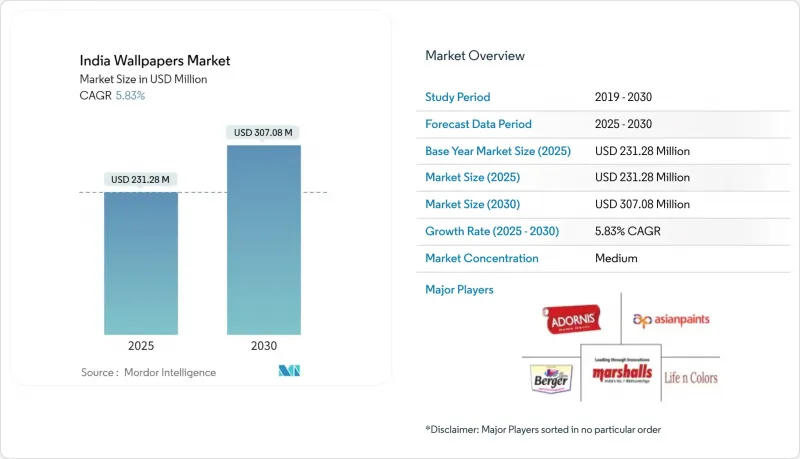
本報告按類型(乙烯基、不織布、紙/傳統材料、布料(紡織品))、分銷管道(電子商務、零售)、最終用戶(住宅、商業)、印刷技術(凹版印刷、數位噴墨印刷等)和地區細分。市場預測以價值(美元)表示。
印度壁紙市場的趨勢和洞察
基礎建設快速擴張和住宅擁有率不斷提高
政府已批准在「總理可負擔住房舉措」(PMAY)下新建3千拉(krolls)住宅,投資36.7億美元用於可負擔住宅建設。這將直接促進壁紙消費。預計到2024年,未償還房屋抵押貸款餘額將達到335.3萬拉克(rak krolls),顯示房屋抵押貸款滲透率進一步提高,並刺激了室內維修。在農村地區,已建成26.9萬拉克住宅,其中74%登記在女性名下,拓寬了審美選擇範圍。住宅指數每年上漲6.8%,推動了房屋翻新預算的增加。 「智慧城市計畫」已撥款16.4萬拉克用於8000個項目,擴大了指揮中心和社區中心的商業機會。
相較於油漆,人們通常更喜歡壁紙。
由於其耐用性和豐富的設計選擇,壁紙在高階空間中逐漸超越傳統塗料。例如,德里泰姬陵酒店的「大君套房」等高檔飯店設施的翻新工程,都採用了客製化壁畫,從而實現了更高的定價。亞洲塗料的「2025色彩展望」獎項中,「春日旋律」壁紙榮獲「年度最佳壁紙」稱號,進一步印證了其主流壁紙。包括HP Latex在內的水性數位系統,能夠實現低VOC排放的客製化小批量生產,滿足了人們日益成長的永續發展需求。酒店項目注重手工元素和本土特色圖案,增強了文化共鳴。 2023-2024會計年度,印度都市區人均家庭支出增加至6,996盧比,帶動了室內裝潢自由裁量權支出的成長。
在高溫高濕環境下使用壽命較短
熱帶地區的高濕度會削弱黏合劑的效力,並導致許多紙質壁紙褪色,限制了其在沿海地區的普及。不織布壁紙透氣性極佳且乾燥迅速,但安裝成本仍較高。乙烯基壁紙雖然防水,但其透氣性差,令人擔憂室內空氣品質。 UDC Homes 的防水「Memuraa」系列桌布既能防止潮氣滲入,又能保持美觀。目前,聚合物混合物和底漆系統的研發工作正在不斷推進,旨在延長壁紙的使用壽命,即使在非溫控環境下也能如此。
細分市場分析
2024年,乙烯基壁紙佔據了印度壁紙市場32.67%的佔有率,主要得益於其防水性能,使其適用於廚房和浴室。隨著都市區消費者對透氣性和環保室內裝潢的需求日益成長,不織布產品正以9.11%的複合年成長率快速擴張。隨著本地生產線產能的提升,印度不織布產品的市場規模預計將進一步加速成長。不織布壁紙易於移除,從而減少了翻新期間的停工時間。傳統的紙質和紡織壁紙在歷史建築和豪華別墅的修復中仍保持著一定的市場需求。 Eximus壁紙的凹版印刷產品體現了其精湛的製造程序,使其始終保持高階地位。印度標準局(BIS)對材料合格性的監管增強了消費者的信心,並有效遏制了不合格產品的進口。
創新之處包括不含揮發性有機化合物(VOC)的塗層和抗菌處理,以應對後疫情時代人們日益增強的衛生意識。 WallKalakar 的兒童產品採用 100% 無毒油墨,這一特徵引起了都市區父母的共鳴。消費者往往會權衡初始成本和生命週期成本,並傾向於選擇既耐用又不影響室內空氣品質的材料。
2024年,實體零售店仍維持53.79%的市場佔有率,反映出消費者對線下參觀和室內設計諮詢的持續需求。然而,隨著消費者越來越信任數位化視覺化工具,印度壁紙市場的線上銷售額正以8.12%的複合年成長率成長。虛擬房間預覽軟體簡化了產品選擇流程,減少了樣品浪費。自黏型產品便於運輸,克服了傳統物流的限制。 iDecorwala.com正透過中心輻射式網路拓展業務,將線上訂單分發給當地的加盟合作夥伴進行最後一公里配送。亞洲塗料已在其網站上整合了電子商務功能,充分利用其塗料和家具產品線的交叉銷售協同效應。
儘管在小規模城鎮,獨立經營店鋪仍然佔據主導地位,但連鎖店憑藉其對品質和保障的承諾,正吸引著那些考慮升級家居產品的消費者。印度壁紙產業持續投資於結合數位目錄和樣品牆的展示室模式,在滿足消費者體驗需求的同時,降低了庫存成本。
其他好處:
- Excel格式的市場預測(ME)表
- 3個月的分析師支持
目錄
第1章:引言
- 研究假設和市場定義
- 調查範圍
第2章:調查方法
第3章執行摘要
第4章 市場狀況
- 市場概覽
- 市場促進因素
- 基礎建設的蓬勃發展和住宅率的上升
- 壁紙越來越受到人們的青睞,取代了油漆。
- 有組織的零售和電子商務的擴張
- 可支配所得驅動的優質化
- 短期出租和合租公寓的維修需求。
- 一種對租戶友善的創新「剝離式黏貼」系統。
- 市場限制因素
- 在高溫高濕環境下壽命縮短
- 與裝飾塗料和層壓板的競爭
- 進口導致原物料外匯波動
- 合格安裝人員短缺
- 供應鏈分析
- 監理情勢
- 技術展望
- 波特五力分析
第5章 市場規模與成長預測
- 按類型
- 乙烯基塑膠
- 不織布
- 紙張/傳統
- 織物(紡織品)
- 透過分銷管道
- 電子商務
- 零售
- 最終用戶
- 住宅
- 商業的
- 飯店業
- 公司總部
- 美容美髮/水療中心
- 醫院
- 其他商業用戶
- 透過印刷技術
- 凹版印刷
- 數位噴墨
- 其他印刷技術
第6章 競爭情勢
- 市場集中度
- 策略趨勢
- 市佔率分析
- 公司簡介
- Marshalls Wallcoverings
- Elementto Lifestyle Wallcoverings Pvt Ltd
- Excel Wallcoverings
- Eximus Wallpaper
- Adornis Wallpapers
- Gratex Industries Ltd
- Woltop India Pvt Ltd
- Ultra Walls(Sonu Art)
- Asian Paints Ltd(Nilaya & Beautiful Homes)
- Berger Paints Ltd
- D'Decor Home Fabrics Pvt Ltd
- Life n Colors Private Limited
- Wallskin(Green Apple Design Pvt Ltd)
- Jaypore E-Commerce Pvt Ltd
- India Circus(Godrej)
- Gloob Decor
- iDecorwala.com
- Kajaria Decor Solutions
- AS Creation Tapeten AG(India Import)
- Muraspec India
第7章 市場機會與未來展望
According to Mordor Intelligence, the India wallpapers market size accounted for USD 231.28 million in 2025 and is projected to reach USD 307.08 million by 2030, translating into a 5.83% CAGR.
This report is Segmented by Type (Vinyl-Based, Non-Woven, Paper/Traditional, and Fabric (Textile)), Distribution Channel (E-Commerce, and Retail), End User (Residential, and Commercial), Print Technology (Gravure, Digital Inkjet, and More), and Geography. The Market Forecasts are Provided in Terms of Value (USD).
India Wallpapers Market Trends and Insights
Infrastructural Boom and Rising Home-Ownership
The government cleared 3 crore new dwellings under PMAY, channelling USD 3.67 billion toward affordable housing that directly lifts wallpaper consumption. Housing loans outstanding touched INR 33.53 lakh crore in 2024, signalling deeper mortgage penetration that fosters interior upgrades. Rural completions of 2.69 crore houses, 74% in women's names, expand the aesthetic decision pool. A 6.8% annual increase in the Housing Price Index supports higher refurbishment budgets. Smart Cities Mission funds of INR 1.64 lakh crore across 8,000 projects add commercial opportunities in command centres and civic halls.
Growing Preference for Wallpapers Over Paint
Durability and design range give wallpapers an edge over traditional coatings in premium spaces. High-profile hospitality refurbishments such as the Maharaja Suite at Taj Mahal Delhi showcase bespoke murals that command premium tariffs. Asian Paints' ColourNext 2025 flagged "Spring Tune" as Wallpaper of the Year, confirming mainstream adoption. HP Latex and other water-based digital systems enable custom short runs with low VOC emissions, matching rising sustainability expectations. Hotel projects emphasise handmade and regionally inspired motifs, reinforcing cultural resonance. Urban household expenditure climbed to INR 6,996 per capita in 2023-24, releasing discretionary funds for decor.
Short Lifespan Under Heat and Humidity
Tropical moisture weakens adhesives and discolors many paper-based wallpapers, curbing adoption in coastal states. Non-woven options breathe better and dry faster, but adoption costs remain higher. Vinyl resists water yet restricts airflow, sparking indoor air-quality debates. UDC Homes' waterproof "Memuraa" range tackles moisture ingress while preserving visual fidelity. R&D in polymer blends and primer systems continues to extend service life outside climate-controlled interiors.
Other drivers and restraints analyzed in the detailed report include:
- Expansion of Organised Retail and E-commerce
- Disposable-Income Led Premiumisation
- Competition from Decorative Paints and Laminates
For complete list of drivers and restraints, kindly check the Table Of Contents.
Segment Analysis
Vinyl accounted for 32.67% of the India wallpapers market share in 2024, underpinned by water resistance suited to kitchens and baths. Non-woven products are expanding at a 9.11% CAGR as urban buyers seek breathable, eco-aligned interiors. The India wallpapers market size within non-wovens is forecast to accelerate once local converting lines add capacity. Non-woven fibers permit easier removal, lowering renovation downtime. Traditional paper and textile coverings keep niche appeal in heritage restorations and luxury villas. Eximus Wallpaper's rotogravure output illustrates manufacturing precision that sustains premium status. Material compliance oversight by the Bureau of Indian Standards lifts consumer confidence and curbs sub-standard imports.
Innovations include VOC-free coatings and antimicrobial treatments responding to post-pandemic hygiene awareness. WallKalakar's children-centric launch employs 100% non-toxic inks, a feature that resonates with urban parents. Consumers weigh lifecycle costs against upfront price, tilting preferences toward substrates promising durability without sacrificing indoor air quality.
Retail outlets retained 53.79% value share in 2024, reflecting the enduring need for tactile inspection and decor consultation. Yet the Indian wallpaper market registers an 8.12% CAGR online as consumers gain trust in digital visualization tools. Virtual room-preview software streamlines selection and reduces sample wastage. Self-adhesive SKUs travel well, overcoming prior logistics limitations. iDecorwala.com scales through a hub-and-spoke network where online orders are channel to regional franchisees for last-mile service. Asian Paints integrates e-commerce into its website, capturing cross-sell synergies with paint and furniture lines.
Unorganised mom-and-pop stores still dominate smaller towns, but organised chains promise quality and warranty, tempting upgrade buyers. The Indian wallpaper industry continues to invest in showroom formats that marry digital catalogs with sample walls, reducing inventory overhead yet satisfying consumer touchpoints.
Complete Report Scope:
- By Type
- Vinyl-based
- Non-woven
- Paper / Traditional
- Fabric (Textile)
- By Distribution Channel
- E-commerce
- Retail
- By End User
- Residential
- Commercial
- Hospitality
- Corporate Offices
- Salons and Spas
- Hospitals
- Other Commercial Users
- By Print Technology
- Gravure
- Digital Inkjet
- Other Print Technology
List of Companies Covered in this Report:
- Marshalls Wallcoverings
- Elementto Lifestyle Wallcoverings Pvt Ltd
- Excel Wallcoverings
- Eximus Wallpaper
- Adornis Wallpapers
- Gratex Industries Ltd
- Woltop India Pvt Ltd
- Ultra Walls (Sonu Art)
- Asian Paints Ltd (Nilaya & Beautiful Homes)
- Berger Paints Ltd
- D'Decor Home Fabrics Pvt Ltd
- Life n Colors Private Limited
- Wallskin (Green Apple Design Pvt Ltd)
- Jaypore E-Commerce Pvt Ltd
- India Circus (Godrej)
- Gloob Decor
- iDecorwala.com
- Kajaria Decor Solutions
- A.S. Creation Tapeten AG (India Import)
- Muraspec India
Additional Benefits:
- The market estimate (ME) sheet in Excel format
- 3 months of analyst support
TABLE OF CONTENTS
1 INTRODUCTION
- 1.1 Study Assumptions and Market Definition
- 1.2 Scope of the Study
2 RESEARCH METHODOLOGY
3 EXECUTIVE SUMMARY
4 MARKET LANDSCAPE
- 4.1 Market Overview
- 4.2 Market Drivers
- 4.2.1 Infrastructural Boom and Rising Home-Ownership
- 4.2.2 Growing Preference for Wallpapers Over Paint
- 4.2.3 Expansion of Organised Retail and E-Commerce
- 4.2.4 Disposable-Income Led Premiumisation
- 4.2.5 Short-Stay Rental and Co-Living Refurb Demand
- 4.2.6 Tenant-Friendly Peel-and-Stick Innovation
- 4.3 Market Restraints
- 4.3.1 Short Lifespan Under Heat and Humidity
- 4.3.2 Competition from Decorative Paints and Laminates
- 4.3.3 Import-driven Raw-material FX Volatility
- 4.3.4 Shortage of Certified Installers
- 4.4 Supply-Chain Analysis
- 4.5 Regulatory Landscape
- 4.6 Technological Outlook
- 4.7 Porter's Five Forces Analysis
- 4.7.1 Bargaining Power of Suppliers
- 4.7.2 Bargaining Power of Buyers
- 4.7.3 Threat of New Entrants
- 4.7.4 Threat of Substitutes
- 4.7.5 Intensity of Competitive Rivalry
5 MARKET SIZE AND GROWTH FORECASTS (VALUES)
- 5.1 By Type
- 5.1.1 Vinyl-based
- 5.1.2 Non-woven
- 5.1.3 Paper / Traditional
- 5.1.4 Fabric (Textile)
- 5.2 By Distribution Channel
- 5.2.1 E-commerce
- 5.2.2 Retail
- 5.3 By End User
- 5.3.1 Residential
- 5.3.2 Commercial
- 5.3.2.1 Hospitality
- 5.3.2.2 Corporate Offices
- 5.3.2.3 Salons and Spas
- 5.3.2.4 Hospitals
- 5.3.2.5 Other Commercial Users
- 5.4 By Print Technology
- 5.4.1 Gravure
- 5.4.2 Digital Inkjet
- 5.4.3 Other Print Technology
6 COMPETITIVE LANDSCAPE
- 6.1 Market Concentration
- 6.2 Strategic Moves
- 6.3 Market Share Analysis
- 6.4 Company Profiles (includes Global-level Overview, Market-level Overview, Core Segments, Financials, Strategic Info, Market Rank/Share, Products and Services, Recent Developments)
- 6.4.1 Marshalls Wallcoverings
- 6.4.2 Elementto Lifestyle Wallcoverings Pvt Ltd
- 6.4.3 Excel Wallcoverings
- 6.4.4 Eximus Wallpaper
- 6.4.5 Adornis Wallpapers
- 6.4.6 Gratex Industries Ltd
- 6.4.7 Woltop India Pvt Ltd
- 6.4.8 Ultra Walls (Sonu Art)
- 6.4.9 Asian Paints Ltd (Nilaya & Beautiful Homes)
- 6.4.10 Berger Paints Ltd
- 6.4.11 D'Decor Home Fabrics Pvt Ltd
- 6.4.12 Life n Colors Private Limited
- 6.4.13 Wallskin (Green Apple Design Pvt Ltd)
- 6.4.14 Jaypore E-Commerce Pvt Ltd
- 6.4.15 India Circus (Godrej)
- 6.4.16 Gloob Decor
- 6.4.17 iDecorwala.com
- 6.4.18 Kajaria Decor Solutions
- 6.4.19 A.S. Creation Tapeten AG (India Import)
- 6.4.20 Muraspec India
7 MARKET OPPORTUNITIES AND FUTURE OUTLOOK
- 7.1 White-Space and Unmet-need Assessment

 商用壁紙:市場佔有率分析、產業趨勢與統計、成長預測(2026-2031)布藝壁紙:市場佔有率分析、產業趨勢與統計、成長預測(2026-2031)不織布壁紙:市場佔有率分析、產業趨勢及統計、成長預測(2026-2031)乙烯基壁紙:市場佔有率分析、行業趨勢和統計數據、成長預測(2026-2031)
 乙烯基壁紙市場規模、佔有率和成長分析:按產品類型、設計/圖案、價格範圍、應用、最終用戶細分市場、分銷管道和地區分類-2026-2033年產業預測
 壁紙市場:按產品類型、應用、銷售管道和地區分類壁紙:市場佔有率分析、產業趨勢與統計、成長預測(2026-2031)
 2026-2034年全球壁紙市場規模、佔有率、趨勢和成長分析報告
 日本壁紙市場規模、佔有率、趨勢及預測(按壁紙類型、通路、最終用戶和地區分類),2026-2034年
 壁紙市場 - 全球產業規模、佔有率、趨勢、機會及預測(按產品類型、最終用途、分銷管道、地區和競爭格局分類,2021-2031年)