


 |
市場調查報告書
商品編碼
2119056
不織布壁紙:市場佔有率分析、產業趨勢及統計、成長預測(2026-2031)Non-Woven Wallpaper - Market Share Analysis, Industry Trends & Statistics, Growth Forecasts (2026 - 2031) |
||||||

※ 本網頁內容可能與最新版本有所差異。詳細情況請與我們聯繫。
根據 Mordor Intelligence 預測,不織布壁紙市場規模將從 2025 年的 25.4 億美元成長到 2026 年的 26.7 億美元,到 2031 年將達到 34.9 億美元,2026 年至 2031 年的年複合成長率(CAGR)為 5.5%。
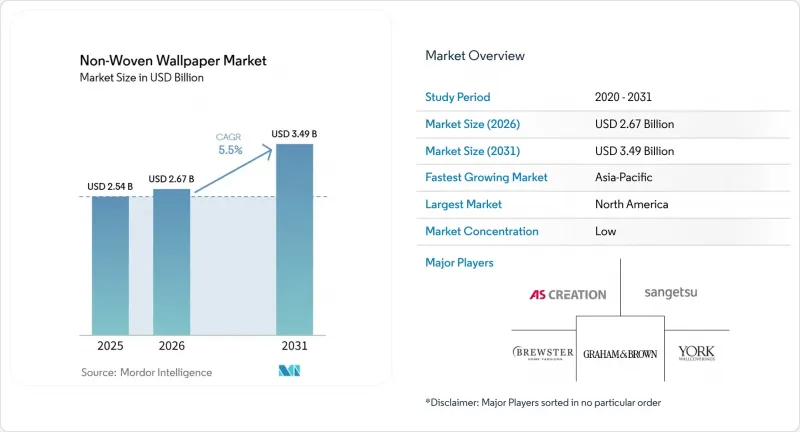
本報告按產品類型(印刷型、素面型、紋理型、壓紋型、金屬型、壁畫/全景型)、應用類型(傳統型/自黏型)、應用領域(新建、維修)、最終用戶(住宅、商業)、分銷管道(B2C、B2B)和地區進行細分。市場預測以美元計價。
全球不織布壁紙市場趨勢與分析
「牆面黏貼式」施工方法與DIY的興起
「牆面黏貼式」壁紙安裝方法減少了壁紙使用中的兩大常見障礙:水分滲透時間和基材損壞風險。由於黏合劑直接塗抹在牆面上而非壁紙本身,因此安裝時間更短,即使是經驗不足的安裝人員也能輕鬆上手。尺寸穩定性降低了氣泡和收縮,使圖案匹配更加容易。對於出租住宅,「乾式剝離」方法尤其重要,因為它允許在不弄濕牆面的情況下移除壁材。此外,EMICODE 和 EN 15102 的性能要求讓設計師和安裝人員在為居住的建築選擇此類系統時更有信心。此認證指南指導消費者、工匠和建築師選擇能夠最大限度防止室內空氣污染、確保最佳健康保護並高度環保的材料。
維修和出租房屋對可移除壁紙的需求
到2025年,維修和改造將佔不織布壁紙市場佔有率的62%,成為本報告中最大的應用領域。預計到2027年中期,美國房屋維修和改造支出將達到每年5,190億美元,為內部裝潢建材提供了廣泛的需求基礎。美國擁有超過4500萬套出租住宅,因此對租戶搬走時可輕鬆撕除的內部裝潢建材的需求持續存在。與自住房屋的維修支出相比,這種租賃住宅需求與住宅活動的關聯性較弱。因此,即使住宅交易放緩,自黏式不織布壁紙也能滿足持續的需求。不織布壁紙市場也受益於此趨勢,因為居住者除了注重外觀外,通常也優先考慮安裝便利性和易於移除的特性。
與通用產品相比,成本較高
與普通乙烯基壁紙相比,不織布壁紙的價格每平方公尺高出40-60%。這種價格差異限制了其在南亞、東南亞、非洲和南美等價格敏感地區的普及。不織布基材採用纖維素、聚酯和粘合劑,其生產流程對纖維成型的防治要求比乙烯基壁紙的壓延製程更為嚴格。如果買家對壁紙的設計和耐用性不夠重視,那麼在比較雙層塗料和壁紙時,他們可能無法接受更高的價格。此外,普通卷材壁紙與普通基材之間的價格差異可能會縮小。
細分市場分析
到2025年,印刷產品將佔不織布壁紙市場佔有率的38%,反映出其在住宅和商用價格區間擁有豐富的設計選擇。壁畫和全景產品預計在2026年至2031年間將以6.3%的複合年成長率成長,是所有產品類型中成長最快的。設計師們正在酒店大廳、醫療機構和高階住宅項目中採用大型單幅壁畫。素色產品仍然是DIY買家的入門級選擇,並繼續用作塗漆的底材。紋理和壓花產品滿足了對錶面紋理的中端需求,而無需複雜的印刷圖案。金屬質感產品仍然是中東和東南亞酒店專案小規模的高階選擇。
2026年4月,Designtex推出了「Borealis」系列,這是一款含有50%生物基材料的非乙烯基基材,專為飯店和醫療機構的室內裝潢而設計。該系列體現了不織布壁紙市場中設計開發與材料選擇之間的緊密聯繫。商業買家也會考慮EN 15102標準的要求,包括阻燃性、耐洗性和尺寸穩定性。由於纖維的內聚性,不織布產品比紙基壁紙更能滿足這些性能要求。數位印刷技術拓展了小批量生產和客製化的可能性,能夠滿足那些不需要標準重複圖案的項目。因此,供應商可以透過視覺上的多樣性和可靠的性能來獲得競爭優勢。
到2025年,傳統無膠壁紙將佔據75.0%的市場佔有率,引領自黏壁紙市場。預計2026年至2031年,自黏式「剝離黏貼」不織布壁紙的複合年成長率將達到6.6%。這種壁紙適合租用住宅,因為它無需永久安裝即可更新牆面裝飾。美國擁有超過4500萬套租賃住宅,這為剝離黏貼式裝飾產品提供了巨大的潛在市場。在歐洲和北美,傳統的安裝方法在翻新工程中仍然非常重要,專業安裝人員和經驗豐富的DIY愛好者仍然會使用黏性產品。不織布壁紙市場可以同時滿足這兩種安裝方法的需求,因為不織布基材既有傳統型又有自黏型。
自黏產品最初是作為住宅DIY用品出現的,但現在也廣泛應用於零售商店和展廳。當展品頻繁更換時,可幹貼且易於移除的產品更受歡迎。這類產品非常適合線上零售,因為簡單的說明可以減少消費者的購買猶豫。儘管自黏產品的線上銷售佔有率不斷擴大,但安裝人員的角色仍然至關重要,尤其是在需要進行牆面處理或精確圖案匹配的情況下。由於需要專業的表面處理技術,這類產品在新興地區的普及程度仍然有限。供應商如果能清楚說明牆面處理和移除的條件,就能減少退貨並增強客戶的信心。
區域分析
到2025年,北美將佔據不織布壁紙市場33.7%的佔有率。該地區受益於老舊住宅存量和大規模的租賃居住者,這不僅支撐了翻新需求,也支撐了對可移除壁材的需求。除了高階商用產品外,專注於自黏產品的線上DIY市場也在成長。加州的「Title 24」法規和低VOC排放標準促使供應商開發低排放塗料。這些要求可能有利於那些擁有材料認證的不織布系統。因此,該地區正面臨住宅領域強勁的需求和商業項目規範要求的雙重挑戰。
預計到2031年,亞太地區的年複合成長率將達到6.2%,成為受訪地區中成長最快的地區。在中國,需求正從新建主導轉向維修整修;而在印度,都市區住宅基礎設施正在擴張。隨著一二線城市的中等收入購屋者升級室內裝修,預計印度將迎來顯著成長。韓國、東南亞、日本和澳洲的需求也進一步成長,這主要得益於注重設計的室內設計、飯店設施建設和住宅維修。
其他好處:
- Excel格式的市場預測(ME)表
- 3個月的分析師支持
目錄
第1章:引言
- 市場分析與定義的前提條件
- 分析範圍
第2章 分析方法
第3章執行摘要
第4章 市場狀況
- 市場概覽
- 市場促進因素
- 壁掛式安裝和DIY的普及
- 維修和租賃市場對可移除壁紙的需求
- 數位印刷和客製化技術正在拓展設計變化的範圍。
- 對低排放量耐用消費品的商業需求
- 採用不含聚氯乙烯(PVC)且經認證可回收的材料,以支援永續採購。
- 人工智慧驅動的設計和客製印刷正在縮短產品開發週期。
- 市場限制因素
- 與油漆和普通乙烯基壁紙相比,原料成本更高。
- 纖維素、聚酯和特殊塗料等原料價格的波動
- 圖案匹配和基板預處理方面的技術要求。
- 缺乏用於收集和回收複合壁材的基礎設施
- 產業價值鏈分析
- 波特五力分析
- 對產業最新趨勢和創新進行分析。
- 近期產業趨勢的分析(新產品發布、策略舉措、投資、合作、合資企業、業務擴張、併購等)
第5章:預測市場規模與成長率
- 依產品類型
- 印花不織布壁紙
- 素色不織布壁紙
- 紋理不織布壁紙
- 壓紋不織布壁紙
- 金屬不織布壁紙
- 壁畫/全景不織布壁紙
- 按建築類型分類
- 常規/非黏合型
- 自黏/剝離式壁紙
- 透過使用
- 新建工程
- 維修和改造
- 最終用戶
- 住宅
- 客廳
- 廚房
- 臥室
- 浴室
- 兒童房
- 其他領域
- 商業
- 住宅
- 透過分銷管道
- B2C通路
- 大賣場和超級市場
- 專賣店
- 家居建材商店
- 線上
- 當地商店
- 其他分銷管道
- B2B通路(承包商和建築商、室內設計師和建築師、專案採購和機構銷售)
- B2C通路
- 按地區
- 北美洲
- 加拿大
- 美國
- 墨西哥
- 南美洲
- 巴西
- 秘魯
- 智利
- 阿根廷
- 其他南美國家
- 歐洲
- 英國
- 德國
- 法國
- 西班牙
- 義大利
- 比荷盧經濟聯盟(比利時、荷蘭、盧森堡)
- 北歐國家(丹麥、芬蘭、冰島、挪威、瑞典)
- 其他歐洲國家
- 亞太地區
- 印度
- 中國
- 日本
- 澳洲
- 韓國
- 東南亞
- 其他亞太國家
- 中東和非洲
- 阿拉伯聯合大公國
- 沙烏地阿拉伯
- 南非
- 奈及利亞
- 其他中東和非洲國家
- 北美洲
第6章 競爭情勢
- 市場集中度概述
- 策略趨勢
- 市佔率分析
- 公司簡介
- AS Creation Tapeten AG
- Asian Paints Limited
- Arte International
- Brewster Home Fashions LLC
- Eijffinger BV
- F. Schumacher and Co.
- Graham and Brown Limited
- Grandeco Wallfashion Group NV
- Komar Products GmbH
- Marburger Tapetenfabrik JB Schaefer GmbH and Co. KG
- Omexco NV
- Osborne and Little Limited
- Rasch GmbH and Co. KG
- Sanderson Design Group plc
- Sangetsu Corporation
- The Romo Group
- Vescom BV
- York Wallcoverings, Inc.
- Zambaiti Parati SpA
- Wallquest, Inc.
第7章 市場機會與未來展望
According to Mordor Intelligence, the non-woven wallpaper market size is projected to expand from USD 2.54 billion in 2025 to USD 2.67 billion in 2026, and to USD 3.49 billion by 2031, registering a CAGR of 5.5% between 2026 and 2031.
This report is Segmented by Product Format (Printed, Plain, Textured, Embossed, Metallic, and Mural/Panoramic), Installation Type (Traditional and Self-Adhesive), Application (New Construction and Renovation), End User (Residential and Commercial), Distribution Channel (B2C and B2B), and Geography. Market Forecasts are in Terms of Value (USD).
Global Non-Woven Wallpaper Market Trends and Insights
Paste-the-Wall Installation and DIY Adoption
Paste-the-wall wallpaper installation has reduced two common barriers to wallpaper use: soaking time and the risk of substrate damage. Adhesive is applied directly to the wall rather than to the wallpaper, reducing handling time and making the process easier for less experienced installers. Dimensional stability can reduce bubbling and shrinkage, making pattern alignment more manageable. Dry-strippable removal is important in rental homes because it allows occupants to remove wall decoration without wetting the wall surface. EMICODE and EN 15102 performance requirements also give designers and installers greater confidence when selecting these systems for occupied buildings. The label guides consumers, craftsmen, and architects in deciding which materials offer maximum safety against indoor air pollution, ensure optimal health protection, and provide high environmental compatibility.
Renovation and Rental Demand for Removable Wallcoverings
Renovation and remodeling accounted for 62% of the non-woven wallpaper market in 2025, making it the largest application area in the supplied research. United States renovation and repair spending is projected to reach USD 519 billion annually through mid-2027, which provides a broad base for demand for interior surface materials The United States has more than 45 million renter-occupied housing units, creating recurring demand for decoration that can be removed when occupants move . This renter base is less directly tied to home purchase activity than owner-occupied renovation spending. Peel-and-stick non-woven wallpaper can therefore serve a demand pool that continues even when housing transactions slow. The non-woven wallpaper market also benefits from this trend, as rental users often value simple installation and clean removal alongside appearance.
Higher Cost Versus Commodity Alternatives
Non-woven wallpaper carries a 40-60% price premium over commodity vinyl wallpaper per square meter. This gap limits adoption in price-sensitive parts of South and Southeast Asia, Africa, and South America. Non-woven substrates use cellulose, polyester, and binders, and their production requires more controlled fiber formation than vinyl calendering. Buyers comparing wallpaper with a 2-coat paint finish may not always place enough value on design or durability to accept the higher price. Plain rolls also face direct competition from digital print-on-demand vinyl products sold online at closely competing price points. Export-grade production capacity in China could narrow the premium over commodity substrates during the forecast period.
Other drivers and restraints analyzed in the detailed report include:
- Digital Printing and Customization Expanding Design Choice
- Commercial Demand for Durable Low-Emission Products
- Raw-Material Volatility and Supply Chain Exposure
For complete list of drivers and restraints, kindly check the Table Of Contents.
Segment Analysis
Printed formats held 38% of the non-woven wallpaper market share in 2025, reflecting broad design libraries across residential and contract price points. Mural and panoramic products are forecast to grow at a 6.3% CAGR from 2026 to 2031, the highest rate among product formats. Designers use large single-panel murals in hospitality lobbies, healthcare settings, and higher-value residential projects. Plain products remain an entry-level option for DIY buyers and a paint-over base. Textured and embossed products serve mid-priced demand where buyers want surface interest without complex printed artwork. Metallic formats remain a smaller premium option in Middle Eastern and Southeast Asian hospitality projects.
Designtex launched Borealis in April 2026 on a non-vinyl substrate with 50% biobased content for hospitality and healthcare interiors . The collection reflects the overlap between design development and material choices in the non-woven wallpaper market. Commercial buyers also consider EN 15102 requirements, including fire behavior, washability, and dimensional stability. Fiber cohesion can help non-woven products meet these performance needs relative to paper formats. Digital printing enables smaller production runs and more customization, which supports projects that do not require a standard repeat pattern. Suppliers can therefore compete through both visual range and documented performance.
Traditional and non-self-adhesive wallpaper accounted for 75.0% and led the installation-type category in 2025. Self-adhesive, peel-and-stick non-woven wallpaper is forecast to grow at a 6.6% CAGR from 2026 to 2031. The format aligns with rental housing, as users can update walls without a permanent installation. More than 45 million renter-occupied housing units in the United States provide a substantial addressable base for removable decoration. Traditional installation remains important for renovation work in Europe and North America, where professional installers and experienced DIY users continue to use paste-applied products. The non-woven wallpaper market can serve both methods, as non-woven substrates are available in both conventional and self-adhesive formats.
Self-adhesive products began as residential DIY items but are now also used in retail and exhibition spaces. Frequent display changes favor products that can be installed dry and removed cleanly. These products have a strong relationship with online retail because simple instructions can reduce hesitation before purchase. A larger online share for self-adhesive products does not eliminate the role of installers, particularly where walls need preparation or patterns require close alignment. The requirement for skilled preparation can still limit adoption in emerging regions. Suppliers that clearly explain the conditions for wall preparation and removal can reduce returns and improve customer confidence.
Complete Report Scope:
- By Product Format
- Printed Non-Woven Wallpaper
- Plain Non-Woven Wallpaper
- Textured Non-Woven Wallpaper
- Embossed Non-Woven Wallpaper
- Metallic Non-Woven Wallpaper
- Mural and Panoramic Non-Woven Wallpaper
- By Installation Type
- Traditional/Non Self-Adhesive
- Self-Adhesive / Peel-and-Stick Wallpaper
- By Application
- New Construction
- Renovation and Remodeling
- By End User
- Residential
- Living Room
- Kitchen
- Bedroom
- Bathroom
- Kids Room
- Other Areas
- Commercial
- Residential
- By Distribution Channel
- B2C Channels
- Hypermarkets and Supermarkets
- Specialty Stores
- Home Centers
- Online
- Local Shops
- Other Distribution Channels
- B2B Channels (Contractors and Installers, Interior Designers and Architects, Project Procurement and Institutional Sales)
- B2C Channels
- By Geography
- North America
- Canada
- United States
- Mexico
- South America
- Brazil
- Peru
- Chile
- Argentina
- Rest of South America
- Europe
- United Kingdom
- Germany
- France
- Spain
- Italy
- BENELUX (Belgium, Netherlands, Luxembourg)
- NORDICS (Denmark, Finland, Iceland, Norway, Sweden)
- Rest of Europe
- Asia-Pacific
- India
- China
- Japan
- Australia
- South Korea
- South-East Asia
- Rest of Asia-Pacific
- Middle East & Africa
- United Arab Emirates
- Saudi Arabia
- South Africa
- Nigeria
- Rest of Middle East & Africa
- North America
Geography Analysis
North America held 33.7% of the non-woven wallpaper market share in 2025. The region benefits from an aging housing stock and a large renter base, which supports both renovation and demand for removable wall coverings. Premium contract products exist alongside a growing online DIY category focused on self-adhesive formats. California Title 24 requirements and state low-VOC rules have encouraged suppliers to formulate lower-emission coatings. These requirements can favor non-woven systems with documented material credentials. The region, therefore, combines strong residential demand with specification requirements in commercial projects.
Asia-Pacific is forecasted to grow at a 6.2% CAGR through 2031, making it the fastest-growing geography in the supplied research. China is shifting from new-construction-led demand toward renovation and refurbishment, while India has an expanding urban residential base. India is projected to grow significantly as mid-income buyers in tier-1 and tier-2 cities improve interior finishes. South Korea, Southeast Asia, Japan, and Australia add further demand through design-focused interiors, hospitality construction, and housing renovation.
- A.S. Creation Tapeten AG
- Asian Paints Limited
- Arte International
- Brewster Home Fashions LLC
- Eijffinger BV
- F. Schumacher and Co.
- Graham and Brown Limited
- Grandeco Wallfashion Group NV
- Komar Products GmbH
- Marburger Tapetenfabrik J. B. Schaefer GmbH and Co. KG
- Omexco NV
- Osborne and Little Limited
- Rasch GmbH and Co. KG
- Sanderson Design Group plc
- Sangetsu Corporation
- The Romo Group
- Vescom B.V.
- York Wallcoverings, Inc.
- Zambaiti Parati S.p.A.
- Wallquest, Inc.
Additional Benefits:
- The market estimate (ME) sheet in Excel format
- 3 months of analyst support
TABLE OF CONTENTS
1 Introduction
- 1.1 Study Assumptions & Market Definition
- 1.2 Scope of the Study
2 Research Methodology
3 Executive Summary
4 Market Landscape
- 4.1 Market Overview
- 4.2 Market Drivers
- 4.2.1 Paste-the-Wall Installation and DIY Adoption
- 4.2.2 Renovation and Rental Demand for Removable Wallcoverings
- 4.2.3 Digital Printing and Customization Expanding Design Variety
- 4.2.4 Commercial Demand for Durable Low-Emission Products
- 4.2.5 Certified PVC-Free and Recyclable Materials Supporting Sustainable Procurement
- 4.2.6 AI-Assisted Design and On-Demand Printing Shortening Product Development Cycles
- 4.3 Market Restraints
- 4.3.1 Higher Material Cost Compared With Paint and Commodity Vinyl Wallpaper
- 4.3.2 Raw-Material Price Volatility Across Cellulose, Polyester, and Specialty Coatings
- 4.3.3 Skilled Installation Requirements for Pattern Matching and Substrate Preparation
- 4.3.4 Limited Collection and Recycling Infrastructure for Composite Wallcoverings
- 4.4 Industry Value Chain Analysis
- 4.5 Porter's Five Forces Analysis
- 4.5.1 Threat of New Entrants
- 4.5.2 Bargaining Power of Suppliers
- 4.5.3 Bargaining Power of Buyers
- 4.5.4 Threat of Substitutes
- 4.5.5 Competitive Rivalry
- 4.6 Insights into the Latest Trends and Innovations in the Industry
- 4.7 Insights into the Recent Developments (New Product Launches, Strategic Initiatives, Investments, Partnerships, JVs, Expansion, M&As, etc.) in the Industry
5 Market Size & Growth Forecasts
- 5.1 By Product Format
- 5.1.1 Printed Non-Woven Wallpaper
- 5.1.2 Plain Non-Woven Wallpaper
- 5.1.3 Textured Non-Woven Wallpaper
- 5.1.4 Embossed Non-Woven Wallpaper
- 5.1.5 Metallic Non-Woven Wallpaper
- 5.1.6 Mural and Panoramic Non-Woven Wallpaper
- 5.2 By Installation Type
- 5.2.1 Traditional/Non Self-Adhesive
- 5.2.2 Self-Adhesive / Peel-and-Stick Wallpaper
- 5.3 By Application
- 5.3.1 New Construction
- 5.3.2 Renovation and Remodeling
- 5.4 By End User
- 5.4.1 Residential
- 5.4.1.1 Living Room
- 5.4.1.2 Kitchen
- 5.4.1.3 Bedroom
- 5.4.1.4 Bathroom
- 5.4.1.5 Kids Room
- 5.4.1.6 Other Areas
- 5.4.2 Commercial
- 5.4.1 Residential
- 5.5 By Distribution Channel
- 5.5.1 B2C Channels
- 5.5.1.1 Hypermarkets and Supermarkets
- 5.5.1.2 Specialty Stores
- 5.5.1.3 Home Centers
- 5.5.1.4 Online
- 5.5.1.5 Local Shops
- 5.5.1.6 Other Distribution Channels
- 5.5.2 B2B Channels (Contractors and Installers, Interior Designers and Architects, Project Procurement and Institutional Sales)
- 5.5.1 B2C Channels
- 5.6 By Geography
- 5.6.1 North America
- 5.6.1.1 Canada
- 5.6.1.2 United States
- 5.6.1.3 Mexico
- 5.6.2 South America
- 5.6.2.1 Brazil
- 5.6.2.2 Peru
- 5.6.2.3 Chile
- 5.6.2.4 Argentina
- 5.6.2.5 Rest of South America
- 5.6.3 Europe
- 5.6.3.1 United Kingdom
- 5.6.3.2 Germany
- 5.6.3.3 France
- 5.6.3.4 Spain
- 5.6.3.5 Italy
- 5.6.3.6 BENELUX (Belgium, Netherlands, Luxembourg)
- 5.6.3.7 NORDICS (Denmark, Finland, Iceland, Norway, Sweden)
- 5.6.3.8 Rest of Europe
- 5.6.4 Asia-Pacific
- 5.6.4.1 India
- 5.6.4.2 China
- 5.6.4.3 Japan
- 5.6.4.4 Australia
- 5.6.4.5 South Korea
- 5.6.4.6 South-East Asia
- 5.6.4.7 Rest of Asia-Pacific
- 5.6.5 Middle East & Africa
- 5.6.5.1 United Arab Emirates
- 5.6.5.2 Saudi Arabia
- 5.6.5.3 South Africa
- 5.6.5.4 Nigeria
- 5.6.5.5 Rest of Middle East & Africa
- 5.6.1 North America
6 Competitive Landscape
- 6.1 Market Concentration Overview
- 6.2 Strategic Moves
- 6.3 Market Share Analysis
- 6.4 Company Profiles (includes Global level Overview, Market level overview, Core Segments, Financials as available, Strategic Information, Market Rank/Share for key companies, Products & Services, and Recent Developments)
- 6.4.1 A.S. Creation Tapeten AG
- 6.4.2 Asian Paints Limited
- 6.4.3 Arte International
- 6.4.4 Brewster Home Fashions LLC
- 6.4.5 Eijffinger BV
- 6.4.6 F. Schumacher and Co.
- 6.4.7 Graham and Brown Limited
- 6.4.8 Grandeco Wallfashion Group NV
- 6.4.9 Komar Products GmbH
- 6.4.10 Marburger Tapetenfabrik J. B. Schaefer GmbH and Co. KG
- 6.4.11 Omexco NV
- 6.4.12 Osborne and Little Limited
- 6.4.13 Rasch GmbH and Co. KG
- 6.4.14 Sanderson Design Group plc
- 6.4.15 Sangetsu Corporation
- 6.4.16 The Romo Group
- 6.4.17 Vescom B.V.
- 6.4.18 York Wallcoverings, Inc.
- 6.4.19 Zambaiti Parati S.p.A.
- 6.4.20 Wallquest, Inc.
7 Market Opportunities & Future Outlook
- 7.1 PVC-Free Commercial Wallcovering Substitution
- 7.2 Recyclable and Mono-Material Product Development

 商用壁紙:市場佔有率分析、產業趨勢與統計、成長預測(2026-2031)布藝壁紙:市場佔有率分析、產業趨勢與統計、成長預測(2026-2031)印度壁紙:市場佔有率分析、產業趨勢與統計、成長預測(2025-2030)乙烯基壁紙:市場佔有率分析、行業趨勢和統計數據、成長預測(2026-2031)
 乙烯基壁紙市場規模、佔有率和成長分析:按產品類型、設計/圖案、價格範圍、應用、最終用戶細分市場、分銷管道和地區分類-2026-2033年產業預測
 壁紙市場:按產品類型、應用、銷售管道和地區分類壁紙:市場佔有率分析、產業趨勢與統計、成長預測(2026-2031)
 2026-2034年全球壁紙市場規模、佔有率、趨勢和成長分析報告
 日本壁紙市場規模、佔有率、趨勢及預測(按壁紙類型、通路、最終用戶和地區分類),2026-2034年
 壁紙市場 - 全球產業規模、佔有率、趨勢、機會及預測(按產品類型、最終用途、分銷管道、地區和競爭格局分類,2021-2031年)