


 |
市場調查報告書
商品編碼
2117524
零售業數位化工作場所:市場佔有率分析、產業趨勢與統計及成長預測(2026-2031 年)Digital Workplace In Retail - Market Share Analysis, Industry Trends & Statistics, Growth Forecasts (2026 - 2031) |
||||||

※ 本網頁內容可能與最新版本有所差異。詳細情況請與我們聯繫。
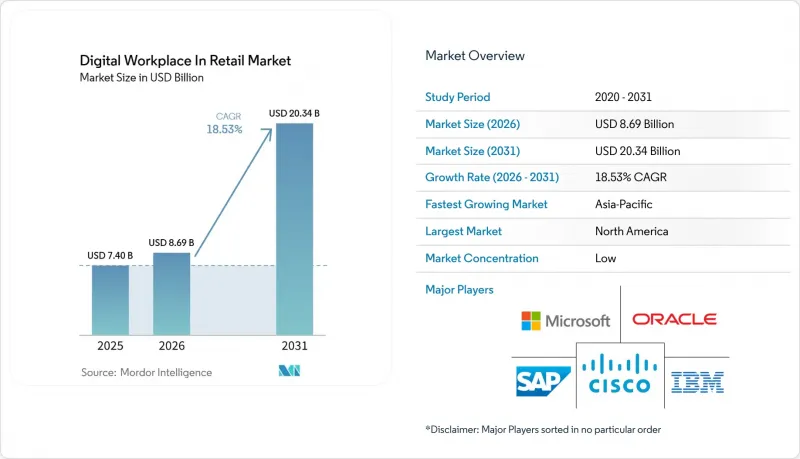
預計到 2025 年,零售業數位工作場所市場規模將達到 74 億美元,到 2026 年將達到 86.9 億美元,到 2031 年將達到 203.4 億美元,2026 年至 2031 年的複合年成長率為 18.53%。
本報告按元件(解決方案[整合通訊與協作、工作流程自動化與知識管理、企業行動化與管理等]、服務)、部署類型(雲端、本地部署、混合部署)、組織規模(大型企業、中小企業)和地區進行細分。市場預測以價值(美元)表示。
全球零售數位化工作場所市場趨勢與洞察
門市員工對即時溝通的需求日益成長。
零售市場採用數位化工作場所的驅動力在於,店內客戶服務溝通延遲導致成本不斷上升。如今,門市員工需要在不離開銷售區域的情況下,即時取得任務更新、服務升級資訊和產品指導。由於員工人數眾多、出差頻繁且工作時間長,電子郵件和消費者通訊應用根本無法滿足這項需求。 2025年4月,Zoom發布了“Zoom Workplace for Frontline”,將一鍵通話、AI輔助的輪班報告、換班、任務管理和知識搜尋等功能整合到一個行動優先的產品中。這表明,供應商正在重塑零售市場的數位化工作場所,摒棄以辦公室為中心的模式,轉而專注於無辦公桌營運。此外,永旺零售(Aeon Retail)於2025年6月起在390家門市引進了AI驅動的一體化終端,使員工能夠透過互動式AI介面即時搜尋數位化手冊。在零售市場,數位化工作場所提供了許多優勢:語音功能、任務處理和知識搜尋整合到一個員工工具中,簡化了培訓,並確保了整個門市網路日常使用的一致性。
拓展全通路零售業務
隨著全通路零售的普及,零售業數位化工作場所正蓬勃發展,因為每位門市員工在同一班次內需要處理的任務數量不斷增加。同時處理店內購買、提貨訂單和線上促銷活動,需要總部規劃資料與現場執行進行即時協調。曼哈頓顧問公司在2025年零售業基準調查報告中指出,員工協作能力正日益成為區分業績優異零售商與整個市場的重要因素。 2025年5月,NEC宣布日本7-Eleven將部署約30萬台具備整合終端管理功能的行動裝置和平板電腦。這表明,大型便利商店營運商正將員工數位轉型視為一項基礎設施,而非可有可無的支出。 SAP也在2026年NRF零售展上展示了其人工智慧驅動的商品組合管理、促銷定價和零售數據功能,旨在將門市活動與公司規劃更緊密地聯繫起來。因此,零售市場的數位化工作場所正在從單純的協作軟體發展成為一個營運層,幫助零售商管理通路複雜性,並最大限度地減少計劃和執行之間的延遲。
對店內設備上的資料安全和隱私問題表示擔憂。
零售市場的數位化工作場所持續受到買家的謹慎關注,因為每增加一台新的手持終端機、平板電腦、自助服務終端或共用設備,都會增加整個門市網路中需要保護的終端數量。當工作場所平台與門市營運、員工資料或支付處理等密切相關的環境整合時,這個問題就顯得尤為重要,因為零售商需要對存取權限、設備策略和審計追蹤進行更嚴格的控制。此外,合規性要求因地區而異,這使得在多個國家/地區運營或受不同法律標準約束的零售商的實施更具挑戰性。 2026年4月,澳洲註冊會計師協會(CPA Australia)報告稱,新加坡44%的中小型企業在2025年因網路安全事件遭受了時間和經濟損失。這表明,安全漏洞不僅會帶來聲譽風險,還會導致營運和財務的直接中斷。因此,企業級行動裝置管理、基於角色的存取控制和加密審計日誌已成為零售市場數位化工作場所的標準採購條件,這減緩了那些無法滿足這些期望的低成本或面向消費者的工具的普及。此外,可靠性、合規應對力和成熟的部署管理已成為候選供應商選擇的關鍵因素,並提高了新供應商的進入門檻。
細分市場分析
預計到2025年,解決方案將佔零售市場數位化工作場所的66.38%,並將以18.93%的複合年成長率成長至2031年。這意味著能夠為溝通、任務和知識存取提供整合支援的軟體平台預計仍將是這些組件的核心。解決方案在2025年也佔據了零售市場數位化工作場所市場規模的66.38%。這是因為零售商仍然傾向於預先整合系統,而不是必須為每個門市單獨管理的獨立工具。整合的通訊和協作平台仍然是最常見的部署方式,因為它們可以即時連接總部和門市團隊,並減少日常協調的差距。 Zoom於2025年4月為現場用戶推出的新服務體現了這項優先事項,它將一鍵通話通訊、人工智慧驅動的輪班報告、任務管理和智慧知識搜尋整合到一個「行動優先」的無桌辦公環境中。此外,在零售業的數位工作場所市場,隨著零售商將終端管理、工作流程自動化和員工體驗 (EX) 功能添加到同一平台,而不是為每個用例購買新系統,對解決方案的需求日益成長。
下一階段的解決方案成長很可能來自那些能夠幫助零售商管理大規模設備資產、更複雜的營運流程以及滿足門市營運一致性日益成長的需求的工具。 NEC 為日本 7-Eleven 打造的下一代系統,以約 30 萬台行動裝置和平板電腦為核心,並整合了終端管理功能,充分展現了大型連鎖營運商積極投資於系統化現場支援的意願。隨著零售商尋求能夠連接員工並以更一致的方式指導營運的平台,員工體驗平台、工作流程自動化模組和知識管理層的重要性日益凸顯。在零售數位化工作場所中,服務仍然至關重要,因為實施支援、營運管理、合規性檢查和客製化工作流程設計往往決定平台能否有效擴展到不同國家和不同門市類型。因此,儘管零售數位化工作場所仍以解決方案主導,但隨著人工智慧層、工作流程更新和管治成為持續平台管理的常態,服務的重要性也不斷提升。
區域分析
到2025年,北美將佔據零售數位化工作場所市場37.42%的佔有率,成為各地區中佔有率最大的。北美在2025年佔據零售數位化工作場所市場37.42%的佔有率,主要得益於其在零售技術領域的巨額投資以及強大的雲端、設備和通訊基礎設施。美國零售商正從部署通訊工具轉向人工智慧主導的執行層,以支援門市規劃、翻譯和庫存管理的即時運作。沃爾瑪計畫於2025年6月為150萬名員工部署人工智慧工具,這充分展現了北美連鎖零售商利用數位化工作場所平台重塑日常門市營運的規模。此外,北美零售市場數位化工作場所的普及也得益於其供應商基礎,與規模小規模、網路連線較弱的地區相比,北美供應商能夠更順暢地支援企業級部署、裝置管理、人工智慧整合和多站點管治。
到2025年,歐洲仍將是第二大區域市場,其中德國、英國、法國、義大利、西班牙和北歐國家是需求的支柱。儘管該地區正穩步邁向人工智慧驅動的現場工具,但採購負責人通常更重視可審計的部署、員工資料處理和政策管理,而非快速部署功能本身。瑪莎百貨2026年的Copilot實施案例研究表明,歐洲大型零售商並非僅僅追隨人工智慧的潮流,而是利用數位化工作場所工具來減輕管理人員的行政負擔並提高門市營運品質。此外,法國Num 2025年的調查顯示,歐洲的中小型零售商也越來越願意採用軟體,這為大型連鎖店以外的更廣泛擴張奠定了基礎。
預計到2031年,亞太地區將以19.47%的複合年成長率成長,成為零售市場數位化工作場所成長最快的區域市場。這一成長得益於大規模的勞動力、不斷擴張的零售業態、積極的公共數位化項目以及適合行動優先模式的多樣化門市形式。日本仍然是一個重要的案例,永旺集團自2025年6月起在390家門市部署了人工智慧驅動的現場終端;NEC為日本7-Eleven便利商店的專案新增了約30萬台行動裝置和平板電腦,以支援下一代門市系統。東南亞地區也正在加速發展,大型零售商正在採用整合通訊和工作流程工具,以提高其快速擴張的門市網路的一致性。 MYDIN與Lark於2026年5月達成的合作,正是該地區大型零售商如何利用數位化工作場所,在其整個國內門市網路中整合通訊、工作流程和員工互動的一個例證。儘管在南美和非洲的部署規模仍然小規模,但Shoprite在超過3400家門市實施YOOBIC的經驗表明,即使在基礎設施不完善的環境中,行動優先架構也能實現規模化擴展。中東地區也取得了進展,尤其是在沙烏地阿拉伯和阿拉伯聯合大公國的主要零售集團。在這些地區,數位經濟推廣計畫和較高的智慧型手機普及率使得長期採用面向門市的平台變得更加容易。
其他好處:
- Excel格式的市場預測(ME)表
- 3個月的分析師支持
目錄
第1章:引言
- 研究假設和市場定義
- 調查範圍
第2章:調查方法
第3章執行摘要
第4章 市場狀況
- 市場概覽
- 市場促進因素
- 與門市員工進行即時溝通的需求日益成長。
- 全通路零售業務的擴張
- 對集中式知識和任務協調的需求
- 關於勞動力流動性和現場生產力的要求
- 零售業對雲端為基礎的協作工具的採用率不斷提高
- 人們越來越關注員工體驗和員工留任率。
- 市場限制因素
- 對店內每台設備的資料安全和隱私問題感到擔憂。
- 與傳統零售系統整合的複雜性
- 門市層級實施過程中變更管理負擔沉重
- 不同零售業態和地區的數位化成熟度有差異。
- 產業價值鏈分析
- 宏觀經濟因素對市場的影響
- 監理情勢
- 技術展望
- 波特五力分析
第5章 市場規模與成長預測
- 按組件
- 解決方案
- 整合通訊與協作
- 整合端點管理
- 企業移動性與管理
- 員工體驗平台與內網
- 工作流程自動化與知識管理
- 虛擬桌面基礎架構與雲端電腦
- 服務
- 解決方案
- 部署模式
- 雲
- 現場
- 混合
- 按組織規模
- 大公司
- 小型企業
- 按地區
- 北美洲
- 美國
- 加拿大
- 墨西哥
- 南美洲
- 巴西
- 阿根廷
- 智利
- 哥倫比亞
- 其他南美國家
- 歐洲
- 德國
- 英國
- 法國
- 義大利
- 西班牙
- 荷蘭
- 北歐的
- 俄羅斯
- 其他歐洲國家
- 亞太地區
- 中國
- 日本
- 印度
- 韓國
- 澳洲和紐西蘭
- 東南亞
- 其他亞太國家
- 中東
- 沙烏地阿拉伯
- 阿拉伯聯合大公國
- 土耳其
- 以色列
- 其他中東國家
- 非洲
- 南非
- 埃及
- 奈及利亞
- 肯亞
- 其他非洲國家
- 北美洲
第6章 競爭情勢
- 市場集中度
- 策略趨勢
- 市佔率分析
- 公司簡介
- Microsoft Corporation
- Cisco Systems, Inc.
- IBM Corporation
- Google LLC
- SAP SE
- Oracle Corporation
- VMware, Inc.
- Citrix Systems, Inc.
- HPE Development LP
- Dell Technologies Inc.
- VMware by Broadcom Inc.
- ServiceNow, Inc.
- Slack Technologies, LLC
- Zoom Video Communications, Inc.
- RingCentral, Inc.
- Salesforce, Inc.
- Zebra Technologies Corporation
- Honeywell International Inc.
- Panasonic Holdings Corporation
- Samsung Electronics Co., Ltd.
第7章 市場機會與未來展望
According to Mordor Intelligence, the digital workplace in retail market size is projected to be USD 7.4 billion in 2025, USD 8.69 billion in 2026, and reach USD 20.34 billion by 2031, growing at a CAGR of 18.53% from 2026 to 2031.
This report is Segmented by Component (Solutions [Unified Communication and Collaboration, Workflow Automation and Knowledge Management, Enterprise Mobility and Management, and More], and Services), Deployment Mode (Cloud, On-Premises, and Hybrid), Organization Size (Large Enterprises, and Small and Medium-Sized Enterprises), and Geography. The Market Forecasts are Provided in Terms of Value (USD).
Global Digital Workplace In Retail Market Trends and Insights
Rising Demand For Real-Time Store Associate Communication
The digital workplace in the retail market is being pushed forward by the growing cost of slow store communication during customer-facing activity. Store teams now need instant access to task updates, service escalations, and product guidance without leaving the sales floor. Email and consumer messaging apps do not solve that need well when the workforce is large, mobile, and spread across long operating hours. Zoom launched Zoom Workplace for Frontline in April 2025 with push-to-talk, AI-assisted shift reporting, shift swapping, task management, and knowledge search in one mobile-first product, which shows how vendors are reshaping the digital workplace in the retail market around deskless work rather than office templates. Aeon Retail also deployed AI-equipped all-in-one devices across 390 stores from June 2025 so associates could search digitized manuals through a conversational AI interface in real time. The digital workplace in the retail market benefits when voice, task handling, and knowledge retrieval sit in one associate-facing tool because training becomes easier and daily usage becomes more consistent across store networks.
Expansion of Omnichannel Retail Operations
The digital workplace in the retail market is gaining momentum because omnichannel retail has increased the number of tasks each store associate must manage within the same shift. Fulfilling store purchases, pickup orders, and digital promotions at the same time now requires live coordination between corporate planning data and frontline execution. Manhattan Associates reported in its 2025 retail benchmark work that workforce coordination capability was becoming a more visible differentiator between top-performing retailers and the broader market. NEC announced in May 2025 that Seven-Eleven Japan was deploying around 300,000 mobile and tablet terminals with unified endpoint management, which showed that large convenience operators were treating workforce digitalization as infrastructure rather than optional spend. SAP also used NRF 2026 to show AI-assisted assortment management, promotion pricing, and retail data capabilities that connect store activity more closely to enterprise planning. The digital workplace in the retail market is therefore moving beyond collaboration software and toward an operational layer that helps retailers manage channel complexity with less delay between planning and execution.
Data Security and Privacy Concerns Across Store Devices
The digital workplace in the retail market still faces caution from buyers because every new handheld, tablet, kiosk, and shared device expands the number of endpoints that must be secured across the store network. This matters even more when workplace platforms connect with store operations, workforce data, or environments close to payment activity, because retailers then need stronger controls over access rights, device policies, and audit trails. Compliance needs also vary across regions, making rollouts more challenging for retailers operating across several countries and different legal standards. CPA Australia reported in April 2026 that 44% of small businesses in Singapore lost time or money due to cybersecurity incidents in 2025, which showed how security gaps create direct operational and financial disruption rather than only reputational risk. As a result, enterprise-grade mobile device management, role-based access control, and encrypted audit logging have become standard buying criteria for the digital workplace in the retail market, slowing adoption of lower-cost or consumer-style tools that cannot meet those expectations. This also raises the barrier for new vendors because trust, compliance readiness, and proven deployment controls now play a major role in shortlist decisions.
Other drivers and restraints analyzed in the detailed report include:
- Need for Centralized Knowledge and Task Orchestration
- Workforce Mobility and Frontline Productivity Requirements
- Integration Complexity With Legacy Retail Systems
For complete list of drivers and restraints, kindly check the Table Of Contents.
Segment Analysis
Solutions captured 66.38% of the digital workplace in retail market in 2025 and are projected to expand at an 18.93% CAGR through 2031, which keeps the component mix centered on software platforms that can support communication, tasks, and knowledge access in a unified way. Solutions also accounted for 66.38% of the digital workplace in retail market size in 2025 because retailers continue to prefer pre-integrated systems over separate tools that have to be managed one by one across stores. Unified communication and collaboration platforms remain the most common entry point because they give retailers an immediate way to connect headquarters with store teams and reduce day-to-day coordination gaps. Zoom's April 2025 frontline launch reflected that priority by combining push-to-talk communication, AI-assisted shift reporting, task management, and smart knowledge search in one mobile-first environment for deskless work. The digital workplace in retail market is also pushing solution demand higher as retailers add endpoint management, workflow automation, and employee experience functions to the same platform rather than buying new systems for each use case.
The next layer of solution growth is coming from tools that help retailers manage larger device estates, more complex execution workflows, and higher expectations for operational consistency across stores. NEC's next-generation system for Seven-Eleven Japan, built around around 300,000 mobile and tablet terminals and unified endpoint management, showed how far large-format operators are now willing to invest in structured frontline enablement. Employee experience platforms, workflow automation modules, and knowledge management layers are becoming more important because retailers want platforms that not only connect workers but also guide work in a more consistent way. In the digital workplace in retail industry, services still matter because implementation support, managed operations, compliance checks, and custom workflow design often determine whether a platform scales well across countries and formats. That is why the digital workplace in retail market continues to stay solutions-led while services grow in supporting importance as AI layers, workflow updates, and governance needs become a regular part of ongoing platform management.
Complete Report Scope:
- By Component
- Solutions
- Unified Communication and Collaboration
- Unified Endpoint Management
- Enterprise Mobility and Management
- Employee Experience Platforms and Intranet
- Workflow Automation and Knowledge Management
- Virtual Desktop Infrastructure and Cloud PC
- Services
- Solutions
- By Deployment Mode
- Cloud
- On-premises
- Hybrid
- By Organization Size
- Large Enterprises
- Small and Medium-sized Enterprises
- By Geography
- North America
- United States
- Canada
- Mexico
- South America
- Brazil
- Argentina
- Chile
- Colombia
- Rest of South America
- Europe
- Germany
- United Kingdom
- France
- Italy
- Spain
- Netherlands
- Nordics
- Russia
- Rest of Europe
- Asia-Pacific
- China
- Japan
- India
- South Korea
- Australia and New Zealand
- Southeast Asia
- Rest of Asia-Pacific
- Middle East
- Saudi Arabia
- United Arab Emirates
- Turkey
- Israel
- Rest of Middle East
- Africa
- South Africa
- Egypt
- Nigeria
- Kenya
- Rest of Africa
- North America
Geography Analysis
North America held 37.42% of the digital workplace in retail market in 2025, which made it the largest regional contributor. North America also represented 37.42% of the digital workplace in retail market share in 2025 because the region combines deep retail technology spending with strong cloud, device, and communications infrastructure. U.S. retailers have moved beyond simple deployment of messaging tools and into AI-led execution layers that support store planning, translation, and inventory work in real time. Walmart's June 2025 launch of AI-powered tools for 1.5 million associates showed the scale at which North American chains are using digital workplace platforms to reshape daily store operations. The digital workplace in retail market in North America is also helped by a vendor base that can support enterprise rollout, device management, AI integration, and multi-site governance with less friction than in smaller or less connected regions.
Europe remained the second-largest regional market in 2025, with Germany, the United Kingdom, France, Italy, Spain, and the Nordics anchoring demand. The region is moving steadily toward AI-augmented frontline tools, but buyers usually place more weight on auditable deployment, employee data handling, and policy control than on rapid feature adoption alone. Marks and Spencer's 2026 Copilot rollout showed that large European retailers are using digital workplace tools to reduce manager administration and improve store execution quality rather than to follow a general AI trend. France Num's 2025 findings also showed that smaller commerce businesses in Europe are increasingly comfortable with software adoption, which supports a broader base for expansion beyond large chains.
Asia-Pacific is projected to expand at a 19.47% CAGR through 2031, which makes it the fastest-growing regional segment in the digital workplace in retail market. Growth in the region is being supported by large frontline workforces, rising organized retail activity, active public digitalization programs, and broad variation in store formats that favor mobile-first deployment. Japan remains a major reference point because Aeon Retail deployed AI-equipped frontline devices across 390 stores from June 2025, while NEC's Seven-Eleven Japan project added around 300,000 mobile and tablet terminals to support the next-generation store system. Southeast Asia is also gaining momentum as organized retailers adopt unified communications and workflow tools to improve consistency across fast-growing networks. MYDIN's May 2026 partnership with Lark showed how large regional retailers are using the digital workplace in retail market to unify communications, workflows, and employee engagement across national store estates. South America and Africa are building from a smaller base, but Shoprite's rollout of YOOBIC across more than 3,400 stores demonstrated that mobile-first architectures can still support scale in environments where infrastructure conditions are less even. The Middle East is also moving ahead through large retail groups in Saudi Arabia and the United Arab Emirates, where digital economy programs and high smartphone usage are making frontline platform deployment easier to support over time.
- Microsoft Corporation
- Cisco Systems, Inc.
- IBM Corporation
- Google LLC
- SAP SE
- Oracle Corporation
- VMware, Inc.
- Citrix Systems, Inc.
- HPE Development LP
- Dell Technologies Inc.
- VMware by Broadcom Inc.
- ServiceNow, Inc.
- Slack Technologies, LLC
- Zoom Video Communications, Inc.
- RingCentral, Inc.
- Salesforce, Inc.
- Zebra Technologies Corporation
- Honeywell International Inc.
- Panasonic Holdings Corporation
- Samsung Electronics Co., Ltd.
Additional Benefits:
- The market estimate (ME) sheet in Excel format
- 3 months of analyst support
TABLE OF CONTENTS
1 INTRODUCTION
- 1.1 Study Assumptions and Market Definition
- 1.2 Scope of the Study
2 RESEARCH METHODOLOGY
3 EXECUTIVE SUMMARY
4 MARKET LANDSCAPE
- 4.1 Market Overview
- 4.2 Market Drivers
- 4.2.1 Rising Demand for Real-Time Store Associate Communication
- 4.2.2 Expansion of Omnichannel Retail Operations
- 4.2.3 Need for Centralized Knowledge and Task Orchestration
- 4.2.4 Workforce Mobility and Frontline Productivity Requirements
- 4.2.5 Increased Adoption of Cloud-Based Retail Collaboration Tools
- 4.2.6 Growing Focus on Employee Experience and Retention
- 4.3 Market Restraints
- 4.3.1 Data Security and Privacy Concerns Across Store Devices
- 4.3.2 Integration Complexity With Legacy Retail Systems
- 4.3.3 High Change Management Burden for Store-Level Adoption
- 4.3.4 Uneven Digital Maturity Across Retail Formats and Regions
- 4.4 Industry Value Chain Analysis
- 4.5 Impact of Macroeconomic Factors on the Market
- 4.6 Regulatory Landscape
- 4.7 Technological Outlook
- 4.8 Porter's Five Forces Analysis
- 4.8.1 Bargaining Power of Suppliers
- 4.8.2 Bargaining Power of Buyers
- 4.8.3 Threat of New Entrants
- 4.8.4 Threat of Substitutes
- 4.8.5 Intensity of Competitive Rivalry
5 MARKET SIZE AND GROWTH FORECASTS (VALUE)
- 5.1 By Component
- 5.1.1 Solutions
- 5.1.1.1 Unified Communication and Collaboration
- 5.1.1.2 Unified Endpoint Management
- 5.1.1.3 Enterprise Mobility and Management
- 5.1.1.4 Employee Experience Platforms and Intranet
- 5.1.1.5 Workflow Automation and Knowledge Management
- 5.1.1.6 Virtual Desktop Infrastructure and Cloud PC
- 5.1.2 Services
- 5.1.1 Solutions
- 5.2 By Deployment Mode
- 5.2.1 Cloud
- 5.2.2 On-premises
- 5.2.3 Hybrid
- 5.3 By Organization Size
- 5.3.1 Large Enterprises
- 5.3.2 Small and Medium-sized Enterprises
- 5.4 By Geography
- 5.4.1 North America
- 5.4.1.1 United States
- 5.4.1.2 Canada
- 5.4.1.3 Mexico
- 5.4.2 South America
- 5.4.2.1 Brazil
- 5.4.2.2 Argentina
- 5.4.2.3 Chile
- 5.4.2.4 Colombia
- 5.4.2.5 Rest of South America
- 5.4.3 Europe
- 5.4.3.1 Germany
- 5.4.3.2 United Kingdom
- 5.4.3.3 France
- 5.4.3.4 Italy
- 5.4.3.5 Spain
- 5.4.3.6 Netherlands
- 5.4.3.7 Nordics
- 5.4.3.8 Russia
- 5.4.3.9 Rest of Europe
- 5.4.4 Asia-Pacific
- 5.4.4.1 China
- 5.4.4.2 Japan
- 5.4.4.3 India
- 5.4.4.4 South Korea
- 5.4.4.5 Australia and New Zealand
- 5.4.4.6 Southeast Asia
- 5.4.4.7 Rest of Asia-Pacific
- 5.4.5 Middle East
- 5.4.5.1 Saudi Arabia
- 5.4.5.2 United Arab Emirates
- 5.4.5.3 Turkey
- 5.4.5.4 Israel
- 5.4.5.5 Rest of Middle East
- 5.4.6 Africa
- 5.4.6.1 South Africa
- 5.4.6.2 Egypt
- 5.4.6.3 Nigeria
- 5.4.6.4 Kenya
- 5.4.6.5 Rest of Africa
- 5.4.1 North America
6 COMPETITIVE LANDSCAPE
- 6.1 Market Concentration
- 6.2 Strategic Moves
- 6.3 Market Share Analysis
- 6.4 Company Profiles (includes Global Level Overview, Market Level Overview, Core Segments, Financials as available, Strategic Information, Market Rank/Share, Products and Services, Recent Developments)
- 6.4.1 Microsoft Corporation
- 6.4.2 Cisco Systems, Inc.
- 6.4.3 IBM Corporation
- 6.4.4 Google LLC
- 6.4.5 SAP SE
- 6.4.6 Oracle Corporation
- 6.4.7 VMware, Inc.
- 6.4.8 Citrix Systems, Inc.
- 6.4.9 HPE Development LP
- 6.4.10 Dell Technologies Inc.
- 6.4.11 VMware by Broadcom Inc.
- 6.4.12 ServiceNow, Inc.
- 6.4.13 Slack Technologies, LLC
- 6.4.14 Zoom Video Communications, Inc.
- 6.4.15 RingCentral, Inc.
- 6.4.16 Salesforce, Inc.
- 6.4.17 Zebra Technologies Corporation
- 6.4.18 Honeywell International Inc.
- 6.4.19 Panasonic Holdings Corporation
- 6.4.20 Samsung Electronics Co., Ltd.
7 MARKET OPPORTUNITIES AND FUTURE OUTLOOK
- 7.1 White-Space and Unmet-Need Assessment

 2026-2030年全球數位化職場市場
 包容性職場無障礙平台市場預測至2034年—全球無障礙解決方案、身心障礙者支援、無障礙功能、合規標準、最終用戶和區域分析
 數位化工作場所市場:2026-2032年全球市場預測(按服務類型、應用、產業、組織規模和部署類型分類)
 教育產業的數位化工作場所:市場佔有率分析、產業趨勢和統計數據以及成長預測(2026-2031 年)越南數位化工作場所:市場佔有率分析、產業趨勢與統計及成長預測(2026-2031)政府和公共部門數位化工作場所:市場佔有率分析、行業趨勢和統計數據以及成長預測(2026-2031 年)法律與專業服務的數位化工作場所:市場佔有率分析、產業趨勢與統計數據以及成長預測(2026-2031 年)製造業數位化工作場所:市場佔有率分析、產業趨勢與統計及成長預測(2026-2031 年)醫療保健領域的數位化工作場所:市場佔有率分析、行業趨勢和統計數據以及成長預測(2026-2031 年)銀行、金融服務和保險 (BFSI) 行業的數位化工作場所:市場佔有率分析、行業趨勢和統計數據以及成長預測(2026-2031 年)