


 |
市場調查報告書
商品編碼
2116714
印度天然氣:市場佔有率分析、產業趨勢與統計及成長預測(2026-2031)India Natural Gas - Market Share Analysis, Industry Trends & Statistics, Growth Forecasts (2026 - 2031) |
||||||

※ 本網頁內容可能與最新版本有所差異。詳細情況請與我們聯繫。
據 Mordor Intelligence 稱,2025 年印度天然氣市場價值為 77400 百萬標準立方米,預計到 2031 年將從 2026 年的 81470 百萬標準立方米成長至 105280 百萬標準立方米,預測期(2026-2031 年)的複合年成長率為 5.26%。
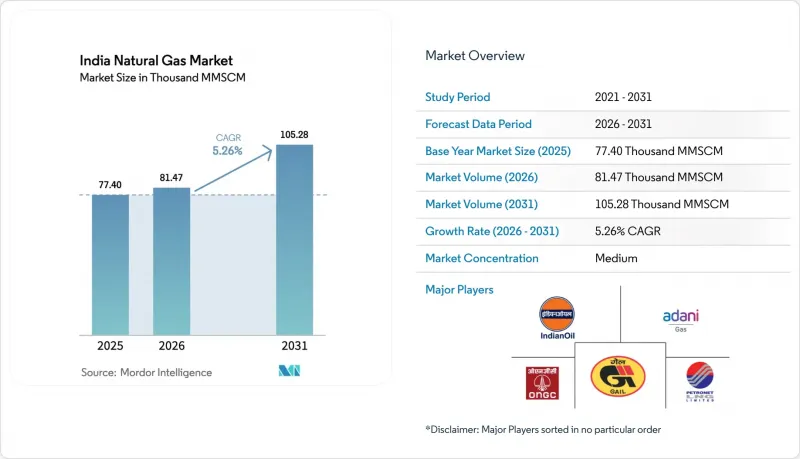
《印度天然氣市場報告》按類型(壓縮天然氣、管道天然氣、液化天然氣)、來源(國內陸生產、國內海上生產、液化天然氣進口)和最終用途(化肥生產、城市燃氣供應、運輸、石化原料、其他)細分。市場規模和預測以百萬立方米(MMSCM)為單位。
印度天然氣市場趨勢與洞察
二、三線城市城市燃氣供應網擴建
古吉拉特天然氣公司( Gujarat Gas)的業務遍及307個地區,目標是在2034年前建成1.26億個管道天然氣(PNG)連接和18336個壓縮天然氣(CNG)加氣站,從而將印度天然氣市場深入滲透到中小城市。該公司已為2025年累計120億印度盧比,用於連接33萬戶新家庭並建立200個CNG銷售點。其他一些正在向飽和的大都會圈以外地區擴張的天然氣發行也採用了類似的策略。儘管都市化趨勢、對無污染燃料的重視以及標準化的收費系統提高了專案的可行性,但低消費密度仍需要創新的「最後一公里」配送模式和長期的政策支持。
營養補貼改革後,化肥產業轉向使用氣態原料。
到2024年,該行業將佔國內需求的31%,並且由於政府的直接支持,受液化天然氣價格波動的影響相對較小。改革使得生產者支持價格(APM)和新井天然氣能夠供應給化肥廠,從而促進了對石腦油的依賴性降低,並增強了供應穩定性。該領域價格彈性較低,穩定的出貨量有助於提高基礎設施利用率,同時保護印度天然氣市場免受工業燃料轉換週期的影響。
現貨液化天然氣價格波動導致工業燃料變化
現貨液化天然氣價格從2020年初的2美元/百萬英熱單位(MMBTU)波動至2021年底的30美元/百萬英熱單位(MMBTU),迫使對價格敏感的用戶在獲利能力閾值時轉而使用重質燃油和煤炭。印度約25%的天然氣供應依賴現貨交易,因此其天然氣市場極易受到外部衝擊,尤其是那些缺乏對沖手段的非補貼產業和尖峰時段用電電廠。
細分市場分析
預計到2025年,壓縮天然氣(CNG)將佔印度天然氣市場47.10%的佔有率,複合年成長率(CAGR)為5.83%。另一方面,管道天然氣(PNG)將維持52.90%的主導佔有率,但其成長速度將放緩。加氣站的快速發展(預計到2025年3月運作)和扶持性的交通政策,使得CNG成為商用車可及的脫碳選擇。 Bajaj Auto推出CNG摩托車以及計畫推出CNG踏板車平台,正在擴大摩托車的市場範圍。然而,PNG的推廣仍面臨挑戰,例如連接成本、來自補貼液化石油氣(LPG)的競爭以及農村地區人口密度低等問題,導致93個地區沒有家庭接觸PNG。這迫使城市燃氣分銷公司(CGD)付費使用制並建造區域管道解決方案。
其他好處
- Excel格式的市場預測(ME)表
- 3個月的分析師支持
目錄
第1章:引言
- 研究假設和市場定義
- 調查範圍
第2章:調查方法
第3章執行摘要
第4章 市場狀況
- 市場概覽
- 市場促進因素
- 二、三線城市城市燃氣供應網擴建
- 營養補貼改革後,化肥產業轉向使用氣態原料。
- 與新興國內天然氣樞紐價格相關的液化天然氣合約重組
- 鋼鐵和煉油產業叢集的強制性脫碳
- 透過「一個國家,一個天然氣管網」計畫連接州際管道。
- 生物壓縮天然氣混合燃料目標的出現,為城市燃氣分銷營運商提供了新的選擇。
- 市場限制因素
- 現貨液化天然氣價格波動導致工業燃料變化
- 森林走廊管線用地徵用過程延誤
- 由於價格計算公式存在上限,上游投資的獲利能力受到限制。
- 由於太陽能發電和儲能結合的系統所產生的平準化電力成本迅速下降,競爭日益激烈。
- 供應鏈分析
- 監理展望
- 技術展望
- PESTLE分析
- 波特五力模型
第5章 市場規模與成長預測
- 按類型
- 壓縮天然氣(CNG)
- 管道天然氣(PNG)
- 液化天然氣(LNG)
- 按供應來源
- 國內生產-在土地上
- 國內生產 - 離岸
- 液化天然氣進口
- 按最終用途細分市場
- 化肥生產
- 城市瓦斯供應
- 運輸
- 石油化學原料
- 其他[工業製造、農業(茶葉種植園)、管道系統積體電路、液化石油氣收縮、海綿鐵和鋼鐵]
第6章 競爭情勢
- 市場集中度
- 策略趨勢(併購、聯盟、購電協議)
- 市場佔有率分析(主要公司的市場排名和佔有率)
- 公司簡介
- Adani Total Gas Limited
- Assam Gas Company Limited
- Bharat Petroleum Corporation Limited
- Cairn Oil & Gas(Vedanta Limited)
- Essar Oil & Gas Exploration & Production Ltd.
- ExxonMobil India
- GAIL (India) Limited
- Gujarat Gas Limited
- Gujarat State Petronet Limited
- H-Energy Private Limited
- Hindustan Petroleum Corporation Limited
- Indian Oil Corporation Limited
- Indraprastha Gas Limited
- Mahanagar Gas Limited
- Oil and Natural Gas Corporation(ONGC)
- Petronet LNG Limited
- Reliance Industries Limited
- Shell Energy India Private Limited
- Torrent Gas Private Limited
- TotalEnergies SE(India Operations)
第7章 市場機會與未來展望
According to Mordor Intelligence, the India natural gas market size was valued at 77.40 Thousand MMSCM in 2025 and estimated to grow from 81.47 Thousand MMSCM in 2026 to reach 105.28 Thousand MMSCM by 2031, at a CAGR of 5.26% during the forecast period (2026-2031).
The India Natural Gas Market Report is Segment by Type (Compressed Natural Gas, Piped Natural Gas, and Liquefied Natural Gas ), Source (Domestic Production - Onshore, Domestic Production - Offshore, and LNG Imports), and End-Use Sector (Fertilizer Production, City Gas Distribution, Transportation, Petrochemical Feedstock, and Others). The Market Sizes and Forecasts are Provided in Terms of Volume (MMSCM).
India Natural Gas Market Trends and Insights
Expanding City Gas Distribution Network in Tier-2 & Tier-3 Cities
Roll-outs across 307 areas aim for 12.6 crore PNG connections and 18,336 CNG stations by 2034, pushing the India natural gas market deep into smaller cities . Gujarat Gas has earmarked INR 1,200 crore to hook 3.3 lakh new homes and 200 CNG outlets in FY25-an approach replicated by other distributors venturing beyond saturated metros. Urbanization trends, cleaner-fuel priorities, and standardized tariffs improve project viability, though low consumption density demands innovative last-mile models and long-term policy backing.
Fertilizer Sector's Shift to Gas-Based Feedstock under Nutrient-Based Subsidy Reforms
The sector drew 31% of national demand in 2024 and remains insulated from LNG price swings through direct government support. Reforms channel APM and new-well gas to fertilizer plants, incentivizing a move away from naphtha and reinforcing supply security. Stable offtake from this price-inelastic segment cushions the India natural gas market against industrial fuel-switching cycles while anchoring infrastructure utilization.
Volatility in Spot LNG Prices Driving Industrial Fuel Switching
Spot LNG fluctuated from USD 2/MMBTU in early 2020 to USD 30/MMBTU in late 2021, prompting price-sensitive users to revert to fuel oil or coal whenever landed costs breach viability thresholds. Reliance on spot cargoes for roughly 25% of supply exposes the India natural gas market to exogenous shocks, especially in non-subsidized industries and peaking power plants that lack hedging mechanisms.
Other drivers and restraints analyzed in the detailed report include:
- LNG Contract Restructuring Linking Prices to Emerging Domestic Gas Hub
- Interstate Pipeline Connectivity via "One Nation, One Gas Grid" Policy
- Delays in Pipeline Right-of-Way Clearances across Forest Corridors
For complete list of drivers and restraints, kindly check the Table Of Contents.
Segment Analysis
CNG delivered 47.10% of the India natural gas market size in 2025 and is forecast for a 5.83% CAGR, versus PNG's dominant 52.90% share but slower trajectory. Rapid station build-outs-8,067 outlets operational by March 2025-and supportive transport policies make CNG an accessible decarbonization lever for commercial fleets. Bajaj Auto's launch of CNG motorcycles and forthcoming CNG scooter platforms broadens the addressable two-wheeler universe. PNG expansion remains challenged by connection cost, subsidized LPG competition, and lower rural densities, leaving 93 geographical areas without a single household hookup, which compels CGD firms to craft pay-as-you-go and community pipeline solutions.
Complete Report Scope:
- By Type
- Compressed Natural Gas (CNG)
- Piped Natural Gas (PNG)
- Liquefied Natural Gas (LNG)
- By Source
- Domestic Production - Onshore
- Domestic Production - Offshore
- LNG Imports
- By End-Use Sector
- Fertilizer Production
- City Gas Distribution
- Transportation
- Petrochemical Feedstock
- Others [Industrial Manufacturing, Agriculture (Tea Plantation), IC for Pipeline System, LPG Shrinkage, Sponge Iron/Steel]
List of Companies Covered in this Report:
- Adani Total Gas Limited
- Assam Gas Company Limited
- Bharat Petroleum Corporation Limited
- Cairn Oil & Gas (Vedanta Limited)
- Essar Oil & Gas Exploration & Production Ltd.
- ExxonMobil India
- GAIL (India) Limited
- Gujarat Gas Limited
- Gujarat State Petronet Limited
- H-Energy Private Limited
- Hindustan Petroleum Corporation Limited
- Indian Oil Corporation Limited
- Indraprastha Gas Limited
- Mahanagar Gas Limited
- Oil and Natural Gas Corporation (ONGC)
- Petronet LNG Limited
- Reliance Industries Limited
- Shell Energy India Private Limited
- Torrent Gas Private Limited
- TotalEnergies SE (India Operations)
Additional Benefits:
- The market estimate (ME) sheet in Excel format
- 3 months of analyst support
TABLE OF CONTENTS
1 Introduction
- 1.1 Study Assumptions & Market Definition
- 1.2 Scope of the Study
2 Research Methodology
3 Executive Summary
4 Market Landscape
- 4.1 Market Overview
- 4.2 Market Drivers
- 4.2.1 Expanding City Gas Distribution Network in Tier-2 & Tier-3 Cities
- 4.2.2 Fertilizer Sector's Shift to Gas-Based Feedstock under Nutrient-Based Subsidy Reforms
- 4.2.3 LNG Contract Restructuring Linking Prices to Emerging Domestic Gas Hub
- 4.2.4 Industrial Decarbonization Mandates for Steel & Refining Clusters
- 4.2.5 Interstate Pipeline Connectivity via "One Nation, One Gas Grid" Policy
- 4.2.6 Emergence of Bio-CNG Blending Targets for CGD Operators
- 4.3 Market Restraints
- 4.3.1 Volatility in Spot LNG Prices Driving Industrial Fuel Switching
- 4.3.2 Delays in Pipeline Right-of-Way Clearances across Forest Corridors
- 4.3.3 Pricing Formula Caps Limiting Upstream Investment Economics
- 4.3.4 Competition from Rapidly Falling Levelized Cost of Solar-plus-Storage
- 4.4 Supply-Chain Analysis
- 4.5 Regulatory Outlook
- 4.6 Technological Outlook
- 4.7 PESTLE Analysis
- 4.8 Porter's Five Forces
- 4.8.1 Threat of New Entrants
- 4.8.2 Bargaining Power of Suppliers
- 4.8.3 Bargaining Power of Buyers
- 4.8.4 Threat of Substitutes
- 4.8.5 Competitive Rivalry
5 Market Size & Growth Forecasts
- 5.1 By Type
- 5.1.1 Compressed Natural Gas (CNG)
- 5.1.2 Piped Natural Gas (PNG)
- 5.1.3 Liquefied Natural Gas (LNG)
- 5.2 By Source
- 5.2.1 Domestic Production - Onshore
- 5.2.2 Domestic Production - Offshore
- 5.2.3 LNG Imports
- 5.3 By End-Use Sector
- 5.3.1 Fertilizer Production
- 5.3.2 City Gas Distribution
- 5.3.3 Transportation
- 5.3.4 Petrochemical Feedstock
- 5.3.5 Others [Industrial Manufacturing, Agriculture (Tea Plantation), IC for Pipeline System, LPG Shrinkage, Sponge Iron/Steel]
6 Competitive Landscape
- 6.1 Market Concentration
- 6.2 Strategic Moves (M&A, Partnerships, PPAs)
- 6.3 Market Share Analysis (Market Rank/Share for key companies)
- 6.4 Company Profiles (includes Global level Overview, Market level overview, Core Segments, Financials as available, Strategic Information, Products & Services, and Recent Developments)
- 6.4.1 Adani Total Gas Limited
- 6.4.2 Assam Gas Company Limited
- 6.4.3 Bharat Petroleum Corporation Limited
- 6.4.4 Cairn Oil & Gas (Vedanta Limited)
- 6.4.5 Essar Oil & Gas Exploration & Production Ltd.
- 6.4.6 ExxonMobil India
- 6.4.7 GAIL (India) Limited
- 6.4.8 Gujarat Gas Limited
- 6.4.9 Gujarat State Petronet Limited
- 6.4.10 H-Energy Private Limited
- 6.4.11 Hindustan Petroleum Corporation Limited
- 6.4.12 Indian Oil Corporation Limited
- 6.4.13 Indraprastha Gas Limited
- 6.4.14 Mahanagar Gas Limited
- 6.4.15 Oil and Natural Gas Corporation (ONGC)
- 6.4.16 Petronet LNG Limited
- 6.4.17 Reliance Industries Limited
- 6.4.18 Shell Energy India Private Limited
- 6.4.19 Torrent Gas Private Limited
- 6.4.20 TotalEnergies SE (India Operations)
7 Market Opportunities & Future Outlook
- 7.1 White-space & Unmet-Need Assessment

 全球可再生天然氣市場規模、佔有率、趨勢和成長分析報告(2026-2034年)
 天然氣燃料基礎設施:市場佔有率分析、產業趨勢與統計、成長預測(2026-2031 年)
 可再生天然氣市場分析及預測(至2035年):依類型、服務、技術、組件、應用、製程、部署、最終用戶、設備及解決方案分類可再生天然氣市場規模、佔有率、成長、全球產業分析、區域趨勢及2026年至2034年預測。
 天然氣充裝基礎設施市場:2026-2032年全球市場預測(依天然氣類型、站型、所有權、部署類型、應用程式和最終用戶分類)德國廢棄物製取可再生氣體:市場佔有率分析、產業趨勢與統計及成長預測(2026-2031 年)中國廢棄物衍生可再生氣體:市場佔有率分析、產業趨勢與統計及成長預測(2026-2031年)廢棄物衍生可再生氣體:市場佔有率分析、行業趨勢和統計數據以及成長預測(2026-2031 年)歐洲廢棄物衍生可再生氣體:市場佔有率分析、產業趨勢和統計數據以及成長預測(2026-2031 年)美國廢棄物衍生可再生氣體:市場佔有率分析、行業趨勢和統計數據以及成長預測(2026-2031 年)