


 |
市場調查報告書
商品編碼
2097460
德國廢棄物製取可再生氣體:市場佔有率分析、產業趨勢與統計及成長預測(2026-2031 年)Germany Renewable Gas From Waste - Market Share Analysis, Industry Trends & Statistics, Growth Forecasts (2026 - 2031) |
||||||

※ 本網頁內容可能與最新版本有所差異。詳細情況請與我們聯繫。
據 Mordor Intelligence 稱,德國廢棄物衍生可再生氣體市場規模預計將從 2025 年的 17.3 億美元擴大到 2026 年的 18.4 億美元,到 2031 年達到 25.8 億美元,2026 年至 2031 年的複合年成長率為 6.9%。
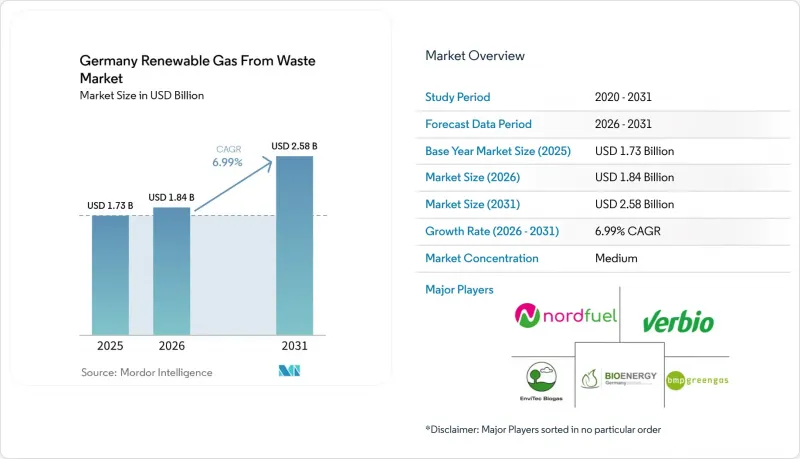
本報告依原料(都市固態廢棄物、食物廢棄物等)、技術(厭氧消化、氣化、熱解等)、氣體類型(沼氣、合成氣等)、應用(發電、併網等)和組件(氣體回收、消化器/發酵等)進行分類。市場預測以美元計價。
德國廢棄物衍生可再生氣體市場的趨勢與洞察
隨著《可再生能源法》下的上網電價補貼制度的結束,沼氣汽車正在轉型生產生物甲烷並將其輸送到電網。
德國20年的《能源效率法》(EEG)支援架構推動了2000年至2012年間沼氣廠建設的大規模浪潮,而同樣的建設週期如今也影響著德國廢棄物衍生可再生天然氣市場的維修需求。在初期擴張階段投入運作的沼氣廠將在2025年至2028年間逐步失去上網電價補貼,使得營運商從發電轉向生物甲烷生產成為直接的獎勵。對許多業主而言,升級設備和併網是維持資產運作最直接的途徑,因為這能夠滿足運輸燃料的需求、天然氣市場銷售需求以及《建築能源法》規定的未來供暖需求。因此,在德國廢棄物衍生可再生天然氣市場,對設備、氣體淨化系統和併網基礎設施的投資不再只是可選項,而是因應收入保障措施到期的必然之舉。 EnviTec公司表示,其「EnviThan」升級生產線在EEG改造項目中的需求日益成長,其中包括與石勒蘇益格-荷爾斯泰因州和勃蘭登堡州工廠相關的合約工作。此外,FNR繼續透過為退出EEG計畫的工廠提供技術和財務指導,支持生物甲烷轉型。
溫室氣體配額制度使運輸燃料中生物甲烷的需求量增加了兩倍
溫室氣體配額制度是德國廢棄物衍生可再生氣體市場需求的最強勁驅動力之一,因為它為燃料經銷商提供了購買低碳氣體燃料的直接合規理由。德國已批准一項修訂後的配額路徑,將目標提高到2040年的59%,為生物甲烷生產商提供了更清晰的運輸需求政策前景。在該制度下,生物甲烷具有更高的價值,因為廢棄物衍生氣體屬於「先進生質燃料」的範疇,從而提高了每噸減排量的脫碳價值。根據歐盟統計,2018年至2023年間,交通運輸領域對生物甲烷的需求成長了兩倍,達到近10太瓦時(TWh)。隨著監管要求的日益嚴格,其需求量也持續以每年高達10%的速度成長。預計從2026年起取消重複計算將改善檢驗的國內廢棄物衍生供應的地位,從而加強德國廢棄物衍生可再生氣體市場中真正的生產者定價機制。先進生質燃料的子配額計畫從 2026 年的 2% 增加到 2040 年的 8%,這將確保運輸部門繼續成為廢棄物衍生可再生氣體的長期市場。
GasNZV電網接入規定的到期為長期投資帶來了不確定性。
2025年底GasNZV的到期,在德國廢棄物衍生可再生天然氣市場造成了最明顯的短期政策真空。先前的框架為開發商提供了明確的併網權、成本分攤規則和驗收義務,從而為資產長期生命週期內的系統維修和注入項目提供了資金籌措支持。產業組織警告稱,如果沒有同樣清晰的後續體系,就恢復到更廣泛的EnWG框架,將會削弱投資確定性,並增加新計畫的併網風險。儘管EnWG第118條第4款規定的過渡措施仍然保護在2026年12月31日前已支付預付款的項目,但在此日期之後啟動的項目的未來仍然充滿不確定性。因此,在法律體制更加清晰之前,新計畫的推出正在放緩,而現有專案則在快速推進,導致短期專案儲備緊張。因此,德國廢棄物衍生可再生天然氣市場目前仍由需求支撐。然而,由於電網連接的可靠性跟不上需求成長的步伐,發電能力成長的時間越來越不均衡。
細分市場分析
2025年,在德國的廢棄物衍生可再生氣體市場中,農業殘餘物佔原料總量的29.4%,成為最大的原料來源。這一主導地位反映了在《可再生能源法》(EEG)的支持下,農場規模沼氣設施的長期發展,以及能夠穩定供應原料的綜合農業區域的廣泛存在。 2024年12月最新修訂的肥料條例規定,畜禽糞便中有機氮的年施用量上限為170公斤/公頃(總氮),從而鼓勵大型農場繼續採用厭氧消化作為一種切實可行的廢棄物管理方法。此外,隨著歐盟甲烷框架加強對畜牧業相關能源計畫的監管要求,畜禽糞便在德國的廢棄物衍生可再生氣體產業中扮演更重要的角色。
預計到2031年,德國食物廢棄物將以7.2%的複合年成長率成長,成為德國廢棄物衍生可再生氣體市場中成長最快的原料。歐盟強制實施廚餘垃圾分類收集政策,自2024年起擴大了市政和商業設施的有機物來源,推動了這一成長趨勢。食品加工殘渣、零售業有機物和都市區食物廢棄物的成長模式與農業廢棄物不同,這是因為它們的體積集中且通常具有較高的甲烷產量。來自啤酒廠、乳製品廠和食品加工廠的工業有機廢棄物因其穩定的收集系統和可預測的成分而日益受到青睞。污水污泥和垃圾掩埋氣仍然是既定的原料,但RED III指令下更嚴格的永續性法規可能會限制它們在原料組合中的長期貢獻。總體而言,儘管農業殘渣仍然是目前的基石,但德國廢棄物衍生可再生氣體市場對任何單一原料的依賴性正在降低。
到2025年,厭氧消化將佔德國廢棄物衍生可再生氣體市場46.3%的佔有率,鞏固其領先技術的地位。這一主導地位源自於《可再生能源法》(EEG)時期建設的大規模基礎設施,當時厭氧消化是農業和混合廢棄物的主要轉化途徑。現有基礎設施仍然至關重要,因為大部分短期產能將透過現有設施的擴建、維修或最佳化來實現。同時,沼氣氣體純化系統預計到2031年將以7.7%的複合年成長率成長,成為德國廢棄物衍生可再生氣體市場中成長最快的技術類別。這一快速成長與《再生能源法》週期的結束直接相關,因為從純發電模式轉型為沼氣生產模式的工廠需要升級設備以滿足電網級氣體標準。
透過分析EnviTec公司2025年和2026年模組化「EnviThan」變壓式吸附系統的訂單趨勢,我們發現,隨著維修浪潮的推進,新的客戶正在湧入煉油業。掩埋氣回收、氣化和熱解雖然目前規模尚小,但由於其拓展了原料的柔軟性,使其超越了傳統農業和市政厭氧消化的範疇,因此備受關注。這對德國的廢棄物可再生氣體產業具有重要意義,因為工業廢棄物產生者和地方政府都在尋求能夠處理更多樣化物料流的方法。修訂後的《工業排放指令》預計也將促進對大規模畜牧場農業厭氧消化技術的投資,而這項核心技術將有助於在其他方法發展的同時,維持一定的規模。預期結果並非消化技術的快速更迭,而是多種技術更加多元化的組合,其中技術升級推動成長,而消化技術仍是市場推廣的關鍵。
其他好處:
- Excel格式的市場預測(ME)表
- 3個月的分析師支持
目錄
第1章:引言
- 研究假設和市場定義
- 調查範圍
第2章:調查方法
第3章執行摘要
第4章 市場狀況
- 市場概覽
- 市場促進因素
- 隨著 EEG 固定價格購買制度的到期,沼氣發電廠將改用生物甲烷發電並輸送至電網。
- 溫室氣體排放配額制度使生物甲烷作為運輸燃料的需求增加了兩倍。
- 《建築能源法案》將在暖氣領域創造對生物甲烷的大規模新需求。
- 歐盟排放交易體系(ETS)下碳價格的上漲正在縮小生物甲烷和化石氣體之間的成本差距。
- 歐盟的甲烷法規和化肥法規正在鼓勵畜牧養殖戶採用沼氣。
- REPowerEU 規定德國必須根據生物甲烷產量的成長比例做出貢獻。
- 市場限制因素
- GasNZV電網接取限制的到期會造成長期投資的不確定性。
- 由於需要大量的資本投資以及沼氣基礎設施老化,現代化面臨的挑戰日益增加。
- 偏遠沼氣廠與天然氣輸送和分配網路的連接不足,限制了生物甲烷的轉換。
- 批發電力價格下降和電力電子競標競價效率低下,阻礙了收入多元化。
- 價值供應鏈分析
- 監理情勢
- 技術展望
- 波特五力模型
- 透過數位化原料管理和製程最佳化,提高可再生燃氣發電廠的效率。
- 制定有機廢棄物再利用和分類政策,以支持擴大原料供應
- 地緣政治事件對市場的影響
第5章 市場規模與成長預測
- 按原料
- 都市固態廢棄物(MSW)
- 農業殘餘物
- 牲畜糞便
- 工業有機廢棄物
- 污水污泥
- 食物廢棄物
- 其他
- 透過技術
- 厭氧消化
- 垃圾掩埋沼氣回收
- 氣化
- 熱解
- 沼氣氣體純化系統
- 其他
- 依氣體類型
- 沼氣
- 生物甲烷/可再生天然氣(RNG)
- 合成氣
- 透過使用
- 發電
- 熱電聯產(CHP)
- 注入電網
- 運輸燃料
- 工業加熱
- 住宅和商業供暖
- 其他
- 按組件
- 氣體收集系統
- 消化槽和發酵系統
- 氣體處理及淨化設備
- 壓縮機和儲能系統
- 發電設備
- 監控系統
- 其他
第6章 競爭情勢
- 市場集中度
- 策略趨勢
- 市佔率分析
- 公司簡介
- EnviTec Biogas AG
- Verbio SE
- bmp greengas GmbH
- Nordfuel GmbH
- BioEnergie Tauberfranken GmbH & Co. KG
- Loick Bioenergie GmbH
- Arcus Greencycling Technologies GmbH
- Landwarme GmbH
- Viessmann BioEnergy GmbH
- REVIS Bioenergy GmbH
- TURN2X GmbH
- BioConstruct GmbH
- Agrikomp GmbH
- PlanET Biogas Group GmbH
- Weltec Biopower GmbH
- BALANCE Erneuerbare Energien GmbH
- Schmack Biogas GmbH
- Krieg & Fischer Ingenieure GmbH
- NAWARO BioEnergie AG
- Erdgas Sudwest Bio-LNG GmbH
第7章 市場機會與未來展望
According to Mordor Intelligence, the Germany renewable gas from waste market size is expected to increase from USD 1.73 billion in 2025 to USD 1.84 billion in 2026 and reach USD 2.58 billion by 2031, growing at a CAGR of 6.99% over 2026-2031.
This report is Segmented by Feedstock (Municipal Solid Waste, Food Waste, and More), by Technology (Anaerobic Digestion, Gasification, Pyrolysis, and More), by Gas Type (Biogas, Syngas, and More), by Application (Electricity Generation, Grid Injection, and More), and by Component (Gas Collection, Digesters & Fermentation, and More). The Market Forecasts are Provided in Terms of Value (USD).
Germany Renewable Gas From Waste Market Trends and Insights
EEG Tariff Expiry Converting Biogas Fleet Toward Biomethane Grid Injection
Germany's 20-year EEG support framework backed a large wave of biogas construction between 2000 and 2012, and that same build cycle is now shaping retrofit demand in Germany renewable gas from waste market. Plants commissioned during the earlier expansion phase are losing fixed-tariff support in successive waves between 2025 and 2028, leaving operators with a direct incentive to shift from power-only generation to biomethane production. For many owners, upgrading and grid injection have become the clearest way to keep assets operating because they open access to transport fuel demand, gas market sales, and future heating demand under the Buildings Energy Act. That is why spending on upgrading units, gas-cleaning systems, and connection infrastructure is not simply optional modernization in the Germany renewable gas from waste market, but a response to expiring revenue protection. EnviTec stated that its EnviThan upgrading line was seeing stronger demand from EEG conversion projects, including contracted work linked to Schleswig-Holstein and Brandenburg sites. FNR also continued to support the biomethane conversion pathway through technical and funding guidance aimed at plants leaving the EEG regime.
GHG Quota System Driving Tripled Biomethane Demand in Transport Fuels
The GHG quota regime has become one of the strongest demand anchors for the Germany renewable gas from waste market because it gives fuel distributors a direct compliance reason to buy low-carbon gaseous fuels. Germany approved a revised quota pathway that raised the target to 59% by 2040, providing biomethane producers with a clearer policy horizon for transport demand. Biomethane adds extra value within that system because waste-based gas qualifies under the advanced biofuels framework and therefore earns stronger decarbonization value per tonne of avoided emissions. Demand for biomethane in transport tripled between 2018 and 2023, reaching close to 10TWh, and continued rising by as much as 10% year over year as compliance requirements tightened, according to the European Union (EU). The upcoming removal of double-counting from 2026 should improve the position of verifiable domestic waste-based supply, thereby strengthening price formation for genuine producers in the German renewable gas-from-waste market. The advanced biofuels sub-quota is due to rise from 2% in 2026 to 8% by 2040, keeping transport as a long-term outlet for renewable gas from waste.
Expiry of GasNZV Grid Access Regulation Creating Long-Term Investment Uncertainty
The expiry of GasNZV at the end of 2025 created the clearest near-term policy gap in Germany renewable gas from waste market. The earlier framework gave developers explicit connection rights, cost-sharing rules, and acceptance obligations, which supported financing for upgrading systems and injection projects over long asset lives. Industry groups warned that reverting to the broader EnWG framework without an equally clear successor would weaken investment certainty and increase connection risk for new projects. A transitional clause under Section 118(4) EnWG still protects projects that submit advance payments by December 31, 2026, but it does not fully solve the visibility problem for projects launched after that window. This has compressed the near-term pipeline, as existing projects are being rushed forward while new project origination is slowing until the legal framework becomes clearer. The Germany renewable gas from waste market, therefore, still has demand support. Still, the timing of capacity additions is becoming more uneven because grid access certainty is not keeping pace with demand growth.
Other drivers and restraints analyzed in the detailed report include:
- Buildings Energy Act Creating a Large New Biomethane Demand in the Heating Sector
- Rising European Union ETS Carbon Prices Narrowing the Biomethane-to-Fossil-Gas Cost Gap
- High Capital Expenditure and Aging Biogas Infrastructure Increasing Modernization Challenges
For complete list of drivers and restraints, kindly check the Table Of Contents.
Segment Analysis
Agricultural residues accounted for 29.4% of the feedstock base in the Germany renewable gas from waste market in 2025, making them the largest feedstock base. That lead reflects the country's long-term build-out of farm-scale biogas under EEG support and the strong presence of mixed-farming regions with steady substrate availability. The fertilizer ordinance, last amended in December 2024, keeps the cap on organic nitrogen application from livestock manure at 170kg total N/ha/year, which supports continued use of digestion as a practical waste management route for larger farms. Animal manure is also gaining a clearer role in the German renewable gas from waste industry because the EU methane framework has tightened monitoring requirements for livestock-linked energy operations.
Food waste is projected to grow at a 7.2% CAGR through 2031, making it the fastest-growing feedstock in the German renewable gas-from-waste market. The growth path is supported by the EU requirement for separate biowaste collection, which widened the available pipeline of municipal and commercial organic material from 2024 onward. Food processing residues, retail organics, and urban food waste offer a different growth profile from farm waste because volumes are concentrated and methane yields are often attractive. Industrial organic waste from breweries, dairies, and food plants is increasingly attractive because it offers reliable off-take structures and a predictable composition. Sewage sludge and landfill gas remain established inputs, but tighter sustainability rules under RED III may limit their contribution to the long-run mix. The broader effect is that the Germany renewable gas from waste market is becoming less dependent on any single feedstock, even though agricultural residues remain the current anchor.
Anaerobic digestion accounted for 46.3% of Germany renewable gas from waste market in 2025, confirming its position as the dominant technology. That leadership comes from the large installed fleet built under the EEG era, where digestion served as the core conversion route for agricultural and mixed organic waste. The installed base still matters because most near-term capacity comes from extending, retrofitting, or optimizing existing assets. At the same time, biogas upgrading systems are forecast to grow at a 7.7% CAGR through 2031, the fastest among the technology categories in the German renewable gas-from-waste market. This faster growth is directly tied to the EEG exit cycle, since plants moving away from power-only generation need to upgrade their equipment to meet grid-quality gas standards.
EnviTec's contract flow for modular EnviThan pressure swing adsorption units in 2025 and 2026 showed that first-time customers are entering the upgrading space as the retrofit wave expands. Landfill gas recovery, gasification, and pyrolysis are still smaller, but they are gaining attention because they widen feedstock flexibility beyond the traditional farm and municipal digestion base. This matters in the German renewable gas from waste industry because industrial waste generators and local authorities are looking for routes that can handle more varied material streams. The revised Industrial Emissions Directive is also likely to support more farm-linked anaerobic digestion investment at larger livestock sites, helping the core technology maintain meaningful scale even as other routes develop. The likely outcome is not a quick replacement of digestion, but a more layered technology mix where upgrading captures growth while digestion holds the installed-volume center of the market.
Complete Report Scope:
- By Feedstock
- Municipal Solid Waste (MSW)
- Agricultural Residues
- Animal Manure
- Industrial Organic Waste
- Sewage Sludge
- Food Waste
- Others
- By Technology
- Anaerobic Digestion
- Landfill Gas Recovery
- Gasification
- Pyrolysis
- Biogas Upgrading Systems
- Others
- By Gas Type
- Biogas
- Biomethane / Renewable Natural Gas (RNG)
- Syngas
- By Application
- Electricity Generation
- Combined Heat & Power (CHP)
- Grid Injection
- Transportation Fuel
- Industrial Heating
- Residential & Commercial Heating
- Others
- By Component
- Gas Collection Systems
- Digesters & Fermentation Systems
- Gas Processing & Upgrading Units
- Compressors & Storage Systems
- Power Generation Equipment
- Monitoring & Control Systems
- Others
List of Companies Covered in this Report:
- EnviTec Biogas AG
- Verbio SE
- bmp greengas GmbH
- Nordfuel GmbH
- BioEnergie Tauberfranken GmbH & Co. KG
- Loick Bioenergie GmbH
- Arcus Greencycling Technologies GmbH
- Landwarme GmbH
- Viessmann BioEnergy GmbH
- REVIS Bioenergy GmbH
- TURN2X GmbH
- BioConstruct GmbH
- Agrikomp GmbH
- PlanET Biogas Group GmbH
- Weltec Biopower GmbH
- BALANCE Erneuerbare Energien GmbH
- Schmack Biogas GmbH
- Krieg & Fischer Ingenieure GmbH
- NAWARO BioEnergie AG
- Erdgas Sudwest Bio-LNG GmbH
Additional Benefits:
- The market estimate (ME) sheet in Excel format
- 3 months of analyst support
TABLE OF CONTENTS
1 Introduction
- 1.1 Study Assumptions & Market Definition
- 1.2 Scope of the Study
2 Research Methodology
3 Executive Summary
4 Market Landscape
- 4.1 Market Overview
- 4.2 Market Drivers
- 4.2.1 EEG Tariff Expiry Converting Biogas Fleet Toward Biomethane Grid Injection
- 4.2.2 GHG Quota System Driving Tripled Biomethane Demand in Transport Fuels
- 4.2.3 Buildings Energy Act Creating a Large New Biomethane Demand in the Heating Sector
- 4.2.4 Rising European Union ETS Carbon Prices Narrowing the Biomethane-to-Fossil-Gas Cost Gap
- 4.2.5 European Union Methane Regulation and Fertilizer Ordinance Pushing Livestock Farms Toward Biogas
- 4.2.6 REPowerEU Mandate Requiring Germany's Proportional Biomethane Scale-Up Contribution
- 4.3 Market Restraints
- 4.3.1 Expiry of GasNZV Grid Access Regulation Creating Long-Term Investment Uncertainty
- 4.3.2 High Capital Expenditure and Aging Biogas Infrastructure Increasing Modernization Challenges
- 4.3.3 Lack of Gas Grid Access for Remote Biogas Plants Constraining Biomethane Conversion
- 4.3.4 Declining Wholesale Electricity Prices and Ineffective EEG Tendering Reducing Revenue Diversification
- 4.4 Value / Supply-Chain Analysis
- 4.5 Regulatory Landscape
- 4.6 Technological Outlook
- 4.7 Porter's Five Forces
- 4.7.1 Threat of New Entrants
- 4.7.2 Bargaining Power of Suppliers
- 4.7.3 Bargaining Power of Buyers
- 4.7.4 Threat of Substitutes
- 4.7.5 Industry Rivalry
- 4.8 Digital Feedstock Management and Process Optimization Improving Renewable Gas Plant Efficienc
- 4.9 Organic Waste Diversion and Segregation Policies Supporting Feedstock Supply Growth
- 4.10 Impact of Geopolitical Events on the Market
5 Market Size & Growth Forecasts
- 5.1 By Feedstock
- 5.1.1 Municipal Solid Waste (MSW)
- 5.1.2 Agricultural Residues
- 5.1.3 Animal Manure
- 5.1.4 Industrial Organic Waste
- 5.1.5 Sewage Sludge
- 5.1.6 Food Waste
- 5.1.7 Others
- 5.2 By Technology
- 5.2.1 Anaerobic Digestion
- 5.2.2 Landfill Gas Recovery
- 5.2.3 Gasification
- 5.2.4 Pyrolysis
- 5.2.5 Biogas Upgrading Systems
- 5.2.6 Others
- 5.3 By Gas Type
- 5.3.1 Biogas
- 5.3.2 Biomethane / Renewable Natural Gas (RNG)
- 5.3.3 Syngas
- 5.4 By Application
- 5.4.1 Electricity Generation
- 5.4.2 Combined Heat & Power (CHP)
- 5.4.3 Grid Injection
- 5.4.4 Transportation Fuel
- 5.4.5 Industrial Heating
- 5.4.6 Residential & Commercial Heating
- 5.4.7 Others
- 5.5 By Component
- 5.5.1 Gas Collection Systems
- 5.5.2 Digesters & Fermentation Systems
- 5.5.3 Gas Processing & Upgrading Units
- 5.5.4 Compressors & Storage Systems
- 5.5.5 Power Generation Equipment
- 5.5.6 Monitoring & Control Systems
- 5.5.7 Others
6 Competitive Landscape
- 6.1 Market Concentration
- 6.2 Strategic Moves
- 6.3 Market Share Analysis
- 6.4 Company Profiles (Includes Global Level Overview, Market Level Overview, Core Segments, Financials as Available, Strategic Information, Products & Services, and Recent Developments)
- 6.4.1 EnviTec Biogas AG
- 6.4.2 Verbio SE
- 6.4.3 bmp greengas GmbH
- 6.4.4 Nordfuel GmbH
- 6.4.5 BioEnergie Tauberfranken GmbH & Co. KG
- 6.4.6 Loick Bioenergie GmbH
- 6.4.7 Arcus Greencycling Technologies GmbH
- 6.4.8 Landwarme GmbH
- 6.4.9 Viessmann BioEnergy GmbH
- 6.4.10 REVIS Bioenergy GmbH
- 6.4.11 TURN2X GmbH
- 6.4.12 BioConstruct GmbH
- 6.4.13 Agrikomp GmbH
- 6.4.14 PlanET Biogas Group GmbH
- 6.4.15 Weltec Biopower GmbH
- 6.4.16 BALANCE Erneuerbare Energien GmbH
- 6.4.17 Schmack Biogas GmbH
- 6.4.18 Krieg & Fischer Ingenieure GmbH
- 6.4.19 NAWARO BioEnergie AG
- 6.4.20 Erdgas Sudwest Bio-LNG GmbH
7 Market Opportunities & Future Outlook
- 7.1 White-Space & Unmet-Need Assessment

 全球可再生天然氣市場規模、佔有率、趨勢和成長分析報告(2026-2034年)
 印度天然氣:市場佔有率分析、產業趨勢與統計及成長預測(2026-2031)天然氣燃料基礎設施:市場佔有率分析、產業趨勢與統計、成長預測(2026-2031 年)
 可再生天然氣市場分析及預測(至2035年):依類型、服務、技術、組件、應用、製程、部署、最終用戶、設備及解決方案分類可再生天然氣市場規模、佔有率、成長、全球產業分析、區域趨勢及2026年至2034年預測。
 天然氣充裝基礎設施市場:2026-2032年全球市場預測(依天然氣類型、站型、所有權、部署類型、應用程式和最終用戶分類)中國廢棄物衍生可再生氣體:市場佔有率分析、產業趨勢與統計及成長預測(2026-2031年)廢棄物衍生可再生氣體:市場佔有率分析、行業趨勢和統計數據以及成長預測(2026-2031 年)歐洲廢棄物衍生可再生氣體:市場佔有率分析、產業趨勢和統計數據以及成長預測(2026-2031 年)美國廢棄物衍生可再生氣體:市場佔有率分析、行業趨勢和統計數據以及成長預測(2026-2031 年)