


 |
市場調查報告書
商品編碼
2116331
中國海運:市場佔有率分析、產業趨勢與統計及成長預測(2026-2031年)China Sea Freight Transport - Market Share Analysis, Industry Trends & Statistics, Growth Forecasts (2026 - 2031) |
||||||

※ 本網頁內容可能與最新版本有所差異。詳細情況請與我們聯繫。
根據 Mordor Intelligence 估計,中國海運市場規模在 2025 年將達到 1319.7 億美元,預計到 2031 年將達到 1974.6 億美元,而 2026 年為 1411.4 億美元,預測期內(2026-2031 年)複合年成長率為 6.95%。
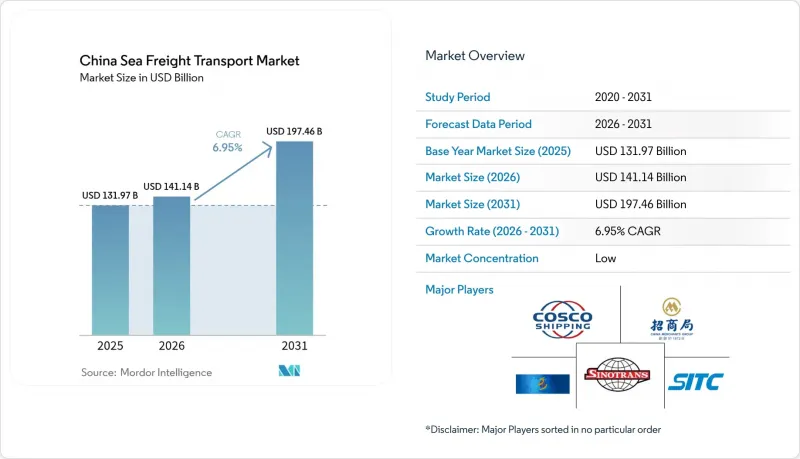
本報告按貨物類型(貨櫃貨物、散裝貨等)、終端用戶行業(製造業和工業設備、汽車、快速消費品和零售業(包括電子商務)、農業和食品等)以及貿易路線/目的地區域(亞洲內部、北美、歐洲、中東和非洲、南美、大洋洲)進行分類。市場預測以美元計價。
中國海運市場的趨勢與洞察
「一帶一路」計劃下海上絲綢之路基礎設施的發展,正在擴大海運出口貨物的數量。
在「海上絲路」框架下,中國持續加大港口投資,以大多數貿易夥伴難以承受的速度擴大貨運量,使托運人能夠以最小的摩擦重新規劃貨物運輸路線。拉丁美洲和東南亞新建的深水港樞紐縮短了先前服務不足航線的運輸時間,使出口商更容易實現出口產品多元化。中國港口營運商透過將股權與長期碼頭營運權結合,確保取得優先泊位使用權,從而保障貨運量承諾。這種一體化模式增強了其在貨運談判中的議價能力,隨著港口將保稅倉儲等輔助服務貨幣化,預計這一優勢將繼續保持。
跨境電子商務的快速成長正在推動中國貨櫃航運的發展。
跨境電商持續保持兩位數成長,其運輸模式也不斷變化,小批量貨物被集中裝入貨櫃,運往海外微型倉配中心。在自由貿易區的電商試點區域,簡化的海關手續和更短的前置作業時間,訂單海運成為以往空運貨物的可行選擇。各大平台正直接與船公司洽談年度服務契約,以確保最低貨運量,從而便於運力規劃。為了因應這一可預測的需求趨勢,船公司正將更多冷藏貨櫃和高箱貨櫃分配給暢銷的消費品領域,導致貨櫃船隊的專業化程度不斷提高。
2023 年新一輪造船熱潮過後,貨櫃船供應過剩,導致運費下降。
2024年達到高峰的積壓訂單如今隨著船舶陸續投入營運不斷擴大,且成長超過需求,對主要航線的現貨運價帶來下行壓力。航運公司採取策略性停運措施應對,但船舶的持續交付導致閒置運力不斷增加,尤其是在8000至12000標準箱級別的船舶。這種運力過剩迫使一些業者將運力重新分配到次要航線,即使在需求強勁的地區,這項策略也減緩了運價的復甦。一個意想不到的後果是,托運人在合約談判中獲得了更大的議價能力,促使他們以更低的基準運價爭取更長的合約期限。
細分市場分析
預計到2025年,貨櫃運輸將佔據中國海運市場43.55%的佔有率,這主要得益於中國龐大的製造業規模和蓬勃發展的電子商務出口。主要港口泊位的持續擴建將使24,000標準箱的船舶能夠不受潮汐限制地進港,從而增強托運人對船期可靠性的信心。在貨櫃市場內部,隨著藥品和生鮮食品出口商對溫控運輸環境的需求,冷藏貨櫃的需求正迅速超過一般貨櫃。這一轉變促使航運公司調整船隊配置,增加高功率發電機組的船舶,而這項投資正在提高每次航次的艙等利用率。
滾裝船(RoRo)貨物預計將以7.95%的複合年成長率成長,主要受汽車出口成長和新能源汽車運輸需求(需要專用汽車裝運船隻)的推動。這一成長動能正推動專業碼頭多層坡道的擴建,提高每小時的貨物處理量並減少泊位波動。乾散貨運輸仍然強勁,但成長主要集中在高品質礦石領域,以支持鋼鐵業的脫碳目標,這表明成長的重點在於品質而非數量。在液體散貨領域,強勁的液化天然氣(LNG)進口計畫支撐了對薄膜油輪的需求,提升了具備建造低溫船舶能力的船廠的戰略價值。
其他好處:
- Excel格式的市場預測(ME)表
- 3個月的分析師支持
目錄
第1章:引言
- 研究假設和市場定義
- 調查範圍
第2章:調查方法
第3章執行摘要
第4章 市場狀況
- 市場概覽
- 市場促進因素
- 「一帶一路」計劃海上絲綢之路沿線的基礎設施建設正在推動海外海運量的成長。
- 跨境電子商務的快速成長導致從中國開始的貨櫃貨運量增加。
- Delta和Delta的港口自動化以及超大型船舶泊位的擴建正在提高船舶處理能力。
- 液化天然氣和石化產品進口需求的成長,推動了專用油輪的使用量增加。
- 優質鐵礦石進口量的增加提高了好望角型散裝貨船的運轉率。
- 政府對綠色船舶和雙燃料船舶的激勵措施正在加速船隊的現代化進程。
- 市場限制因素
- 自 2023 年以來,由於新船建造熱潮,貨櫃船供應過剩,導致運費下降。
- 鐵路和管道運輸的興起正在減少煤炭和散裝貨物的海運量。
- 國際海事組織更嚴格的規定以及遵守中國排放法規成本的增加正在影響航空公司的利潤率。
- 地緣政治因素正在擾亂貿易,導致價格波動和需求不確定性。
- 價值供應鏈分析
- 監理展望
- 技術展望
- 波特五力模型
- 轉運貿易分析
- 貨櫃運輸與非貨櫃運輸分析
- 燃料庫服務和船用燃料的發展趨勢
- 投資趨勢及港口吞吐能力擴張
- 地緣政治事件對市場的影響
第5章 市場規模與成長預測
- 按貨物類型
- 貨櫃貨物
- 乾燥
- 冷藏貨物
- 乾散貨
- 液體散貨
- 普通貨物
- 滾裝/滾卸貨物
- 貨櫃貨物
- 按最終用途行業分類
- 製造和工業設備
- 車
- 快速消費品和零售(包括電子商務)
- 農業和食品
- 能源和採礦(煤炭、礦物和礦石)
- 化工/石油化工
- 藥品和醫療保健
- 其他
- 貿易路線/按目的地區域
- 亞洲內部
- 北美洲
- 歐洲
- 中東
- 非洲
- 南美洲
- 大洋洲
第6章 競爭情勢
- 市場集中度
- 市佔率分析
- 公司簡介
- COSCO Shipping Lines
- SINOTRANS Limited
- China Merchants Group
- SITC International Holdings Company Limited
- Hebei Ocean Shipping(HOSCO)
- Nanjing Ocean Shipping Co. Ltd.
- C&K Ocean Shipping Company
- Fujian Xiamen Shipping Co., Ltd.
- CTS China Hong Kong International Logistics Co., Ltd.
- China Shipping Tanker Company Limited
- Shandong Shipping Corporation
- CIMC Logistics(China International Marine Containers)
- Shanghai Jinjiang Shipping(Group)Co., Ltd.
- CHINALCO Shipping Corporation Ltd.
- PetroChina International Shipping Co.
- Maersk Line(China Operations)
- Mediterranean Shipping Company(MSC)-China Services
- CMA CGM(China)Shipping Co., Ltd.
- Evergreen Marine Corp.(China)Ltd.
- Ocean Network Express(ONE)-China
- Hapag-Lloyd(China)Ltd.
- Yang Ming Marine Transport Corp.(China)
- PIL(China)Holdings*
第7章 市場機會與未來展望
According to Mordor Intelligence, the China sea freight transport market size was valued at USD 131.97 billion in 2025 and estimated to grow from USD 141.14 billion in 2026 to reach USD 197.46 billion by 2031, at a CAGR of 6.95% during the forecast period (2026-2031).
This report is Segmented by Cargo Type (Containerised Cargo, Dry Bulk Cargo and More), End User Industry (Manufacturing & Industrial Equipment, Automotive, FMCG & Retail (incl. E-Commerce), Agriculture & Food Products, and More), Trade Lane/Destination Region (Intra-Asia, North America, Europe, Middle East, Africa, South America, Oceania). The Market Forecasts are Provided in Terms of Value (USD).
China Sea Freight Transport Market Trends and Insights
Belt & Road Maritime Silk Road Infrastructure Build-out Amplifying Outbound Sea Freight Volumes
China's sustained port investments under the Maritime Silk Road banner are adding throughput faster than most trading partners can absorb, enabling shippers to reroute cargo flows with minimal friction. Newly completed deep-water hubs in Latin America and Southeast Asia shorten transit times on previously underserved corridors, a shift that encourages exporters to diversify destination portfolios. By pairing equity stakes with long-term terminal concessions, Chinese operators ensure preferential berth windows that lock in volume commitments. This integrated approach strengthens bargaining power in freight-rate negotiations, an advantage that is likely to endure as ports monetise ancillary services such as bonded warehousing.
Cross-Border E-Commerce Boom Elevating China-Origin Containerized Shipments
Double-digit growth in cross-border online retail continues to reshape shipping patterns, pulling parcelised goods into consolidated container loads bound for micro-fulfilment centres overseas. Dedicated e-commerce pilot zones inside free-trade areas offer streamlined customs clearance, compressing order-to-ship lead times and making sea freight viable for categories once flown by air. Major platforms are now negotiating annual service contracts directly with carriers, guaranteeing baseline volumes that smooth capacity planning. This predictable demand profile is prompting liners to allocate more reefer and high-cube containers to fast-moving consumer segments, nudging equipment fleets toward greater specialisation.
Container Fleet Overcapacity Post-2023 Newbuild Wave Suppressing Freight Rates
The orderbook expansion that peaked in 2024 is now filtering into active service, outpacing incremental demand and placing downward pressure on spot rates across mainline routes. Carriers respond with strategic blank sailings, but persistent vessel deliveries continue to inflate idle capacity, especially in the 8 000-to-12 000 TEU band. This surplus is pushing some operators to reposition tonnage into secondary trades, a tactic that dampens rate recovery even where demand is firm. An unintended consequence is that shippers gain more leverage in contract talks, encouraging them to negotiate longer validity periods at lower base rates.
Other drivers and restraints analyzed in the detailed report include:
- Port Automation & Mega-Vessel Berth Expansion in Yangtze & Pearl River Deltas Enhancing Throughput Capacity
- Rising LNG & Petrochemical Import Demand Driving Specialized Tanker Traffic
- Rail & Pipeline Substitution Curtailing Seaborne Coal and Bulk Commodity Volumes
For complete list of drivers and restraints, kindly check the Table Of Contents.
Segment Analysis
The containerised segment commands a 43.55 % China Sea Freight Transport market share in 2025, a position anchored by the country's manufacturing scale and flourishing e-commerce exports. Continuous berth enhancements at flagship ports allow 24,000-TEU vessels to call without tidal restrictions, giving shippers confidence in schedule reliability. Within the container pool, demand for reefer boxes grows faster than dry units as pharmaceutical and fresh-produce exporters seek temperature-controlled integrity. This evolution nudges carriers to rebalance fleet mix toward higher-power generator sets, an investment that raises slot yields per voyage.
Roll-on/Roll-off cargo is expanding at a forecast CAGR of 7.95 %, fuelled by rising vehicle exports and new-energy-vehicle shipments that require purpose-built car carriers. The segment's momentum is prompting specialised terminals to add multistorey ramps, which increases hourly throughput and reduces berth time variance. Dry-bulk flows remain substantial, yet incremental gains concentrate in premium-grade ores that support steel decarbonisation targets, indicating a qualitative shift rather than pure volume growth. In liquid bulk, robust LNG import programmes sustain demand for membrane-type tankers, reinforcing the strategic value of shipyards capable of cryogenic construction.
Complete Report Scope:
- By Cargo Type
- Containerized Cargo
- Dry
- Reefer
- Dry Bulk Cargo
- Liquid Bulk Cargo
- General Cargo
- Roll-On/Roll-Off Cargo
- Containerized Cargo
- By End-Use Industry
- Manufacturing & Industrial Equipment
- Automotive
- FMCG & Retail (incl. E-commerce)
- Agriculture & Food Products
- Energy & Mining (Coal, Minerals & Ores)
- Chemicals & Petrochemicals
- Pharmaceutical & Healthcare
- Others
- By Trade Lane / Destination Region
- Intra-Asia
- North America
- Europe
- Middle East
- Africa
- South America
- Oceania
List of Companies Covered in this Report:
- COSCO Shipping Lines
- SINOTRANS Limited
- China Merchants Group
- SITC International Holdings Company Limited
- Hebei Ocean Shipping (HOSCO)
- Nanjing Ocean Shipping Co. Ltd.
- C&K Ocean Shipping Company
- Fujian Xiamen Shipping Co., Ltd.
- CTS China Hong Kong International Logistics Co., Ltd.
- China Shipping Tanker Company Limited
- Shandong Shipping Corporation
- CIMC Logistics (China International Marine Containers)
- Shanghai Jinjiang Shipping (Group) Co., Ltd.
- CHINALCO Shipping Corporation Ltd.
- PetroChina International Shipping Co.
- Maersk Line (China Operations)
- Mediterranean Shipping Company (MSC) - China Services
- CMA CGM (China) Shipping Co., Ltd.
- Evergreen Marine Corp. (China) Ltd.
- Ocean Network Express (ONE) - China
- Hapag-Lloyd (China) Ltd.
- Yang Ming Marine Transport Corp. (China)
- PIL (China) Holdings*
Additional Benefits:
- The market estimate (ME) sheet in Excel format
- 3 months of analyst support
TABLE OF CONTENTS
1 Introduction
- 1.1 Study Assumptions & Market Definition
- 1.2 Scope of the Study
2 Research Methodology
3 Executive Summary
4 Market Landscape
- 4.1 Market Overview
- 4.2 Market Drivers
- 4.2.1 Belt & Road Maritime Silk Road Infrastructure Build-out Amplifying Outbound Sea Freight Volumes
- 4.2.2 Cross-Border E-Commerce Boom Elevating China-Origin Containerized Shipments
- 4.2.3 Port Automation & Mega-Vessel Berth Expansion in Yangtze & Pearl River Deltas Enhancing Throughput Capacity
- 4.2.4 Rising LNG & Petrochemical Import Demand Driving Specialized Tanker Traffic
- 4.2.5 Increased High-Grade Iron Ore Imports Fueling Capesize Bulk Carrier Utilization
- 4.2.6 Government Incentives for Green & Dual-Fuel Vessels Accelerating Fleet Renewal
- 4.3 Market Restraints
- 4.3.1 Container Fleet Overcapacity Post-2023 Newbuild Wave Suppressing Freight Rates
- 4.3.2 Rail & Pipeline Substitution Curtailing Seaborne Coal and Bulk Commodity Volumes
- 4.3.3 Escalating IMO / China Emission Compliance Costs Impacting Operator Margins
- 4.3.4 Geopolitical Trade Disruptions Introducing Route Volatility & Demand Uncertainty
- 4.4 Value / Supply-Chain Analysis
- 4.5 Regulatory Outlook
- 4.6 Technological Outlook
- 4.7 Porter's Five Forces
- 4.7.1 Bargaining Power of Buyers
- 4.7.2 Bargaining Power of Suppliers
- 4.7.3 Threat of New Entrants
- 4.7.4 Threat of Substitutes
- 4.7.5 Competitive Rivalry
- 4.8 Transshipment Trade Analysis
- 4.9 Containerized vs Non-Containerized Shipment Insights
- 4.10 Bunkering Services & Marine Fuel Dynamics
- 4.11 Investment & Port Capacity Expansion Trends
- 4.12 Impact of Geo Political Events on the Market
5 Market Size & Growth Forecasts (Value)
- 5.1 By Cargo Type
- 5.1.1 Containerized Cargo
- 5.1.1.1 Dry
- 5.1.1.2 Reefer
- 5.1.2 Dry Bulk Cargo
- 5.1.3 Liquid Bulk Cargo
- 5.1.4 General Cargo
- 5.1.5 Roll-On/Roll-Off Cargo
- 5.1.1 Containerized Cargo
- 5.2 By End-Use Industry
- 5.2.1 Manufacturing & Industrial Equipment
- 5.2.2 Automotive
- 5.2.3 FMCG & Retail (incl. E-commerce)
- 5.2.4 Agriculture & Food Products
- 5.2.5 Energy & Mining (Coal, Minerals & Ores)
- 5.2.6 Chemicals & Petrochemicals
- 5.2.7 Pharmaceutical & Healthcare
- 5.2.8 Others
- 5.3 By Trade Lane / Destination Region
- 5.3.1 Intra-Asia
- 5.3.2 North America
- 5.3.3 Europe
- 5.3.4 Middle East
- 5.3.5 Africa
- 5.3.6 South America
- 5.3.7 Oceania
6 Competitive Landscape
- 6.1 Market Concentration
- 6.2 Market Share Analysis
- 6.3 Company Profiles (includes Global level Overview, Market level overview, Core Segments, Financials as available, Strategic Information, Market Rank/Share, Products & Services, Recent Developments)
- 6.3.1 COSCO Shipping Lines
- 6.3.2 SINOTRANS Limited
- 6.3.3 China Merchants Group
- 6.3.4 SITC International Holdings Company Limited
- 6.3.5 Hebei Ocean Shipping (HOSCO)
- 6.3.6 Nanjing Ocean Shipping Co. Ltd.
- 6.3.7 C&K Ocean Shipping Company
- 6.3.8 Fujian Xiamen Shipping Co., Ltd.
- 6.3.9 CTS China Hong Kong International Logistics Co., Ltd.
- 6.3.10 China Shipping Tanker Company Limited
- 6.3.11 Shandong Shipping Corporation
- 6.3.12 CIMC Logistics (China International Marine Containers)
- 6.3.13 Shanghai Jinjiang Shipping (Group) Co., Ltd.
- 6.3.14 CHINALCO Shipping Corporation Ltd.
- 6.3.15 PetroChina International Shipping Co.
- 6.3.16 Maersk Line (China Operations)
- 6.3.17 Mediterranean Shipping Company (MSC) - China Services
- 6.3.18 CMA CGM (China) Shipping Co., Ltd.
- 6.3.19 Evergreen Marine Corp. (China) Ltd.
- 6.3.20 Ocean Network Express (ONE) - China
- 6.3.21 Hapag-Lloyd (China) Ltd.
- 6.3.22 Yang Ming Marine Transport Corp. (China)
- 6.3.23 PIL (China) Holdings*
7 Market Opportunities & Future Outlook

 海運:市場佔有率分析、產業趨勢與統計、成長預測(2026-2031)
 生鮮產品海運市場規模、佔有率及成長分析:依運輸方式、貨物類型、溫區、貨櫃尺寸、服務類型、最終用戶及地區分類-2026-2033年產業預測新加坡海運:市場佔有率分析、行業趨勢和統計數據以及成長預測(2026-2031 年)中國海運貨運代理:市場佔有率分析、產業趨勢與統計及成長預測(2026-2031年)美國海運貨運代理:市場佔有率分析、產業趨勢與統計及成長預測(2026-2031)
 貨運代理市場規模:按類型、服務、產業和地區分類(2026-2034 年)
 2026年全球海運市場報告2026年全球生鮮產品海運市場報告海運貨運代理:市場佔有率分析、產業趨勢與統計、成長預測(2026-2031)
 海運市場規模、佔有率及成長分析(依貨物類型、船舶類型、最終用途及地區分類)-2026-2033年產業預測