


 |
市場調查報告書
商品編碼
2100729
中東和非洲特種肥料市場:市場佔有率分析、行業趨勢和統計數據以及成長預測(2026-2031 年)Middle East and Africa Specialty Fertilizer - Market Share Analysis, Industry Trends & Statistics, Growth Forecasts (2026 - 2031) |
||||||

※ 本網頁內容可能與最新版本有所差異。詳細情況請與我們聯繫。
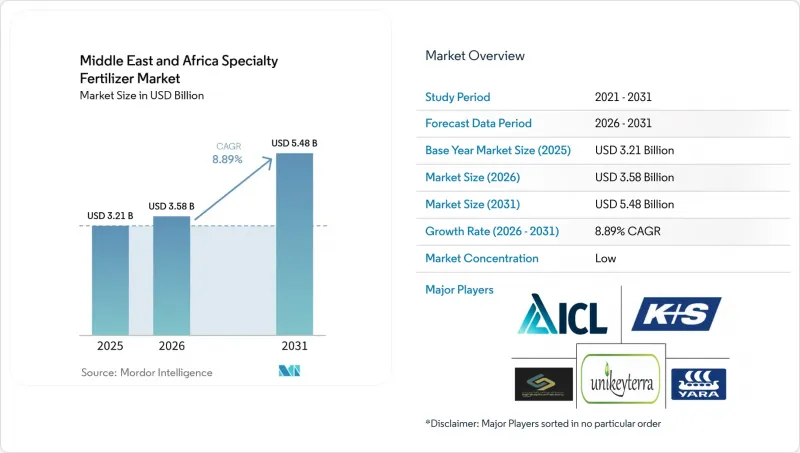
根據 Mordor Intelligence 預測,中東和非洲的特殊肥料市場規模將從 2025 年的 32.1 億美元成長到 2026 年的 35.8 億美元,到 2031 年將達到 54.8 億美元,2026 年至 2031 年的複合年成長率預計為 8.89%預計為 8.89%。
本報告按特種肥料類型(包膜性肥料、緩釋肥料、液體肥料等)、施用方法(土壤施用、葉面噴布等)、作物類型(田間作物、園藝作物等)和地區(南非、奈及利亞、沙烏地阿拉伯等)進行細分。市場預測以貨幣值和數量值兩種形式呈現。
中東和非洲特種肥料市場趨勢與洞察
保護性耕作面積快速成長
在沙烏地阿拉伯,受「2030願景」中高價值農產品自給自足目標的推動,2022年至2024年間,保護性種植面積增加了35%。這些設施依賴水溶性和液態肥料,可透過自動化系統精確控制養分比例,從而帶動了對優質肥料需求的激增。南非西開普省的溫室集群也呈現類似的趨勢,自2023年以來,這些設施的特種肥料消耗量以每年40%的速度成長。生產者正利用最佳施肥時間來最大限度地提高平方公尺產量,這不僅為肥料的溢價提供了依據,也推動了包膜性肥料和螯合微量元素混合物的持續應用。
政府糧食安全計劃
沙烏地阿拉伯已撥款200億美元用於農業轉型舉措,該計劃結合了補貼、技術轉移和引進特種肥料,旨在提升國內農產品附加價值,確保糧食供應。埃及的國家糧食安全戰略和奈及利亞的農業轉型議程也推出了類似的獎勵,通常將投入品支持與在地採購協議掛鉤。摩洛哥正透過將其磷酸鹽資源整合到下游價值鏈中,以支持出口導向型特殊肥料的生產,從而增強區域供應韌性並吸引私營部門資本。
特殊原物料價格波動
受石化供應鏈中斷的影響,用於包膜性肥料的關鍵材料——聚合物包衣的價格在2024年上漲了45%,給生產商的利潤率帶來了壓力。由於礦業重組和地緣政治限制,硫酸鋅和螯合鐵的成本也呈現類似的上漲趨勢,迫使生產商採取彈性價格設定條款並對沖庫存風險。擁有自有硫酸和氨生產能力的垂直整合型大型磷酸鹽生產商,即使在價格劇烈波動時期也保持了競爭優勢。
細分市場分析
預計到2025年,液態肥料將佔中東和非洲特種肥料市場規模的44.6%。這主要歸功於液態肥料能夠與滴灌和噴灌施肥系統無縫銜接,而這些系統在現代農場中被廣泛應用。與顆粒狀肥料相比,液態肥料具有養分吸收更快、分佈更均勻、減少人工成本等優點,深受生產者的青睞。包膜性肥料因其聚合物包膜的特性,預計在2026年至2031年間以9.3%的複合年成長率成長,成為成長最快的細分市場。這主要得益於能夠耐受該地區高溫的聚合物技術的創新。這些產品透過減少施肥頻率和節約用水,符合永續性的要求。如果目前的市場普及率持續下去,預計到2031年,包膜性肥料規模將超過21.2億美元。
液態肥料混合物包括均衡的氮磷鉀複合肥、硝酸鈣混合物以及專為溫室蔬菜、花卉和水耕系統配製的微量元素螯合劑。在夏季高峰期,液態肥料的需求量激增,因為它們可以防止鹽分沉澱堵塞發送器。製造商也會將生物促效劑和酸化劑組合使用,以區分其產品。同時,種植椰棗、柑橘類水果和大型小麥田的種植者青睞聚合物包衣尿素和聚合物硫包衣氮磷鉀複合肥,因為它們可以將每週追肥減少到只需兩到三次季節性施肥。 ICL集團的溫度反應型包衣技術能夠滿足乾旱地區的需求,與傳統技術相比,在40°C下可將養分釋放速率降低25%。預計供應商將在五年內推出木質素和多醣體衍生的可生物分解包衣,但仍在考慮其價格競爭力。
其他好處:
- Excel格式的市場預測(ME)表
- 3個月的分析師支持
目錄
第1章:引言
- 研究假設和市場定義
- 調查範圍
- 調查方法
第2章:本報告的內容
第3章執行摘要
第4章:主要產業趨勢
- 主要農作物種植面積
- 田間作物
- 園藝作物
- 平均施肥量
- 微量營養素
- 田間作物
- 園藝作物
- 主要營養素
- 田間作物
- 園藝作物
- 次要大量營養元素
- 田間作物
- 園藝作物
- 微量營養素
- 配備灌溉設施的農田
- 法律規範
- 價值鍊和通路分析
- 市場促進因素
- 保護性耕作面積快速成長
- 政府糧食安全計劃
- 擴大施肥和灌溉系統
- 海水淡化營養供應試點項目
- 精準施肥的排碳權獎勵
- 在可控環境下快速擴大棗椰種植
- 市場限制因素
- 特殊原物料價格波動
- 撒哈拉以南非洲地區缺乏銷售代理商網路
- 乾旱土壤中鹽分累積的風險
- 奈米營養素註冊方面的監管延誤
第5章 市場規模與成長預測
- 按類型分類的專用肥料
- 包膜性肥料(CRF)
- 聚合物塗層
- 聚合物和硫塗層
- 其他
- 緩效性肥料(SRF)
- 液體肥料
- 水溶性肥料
- 包膜性肥料(CRF)
- 透過應用方法
- 土壤施用
- 葉面噴布
- 施肥和灌溉
- 按作物類型
- 田間作物
- 園藝作物
- 草坪和觀賞植物
- 按地區
- 南非
- 奈及利亞
- 沙烏地阿拉伯
- 土耳其
- 其他中東和非洲國家
第6章 競爭情勢
- 市場集中度
- 策略趨勢
- 市佔率分析
- 公司簡介
- Yara International ASA
- ICL Group Ltd
- K+S Aktiengesellschaft
- The Mosaic Company
- Nutrien Ltd
- Haifa Group
- EuroChem Group AG
- Saudi Basic Industries Corporation(SABIC)
- OCI Global
- OCP Group
- SQM
- Grupa Azoty SA
- Arab Potash Company
- Ma'aden Phosphate Company
- Valagro SpA
第7章:特種肥料公司執行長面臨的關鍵策略挑戰
According to Mordor Intelligence, the Middle East and Africa specialty fertilizer market size is projected to grow from USD 3.21 billion in 2025 to USD 3.58 billion in 2026 and is forecast to reach USD 5.48 billion by 2031, registering a CAGR of 8.89% during 2026-2031.
This report is Segmented by Specialty Type (Controlled-Release Fertilizer, Slow-Release Fertilizer, Liquid Fertilizer, and More), Application Mode (Soil, Foliar, and More), Crop Type (Field Crops, Horticultural Crops, and More), and Geography (South Africa, Nigeria, Saudi Arabia, and More). The Market Forecasts are Provided in Terms of Value (USD) and Volume (Metric Tons).
Middle East and Africa Specialty Fertilizer Market Trends and Insights
Surge in Protected Cultivation Acreage
Protected cultivation acreage in Saudi Arabia increased 35% between 2022 and 2024 as Vision 2030 targets self-sufficiency in high-value produce. These facilities depend on water-soluble and liquid grades that deliver precise nutrient ratios through automated systems, sharply raising premium fertilizer demand. South Africa mirrors this pattern in Western Cape greenhouse clusters, where specialty fertilizer consumption in such structures jumped 40% per year since 2023. Growers leverage optimal nutrient timing to maximize output per square meter, making price premiums viable and supporting continual uptake of controlled-release and chelated micronutrient blends.
Government Food-Security Programs
Saudi Arabia earmarked USD 20 billion for agricultural transformation initiatives that bundle subsidies, technology transfer, and specialty fertilizer adoption, reinforcing domestic value addition to safeguard food supply. Egypt's National Food Security Strategy and Nigeria's Agricultural Transformation Agenda introduce similar incentives, often tying input support to local content agreements. Morocco integrates its phosphate endowment into a downstream value chain that backs export-oriented specialty grades, strengthening regional supply resilience and attracting private-sector capital.
Price Volatility of Specialty Raw Materials
Polymer coatings essential for controlled-release fertilizers rose 45% in 2024 amid petrochemical supply disruptions, squeezing producer margins. Zinc sulfate and iron chelate costs followed similar trajectories due to mining consolidation and geopolitical constraints, forcing manufacturers to adopt flexible pricing clauses and hedge inventory exposure. Vertically integrated phosphate majors holding internal sulfuric acid and ammonia capacity maintain a competitive edge during volatile periods.
Other drivers and restraints analyzed in the detailed report include:
- Rising Adoption of Fertigation Systems
- Desalination-Linked Nutrient Delivery Pilots
- Limited Distributor Networks in Sub-Saharan Africa
For complete list of drivers and restraints, kindly check the Table Of Contents.
Segment Analysis
Liquid fertilizers account for 44.6% of the Middle East and Africa specialty fertilizer market size in 2025 because it integrates seamlessly with drip and sprinkler delivery hardware prevalent in modern farms. Growers appreciate quick nutrient uptake, uniform distribution, and reduced labor relative to granular products. Polymer-coated controlled-release fertilizers are projected to be the fastest-growing segment, with a forecast CAGR of 9.3% from 2026 to 2031, driven by polymer innovations that withstand high regional temperatures. These products cut application frequency and conserve water, benefits aligned with sustainability mandates. The specialty fertilizer market for controlled-release variants is on track to surpass USD 2.12 billion by 2031 if current adoption rates continue.
Liquid blends span balanced NPK solutions, calcium nitrate mixes, and trace-element chelates tailored to greenhouse vegetables, floriculture, and hydroponics. Demand surges during peak summer because liquids avoid salt precipitation that clogs emitters. Manufacturers also bundle biostimulants and acidifiers to differentiate offerings. Conversely, polymer-coated urea and polymer-sulfur-coated NPK products appeal to date palm, citrus, and broad-acre wheat growers by cutting weekly top-dressings to two or three seasonal applications. ICL Group's temperature-responsive coatings show 25% slower nutrient release at 40 °C versus legacy technology, meeting arid-zone needs. Suppliers anticipate integrating biodegradable coatings derived from lignin and polysaccharides within five years, though price competitiveness remains under review.
Complete Report Scope:
- By Specialty Type
- Controlled-Release Fertilizer (CRF)
- Polymer-Coated
- Polymer Sulfur-Coated
- Others
- Slow-Release Fertilizer (SRF)
- Liquid Fertilizer
- Water-Soluble Fertilizer
- Controlled-Release Fertilizer (CRF)
- By Application Mode
- Soil
- Foliar
- Fertigation
- By Crop Type
- Field Crops
- Horticultural Crops
- Turf and Ornamental
- By Geography
- South Africa
- Nigeria
- Saudi Arabia
- Turkey
- Rest of Middle East and Africa
List of Companies Covered in this Report:
- Yara International ASA
- ICL Group Ltd
- K+S Aktiengesellschaft
- The Mosaic Company
- Nutrien Ltd
- Haifa Group
- EuroChem Group AG
- Saudi Basic Industries Corporation (SABIC)
- OCI Global
- OCP Group
- SQM
- Grupa Azoty S.A.
- Arab Potash Company
- Ma'aden Phosphate Company
- Valagro S.p.A.
Additional Benefits:
- The market estimate (ME) sheet in Excel format
- 3 months of analyst support
TABLE OF CONTENTS
1 Introduction
- 1.1 Study Assumptions and Market Definition
- 1.2 Scope of the Study
- 1.3 Research Methodology
2 Report Offers
3 Executive Summary
4 Key Industry Trends
- 4.1 Acreage Of Major Crop Types
- 4.1.1 Field Crops
- 4.1.2 Horticultural Crops
- 4.2 Average Nutrient Application Rates
- 4.2.1 Micronutrients
- 4.2.1.1 Field Crops
- 4.2.1.2 Horticultural Crops
- 4.2.2 Primary Nutrients
- 4.2.2.1 Field Crops
- 4.2.2.2 Horticultural Crops
- 4.2.3 Secondary Macronutrients
- 4.2.3.1 Field Crops
- 4.2.3.2 Horticultural Crops
- 4.2.1 Micronutrients
- 4.3 Agricultural Land Equipped For Irrigation
- 4.4 Regulatory Framework
- 4.5 Value Chain & Distribution Channel Analysis
- 4.6 Market Drivers
- 4.6.1 Surge in protected cultivation acreage
- 4.6.2 Government food-security programs
- 4.6.3 Rising adoption of fertigation systems
- 4.6.4 Desalination-linked nutrient delivery pilots
- 4.6.5 Carbon-credit incentives for precision fertilization
- 4.6.6 Rapid expansion of controlled-environment date farming
- 4.7 Market Restraints
- 4.7.1 Price volatility of specialty raw materials
- 4.7.2 Limited distributor networks in Sub-Saharan Africa
- 4.7.3 Salinity build-up risks in arid soils
- 4.7.4 Regulatory delays on nano-nutrient registration
5 Market Size and Growth Forecasts (Value and Volume)
- 5.1 By Specialty Type
- 5.1.1 Controlled-Release Fertilizer (CRF)
- 5.1.1.1 Polymer-Coated
- 5.1.1.2 Polymer Sulfur-Coated
- 5.1.1.3 Others
- 5.1.2 Slow-Release Fertilizer (SRF)
- 5.1.3 Liquid Fertilizer
- 5.1.4 Water-Soluble Fertilizer
- 5.1.1 Controlled-Release Fertilizer (CRF)
- 5.2 By Application Mode
- 5.2.1 Soil
- 5.2.2 Foliar
- 5.2.3 Fertigation
- 5.3 By Crop Type
- 5.3.1 Field Crops
- 5.3.2 Horticultural Crops
- 5.3.3 Turf and Ornamental
- 5.4 By Geography
- 5.4.1 South Africa
- 5.4.2 Nigeria
- 5.4.3 Saudi Arabia
- 5.4.4 Turkey
- 5.4.5 Rest of Middle East and Africa
6 Competitive Landscape
- 6.1 Market Concentration
- 6.2 Strategic Moves
- 6.3 Market Share Analysis
- 6.4 Company Profiles (Includes Global Level Overview, Market Level Overview, Core Segments, Financials as Available, Strategic Information, Market Rank/Share, Products and Services, Recent Developments)
- 6.4.1 Yara International ASA
- 6.4.2 ICL Group Ltd
- 6.4.3 K+S Aktiengesellschaft
- 6.4.4 The Mosaic Company
- 6.4.5 Nutrien Ltd
- 6.4.6 Haifa Group
- 6.4.7 EuroChem Group AG
- 6.4.8 Saudi Basic Industries Corporation (SABIC)
- 6.4.9 OCI Global
- 6.4.10 OCP Group
- 6.4.11 SQM
- 6.4.12 Grupa Azoty S.A.
- 6.4.13 Arab Potash Company
- 6.4.14 Ma'aden Phosphate Company
- 6.4.15 Valagro S.p.A.
7 Key Strategic Questions For Specialty Fertilizer CEOS

 晶體肥料市場-2026-2032年全球市場預測特種肥料市場-2026-2032年全球市場預測
 特種肥料市場:商機、成長要素、產業趨勢分析及2026-2035年預測
 全球特種肥料市場(至2031年):依技術(緩釋肥料、微量元素肥料、水溶性肥料)、形態(乾粉、液體)、施用方法、類型、作物和地區分類的預測
 北美特種肥料市場:市場佔有率分析、產業趨勢與統計及成長預測(2026-2031 年)印度特種肥料市場:市場佔有率分析、產業趨勢與統計及成長預測(2026-2031)歐洲特種肥料:市場佔有率分析、產業趨勢與統計及成長預測(2026-2031 年)非洲特種肥料:市場佔有率分析、產業趨勢與統計及成長預測(2026-2031 年)中國特種肥料市場:市場佔有率分析、產業趨勢與統計及成長預測(2026-2031年)美國特種肥料:市場佔有率分析、行業趨勢和統計數據、成長預測(2026-2031 年)