


 |
市場調查報告書
商品編碼
2100724
印度特種肥料市場:市場佔有率分析、產業趨勢與統計及成長預測(2026-2031)India Specialty Fertilizers - Market Share Analysis, Industry Trends & Statistics, Growth Forecasts (2026 - 2031) |
||||||

※ 本網頁內容可能與最新版本有所差異。詳細情況請與我們聯繫。
據 Mordor Intelligence 稱,印度特種肥料市場在 2025 年的估值為 6.1 億美元,預計到 2026 年將達到 6.6 億美元。
預計在 2026 年至 2031 年的預測期內,其複合年成長率將達到 7.36%。
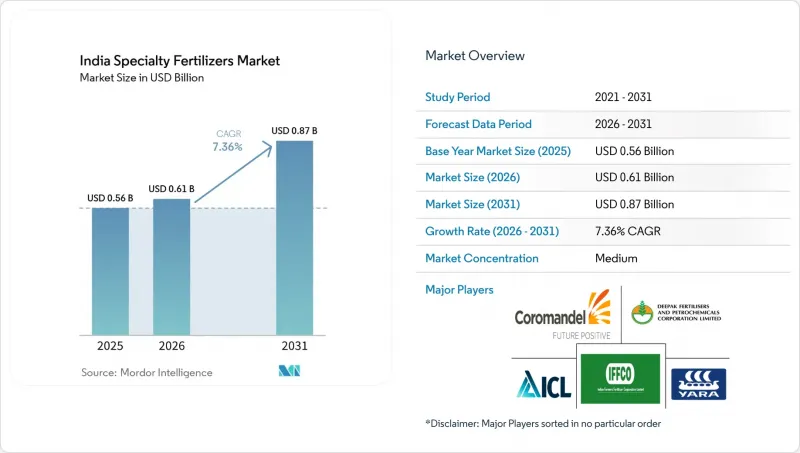
本報告依特殊肥料類型(控釋肥、液體肥料、緩釋肥、水溶性肥料)、施用方法(灌溉施肥、葉面噴布、土壤施用)和作物類型(田間作物、園藝作物、草坪和觀賞植物)進行分類。市場預測以貨幣值和銷售兩種形式呈現。
印度特種肥料市場趨勢與洞察
對高營養利用率產品補貼計畫的審查
總理農業改良計畫(PM-PRANAM)允許各邦將50%的補貼削減額用於發展高效利用養分的基礎設施,預計到2023-24年度,傳統化肥的使用量將減少15.14公噸。目前,資金正轉向奈米尿素、水溶性肥料和緩釋肥料等產品,這些產品正在提高主要小麥和水稻產區的養分回收率。此前,這些地區的化肥施用量過高,超出農藝標準高達30%。大型合作社正在銷售奈米尿素與傳統混合肥料的組合產品,使農民能夠在繼續使用熟悉的肥料的同時,獲得基於績效的獎勵。一項由2481卡羅爾印度盧比(約2.99億美元)支持的國家自然農業計劃,正在推動對符合額外邦級補貼條件的有機-無機混合肥料的需求。旁遮普邦和哈里亞納邦的早期採用者報告稱,每公頃成本降低了10-15%,證明了該政策的合理性。新的補貼方案注重的是有效性而非用量,從而擴大了印度特種肥料市場的高階價格區間。
採用微灌技術的種植面積以及向施肥灌溉系統的快速維修。
在總理農業灌溉計畫(Pradhan Mantri Krishi Sinchayee Yojana)的領導下,政府投入21,968.75卡羅爾(約26.5億美元)用於微灌,到2024年3月,微灌面積已擴大至95.58拉克公頃。液態和全可溶性NPK複合肥料可與滴灌和噴灌系統無縫銜接,實現根據作物生長階段進行分段施肥。在馬哈拉斯特拉邦和古吉拉突邦,政府承擔小規模農戶灌溉設備投資成本的75%,加速了對液態肥料的需求。為了滿足這一特定基本客群的需求,科羅曼德國際公司已將其位於卡基納達工廠的水溶性肥料產能提高了30%。在拉賈斯坦邦和卡納塔克邦,正在進行維修,將施肥和灌溉模組引入洪氾區農田,這將緩解地下水短缺,並將設備的使用壽命延長至 15-20 年,確保在整個資產週期內消耗特種肥料。
進口MOP和MAP價格波動
2024年,印度進口了440萬噸氯化鉀。由於白俄羅斯和俄羅斯的供應緊張,價格在每噸350至480美元之間波動。磷酸一銨的平均價格為每噸520至680美元,由於營養補貼每季調整,經銷商的利潤空間受到擠壓。沿海市場比內陸尿素中心更容易受到價格波動的影響。鉀資源的匱乏加劇了這種風險,而將貨源轉向加拿大和以色列則需要每噸支付30至50美元的額外運費。
細分市場分析
2025年,液態肥料佔印度特種肥料市場的47.9%。這主要得益於該國灌溉計劃下滴灌和噴水灌溉的快速擴張。此外,由於國產生物聚合物成本的降低以及碳權市場中永續養分供應的價值,預計到2031年,包膜性肥料(CRF)的複合年成長率將達到11.6%。
基於尿素和甲醛化學的緩釋肥料產品因甲醛滲漏問題而受到嚴格的監管審查,導致市場轉向亞甲基脲配方。水溶性肥料在溫室葡萄和鮮切花種植區的需求不斷成長。根據《肥料控制法》,聚合物包膜尿素已獲得暫時批准,有效期至2025年6月,允許在建立永久性檢測程序之前擴大生產規模。在中央邦的主要油籽產區,硫磺和聚合物包膜滿足了兩種營養素的需求。茶葉和咖啡種植園正在試驗使用國產澱粉和木質素包膜,以解決微塑膠問題,並響應國家減少一次性塑膠製品的號召。在尿素生產設施附近運作專用液體肥料生產線的合作工廠正在確保轉化利潤,從而強化了特種肥料市場的結構,該市場呈現出兩條並行發展路徑並存的局面。
其他好處:
- Excel格式的市場預測(ME)表
- 3個月的分析師支持
目錄
第1章:引言
- 研究假設和市場定義
- 調查範圍
- 調查方法
第2章:本報告的內容
第3章:執行摘要和主要發現
第4章:主要產業趨勢
- 主要農作物種植面積
- 田間作物
- 園藝作物
- 平均施肥量
- 微量營養素
- 田間作物
- 園藝作物
- 主要營養素
- 田間作物
- 園藝作物
- 次要大量營養元素
- 田間作物
- 園藝作物
- 微量營養素
- 配備灌溉設施的農田
- 法律規範
- 價值鍊和通路分析
- 市場促進因素
- 對高營養利用率產品補貼的審查
- 微灌實施面積迅速增加,並維修化學肥料灌溉。
- 東部省份的作物多樣化計劃
- 農業技術土壤感測器產業的合作夥伴關係
- 高效能肥料排碳權溢價
- 國內生物聚合物塗層技術可降低成本
- 市場限制因素
- 進口MOP和MAP價格波動
- FCO對新添加劑的註冊有所延遲。
- 缺乏可靠的產量數據導致小規模農戶產生負面態度。
- 內陸配送中心液體散貨物流面臨的挑戰
第5章 市場區隔
- 按類型分類的專用肥料
- CRF
- 聚合物塗層
- 聚合物和硫塗層
- 其他
- 液體肥料
- SRF
- 水溶性肥料
- CRF
- 透過應用方法
- 施肥和灌溉
- 葉面噴布
- 土壤施用
- 作物類型
- 田間作物
- 園藝作物
- 草坪和觀賞植物
第6章 競爭情勢
- 關鍵策略趨勢
- 市佔率分析
- 企業狀況
- 公司簡介。
- Indian Farmers Fertiliser Cooperative Limited
- Coromandel International Limited
- Deepak Fertilizers and Petrochemicals Corporation Limited
- Yara International ASA
- ICL Group Ltd.
- Chambal Fertilizers and Chemicals Limited
- Mangalore Chemicals and Fertilizers Limited
- Grupa Azoty SA(Compo Expert)
- Sociedad Quimica y Minera de Chile SA
- Nutrien Ltd.
- K+S Aktiengesellschaft
- Gujarat State Fertilizers and Chemicals Limited
- Rashtriya Chemicals and Fertilizers Limited
- Tata Chemicals Limited
- EuroChem Group AG
第7章 化肥產業執行長面臨的關鍵策略挑戰
Liquid fertilizers accounted for 47.9% of the India specialty fertilizers market size in 2025, driven by the rapid expansion of drip and sprinkler acreage under national irrigation programs. Controlled-release grades are forecast to grow at a 11.6% CAGR through 2031 as domestic bio-polymers lower costs and carbon-credit markets reward longer nutrient availability.
According to Mordor Intelligence, the India specialty fertilizers market size is estimated at USD 0.61 billion in 2025 and is projected to reach USD 0.66 billion in 2026. This report is Segmented by Speciality Type (CRF, Liquid Fertilizer, SRF, and Water Soluble), by Application Mode (Fertigation, Foliar, and Soil), and by Crop Type (Field Crops, Horticultural Crops, and Turf and Ornamental). The Market Forecasts are Provided in Terms of Value (USD) and Volume (Metric Tons).
India Specialty Fertilizers Market Trends and Insights
Subsidy Realignment Toward Nutrient Use Efficiency Products
The PM-PRANAM scheme enables states to retain 50% of the subsidy savings for nutrient-efficient infrastructure, resulting in a 15.14 lakh metric ton reduction in conventional fertilizer use during 2023-24 . Funds are now shifting toward nano-urea, water-soluble, and controlled-release grades that enhance nutrient recovery in wheat and rice belts, where over-application once exceeded agronomic norms by up to 30%. Cooperative majors bundle nano-urea with traditional blends, ensuring farmer familiarity while accessing performance-linked incentives. The National Mission on Natural Farming, backed by INR 2,481 crore (approximately USD 299 million), increases demand for organic-mineral hybrids that qualify for additional state credits. Early adopters in Punjab and Haryana report per-hectare cost savings of 10-15%, validating the policy's premise. The new subsidy logic rewards efficacy rather than volume and widens premium pricing corridors for the India specialty fertilizer market.
Surge in Micro-Irrigation Acreage and Fertigation Retrofits
Government outlays of INR 21,968.75 crore (approximately USD 2.65 billion) under the Pradhan Mantri Krishi Sinchayee Yojana expanded micro-irrigation to 95.58 lakh hectares by March 2024 . Liquid and fully soluble NPK blends integrate seamlessly with drip and sprinkler systems, enabling split dosing that aligns with crop phenology. Maharashtra and Gujarat cover up to 75% of irrigation capital costs for smallholders, accelerating liquid demand. Coromandel International expanded water-soluble capacity by 30% at Kakinada to service this captive base. Retrofitting flood fields with fertigation modules in Rajasthan and Karnataka addresses groundwater stress and prolongs equipment life to 15-20 years, effectively locking in specialty fertilizer consumption over the asset cycle.
Volatility in Imported MOP and MAP Prices
India imported 4.4 million metric tons of muriate of potash in 2024, at values ranging from USD 350 to USD 480 per metric ton, as the supply from Belarus and Russia tightened . Mono-ammonium phosphate averaged USD 520-680, eroding distributor margins because Nutrient-Based Subsidy reimbursements adjust quarterly. Coastal markets tend to experience sharper shocks than inland urea hubs. A lack of a potash reserve amplifies exposure, while diversification toward Canada and Israel incurs freight premiums of USD 30-50 per metric ton.
Other drivers and restraints analyzed in the detailed report include:
- Crop Diversification Programs in Eastern States
- Industry Partnerships with Ag-Tech Soil Sensors
- Slow Registration of Novel Additives by FCO
For complete list of drivers and restraints, kindly check the Table Of Contents.
Segment Analysis
Slow-release products that rely on urea-formaldehyde chemistries face regulatory scrutiny due to formaldehyde leaching, prompting a shift toward methylene urea formulations. Water-soluble grades thrive in greenhouse belts for grapes and cut flowers.Polymer-coated urea has received provisional clearance under the Fertilizer Control Order until June 2025, allowing for scale-up while permanent testing protocols are being developed. Sulfur-polymer shells meet dual nutrient needs in oilseed heartlands of Madhya Pradesh. Indigenous starch-lignin coatings pilot in tea and coffee estates, addressing microplastic concerns and aligning with national efforts to curb single-use plastics. Cooperative plants running captive liquid lines near urea units lock in conversion margins, reinforcing a two-track specialty landscape.
Complete Report Scope:
- Speciality Type
- CRF
- Polymer Coated
- Polymer-Sulfur Coated
- Others
- Liquid Fertilizer
- SRF
- Water Soluble
- CRF
- Application Mode
- Fertigation
- Foliar
- Soil
- Crop Type
- Field Crops
- Horticultural Crops
- Turf and Ornamental
List of Companies Covered in this Report:
- Indian Farmers Fertiliser Cooperative Limited
- Coromandel International Limited
- Deepak Fertilizers and Petrochemicals Corporation Limited
- Yara International ASA
- ICL Group Ltd.
- Chambal Fertilizers and Chemicals Limited
- Mangalore Chemicals and Fertilizers Limited
- Grupa Azoty S.A. (Compo Expert)
- Sociedad Quimica y Minera de Chile S.A.
- Nutrien Ltd.
- K+S Aktiengesellschaft
- Gujarat State Fertilizers and Chemicals Limited
- Rashtriya Chemicals and Fertilizers Limited
- Tata Chemicals Limited
- EuroChem Group AG
Additional Benefits:
- The market estimate (ME) sheet in Excel format
- 3 months of analyst support
TABLE OF CONTENTS
1 INTRODUCTION
- 1.1 Study Assumptions and Market Definition
- 1.2 Scope of the Study
- 1.3 Research Methodology
2 REPORT OFFERS
3 EXECUTIVE SUMMARY AND KEY FINDINGS
4 KEY INDUSTRY TRENDS
- 4.1 Acreage of Major Crop Types
- 4.1.1 Field Crops
- 4.1.2 Horticultural Crops
- 4.2 Average Nutrient Application Rates
- 4.2.1 Micronutrients
- 4.2.1.1 Field Crops
- 4.2.1.2 Horticultural Crops
- 4.2.2 Primary Nutrients
- 4.2.2.1 Field Crops
- 4.2.2.2 Horticultural Crops
- 4.2.3 Secondary Macronutrients
- 4.2.3.1 Field Crops
- 4.2.3.2 Horticultural Crops
- 4.2.1 Micronutrients
- 4.3 Agricultural Land Equipped For Irrigation
- 4.4 Regulatory Framework
- 4.5 Value Chain and Distribution Channel Analysis
- 4.6 Market Drivers
- 4.6.1 Subsidy realignment toward nutrient-use-efficiency products
- 4.6.2 Surge in micro-irrigation acreage and fertigation retrofits
- 4.6.3 Crop diversification programs in eastern states
- 4.6.4 Industry partnerships with ag-tech soil sensors
- 4.6.5 Carbon-credit premiums for enhanced-efficiency fertilizers
- 4.6.6 Indigenous bio-polymer coating technology lowering cost
- 4.7 Market Restraints
- 4.7.1 Volatility in imported MOP and MAP prices
- 4.7.2 Slow registration of novel additives by FCO
- 4.7.3 Smallholder reluctance without proven yield data
- 4.7.4 Liquid bulk logistics gaps at inland depots
5 MARKET SEGMENTATION (VALUE AND VOLUME)
- 5.1 Speciality Type
- 5.1.1 CRF
- 5.1.1.1 Polymer Coated
- 5.1.1.2 Polymer-Sulfur Coated
- 5.1.1.3 Others
- 5.1.2 Liquid Fertilizer
- 5.1.3 SRF
- 5.1.4 Water Soluble
- 5.1.1 CRF
- 5.2 Application Mode
- 5.2.1 Fertigation
- 5.2.2 Foliar
- 5.2.3 Soil
- 5.3 Crop Type
- 5.3.1 Field Crops
- 5.3.2 Horticultural Crops
- 5.3.3 Turf and Ornamental
6 COMPETITIVE LANDSCAPE
- 6.1 Key Strategic Moves
- 6.2 Market Share Analysis
- 6.3 Company Landscape
- 6.4 Company Profiles (Includes Global Level Overview, Market Level Overview, Core Business Segments, Financials, Headcount, Key Information, Market Rank, Market Share, Products and Services, and Analysis of Recent Developments).
- 6.4.1 Indian Farmers Fertiliser Cooperative Limited
- 6.4.2 Coromandel International Limited
- 6.4.3 Deepak Fertilizers and Petrochemicals Corporation Limited
- 6.4.4 Yara International ASA
- 6.4.5 ICL Group Ltd.
- 6.4.6 Chambal Fertilizers and Chemicals Limited
- 6.4.7 Mangalore Chemicals and Fertilizers Limited
- 6.4.8 Grupa Azoty S.A. (Compo Expert)
- 6.4.9 Sociedad Quimica y Minera de Chile S.A.
- 6.4.10 Nutrien Ltd.
- 6.4.11 K+S Aktiengesellschaft
- 6.4.12 Gujarat State Fertilizers and Chemicals Limited
- 6.4.13 Rashtriya Chemicals and Fertilizers Limited
- 6.4.14 Tata Chemicals Limited
- 6.4.15 EuroChem Group AG
7 KEY STRATEGIC QUESTIONS FOR FERTILIZER CEOS

 晶體肥料市場-2026-2032年全球市場預測特種肥料市場-2026-2032年全球市場預測
 特種肥料市場:商機、成長要素、產業趨勢分析及2026-2035年預測
 全球特種肥料市場(至2031年):依技術(緩釋肥料、微量元素肥料、水溶性肥料)、形態(乾粉、液體)、施用方法、類型、作物和地區分類的預測
 北美特種肥料市場:市場佔有率分析、產業趨勢與統計及成長預測(2026-2031 年)歐洲特種肥料:市場佔有率分析、產業趨勢與統計及成長預測(2026-2031 年)非洲特種肥料:市場佔有率分析、產業趨勢與統計及成長預測(2026-2031 年)中國特種肥料市場:市場佔有率分析、產業趨勢與統計及成長預測(2026-2031年)中東和非洲特種肥料市場:市場佔有率分析、行業趨勢和統計數據以及成長預測(2026-2031 年)美國特種肥料:市場佔有率分析、行業趨勢和統計數據、成長預測(2026-2031 年)