


 |
市場調查報告書
商品編碼
2100728
非洲特種肥料:市場佔有率分析、產業趨勢與統計及成長預測(2026-2031 年)Africa Specialty Fertilizers - Market Share Analysis, Industry Trends & Statistics, Growth Forecasts (2026 - 2031) |
||||||

※ 本網頁內容可能與最新版本有所差異。詳細情況請與我們聯繫。
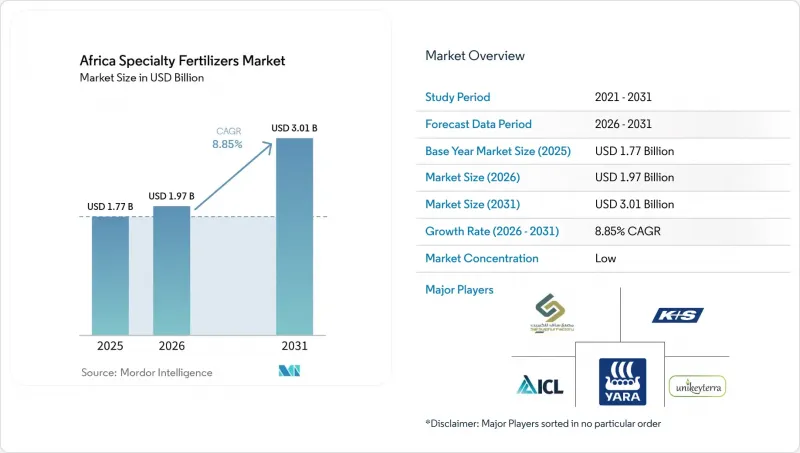
根據 Mordor Intelligence 預測,非洲特種肥料市場規模預計將在 2025 年達到 17.7 億美元,在 2026 年達到 19.7 億美元,從 2026 年到 2031 年將以 8.85% 的複合年成長率成長,到 2031 年達到 30.1 億美元。
本報告按特殊肥料類型(包膜性肥料(CRF)、液體肥料、緩釋肥料 (SRF)、水溶性肥料)、施用方法(灌溉施肥、葉面噴布、土壤施用)、作物類型(田間作物、園藝作物、草坪和觀賞植物)以及國家進行細分。市場預測以價值和數量兩種形式呈現。
非洲特種肥料市場的趨勢與洞察
政府補貼和政策獎勵
非洲各地的化肥補貼改革已將超過10億美元的資金重新導向氣候友善特殊肥料,從根本上改變了採購模式,使其從散裝肥料轉向精準配方產品。奈及利亞的特殊農業加工區(SAPZ)計畫在2024年專門撥款5億美元用於特種肥料的分銷基礎設施建設,而肯亞的化肥補貼計畫首次擴大範圍,將水溶性和緩釋配方肥料納入其中。非洲聯盟(非盟)2024年《內羅畢宣言》承諾成員國在2030年實現50%的化肥自給率,從而促進政策向特種肥料生產和區域價值鏈方向發展。這些補貼改革正在創造對高效複合肥料的持續需求,同時降低農民對高階特種肥料的價格敏感度。
人均可耕種面積減少
預計非洲人均可耕種面積將從2000年的0.31公頃減少到2024年的0.23公頃,因此,農業集約化必須透過高效率的營養解決方案來實現,而非擴大面積。在撒哈拉以南非洲,平均每公頃施肥量僅為13-20公斤,而已開發地區的施肥量則高達每公頃150公斤,這表明在引入專用肥料以彌合產量差距方面仍有很大的空間。土壤劣化影響非洲大陸高達65%的耕地,表土流失造成的年產量損失在4.3%至26.6%之間,凸顯了補充微量元素和使用高效複合肥料的必要性。馬利共和國的特雷納武古地區就是這項挑戰的典型例證,土壤分析顯示該地區氮、鉀、鎂以及鎳、錳、硼等微量元素均缺乏。
有限的經銷基礎設施
液態肥料低溫運輸和散裝碼頭基礎設施不足,導致其分銷成本比顆粒狀肥料高出12%,阻礙了其在偏遠農業地區的推廣應用。儘管杜拜環球港務集團(DP World)計劃在2029年投資30億美元用於非洲港口建設,預計將彌補部分基礎設施缺口,但對於溫度敏感型特種肥料而言,農村地區的「最後一公里」配送仍然是一大挑戰。奈及利亞的肥料分銷網路僅覆蓋了40%擁有充足倉儲設施的農業社區,迫使農民依賴不適合的常溫儲存,導致產品品質下降。據南非農業合作社稱,農村倉庫冷藏不足導致液態肥料的損耗率高達25%。
細分市場分析
預計到2025年,液體肥料將佔非洲特種肥料市場47.8%的佔有率。這一成長主要得益於施肥和灌溉基礎設施的不斷完善,以及出口作物對精準養分管理的需求。液體肥料因其與現代灌溉系統和先進栽培方法(如水耕和魚菜共生)的兼容性而備受關注。灌溉技術的進步和精密農業技術的廣泛應用也推動了這一領域的成長。同時,緩釋肥料(SRF)雖然規模較小,但在減少土壤板結和調節植物養分輸送方面發揮著至關重要的作用。這類肥料尤其能有效降低施肥頻率和整體肥料成本,並帶來減少氮揮發和淋溶等環境效益。
包膜性肥料(CRF)是成長最快的細分市場,預計2026年至2031年將以8.4%的複合年成長率成長。包膜肥料主要用於商業農場和高價值園藝領域,其較長的養分釋放期使其價格較高。該細分市場正朝著更精準的配方發展,這為區域製造商開發適應氣候的產品創造了機會,而全球公司則專注於技術轉移和本地夥伴關係。在田間作物中,最大限度地減少因淋溶和揮發造成的養分損失至關重要,因此該細分市場的成長尤其顯著。隨著農民越來越認知到減少施肥頻率和提高養分利用效率的好處,預計包膜性肥料(CRF)的採用率將加快。
其他好處:
- Excel格式的市場預測(ME)表
- 3個月的分析師支持
目錄
第1章:引言
- 研究假設和市場定義
- 調查範圍
- 調查方法
第2章:本報告的內容
第3章:執行摘要和主要發現
第4章:主要產業趨勢
- 主要農作物種植面積
- 田間作物
- 園藝作物
- 平均施肥量
- 微量營養素
- 田間作物
- 園藝作物
- 主要營養素
- 田間作物
- 園藝作物
- 次要大量營養元素
- 田間作物
- 園藝作物
- 微量營養素
- 配備灌溉設施的農田
- 法律規範
- 價值鍊和通路分析
- 市場促進因素
- 政府補貼和政策激勵
- 人均可耕種面積減少
- 轉向出口高附加價值園藝產品
- 由非洲開發銀行(非行)支持的微灌項目
- 利用無人機進行葉面施肥
- 與排碳權掛鉤的溢價
- 市場限制因素
- 有限的經銷基礎設施
- 包膜性肥料(CRF)用聚合物的初始成本較高
- 不同地區的重金屬標準不同
- 供應鏈對塗料聚合物進口的依賴性
第5章 市場規模與成長預測
- 按類型分類的專用肥料
- 包膜性肥料(CRF)
- 聚合物塗層
- 聚合物和硫塗層
- 其他
- 液體肥料
- 緩效性肥料(SRF)
- 水溶性肥料
- 包膜性肥料(CRF)
- 透過應用方法
- 施肥和灌溉
- 葉面噴布
- 土壤施用
- 按作物類型
- 田間作物
- 園藝作物
- 草坪和觀賞植物
- 國家
- 奈及利亞
- 南非
- 其他非洲國家
第6章 競爭情勢
- 關鍵策略趨勢
- 市佔率分析
- 企業狀況
- 公司簡介。
- Yara International ASA
- ICL Group Ltd
- K+S Aktiengesellschaft
- Unikeyterra Chemical
- Safsulphur
- OCP SA
- Haifa Chemicals Ltd.
- UPL Limited
- Omnia Holdings Ltd
- EuroChem Group AG
- PhosAgro Africa Ltd
- Kynoch Holdings Pty Ltd
- Kynoch Holdings Pty Ltd
- Zimbabwe Phosphate Industries Ltd
- Gavilon South Africa(MacroSource, LLC)
第7章 化肥產業執行長面臨的關鍵策略挑戰
According to Mordor Intelligence, the Africa specialty fertilizers market size was USD 1.77 billion in 2025 to USD 1.97 billion in 2026 and is forecast to reach USD 3.01 billion by 2031 at 8.85% CAGR over 2026-2031.
This report is Segmented by Speciality Type (Controlled-Release Fertilizer (CRF), Liquid Fertilizer, Slow-Release Fertilizer (SRF), and Water Soluble), by Application Mode (Fertigation, Foliar, and Soil), by Crop Type (Field Crops, Horticultural Crops, and Turf & Ornamental), and by Country. The Market Forecasts are Provided in Terms of Value (USD) and Volume (Metric Tons).
Africa Specialty Fertilizers Market Trends and Insights
Government Subsidies and Policy Incentives
National fertilizers subsidy reforms across Africa are redirecting over USD 1 billion toward climate-smart specialty inputs, fundamentally reshaping procurement patterns from bulk commodities to precision formulations. Nigeria's Special Agro-Processing Zones program allocated USD 500 million in 2024 specifically for specialty fertilizers distribution infrastructure, while Kenya's fertilizers subsidy program expanded to include water-soluble and controlled-release formulations for the first time . The African Union's Nairobi Declaration 2024 committed member states to achieve 50% fertilizer self-sufficiency by 2030, driving policy alignment toward specialty product manufacturing and regional value chains. These subsidy reforms create sustained demand for enhanced-efficiency formulations while reducing farmers' price sensitivity to premium specialty products.
Decreasing Arable Land Per Capita
Africa's arable land per capita declined from 0.31 hectares in 2000 to 0.23 hectares in 2024, forcing agricultural intensification through higher-efficiency nutrient solutions rather than area expansion. Sub-Saharan Africa averages only 13-20 kg nutrient application per hectare compared to 150 kg/ha in developed regions, creating substantial scope for specialty fertilizers adoption to bridge yield gaps. Soil degradation affects up to 65% of arable land across the continent, with annual productivity losses of 4.3-26.6% from topsoil depletion requiring micronutrient supplementation and enhanced-efficiency formulations. Mali's Trenabougou region exemplifies the challenge, with soil analysis revealing deficiencies in nitrogen, potassium, and magnesium alongside limited micronutrients including nickel, manganese, and boron.
Limited Distribution Infrastructure
Poor cold-chain and bulk terminal infrastructure for liquid fertilizers raises distribution costs by 12% compared to granular products, constraining adoption in remote agricultural areas. DP World's USD 3 billion African ports investment through 2029 addresses some infrastructure gaps, but rural last-mile distribution remains problematic for temperature-sensitive specialty formulations. Nigeria's fertilizers distribution network covers only 40% of farming communities with proper storage facilities, forcing farmers to rely on suboptimal ambient storage that degrades product quality. South Africa's agricultural cooperatives report 25% product loss rates for liquid fertilizers due to inadequate cold storage in rural depots.
Other drivers and restraints analyzed in the detailed report include:
- Shift Toward High-Value Horticultural Exports
- Micro-Irrigation Projects Backed by AfDB (African Development Bank)
- High Upfront Cost of Controlled-Release Fertilizer (CRF) Polymers
For complete list of drivers and restraints, kindly check the Table Of Contents.
Segment Analysis
Liquid fertilizers accounted for 47.8% of the Africa specialty fertilizers market share in 2025, driven by expanding fertigation infrastructure and export crop requirements for precise nutrition management. Liquid fertilizers have gained significant traction due to their compatibility with modern irrigation systems and advanced cultivation methods like hydroponics and aquaponics. The segment's growth is supported by developments in irrigation technology and the increasing adoption of precision farming techniques. Meanwhile, the Slow-Release Fertilizer (SRF) segment, while smaller, plays a crucial role in minimizing soil hardening and coordinating nutrient flow to plants. These fertilizers are particularly valuable in reducing application frequency and overall fertilizers costs, while also offering environmental benefits such as reduced nitrogen volatilization and leaching.
Controlled-release fertilizers (CRF) are the fastest-growing segment, with a projected CAGR of 8.4% from 2026 to 2031, primarily serving commercial farms and high-value horticulture where extended nutrient release justifies premium pricing. The segment evolution toward precision formulations creates opportunities for regional manufacturers to develop climate-adapted products while global players focus on technology transfer and local partnerships. The segment's growth is particularly notable in field crops, where the need to minimize nutrient losses through leaching and volatilization is critical. The adoption of Controlled-Release Fertilizer (CRF) is likely to accelerate as farmers increasingly recognize its benefits in reducing application frequency and improving nutrient use efficiency.
Complete Report Scope:
- Speciality Type
- Controlled-Release Fertilizer (CRF)
- Polymer Coated
- Polymer-Sulfur Coated
- Others
- Liquid Fertilizer
- Slow-Release Fertilizer (SRF)
- Water Soluble
- Controlled-Release Fertilizer (CRF)
- Application Mode
- Fertigation
- Foliar
- Soil
- Crop Type
- Field Crops
- Horticultural Crops
- Turf & Ornamental
- Country
- Nigeria
- South Africa
- Rest of Africa
List of Companies Covered in this Report:
- Yara International ASA
- ICL Group Ltd
- K+S Aktiengesellschaft
- Unikeyterra Chemical
- Safsulphur
- OCP SA
- Haifa Chemicals Ltd.
- UPL Limited
- Omnia Holdings Ltd
- EuroChem Group AG
- PhosAgro Africa Ltd
- Kynoch Holdings Pty Ltd
- Kynoch Holdings Pty Ltd
- Zimbabwe Phosphate Industries Ltd
- Gavilon South Africa (MacroSource, LLC)
Additional Benefits:
- The market estimate (ME) sheet in Excel format
- 3 months of analyst support
TABLE OF CONTENTS
1 INTRODUCTION
- 1.1 Study Assumptions & Market Definition
- 1.2 Scope of the Study
- 1.3 Research Methodology
2 REPORT OFFERS
3 EXECUTIVE SUMMARY & KEY FINDINGS
4 KEY INDUSTRY TRENDS
- 4.1 Acreage of Major Crop Types
- 4.1.1 Field Crops
- 4.1.2 Horticultural Crops
- 4.2 Average Nutrient Application Rates
- 4.2.1 Micronutrients
- 4.2.1.1 Field Crops
- 4.2.1.2 Horticultural Crops
- 4.2.2 Primary Nutrients
- 4.2.2.1 Field Crops
- 4.2.2.2 Horticultural Crops
- 4.2.3 Secondary Macronutrients
- 4.2.3.1 Field Crops
- 4.2.3.2 Horticultural Crops
- 4.2.1 Micronutrients
- 4.3 Agricultural Land Equipped For Irrigation
- 4.4 Regulatory Framework
- 4.5 Value Chain & Distribution Channel Analysis
- 4.6 Market Drivers
- 4.6.1 Government subsidies and policy incentives
- 4.6.2 Decreasing arable land per capita
- 4.6.3 Shift toward high-value horticultural exports
- 4.6.4 Micro-irrigation projects backed by AfDB (African Development Bank)
- 4.6.5 Drone-based foliar nutrient application
- 4.6.6 Carbon-credit linked premium pricing
- 4.7 Market Restraints
- 4.7.1 Limited distribution infrastructure
- 4.7.2 High upfront cost of Controlled-Release Fertilizer (CRF) polymers
- 4.7.3 Inconsistent regional heavy-metal standards
- 4.7.4 Supply-chain exposure to coating polymer imports
5 MARKET SIZE AND GROWTH FORECASTS (VALUE AND VOLUME)
- 5.1 Speciality Type
- 5.1.1 Controlled-Release Fertilizer (CRF)
- 5.1.1.1 Polymer Coated
- 5.1.1.2 Polymer-Sulfur Coated
- 5.1.1.3 Others
- 5.1.2 Liquid Fertilizer
- 5.1.3 Slow-Release Fertilizer (SRF)
- 5.1.4 Water Soluble
- 5.1.1 Controlled-Release Fertilizer (CRF)
- 5.2 Application Mode
- 5.2.1 Fertigation
- 5.2.2 Foliar
- 5.2.3 Soil
- 5.3 Crop Type
- 5.3.1 Field Crops
- 5.3.2 Horticultural Crops
- 5.3.3 Turf & Ornamental
- 5.4 Country
- 5.4.1 Nigeria
- 5.4.2 South Africa
- 5.4.3 Rest of Africa
6 COMPETITIVE LANDSCAPE
- 6.1 Key Strategic Moves
- 6.2 Market Share Analysis
- 6.3 Company Landscape
- 6.4 Company Profiles (Includes Global Level Overview, Market Level Overview, Core Business Segments, Financials, Headcount, Key Information, Market Rank, Market Share, Products and Services, and Analysis of Recent Developments).
- 6.4.1 Yara International ASA
- 6.4.2 ICL Group Ltd
- 6.4.3 K+S Aktiengesellschaft
- 6.4.4 Unikeyterra Chemical
- 6.4.5 Safsulphur
- 6.4.6 OCP SA
- 6.4.7 Haifa Chemicals Ltd.
- 6.4.8 UPL Limited
- 6.4.9 Omnia Holdings Ltd
- 6.4.10 EuroChem Group AG
- 6.4.11 PhosAgro Africa Ltd
- 6.4.12 Kynoch Holdings Pty Ltd
- 6.4.13 Kynoch Holdings Pty Ltd
- 6.4.14 Zimbabwe Phosphate Industries Ltd
- 6.4.15 Gavilon South Africa (MacroSource, LLC)
7 KEY STRATEGIC QUESTIONS FOR FERTILIZER CEOS

 晶體肥料市場-2026-2032年全球市場預測特種肥料市場-2026-2032年全球市場預測
 特種肥料市場:商機、成長要素、產業趨勢分析及2026-2035年預測
 全球特種肥料市場(至2031年):依技術(緩釋肥料、微量元素肥料、水溶性肥料)、形態(乾粉、液體)、施用方法、類型、作物和地區分類的預測
 北美特種肥料市場:市場佔有率分析、產業趨勢與統計及成長預測(2026-2031 年)印度特種肥料市場:市場佔有率分析、產業趨勢與統計及成長預測(2026-2031)歐洲特種肥料:市場佔有率分析、產業趨勢與統計及成長預測(2026-2031 年)中國特種肥料市場:市場佔有率分析、產業趨勢與統計及成長預測(2026-2031年)中東和非洲特種肥料市場:市場佔有率分析、行業趨勢和統計數據以及成長預測(2026-2031 年)美國特種肥料:市場佔有率分析、行業趨勢和統計數據、成長預測(2026-2031 年)