


 |
市場調查報告書
商品編碼
2100725
北美特種肥料市場:市場佔有率分析、產業趨勢與統計及成長預測(2026-2031 年)North America Specialty Fertilizer - Market Share Analysis, Industry Trends & Statistics, Growth Forecasts (2026 - 2031) |
||||||

※ 本網頁內容可能與最新版本有所差異。詳細情況請與我們聯繫。
根據 Mordor Intelligence 預測,北美特殊肥料市場規模將從 2025 年的 51.4 億美元和 2026 年的 53 億美元成長到 2031 年的 66.4 億美元,預測期內複合年成長率為 4.6%。
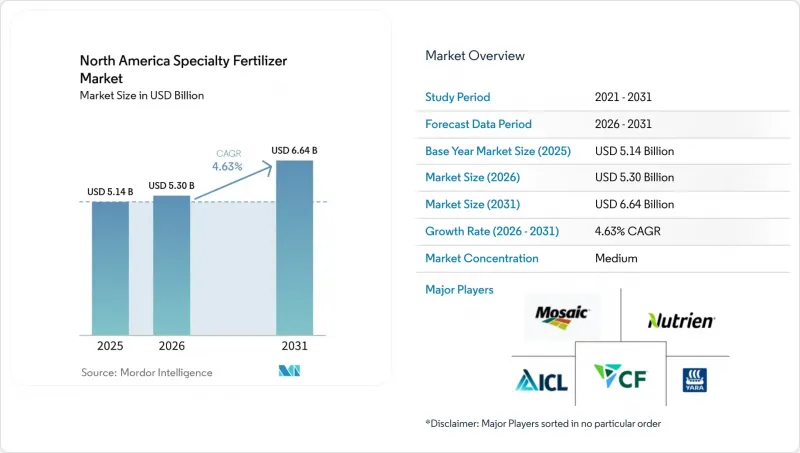
本報告按特殊肥料類型(控釋肥、液體肥料、緩釋肥、水溶性肥料)、施用方法(灌溉施肥、葉面噴布、土壤施用)、作物類型(田間作物、園藝作物、草坪和觀賞作物)以及地區(加拿大、墨西哥、美國、北美及其他地區)進行細分。市場預測以價值(美元)和數量(公噸)表示。
北美特種肥料市場趨勢與洞察
精密農業的引進正在加速水溶性肥料的需求。
隨著變數施肥和感測器控制灌溉對精準養分輸送的需求日益成長,北美特種肥料市場正向水溶性和液態產品轉型。 2024年12月,美國農業部(USDA)報告稱,68%的大型農場正在使用精密農業決策工具,例如產量監測器、土壤圖和自動灌溉系統。同一項USDA調查發現,45%的大型農作物農場已採用變數施肥技術,70%的大型農場已採用自動灌溉系統,而小規模農場的比例僅為9%。這種普及模式意義重大,因為特種肥料能為大型農場帶來最大的經濟效益,它們可以最佳化大面積耕地上的施肥位置和時間,從而最大限度地提高盈利能力。隨著施肥和灌溉的應用範圍從加州的特種作物擴展到安大略省的溫室蔬菜,並遍及美國東南部,全可溶性配方不再只是一種可選的升級,而成為一種系統性的必需品。
監理重點在於養分利用效率與4R管理
北美特種肥料市場也受惠於人們對養分利用效率和4R原則(減少、再利用、減少、再循環)的日益重視。肥料協會在其2025年永續發展報告中指出,預計到2030年,4R計畫的認證面積將超過7,000萬英畝。緩效性肥料、聚合物包膜尿素和抑制劑處理產品符合這一趨勢,因為它們有助於減少氮素流失並提高養分分配效率。切薩皮克灣、五大湖區和各州與硝酸鹽減排計畫相關的法規,正促使種植者使用能改善施肥時間和提高利用效率的產品。這種政策環境正在推動優質營養產品在農作物和高價值種植系統中的應用,從而擴大北美特種肥料市場的商業基礎。
與傳統肥料相比的價格差異
由於價格與傳統肥料有顯著差異,北美特種肥料市場仍面臨巨大的推廣障礙。本文提及的特種肥料產品價格是標準氮磷肥的2至4倍。對於利潤微薄、產量效益必須明確證明的小規模農戶和輪作系統而言,這種價格差異尤其難以負擔。相較之下,溫室和多年生作物系統面臨的挑戰相對較小,因為生產者可以更直接地將精準養分管理與作物品質提升、減少廢棄物和提高勞動效率聯繫起來。希望推廣特種肥料的生產者仍需證明其在田間經濟效益;否則,一旦作物價格下跌,買家可能會重新轉向使用標準肥料。
細分市場分析
到2025年,緩效肥料將佔北美特種肥料市場37.4%的佔有率,成為特種肥料領域最大的市場佔有率。其主導地位源於緩釋肥料在草坪、高爾夫球場、苗圃和不斷擴大的農作物種植中的應用,在這些領域,養分釋放時間可以透過4R(減少、再利用、減少)原則實現經濟效益。聚合物包膜和聚合物硫包膜產品仍佔據緩釋肥料出貨量的大部分,因為它們可以根據土壤條件和作業計劃調整養分釋放。因此,即使由於日益嚴格的環境法規,包膜技術正在被重新評估,緩釋產品仍然是北美特種肥料市場的核心。
預計到2031年,水溶性肥料將以6.7%的複合年成長率成長,成為北美特種肥料市場成長最快的特種肥料類型。這一成長與溫室系統、封閉回路型灌溉以及露天施肥灌溉項目密切相關,這些項目都需要肥料完全溶解且能穩定地進行罐混。液態肥料和緩釋肥料適用於不同的通路;液態肥料非常適合現有的經銷系統,而緩釋肥料則在觀賞植物和草坪管理專案中保持著需求。從成長平衡來看,我們發現高階消費正轉向適用於可控供應系統的產品,但緩釋肥料的現有用戶群並未被取代。
其他好處:
- Excel格式的市場預測(ME)表
- 3個月的分析師支持
目錄
第1章:引言
- 研究假設和市場定義
- 調查範圍
- 調查方法
第2章:本報告的內容
第3章:執行摘要和主要發現
第4章:主要產業趨勢
- 主要農作物種植面積
- 田間作物
- 園藝作物
- 平均施肥量
- 微量營養素
- 田間作物
- 園藝作物
- 主要營養素
- 田間作物
- 園藝作物
- 次要大量營養元素
- 田間作物
- 園藝作物
- 微量營養素
- 配備灌溉設施的農田
- 法律規範
- 價值鍊和通路分析
- 市場概覽
- 市場促進因素
- 精密農業的引進正在加速對水溶性材料的需求。
- 監理重點在於養分利用效率與4R管理
- 北美溫室和可控制環境農業的擴張
- 生物促效劑的整合需要相容的、專門的營養。
- 排碳權計畫旨在鼓勵使用緩效肥料
- 種植面積轉向種植高價值漿果、堅果和麻類作物。
- 市場限制因素
- 與傳統肥料相比的價格差異
- 特殊原料供應不穩定
- 奈米肥料的廣泛應用正在蠶食聚合物包膜肥料的需求。
- 即將訂定的有關聚合物塗層的微塑膠法規
第5章 市場規模與成長預測
- 依產品類型
- CRF
- 聚合物塗層
- 聚合物硫塗層
- 其他
- 液體肥料
- SRF
- 水溶性
- CRF
- 使用方法
- 施肥和灌溉
- 葉面噴布
- 土壤
- 作物類型
- 田間作物
- 園藝作物
- 草坪和觀賞植物
- 國家
- 加拿大
- 墨西哥
- 美國
- 其他北美國家
第6章 競爭情勢
- 關鍵策略趨勢
- 市佔率分析
- 企業狀況
- 公司簡介
- CF Industries Holdings, Inc.
- The Mosaic Company
- Nutrien Ltd.
- Yara International ASA
- ICL Group Ltd.
- Koch Agronomic Services, LLC
- The Andersons, Inc.
- Helena Agri-Enterprises, LLC
- Wilbur-Ellis Holdings, Inc.
- SQM SA
- Tessenderlo Group NV
- Haifa Chemicals Ltd.
- Verdesian Life Sciences, LLC
- K+S Aktiengesellschaft
- JR Simplot Company
第7章 化肥產業執行長面臨的關鍵策略挑戰
According to Mordor Intelligence, the North America specialty fertilizer market size is projected to expand from USD 5.14 billion in 2025 and USD 5.30 billion in 2026 to USD 6.64 billion by 2031, registering a CAGR of 4.6% during the forecast period.
This report is Segmented by Specialty Type (CRF, Liquid Fertilizer, SRF, and Water Soluble), by Application Mode (Fertigation, Foliar, and Soil), by Crop Type (Field Crops, Horticultural Crops, and Turf and Ornamental), and by Geography (Canada, Mexico, The United States, and the Rest of North America). The Market Forecasts are Provided in Terms of Value (USD) and Volume (Metric Tons).
North America Specialty Fertilizer Market Trends and Insights
Precision Agriculture Adoption Accelerating Demand for Water-Soluble Inputs
The North America specialty fertilizer market is moving toward water-soluble and liquid products because variable-rate application and sensor-led irrigation depend on precise nutrient delivery. USDA reported in December 2024 that 68% of large crop farms used precision decision tools such as yield monitors, soil maps, and automated guidance systems. The same USDA survey showed that variable-rate technology reached 45% on large crop farms and autosteering reached 70% on large farms, versus 9% on small farms. That adoption pattern matters because the strongest economic case for specialty inputs lies with large farms that can monetize better placement and timing across wide-acre bases. As fertigation expands from California specialty crops into Ontario greenhouse vegetables and the U.S. Southeast, fully soluble formulations become a system requirement rather than an optional upgrade.
Regulatory Focus on Nutrient-Use Efficiency and 4R Stewardship
The North America specialty fertilizer market is also benefiting from a tighter focus on nutrient-use efficiency and 4R stewardship. The Fertilizer Institute said in its 2025 sustainability report that the 4R program is on track to exceed 70 million certified acres by 2030. Controlled-release blends, polymer-coated urea, and inhibitor-treated products align with this direction because they help document lower nitrogen loss and improved nutrient placement. Rules linked to the Chesapeake Bay, the Great Lakes, and state nitrate reduction programs are increasing pressure on growers to use products that improve timing and use efficiency. This policy setting supports premium nutrition products across row crops and higher-value cropping systems, broadening the commercial base of the North American specialty fertilizer market.
Price Premium Versus Conventional Fertilizers
The North American specialty fertilizer market still faces a clear adoption barrier due to the price gap with conventional fertilizers. Specialty products in the input text carry a 2-4 times premium over standard nitrogen and phosphate blends. That difference is hardest to absorb in smallholder and row-crop systems where margins are tighter and yield response must be visible. The challenge is lower in greenhouse and permanent crop systems because growers can connect nutrition precision more directly to crop quality, reduced waste, and labor efficiency. Producers that want broader adoption still need to prove field-level economics, or buyers can shift back toward standard blends when crop prices weaken.
Other drivers and restraints analyzed in the detailed report include:
- Integration of Biostimulants Requiring Compatible Specialty Nutrition
- Carbon Credit Programs Rewarding Slow-Release Fertilizer Use
- Volatile Supply of Specialty Raw Materials
For complete list of drivers and restraints, kindly check the Table Of Contents.
Segment Analysis
Controlled-release fertilizer held 37.4% of the North America specialty fertilizer market size in 2025, giving it the largest position within the specialty type segmentation. Its lead came from turf, golf, nursery, and expanding row-crop use, where nutrient timing can be monetized through 4R programs. Polymer-coated and polymer-sulfur-coated products still account for most controlled-release volume because they align nutrient release with soil conditions and labor planning. This keeps controlled-release products central to the North America specialty fertilizer market even as coating technology is being reevaluated under tighter environmental scrutiny.
Water-Soluble Fertilizer is projected to grow at a 6.7% CAGR through 2031, making it the fastest-growing specialty type in the North American specialty fertilizer market. Its growth is tied to greenhouse systems, closed-loop irrigation, and open-field fertigation programs that need full solubility and stable tank mixing. Liquid fertilizer and slow-release fertilizer serve different channels, with liquid products fitting established distribution systems and slow-release grades maintaining demand in ornamental and turf programs. The balance of growth shows that premium spending is shifting toward products that fit managed delivery systems without displacing the installed base of controlled-release products.
Complete Report Scope:
- Specialty Type
- CRF
- Polymer Coated
- Polymer-Sulfur Coated
- Others
- Liquid Fertilizer
- SRF
- Water Soluble
- CRF
- Application Mode
- Fertigation
- Foliar
- Soil
- Crop Type
- Field Crops
- Horticultural Crops
- Turf and Ornamental
- Country
- Canada
- Mexico
- United States
- Rest of North America
List of Companies Covered in this Report:
- CF Industries Holdings, Inc.
- The Mosaic Company
- Nutrien Ltd.
- Yara International ASA
- ICL Group Ltd.
- Koch Agronomic Services, LLC
- The Andersons, Inc.
- Helena Agri-Enterprises, LLC
- Wilbur-Ellis Holdings, Inc.
- SQM S.A.
- Tessenderlo Group NV
- Haifa Chemicals Ltd.
- Verdesian Life Sciences, LLC
- K+S Aktiengesellschaft
- J. R. Simplot Company
Additional Benefits:
- The market estimate (ME) sheet in Excel format
- 3 months of analyst support
TABLE OF CONTENTS
1 INTRODUCTION
- 1.1 Study Assumptions and Market Definition
- 1.2 Scope of the Study
- 1.3 Research Methodology
2 REPORT OFFERS
3 EXECUTIVE SUMMARY AND KEY FINDINGS
4 KEY INDUSTRY TRENDS
- 4.1 Acreage Of Major Crop Types
- 4.1.1 Field Crops
- 4.1.2 Horticultural Crops
- 4.2 Average Nutrient Application Rates
- 4.2.1 Micronutrients
- 4.2.1.1 Field Crops
- 4.2.1.2 Horticultural Crops
- 4.2.2 Primary Nutrients
- 4.2.2.1 Field Crops
- 4.2.2.2 Horticultural Crops
- 4.2.3 Secondary Macronutrients
- 4.2.3.1 Field Crops
- 4.2.3.2 Horticultural Crops
- 4.2.1 Micronutrients
- 4.3 Agricultural Land Equipped For Irrigation
- 4.4 Regulatory Framework
- 4.5 Value Chain and Distribution Channel Analysis
- 4.6 Market Overview
- 4.7 Market Drivers
- 4.7.1 Precision-agriculture adoption accelerating demand for water-soluble inputs
- 4.7.2 Regulatory focus on nutrient-use efficiency and 4R stewardship
- 4.7.3 Expansion of greenhouse and controlled environment farming across North America
- 4.7.4 Integration of bio-stimulants requiring compatible specialty nutrition
- 4.7.5 Carbon-credit programs rewarding slow-release fertilizer use
- 4.7.6 Acreage shift toward high-value berries, nuts, and hemp
- 4.8 Market Restraints
- 4.8.1 Price premium versus conventional fertilizers
- 4.8.2 Volatile supply of specialty raw materials
- 4.8.3 Nano-fertilizer adoption cannibalizing polymer-coated demand
- 4.8.4 Forthcoming micro-plastic regulations on polymer coatings
5 MARKET SIZE AND GROWTH FORECASTS (VALUE AND VOLUME)
- 5.1 Specialty Type
- 5.1.1 CRF
- 5.1.1.1 Polymer Coated
- 5.1.1.2 Polymer-Sulfur Coated
- 5.1.1.3 Others
- 5.1.2 Liquid Fertilizer
- 5.1.3 SRF
- 5.1.4 Water Soluble
- 5.1.1 CRF
- 5.2 Application Mode
- 5.2.1 Fertigation
- 5.2.2 Foliar
- 5.2.3 Soil
- 5.3 Crop Type
- 5.3.1 Field Crops
- 5.3.2 Horticultural Crops
- 5.3.3 Turf and Ornamental
- 5.4 Country
- 5.4.1 Canada
- 5.4.2 Mexico
- 5.4.3 United States
- 5.4.4 Rest of North America
6 COMPETITIVE LANDSCAPE
- 6.1 Key Strategic Moves
- 6.2 Market Share Analysis
- 6.3 Company Landscape
- 6.4 Company Profiles (Includes Global Level Overview, Market Level Overview, Core Business Segments, Financials, Headcount, Key Information, Market Rank, Market Share, Products and Services, and Analysis of Recent Developments)
- 6.4.1 CF Industries Holdings, Inc.
- 6.4.2 The Mosaic Company
- 6.4.3 Nutrien Ltd.
- 6.4.4 Yara International ASA
- 6.4.5 ICL Group Ltd.
- 6.4.6 Koch Agronomic Services, LLC
- 6.4.7 The Andersons, Inc.
- 6.4.8 Helena Agri-Enterprises, LLC
- 6.4.9 Wilbur-Ellis Holdings, Inc.
- 6.4.10 SQM S.A.
- 6.4.11 Tessenderlo Group NV
- 6.4.12 Haifa Chemicals Ltd.
- 6.4.13 Verdesian Life Sciences, LLC
- 6.4.14 K+S Aktiengesellschaft
- 6.4.15 J. R. Simplot Company
7 KEY STRATEGIC QUESTIONS FOR FERTILIZER CEOS

 晶體肥料市場-2026-2032年全球市場預測特種肥料市場-2026-2032年全球市場預測
 特種肥料市場:商機、成長要素、產業趨勢分析及2026-2035年預測
 全球特種肥料市場(至2031年):依技術(緩釋肥料、微量元素肥料、水溶性肥料)、形態(乾粉、液體)、施用方法、類型、作物和地區分類的預測
 印度特種肥料市場:市場佔有率分析、產業趨勢與統計及成長預測(2026-2031)歐洲特種肥料:市場佔有率分析、產業趨勢與統計及成長預測(2026-2031 年)非洲特種肥料:市場佔有率分析、產業趨勢與統計及成長預測(2026-2031 年)中國特種肥料市場:市場佔有率分析、產業趨勢與統計及成長預測(2026-2031年)中東和非洲特種肥料市場:市場佔有率分析、行業趨勢和統計數據以及成長預測(2026-2031 年)美國特種肥料:市場佔有率分析、行業趨勢和統計數據、成長預測(2026-2031 年)