


 |
市場調查報告書
商品編碼
2100727
歐洲特種肥料:市場佔有率分析、產業趨勢與統計及成長預測(2026-2031 年)Europe Specialty Fertilizers - Market Share Analysis, Industry Trends & Statistics, Growth Forecasts (2026 - 2031) |
||||||

※ 本網頁內容可能與最新版本有所差異。詳細情況請與我們聯繫。
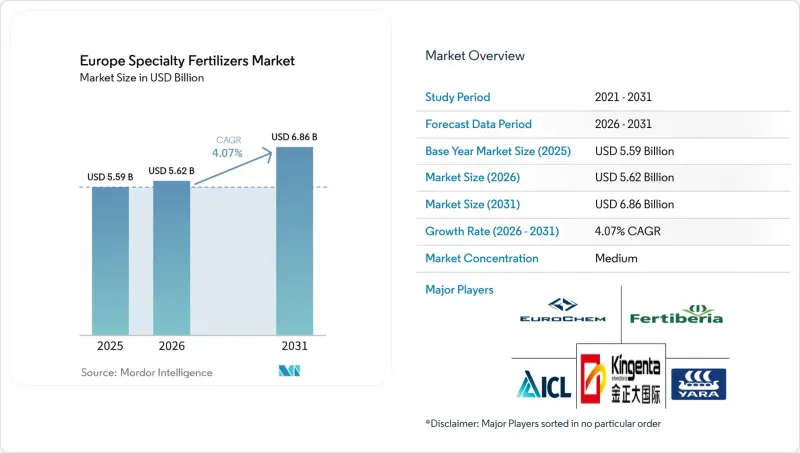
根據 Mordor Intelligence 預測,歐洲特殊肥料市場規模將從 2025 年的 55.9 億美元成長到 2026 年的 56.2 億美元,然後在 2031 年達到 68.6 億美元,2026 年至 2031 年的複合年成長率為 4.07%。
本報告按特殊肥料類型(控釋肥、液體肥料、緩釋肥等)、施用方法(灌溉施肥、葉面噴布噴施、土壤施用)、作物類型(田間作物、園藝作物等)和地區(法國、德國、義大利、荷蘭等)進行細分。市場預測以貨幣價值和銷售兩種形式呈現。
歐洲特種肥料市場的趨勢與洞察
擴大保護性耕作面積
目前,荷蘭有10,500公頃、西班牙有64,000公頃被劃為保護性耕作區,預計到2024年,在出口導向型蔬菜需求的推動下,這一數字將增加15%。無土栽培系統是推動這一成長的主要動力,該系統需要使用水溶性或包膜複合肥料來防止養分固定。在北歐國家,溫室生產能力正在不斷提升,以提高糧食安全,這也持續推動了對pH平衡型特殊肥料的需求。液態肥料適用於封閉回路型循環系統,有助於種植者最大限度地減少廢水排放。因此,隨著溫室經營者將全年養分管理方案標準化,歐洲特種肥料市場的銷售量正在持續成長。
化肥和灌溉系統的採用率迅速提高
在地中海地區,到2024年,施肥和灌溉系統的普及率將達到每年25%,尤其是在面臨缺水問題的西班牙橄欖園和義大利葡萄園。整合感測器能夠實現變數施肥,在保持產量的同時,可減少30%至40%的肥料用量。德國和法國的農民也在安裝滴灌或中心支軸式噴灌機,以符合硝酸鹽指令的限制。隨著施肥和灌溉技術的普及,買家的興趣正轉向液體肥料和全可溶性粉狀肥料,這推動了歐洲特種肥料市場的成長。
東歐耕地面積減少
2024年,波蘭有18萬公頃農地被砍伐,而烏克蘭的農地則面臨勞動力短缺和基礎設施受損的問題。農業整合有利於資本密集、使用特殊肥料的農場,但其總面積正在減少,從而拉低了整體需求。大型農場支撐歐洲特種肥料市場,但區域銷售量仍面臨挑戰。儘管有這些挑戰,大型農場採用特種肥料仍有助於市場穩定。
細分市場分析
由於液態肥料適用於滴灌和均勻施用,預計到2025年將佔據歐洲特種肥料市場34.6%的佔有率。生產商,尤其是溫室蔬菜生產商,優先考慮植物快速吸收和減少人工投入。在「從農場到餐桌」策略的推動下(此策略評估養分利用效率),控釋肥產品系列預計到2031年將以6.2%的複合年成長率成長。隨著聚合物包膜尿素和硫包膜尿素將施肥間隔延長至120天,預計歐洲特種肥料市場中控釋肥產品的市場規模將進一步擴大。
在荷蘭和比利時,水溶性晶體在羅勒、黃瓜和草莓的水耕系統中佔據主導地位,而緩釋顆粒則繼續受到草坪和觀賞植物等小眾用戶的青睞。含有鋅、硼和鐵的微量元素混合物目前正與生物促效劑結合使用,以緩解植物脅迫,這一趨勢與氣候變遷相符。預計到2024年,新型封裝技術的專利申請量將成長15%,凸顯了該領域創新的深度。
其他好處:
- Excel格式的市場預測(ME)表
- 3個月的分析師支持
目錄
第1章:引言
- 研究假設和市場定義
- 調查範圍
- 調查方法
第2章:本報告的內容
第3章:執行摘要和主要發現
第4章:主要產業趨勢
- 主要農作物種植面積
- 田間作物
- 園藝作物
- 平均施肥量
- 微量營養素
- 田間作物
- 園藝作物
- 主要營養素
- 田間作物
- 園藝作物
- 次要大量營養元素
- 田間作物
- 園藝作物
- 微量營養素
- 配備灌溉設施的農田
- 法律規範
- 價值鍊和通路分析
- 市場促進因素
- 擴大保護性耕作面積
- 施肥和灌溉系統的應用正在迅速增加。
- 歐盟「從農場到餐桌」永續性目標
- 英國脫歐後園藝產品出口的復甦
- 綠色氨中心擴建
- 農場碳權貨幣化示範項目
- 市場限制因素
- 東歐耕地減少
- 天然氣衍生原物料價格波動
- 歐盟化肥法對鎘含量有嚴格的規定
- 小規模農戶對數位農業的採用仍落後。
第5章 市場區隔
- 按類型分類的專用肥料
- CRF
- 聚合物塗層
- 聚合物和硫塗層
- 其他
- 液體肥料
- SRF
- 水溶性肥料
- CRF
- 透過應用方法
- 施肥和灌溉
- 葉面噴布
- 土壤施用
- 按作物類型
- 田間作物
- 園藝作物
- 草坪和觀賞植物
- 國家
- 法國
- 德國
- 義大利
- 荷蘭
- 俄羅斯
- 西班牙
- 烏克蘭
- 英國
- 其他歐洲國家
第6章 競爭情勢
- 關鍵策略趨勢
- 市佔率分析
- 企業狀況
- 公司簡介
- Akcine bendrove "Achema"
- AGLUKON Spezialdunger GmbH & Co. KG.
- EuroChem Group AG.
- FERTIBERIA, SA
- Grupa Azoty SA(Compo Expert)
- ICL Group Ltd
- Kingenta Ecological Engineering Group Co., Ltd.
- Petrokemija DD Fertilizer Factory
- Sociedad Quimica y Minera de Chile SA
- Yara International ASA
- Borealis LAT
- Timac Agro
- Haifa Group
- PhosAgro
- Uralchem
第7章 化肥產業執行長面臨的關鍵策略挑戰
According to Mordor Intelligence, the Europe specialty fertilizers market size is projected to grow from USD 5.59 billion in 2025 to USD 5.62 billion in 2026 and is forecast to reach USD 6.86 billion by 2031 at 4.07% CAGR over 2026 to 2031.
This report is Segmented by Specialty Type (CRF, Liquid Fertilizer, SRF, and More), Application Mode (Fertigation, Foliar, and Soil), Crop Type (Field Crops, Horticultural Crops, and More), and Geography (France, Germany, Italy, Netherlands, and More). The Market Forecasts are Provided in Terms of Value (USD) and Volume (Metric Tons).
Europe Specialty Fertilizers Market Trends and Insights
Growth in Protected-Cultivation Acreage
Protected growing sites now cover 10,500 hectares in the Netherlands and 64,000 hectares in Spain, advancing 15% in 2024 on export-oriented vegetable demand. Soilless systems dominate these expansions and require water-soluble or controlled-release blends that prevent nutrient lockup. Nordic countries add greenhouse capacity to improve food security, sustaining consumption of pH-balanced specialty fertilizers. Liquid products suit closed-loop recirculating systems, helping growers minimize discharge. The European specialty fertilizer market, therefore, captures volume as greenhouse operators standardize year-round nutrition programs.
Surge in Fertigation System Installations
Mediterranean farms installed fertigation at a 25% annual pace in 2024, led by Spanish olive groves and Italian vineyards facing water scarcity. Integrated sensors now trigger variable-rate dosing that can trim fertilizer use by 30-40% while maintaining yield. German and French field-crop producers also attach drip or pivot injectors to comply with nitrate-directive limits. Fertigation readiness steers buyers toward liquid and fully soluble powders, reinforcing the Europe specialty fertilizer market trajectory.
Shrinking Arable Land in Eastern Europe
Poland removed 180,000 hectares from cultivation in 2024, while Ukrainian fields faced labor shortages and infrastructure damage. Consolidation favors capital-intensive operations that adopt specialty inputs, yet total addressable hectares decline, trimming aggregate demand. Larger farms cushion the Europe specialty fertilizer market, but regional volume headwinds persist. Despite these challenges, the adoption of specialty inputs by larger farms may help stabilize the market.
Other drivers and restraints analyzed in the detailed report include:
- EU Farm to Fork Sustainability Targets
- Recovery of Horticulture Exports Post-Brexit
- Slow Digital-ag Adoption Among Smallholders
For complete list of drivers and restraints, kindly check the Table Of Contents.
Segment Analysis
Liquid fertilizers commanded 34.6% of the Europe specialty fertilizers market share in 2025 due to drip-ready compatibility and uniform distribution. Growers value rapid plant uptake and lower labor needs, especially in greenhouse vegetables. Controlled-release lines post 6.2% CAGR to 2031, lifted by Farm to Fork rules that reward nutrient-use efficiency. The Europe specialty fertilizers market size for controlled-release options is forecast to widen as polymer-coated urea and sulfur-coated urea stretch feeding intervals to 120 days.
Water-soluble crystals dominate hydroponic basil, cucumber, and strawberry systems in the Netherlands and Belgium, while slow-release granules retain niche turf and ornamental users. Micronutrient blends with zinc, boron, and iron now bundle biostimulants for stress mitigation, a trend aligned with shifting climate patterns. Patent activity for novel encapsulation rose 15% in 2024, underscoring innovation depth. s
Complete Report Scope:
- Speciality Type
- CRF
- Polymer Coated
- Polymer-Sulfur Coated
- Others
- Liquid Fertilizer
- SRF
- Water Soluble
- CRF
- Application Mode
- Fertigation
- Foliar
- Soil
- Crop Type
- Field Crops
- Horticultural Crops
- Turf & Ornamental
- Country
- France
- Germany
- Italy
- Netherlands
- Russia
- Spain
- Ukraine
- United Kingdom
- Rest of Europe
List of Companies Covered in this Report:
- Akcine bendrove "Achema"
- AGLUKON Spezialdunger GmbH & Co. KG.
- EuroChem Group AG.
- FERTIBERIA, S.A.
- Grupa Azoty S.A. (Compo Expert)
- ICL Group Ltd
- Kingenta Ecological Engineering Group Co., Ltd.
- Petrokemija DD Fertilizer Factory
- Sociedad Quimica y Minera de Chile SA
- Yara International ASA
- Borealis L.A.T.
- Timac Agro
- Haifa Group
- PhosAgro
- Uralchem
Additional Benefits:
- The market estimate (ME) sheet in Excel format
- 3 months of analyst support
TABLE OF CONTENTS
1 INTRODUCTION
- 1.1 Study Assumptions and Market Definition
- 1.2 Scope of the Studies
- 1.3 Research Methodology
2 REPORT OFFERS
3 EXECUTIVE SUMMARY AND KEY FINDINGS
4 KEY INDUSTRY TRENDS
- 4.1 Acreage of Major Crop Types
- 4.1.1 Field Crops
- 4.1.2 Horticultural Crops
- 4.2 Average Nutrient Application Rates
- 4.2.1 Micronutrients
- 4.2.1.1 Field Crops
- 4.2.1.2 Horticultural Crops
- 4.2.2 Primary Nutrients
- 4.2.2.1 Field Crops
- 4.2.2.2 Horticultural Crops
- 4.2.3 Secondary Macronutrients
- 4.2.3.1 Field Crops
- 4.2.3.2 Horticultural Crops
- 4.2.1 Micronutrients
- 4.3 Agricultural Land Equipped For Irrigation
- 4.4 Regulatory Framework
- 4.5 Value Chain and Distribution Channel Analysis
- 4.6 Market Drivers
- 4.6.1 Growth in protected-cultivation acreage
- 4.6.2 Surge in fertigation system installations
- 4.6.3 EU Farm to Fork sustainability targets
- 4.6.4 Recovery of horticulture exports post-Brexit
- 4.6.5 Scale-up of green-ammonia hubs
- 4.6.6 On-farm carbon-credit monetization pilots
- 4.7 Market Restraints
- 4.7.1 Shrinking arable land in Eastern Europe
- 4.7.2 Volatility in natural-gas derived feedstocks
- 4.7.3 Stringent cadmium limits in EU fertilizer law
- 4.7.4 Slow digital-ag adoption among smallholders
5 MARKET SEGMENTATION (VALUE AND VOLUME)
- 5.1 Speciality Type
- 5.1.1 CRF
- 5.1.1.1 Polymer Coated
- 5.1.1.2 Polymer-Sulfur Coated
- 5.1.1.3 Others
- 5.1.2 Liquid Fertilizer
- 5.1.3 SRF
- 5.1.4 Water Soluble
- 5.1.1 CRF
- 5.2 Application Mode
- 5.2.1 Fertigation
- 5.2.2 Foliar
- 5.2.3 Soil
- 5.3 Crop Type
- 5.3.1 Field Crops
- 5.3.2 Horticultural Crops
- 5.3.3 Turf & Ornamental
- 5.4 Country
- 5.4.1 France
- 5.4.2 Germany
- 5.4.3 Italy
- 5.4.4 Netherlands
- 5.4.5 Russia
- 5.4.6 Spain
- 5.4.7 Ukraine
- 5.4.8 United Kingdom
- 5.4.9 Rest of Europe
6 COMPETITIVE LANDSCAPE
- 6.1 Key Strategic Moves
- 6.2 Market Share Analysis
- 6.3 Company Landscape
- 6.4 Company Profiles (Includes Global Level Overview, Market Level Overview, Core Business Segments, Financials, Key Information, Market Rank, Market Share, Products and Services, and Analysis of Recent Developments)
- 6.4.1 Akcine bendrove "Achema"
- 6.4.2 AGLUKON Spezialdunger GmbH & Co. KG.
- 6.4.3 EuroChem Group AG.
- 6.4.4 FERTIBERIA, S.A.
- 6.4.5 Grupa Azoty S.A. (Compo Expert)
- 6.4.6 ICL Group Ltd
- 6.4.7 Kingenta Ecological Engineering Group Co., Ltd.
- 6.4.8 Petrokemija DD Fertilizer Factory
- 6.4.9 Sociedad Quimica y Minera de Chile SA
- 6.4.10 Yara International ASA
- 6.4.11 Borealis L.A.T.
- 6.4.12 Timac Agro
- 6.4.13 Haifa Group
- 6.4.14 PhosAgro
- 6.4.15 Uralchem
7 KEY STRATEGIC QUESTIONS FOR FERTILIZER CEOs

 晶體肥料市場-2026-2032年全球市場預測特種肥料市場-2026-2032年全球市場預測
 特種肥料市場:商機、成長要素、產業趨勢分析及2026-2035年預測
 全球特種肥料市場(至2031年):依技術(緩釋肥料、微量元素肥料、水溶性肥料)、形態(乾粉、液體)、施用方法、類型、作物和地區分類的預測
 北美特種肥料市場:市場佔有率分析、產業趨勢與統計及成長預測(2026-2031 年)印度特種肥料市場:市場佔有率分析、產業趨勢與統計及成長預測(2026-2031)非洲特種肥料:市場佔有率分析、產業趨勢與統計及成長預測(2026-2031 年)中國特種肥料市場:市場佔有率分析、產業趨勢與統計及成長預測(2026-2031年)中東和非洲特種肥料市場:市場佔有率分析、行業趨勢和統計數據以及成長預測(2026-2031 年)美國特種肥料:市場佔有率分析、行業趨勢和統計數據、成長預測(2026-2031 年)