


 |
市場調查報告書
商品編碼
2100723
中國特種肥料市場:市場佔有率分析、產業趨勢與統計及成長預測(2026-2031年)China Specialty Fertilizer - Market Share Analysis, Industry Trends & Statistics, Growth Forecasts (2026 - 2031) |
||||||

※ 本網頁內容可能與最新版本有所差異。詳細情況請與我們聯繫。
根據 Mordor Intelligence 預測,中國特種肥料市場規模將從 2025 年的 53.9 億美元成長到 2026 年的 59.2 億美元,到 2031 年將達到 84.6 億美元,2026 年至 2031 年的複合年預計成長率為 7.40%。
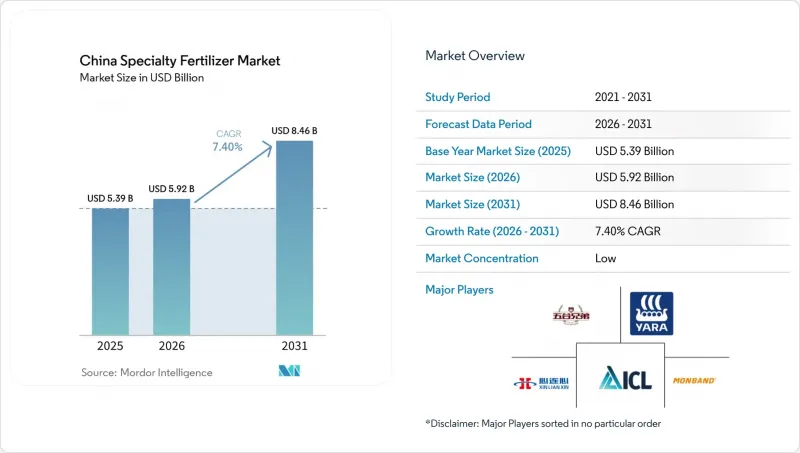
本報告依特殊肥料類型(控釋肥、液體肥料、緩釋肥、水溶性肥料)、施用方法(灌溉施肥、葉面噴布、土壤施用)和作物類型(田間作物、園藝作物、草坪和觀賞作物)進行分類。市場預測以價值(美元)和數量(公噸)表示。
中國特種肥料市場趨勢與洞察
政府對高效肥料的補貼
在中央和省級政府的補貼政策下,緩釋肥料成本最高可享有30%的補貼,從根本上改變了商業農戶和合作社採用緩釋肥料的經濟效益。農業部於2024年制定的政策架構將這些補貼政策延長至2027年,目標是在主要糧食產區的1,500萬公頃土地上推廣高效肥料。這項政策結構造成了市場兩極化:享有補貼的企業能夠實現與傳統肥料相當的成本,而無法獲得補貼的小規模農戶仍面臨價格障礙。該補貼政策透過強制使用國產營養原料來支持國內生產商,促進技術轉讓,旨在提升中國的國內生產能力。
擴大保護性栽培和溫室栽培
預計到2024年,中國保護地栽培面積將擴大至420萬公頃,其中塑膠薄膜溫室和日光溫室將貢獻85%的成長,從而對水溶性和液體肥料配方產生集中需求。光是在新疆,溫室蔬菜產量就年增了23%,這得益於政府推動農業產品多元化,擺脫對棉花的過度依賴。這種擴張趨勢為本地供應鏈創造了機遇,因為溫室經營者需要頻繁、小批量地交付專業營養液,而傳統的散裝肥料經銷商無法有效滿足這一需求。在可控環境下實現全年生產週期的轉變,對施肥時機的精準把握至關重要,因此具備技術諮詢能力的供應商更具優勢。
與傳統肥料相比,每噸成本更高
專用肥料的價格是傳統複合肥料的1.5到3倍,這給中國2億戶平均耕地面積不足0.6公頃的小規模農戶造成了使用障礙。儘管政府補貼符合資格的農民30%的費用,但絕對價格差異仍然是一大障礙,尤其對於中西部發展中省份的農民而言,這些地區的農業收入低於沿海地區,利潤空間也較小。這種成本結構造成了市場兩極化:大規模商業農場和合作社推動了專用肥料的使用,而絕大多數小規模農戶則依賴傳統肥料。在農產品價格下跌時期,由於農民優先考慮降低短期成本而非長期土壤健康,價格差距會進一步擴大。
細分市場分析
得益於完善的施肥和灌溉基礎設施,預計到2025年,液態肥料將在中國特種肥料市場保持42.0%的最大市場佔有率。液態肥料之所以佔據顯著的市場佔有率,是因為它們易於被植物吸收,並且適用於多種施用方式,包括灌溉和噴灑系統。雖然緩釋肥(SRF)的市場佔有率較小,但它在長期持續提供養分方面發揮著至關重要的作用,這對於生長週期長的作物尤其有利。這種市場細分趨勢反映了現有的農業實踐和基礎設施發展,為特種肥料供應商創造了精準的市場機會。
緩釋肥(CRF)正迅速成為成長最快的特殊肥料,預計到2031年將年複合成長率(CAGR) ,這主要得益於政府碳權試點計畫和精密農業的推廣應用。緩釋肥領域受益於聚合物包膜化學技術的進步,製造商正在開發可生物分解的替代品,這些替代品既能保持精準的養分釋放,又能滿足環境法規的要求。水溶性肥料適用於溫室和水耕種植,尤其適用於需要精準養分管理的保守型農業。不同地區的偏好有顯著差異:北方各州傾向於使用緩釋肥以提高糧食生產效率,而南方地區則更青睞液體肥料,用於集約化蔬菜種植。
其他好處:
- Excel格式的市場預測(ME)表
- 3個月的分析師支持
目錄
第1章:引言
- 研究假設和市場定義
- 調查範圍
- 調查方法
第2章:本報告的內容
第3章:執行摘要和主要發現
第4章:主要產業趨勢
- 主要農作物種植面積
- 田間作物
- 園藝作物
- 平均施肥量
- 微量營養素
- 田間作物
- 園藝作物
- 主要營養素
- 田間作物
- 園藝作物
- 次要大量營養元素
- 田間作物
- 園藝作物
- 微量營養素
- 配備灌溉設施的農田
- 法律規範
- 價值鍊和通路分析
- 市場促進因素
- 政府對高效肥料的補貼
- 擴大保育園藝和溫室栽培
- 擴大施肥灌溉及精準灌溉系統
- 向茶葉和特種作物客製化營養混合物轉型
- 農民直接面對消費者的電子商務管道正在減少分銷環節的摩擦。
- 將農業投入品碳權額度與碳足跡掛鉤的試點計畫正在加速對包膜性肥料的需求。
- 市場限制因素
- 與傳統肥料相比,每噸成本更高。
- 聚合物塗料方面的嚴格環境法規
- 針對小規模農戶的現場農業指導有限。
- 綠色食品認證體系中微塑膠問題引發關注
第5章 市場規模與成長預測
- 依產品類型
- CRF
- 聚合物塗層
- 聚合物硫塗層
- 其他
- 液體肥料
- SRF
- 水溶性
- CRF
- 使用方法
- 施肥和灌溉
- 葉面噴布
- 土壤
- 作物類型
- 田間作物
- 園藝作物
- 草坪和觀賞植物
第6章 競爭情勢
- 關鍵策略趨勢
- 市佔率分析
- 企業狀況
- 公司簡介。
- Hebei Woze Wufeng Biological Technology Co., Ltd
- Yara International ASA
- ICL Group Ltd
- Henan XinlianXin Chemicals Group Company Limited
- Hebei Monband Water Soluble Fertilizer Co. Ltd
- Kingenta Ecological Engineering Group Co. Ltd.
- Hubei Xinyangfeng Agricultural Technology Co. Ltd.
- Compo Expert GmbH
- Haifa Group
- Sociedad Quimica y Minera de Chile SA(SQM)
- Zouping Hongyun Biotechnology Co. Ltd.
- Sinochem Fertilizer Co. Ltd.
- Shandong Lvfeng Fertilizer Co. Ltd.
- Hebei HeRong Fertilizer Co. Ltd.
- Jiangsu Huifeng Agrochemical Co. Ltd.
第7章 化肥產業執行長面臨的關鍵策略挑戰
According to Mordor Intelligence, the China specialty fertilizer market size is projected to grow from USD 5.39 billion in 2025 to USD 5.92 billion in 2026 and is forecast to reach USD 8.46 billion by 2031, registering a CAGR of 7.40% during 2026-2031.
This report is Segmented by Speciality Type (CRF, Liquid Fertilizer, SRF, and Water Soluble), by Application Mode (Fertigation, Foliar, and Soil), and by Crop Type (Field Crops, Horticultural Crops, and Turf and Ornamental). The Market Forecasts are Provided in Terms of Value (USD) and Volume (Metric Tons)
China Specialty Fertilizer Market Trends and Insights
Government Subsidies for High-Efficiency Fertilizers
Central and provincial subsidy schemes reimburse up to 30% of controlled-release fertilizer costs, fundamentally altering adoption economics for commercial growers and cooperatives. The Ministry of Agriculture's 2024 policy framework extends these incentives through 2027, targeting 15 million hectares of high-efficiency fertilizer application across major grain-producing regions. This policy architecture creates a two-tier market where subsidized operations achieve cost parity with conventional fertilizers, while unsubsidized smallholders face persistent price barriers. The subsidy structure supports domestic manufacturers by requiring the use of locally sourced nutrient inputs, facilitating technology transfer, and enhancing production capacity within China.
Expansion Of Protected Horticulture and Greenhouse Cultivation
China's protected horticulture area expanded to 4.2 million hectares in 2024, with plastic-film greenhouses and solar greenhouses driving 85% of this growth, creating concentrated demand for water-soluble and liquid fertilizer formulations. Xinjiang's greenhouse vegetable production alone increased 23% year-over-year, supported by government initiatives to diversify the region's agricultural output beyond cotton. This expansion pattern generates localized supply chain opportunities, as greenhouse operators require frequent, small-batch deliveries of specialized nutrient solutions that traditional bulk fertilizer distributors cannot efficiently serve. The trend toward year-round production cycles in controlled environments necessitates precise nutrient timing, favoring suppliers with technical advisory capabilities.
Higher Per-Ton Cost Versus Conventional Fertilizers
Specialty fertilizers command prices 1.5 to 3 times higher than conventional NPK, creating adoption barriers for China's 200 million smallholder farming households with average landholdings below 0.6 hectares. Despite government subsidies covering 30% of costs for eligible operations, the absolute price differential remains prohibitive for farmers operating on thin margins, particularly in less-developed central and western provinces where agricultural incomes lag coastal regions. This cost structure creates a bifurcated market where large commercial operations and cooperatives drive specialty fertilizer adoption, while the numerically dominant smallholder segment relies on conventional products. The pricing gap widens during commodity price downturns, as farmers prioritize immediate cost reduction over long-term soil health benefits.
Other drivers and restraints analyzed in the detailed report include:
- Rising Adoption of Fertigation and Precision Irrigation Systems
- Shift of Tea and Specialty Cash Crops Toward Customized Nutrient Blends
- Stringent Environmental Regulations on Polymer Coatings
For complete list of drivers and restraints, kindly check the Table Of Contents.
Segment Analysis
Liquid fertilizers maintain the largest market share at 42.0% of the China specialty fertilizer market size in 2025, supported by established fertigation infrastructure. Liquid fertilizers account for a significant share of the market, offering advantages such as easy plant absorption and compatibility with various application methods, including irrigation and spraying systems. The SRF segment, while smaller in market share, plays a crucial role in providing sustained nutrient release over extended periods, particularly beneficial for long-duration crops. This segmentation pattern reflects underlying agricultural practices and infrastructure development, creating targeted market opportunities for specialized suppliers.
Controlled-release fertilizers emerge as the fastest-growing specialty type at 9.2% CAGR through 2031, driven by government carbon credit pilots and precision agriculture adoption. The CRF segment benefits from technological advances in polymer coating chemistry, with manufacturers developing biodegradable alternatives that meet environmental regulations while maintaining precise nutrient release. Water-soluble fertilizers are well-suited for greenhouse and hydroponic applications, particularly in protected horticulture operations that require precise nutrient control. Regional preferences vary significantly: northern provinces favor CRF for grain production efficiency, while southern regions emphasize liquid formulations for intensive vegetable cultivation.
Complete Report Scope:
- Speciality Type
- CRF
- Polymer Coated
- Polymer-Sulfur Coated
- Others
- Liquid Fertilizer
- SRF
- Water Soluble
- CRF
- Application Mode
- Fertigation
- Foliar
- Soil
- Crop Type
- Field Crops
- Horticultural Crops
- Turf & Ornamental
List of Companies Covered in this Report:
- Hebei Woze Wufeng Biological Technology Co., Ltd
- Yara International ASA
- ICL Group Ltd
- Henan XinlianXin Chemicals Group Company Limited
- Hebei Monband Water Soluble Fertilizer Co. Ltd
- Kingenta Ecological Engineering Group Co. Ltd.
- Hubei Xinyangfeng Agricultural Technology Co. Ltd.
- Compo Expert GmbH
- Haifa Group
- Sociedad Quimica y Minera de Chile SA (SQM)
- Zouping Hongyun Biotechnology Co. Ltd.
- Sinochem Fertilizer Co. Ltd.
- Shandong Lvfeng Fertilizer Co. Ltd.
- Hebei HeRong Fertilizer Co. Ltd.
- Jiangsu Huifeng Agrochemical Co. Ltd.
Additional Benefits:
- The market estimate (ME) sheet in Excel format
- 3 months of analyst support
TABLE OF CONTENTS
1 INTRODUCTION
- 1.1 Study Assumptions & Market Definition
- 1.2 Scope of the Study
- 1.3 Research Methodology
2 REPORT OFFERS
3 EXECUTIVE SUMMARY & KEY FINDINGS
4 KEY INDUSTRY TRENDS
- 4.1 Acreage Of Major Crop Types
- 4.1.1 Field Crops
- 4.1.2 Horticultural Crops
- 4.2 Average Nutrient Application Rates
- 4.2.1 Micronutrients
- 4.2.1.1 Field Crops
- 4.2.1.2 Horticultural Crops
- 4.2.2 Primary Nutrients
- 4.2.2.1 Field Crops
- 4.2.2.2 Horticultural Crops
- 4.2.3 Secondary Macronutrients
- 4.2.3.1 Field Crops
- 4.2.3.2 Horticultural Crops
- 4.2.1 Micronutrients
- 4.3 Agricultural Land Equipped For Irrigation
- 4.4 Regulatory Framework
- 4.5 Value Chain & Distribution Channel Analysis
- 4.6 Market Drivers
- 4.6.1 Government subsidies for high-efficiency fertilizers
- 4.6.2 Expansion of protected horticulture and greenhouse cultivation
- 4.6.3 Rising adoption of fertigation and precision irrigation systems
- 4.6.4 Shift of tea and specialty cash crops toward customized nutrient blends
- 4.6.5 E-commerce direct-to-farmer channels reducing distribution friction
- 4.6.6 Carbon-footprint linked ag-input credit pilots accelerating coated fertilizer demand
- 4.7 Market Restraints
- 4.7.1 Higher per-ton cost versus conventional fertilizers
- 4.7.2 Stringent environmental regulations on polymer coatings
- 4.7.3 Limited field-level agronomic advisory for smallholders
- 4.7.4 Microplastic concerns in green-food certification schemes
5 MARKET SIZE AND GROWTH FORECASTS (VALUE AND VOLUME)
- 5.1 Speciality Type
- 5.1.1 CRF
- 5.1.1.1 Polymer Coated
- 5.1.1.2 Polymer-Sulfur Coated
- 5.1.1.3 Others
- 5.1.2 Liquid Fertilizer
- 5.1.3 SRF
- 5.1.4 Water Soluble
- 5.1.1 CRF
- 5.2 Application Mode
- 5.2.1 Fertigation
- 5.2.2 Foliar
- 5.2.3 Soil
- 5.3 Crop Type
- 5.3.1 Field Crops
- 5.3.2 Horticultural Crops
- 5.3.3 Turf & Ornamental
6 COMPETITIVE LANDSCAPE
- 6.1 Key Strategic Moves
- 6.2 Market Share Analysis
- 6.3 Company Landscape
- 6.4 Company Profiles (includes Global Level Overview, Market Level Overview, Core Business Segments, Financials, Key Information, Market Rank, Market Share, Products and Services, and Analysis of Recent Developments).
- 6.4.1 Hebei Woze Wufeng Biological Technology Co., Ltd
- 6.4.2 Yara International ASA
- 6.4.3 ICL Group Ltd
- 6.4.4 Henan XinlianXin Chemicals Group Company Limited
- 6.4.5 Hebei Monband Water Soluble Fertilizer Co. Ltd
- 6.4.6 Kingenta Ecological Engineering Group Co. Ltd.
- 6.4.7 Hubei Xinyangfeng Agricultural Technology Co. Ltd.
- 6.4.8 Compo Expert GmbH
- 6.4.9 Haifa Group
- 6.4.10 Sociedad Quimica y Minera de Chile SA (SQM)
- 6.4.11 Zouping Hongyun Biotechnology Co. Ltd.
- 6.4.12 Sinochem Fertilizer Co. Ltd.
- 6.4.13 Shandong Lvfeng Fertilizer Co. Ltd.
- 6.4.14 Hebei HeRong Fertilizer Co. Ltd.
- 6.4.15 Jiangsu Huifeng Agrochemical Co. Ltd.
7 KEY STRATEGIC QUESTIONS FOR FERTILIZER CEOS

 晶體肥料市場-2026-2032年全球市場預測特種肥料市場-2026-2032年全球市場預測
 特種肥料市場:商機、成長要素、產業趨勢分析及2026-2035年預測
 全球特種肥料市場(至2031年):依技術(緩釋肥料、微量元素肥料、水溶性肥料)、形態(乾粉、液體)、施用方法、類型、作物和地區分類的預測
 北美特種肥料市場:市場佔有率分析、產業趨勢與統計及成長預測(2026-2031 年)印度特種肥料市場:市場佔有率分析、產業趨勢與統計及成長預測(2026-2031)歐洲特種肥料:市場佔有率分析、產業趨勢與統計及成長預測(2026-2031 年)非洲特種肥料:市場佔有率分析、產業趨勢與統計及成長預測(2026-2031 年)中東和非洲特種肥料市場:市場佔有率分析、行業趨勢和統計數據以及成長預測(2026-2031 年)美國特種肥料:市場佔有率分析、行業趨勢和統計數據、成長預測(2026-2031 年)