


 |
市場調查報告書
商品編碼
2100726
歐洲緩效肥料:市場佔有率分析、產業趨勢與統計及成長預測(2026-2031 年)Europe Controlled Release Fertilizers - Market Share Analysis, Industry Trends & Statistics, Growth Forecasts (2026 - 2031) |
||||||

※ 本網頁內容可能與最新版本有所差異。詳細情況請與我們聯繫。
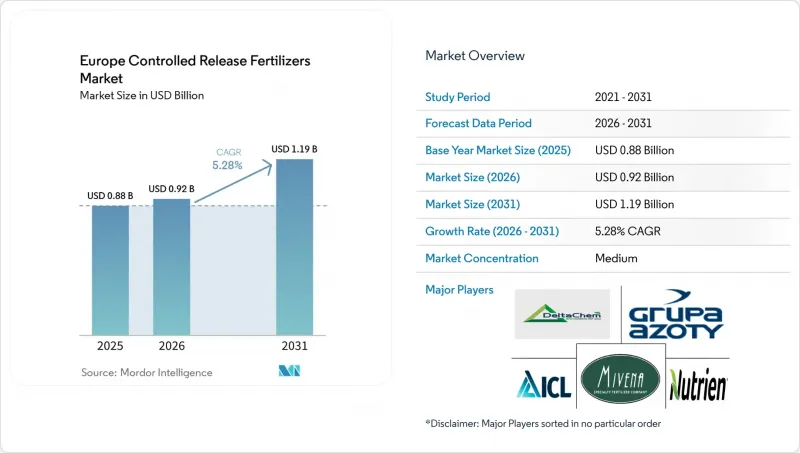
根據 Mordor Intelligence 預測,歐洲緩釋肥料市場在 2025 年的價值為 8.8 億美元,在 2026 年的價值為 9.2 億美元,從 2026 年到 2031 年的複合年成長率為 5.28%,到 2031 年將達到 11.9 億美元。
本報告按塗料類型(聚合物塗料、聚合物硫塗料及其他)、作物類型(田間作物、園藝作物、草坪和觀賞作物)以及地區(法國、德國、義大利、荷蘭、俄羅斯、西班牙、烏克蘭、英國及其他歐洲國家)進行細分。市場預測以貨幣值和數量值兩種形式呈現。
歐洲緩釋肥料市場的趨勢與洞察
受環境問題的影響,歐盟北部禁止使用化學肥料,這推動了緩效肥料的迅速普及。
丹麥和瑞典對傳統化肥使用的季節性禁令延長了限制期,迫使生產者使用能更長時間為作物提供養分的肥料。因此,2024年至2025年間,整個斯堪地那維亞緩釋肥料的使用率激增了40%。監管重點的轉變也改變了農業理念,從短期養分供應轉向全年養分供應。各國執法機構現在要求提供已批准的緩釋肥料使用記錄,作為合規的條件之一,而能夠證明符合REACH法規的生產商則享有先發優勢。
歐盟「從農場到餐桌 2030」減少營養流失的目標要求加快 CRF 補貼的發放。
法國已在其通用農業政策(CAP)環境支持措施中累計1.5億歐元(約1.605億美元),用於補貼購買緩釋肥料成本的40%,使即使是中型農場也能經濟有效地採用高性能包膜技術。德國聯邦農業部也正在資助一項類似的計劃,優先發展能夠提高養分利用效率的技術。這些補貼可以抵消緩釋肥料較高的初始成本,並使生產者能夠透過降低環境遵循成本來收回投資。
生物基塗料化學品認證監理流程延誤
歐洲化學品管理局 (ECHA) 對新型可生物分解塗層材料的 REACH 註冊流程要求進行廣泛的毒性測試和環境動力學研究,批准可能需要三年以上。這嚴重阻礙了緩效肥料技術的創新。這項監管瓶頸使得製造商無法充分利用市場對環保塗層系統的需求,迫使他們依賴傳統的聚合物技術,而這些技術本身也面臨淘汰的期限。核准延遲造成了市場的不確定性,並阻礙了對下一代塗層材料研發的投資。企業必須在多個歐洲司法管轄區並行推進核准流程,而每個司法管轄區的要求和時間安排各不相同,這進一步增加了創新塗層技術打入市場策略。
細分市場分析
聚合物包膜肥料在歐洲緩效肥料市場佔最大佔有率,預計到2025年將達到57.7%。這一主導地位源自於其卓越的性能特性以及遍佈歐洲的成熟生產體系。此細分市場的優勢在於其成熟的養分釋放特性,可根據作物養分吸收模式進行精確調節,釋放週期從2個月到24個月不等,具體取決於包膜厚度和配方。 ICL集團等公司已在下一代聚合物技術方面投入巨資,包括旨在提高養分利用效率和永續性目標的生物分解包膜系統。
聚合物和硫包膜肥料預計將成為成長最快的細分市場,2026年至2031年的複合年成長率將達到7.4%。這些產品結合了控制釋放和補充硫元素的優勢,使其在缺硫生產系統中越來越受歡迎。儘管聚合物和硫包膜肥料目前的市場佔有率較小,但其成本效益和農藝效益表明其將迅速推廣。其他類別包括新興的包膜技術,例如天然蠟基和礦物基配方。這些技術目前僅限於特定應用領域,在商業化和規模化生產方面面臨挑戰。歐洲各地的監管和永續性措施正在加速可生物分解和生物基包膜材料的研究,包括澱粉衍生聚合物和其他可再生替代品。預計這一轉變將為創新企業創造新的機遇,同時也將為製造商帶來更大的壓力,促使產品系列以適應不斷變化的環境要求。
其他好處:
- Excel格式的市場預測(ME)表
- 3個月的分析師支持
目錄
第1章:引言
- 研究假設和市場定義
- 調查範圍
- 調查方法
第2章:本報告的內容
第3章:執行摘要和主要發現
第4章:主要產業趨勢
- 主要農作物種植面積
- 田間作物
- 園藝作物
- 平均施肥量
- 主要營養素
- 田間作物
- 園藝作物
- 主要營養素
- 法律規範
- 價值鍊和通路分析
- 市場促進因素
- 受環境問題的影響,歐盟北部國家禁止使用化肥,這助長了化學精煉農場(CRF)的快速蔓延。
- 歐盟「從農場到餐桌 2030」減少營養流失的指令正在加快向社區救濟基金 (CRF) 提供津貼。
- 一種含有可生物分解聚合物的塗層,可降低加工企業的廢棄物處理成本。
- 將土壤感測器數據與大型農場的控釋肥處方箋聯繫起來的數位孿生體。
- 葡萄園滴灌和施肥系統的維修正在蓬勃發展,對低鹽度 CRF(化學紅纖維)肥料的需求也不斷增加。
- 垂直農業經營者正在努力規範微劑量型 CRF基材塊。
- 市場限制因素
- 生物基塗料化學品認證監理流程延誤
- 通貨膨脹導致聚合物成本急劇上升,給 CRF 製造商的利潤率帶來了壓力。
- 在奧德爾河以東,零售商對農業技術知識的掌握程度不一,阻礙了農民採用這些技術。
- 人們對顆粒物釋放的擔憂促使遊說活動不斷進行,要求對塗料進行可追溯性管理。
第5章 市場規模與成長預測
- 塗層類型
- 聚合物塗層
- 聚合物硫塗層
- 其他
- 作物類型
- 田間作物
- 園藝作物
- 草坪和觀賞植物
- 國家
- 法國
- 德國
- 義大利
- 荷蘭
- 俄羅斯
- 西班牙
- 烏克蘭
- 英國
- 其他歐洲國家
第6章 競爭情勢
- 關鍵策略趨勢
- 市佔率分析
- 企業狀況
- 公司簡介。
- Ekompany International BV(DeltaChem)
- Grupa Azoty SA(Compo Expert)
- Haifa Group
- ICL Group Ltd
- Mivena BV
- Nutrien Ltd.
第7章 化肥產業執行長面臨的關鍵策略挑戰
According to Mordor Intelligence, the Europe controlled release fertilizers market size was USD 0.88 billion in 2025 and USD 0.92 billion in 2026, and is forecast to reach USD 1.19 billion by 2031 at a 5.28% CAGR over 2026-2031.
This report is Segmented by Coating Type (Polymer-Coated, Polymer-Sulfur Coated, and Others), Crop Type (Field Crops, Horticultural Crops, and Turf and Ornamental), and Geography (France, Germany, Italy, Netherlands, Russia, Spain, Ukraine, United Kingdom, and Rest of Europe). The Market Forecasts are Provided in Terms of Value (USD) and Volume (Metric Tons).
Europe Controlled Release Fertilizers Market Trends and Insights
Environmental-driven fertilizer bans in Northern EU pushing rapid CRF adoption
Seasonal bans on conventional fertilizers in Denmark and Sweden have lengthened restriction periods and forced growers to use nutrient forms that supply crops over an extended window. This led to a 40% jump in controlled release fertilizers penetration across Scandinavia between 2024 and 2025. The regulatory emphasis has shifted the agronomic mindset from short-term nutrient boosts to season-long availability. National enforcement agencies now hinge compliance on documented use of approved controlled release products, and manufacturers that demonstrate REACH compliance enjoy a first-mover edge.
EU Farm-to-Fork 2030 nutrient-loss mandates accelerating CRF subsidies
France earmarked EUR 150 million (USD 160.5 million) in Common Agricultural Policy eco-schemes to reimburse up to 40% of controlled release fertilizers purchases, making premium coatings economically viable for mid-sized farms. Germany's federal agriculture ministry is funding similar programs that prioritize nutrient-use-efficiency technologies. These subsidies neutralize the higher upfront cost of controlled release fertilizers and allow growers to recoup investment through reduced environmental compliance fees.
Slow regulatory path for certifying bio-based coating chemistries
The European Chemicals Agency's REACH registration process for novel biodegradable coating materials requires extensive toxicological and environmental fate studies that can extend approval timelines beyond 3 years, creating significant barriers for innovation in controlled release fertilizers technologies. This regulatory bottleneck prevents manufacturers from capitalizing on market demand for environmentally compliant coating systems, forcing continued reliance on conventional polymer technologies that face their own phase-out timelines. The approval delays create market uncertainty and discourage investment in research and development of next-generation coating materials. Companies must navigate parallel approval processes across multiple European jurisdictions, each with distinct requirements and timelines, further complicating market entry strategies for innovative coating technologies.
Other drivers and restraints analyzed in the detailed report include:
- Blended biodegradable polymer coatings cutting disposal costs for processors
- Digital twins linking soil-sensor data to CRF prescriptions on large estates
- Inflation-driven polymer cost spikes squeezing producer margins
For complete list of drivers and restraints, kindly check the Table Of Contents.
Segment Analysis
Polymer-coated controlled-release fertilizers accounted for the largest Europe controlled release fertilizers market share, representing 57.7% of the market in 2025. Their dominance reflects superior performance characteristics and a well-established manufacturing base across European production facilities. The segment benefits from proven nutrient-release profiles that can be precisely calibrated to match crop nutrient uptake patterns, with release durations ranging from two to 24 months depending on coating thickness and formulation. Companies such as ICL Group have invested heavily in next-generation polymer technologies, including biodegradable coating systems designed to improve nutrient-use efficiency and support sustainability objectives.
Polymer-sulfur-coated fertilizers are projected to be the fastest-growing segment, registering a CAGR of 7.4% during 2026-2031. These products combine the benefits of controlled nutrient release with supplemental sulfur nutrition, making them increasingly attractive in sulfur-deficient production systems. While polymer-sulfur-coated fertilizers currently account for a smaller share of the market, their cost-effectiveness and agronomic benefits are anticipated to support rapid adoption. The "Others" category includes emerging coating technologies such as natural wax-based and mineral-based formulations, which currently serve niche applications but face commercialization and scalability challenges. Regulatory and sustainability initiatives across Europe are accelerating research into biodegradable and bio-based coating materials, including starch-derived polymers and other renewable alternatives. This transition is anticipated to create opportunities for innovation leaders while increasing pressure on manufacturers to adapt their product portfolios to evolving environmental requirements.
Complete Report Scope:
- Coating Type
- Polymer Coated
- Polymer-Sulfur Coated
- Others
- Crop Type
- Field Crops
- Horticultural Crops
- Turf & Ornamental
- Country
- France
- Germany
- Italy
- Netherlands
- Russia
- Spain
- Ukraine
- United Kingdom
- Rest of Europe
List of Companies Covered in this Report:
- Ekompany International BV (DeltaChem)
- Grupa Azoty S.A. (Compo Expert)
- Haifa Group
- ICL Group Ltd
- Mivena BV
- Nutrien Ltd.
Additional Benefits:
- The market estimate (ME) sheet in Excel format
- 3 months of analyst support
TABLE OF CONTENTS
1 INTRODUCTION
- 1.1 Study Assumptions & Market Definition
- 1.2 Scope of the Study
- 1.3 Research Methodology
2 REPORT OFFERS
3 EXECUTIVE SUMMARY & KEY FINDINGS
4 KEY INDUSTRY TRENDS
- 4.1 Acreage Of Major Crop Types
- 4.1.1 Field Crops
- 4.1.2 Horticultural Crops
- 4.2 Average Nutrient Application Rates
- 4.2.1 Primary Nutrients
- 4.2.1.1 Field Crops
- 4.2.1.2 Horticultural Crops
- 4.2.1 Primary Nutrients
- 4.3 Regulatory Framework
- 4.4 Value Chain & Distribution Channel Analysis
- 4.5 Market Drivers
- 4.5.1 Environmental-driven fertilizer bans in Northern EU pushing rapid CRF adoption
- 4.5.2 EU "Farm-to-Fork" 2030 nutrient-loss mandates accelerating CRF subsidies
- 4.5.3 Blended biodegradable polymer coatings cutting disposal costs for processors
- 4.5.4 Digital twins linking soil-sensor data to CRF prescriptions on large estates
- 4.5.5 Surge in vineyard drip-fertigation retrofits requiring low-salt CRF formats
- 4.5.6 Vertical-farm operators standardizing on micro-dose CRF substrate cubes
- 4.6 Market Restraints
- 4.6.1 Slow regulatory path for certifying bio-based coating chemistries
- 4.6.2 Inflation-driven polymer cost spikes squeezing CRF producer margins
- 4.6.3 Patchy retailer agronomy skills limiting farmer uptake east of the Oder
- 4.6.4 Microparticle-shedding concerns triggering lobbying for coating traceability
5 MARKET SIZE AND GROWTH FORECASTS (VALUE AND VOLUME)
- 5.1 Coating Type
- 5.1.1 Polymer Coated
- 5.1.2 Polymer-Sulfur Coated
- 5.1.3 Others
- 5.2 Crop Type
- 5.2.1 Field Crops
- 5.2.2 Horticultural Crops
- 5.2.3 Turf & Ornamental
- 5.3 Country
- 5.3.1 France
- 5.3.2 Germany
- 5.3.3 Italy
- 5.3.4 Netherlands
- 5.3.5 Russia
- 5.3.6 Spain
- 5.3.7 Ukraine
- 5.3.8 United Kingdom
- 5.3.9 Rest of Europe
6 COMPETITIVE LANDSCAPE
- 6.1 Key Strategic Moves
- 6.2 Market Share Analysis
- 6.3 Company Landscape
- 6.4 Company Profiles (Includes Global Level Overview, Market Level Overview, Core Business Segments, Financials, Headcount, Key Information, Market Rank, Market Share, Products and Services, and Analysis of Recent Developments).
- 6.4.1 Ekompany International BV (DeltaChem)
- 6.4.2 Grupa Azoty S.A. (Compo Expert)
- 6.4.3 Haifa Group
- 6.4.4 ICL Group Ltd
- 6.4.5 Mivena BV
- 6.4.6 Nutrien Ltd.
7 KEY STRATEGIC QUESTIONS FOR FERTILIZER CEOS

 緩釋液體肥料市場:全球市場預測,2026-2032年
 尿素酶抑制劑市場規模、佔有率和成長分析:按產品類型、劑型、應用、作物類型、最終用戶和地區分類 - 產業預測,2026-2033年
 油籽和豆類接種劑市場規模、佔有率和成長分析:按作物類型、微生物、配方、應用和地區分類-2026-2033年產業預測
 生物分解聚合物包膜複合肥料:市場佔有率分析、產業趨勢與統計、成長預測(2026-2031)
 富含抗氧化劑的果油市場規模、佔有率和成長分析:按原料水果、萃取方法、終端用戶產業、銷售管道和地區分類-2026-2033年產業預測美國可生物分解緩釋肥料:市場佔有率分析、產業趨勢和統計數據以及成長預測(2026-2031 年)美國緩釋肥料:市場佔有率分析、行業趨勢和統計數據以及成長預測(2026-2031 年)中國緩釋肥料:市場佔有率分析、產業趨勢與統計及成長預測(2026-2031年)北美緩釋肥料:市佔率分析、產業趨勢與統計及成長預測(2026-2031 年)
 2026 年至 2035 年緩釋肥料市場的商業機會、成長要素、產業趨勢與預測。