


 |
市場調查報告書
商品編碼
2100721
美國緩釋肥料:市場佔有率分析、行業趨勢和統計數據以及成長預測(2026-2031 年)United States Controlled Release Fertilizers - Market Share Analysis, Industry Trends & Statistics, Growth Forecasts (2026 - 2031) |
||||||

※ 本網頁內容可能與最新版本有所差異。詳細情況請與我們聯繫。
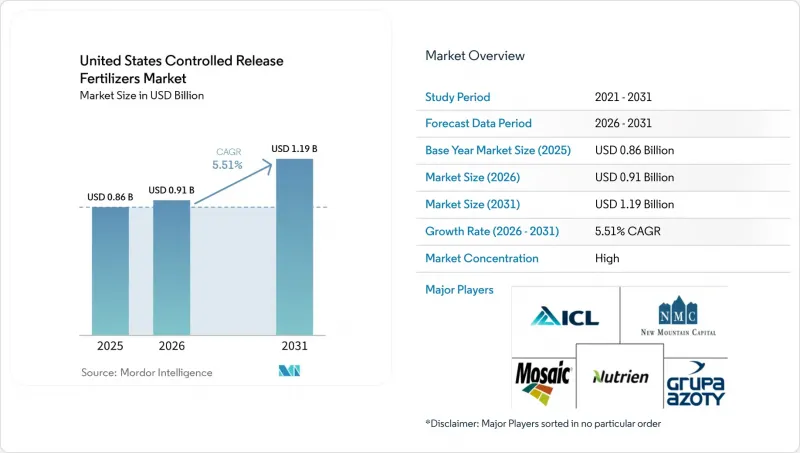
據 Mordor Intelligence 稱,2025 年美國緩釋肥料市場價值 8.6 億美元,預計到 2031 年將從 2026 年的 9.1 億美元成長至 11.9 億美元,預測期(2026-2031 年)複合年成長率為 5.51%。
本報告按塗料類型(聚合物塗料、聚合物硫塗料及其他)和作物類型(田間作物、園藝作物和草坪/觀賞植物)進行分類。市場預測以貨幣值和數量值兩種形式呈現。
美國緩釋肥料市場的趨勢與洞察
精密農業的引進提高了養分利用效率。
透過將變數施肥技術與緩釋肥料結合,可以根據不同土壤特性,最佳化各區域的施肥位置和時間。美國農業部經濟研究局的報告顯示,2024年,大多數玉米面積的精準施肥都採用了聚合物包膜尿素,在不損失產量的情況下,可減少15-20%的氮肥總用量。 GPS導航的廣泛應用最大限度地減少了田邊重複施肥,而傳統施肥方法往往會造成田邊養分的浪費。這些優勢有助於降低投入成本、改善土壤健康並符合徑流標準,從而促進大型種植園面積栽農業中的廣泛應用。
各國對 CRF 出境實施更嚴格的限制,促進了 CRF 的普及。
俄亥俄州的H2Ohio計畫將在2024年承擔緩釋肥料溢價的大部分成本,這將推動130萬英畝土地上的產品試點推廣。切薩皮克灣沿岸各州已收緊了最大允許日負荷量(TMDL)的監管,要求農民證明其養分利用效率提高。緩釋技術符合這些要求,它僅在溫度和濕度條件適宜作物吸收時才釋放氮肥,從而減少養分流失。違規行為的處罰進一步加速了美國市場向緩釋肥料解決方案的轉型。
與傳統尿素相比的價格差異
包膜肥料比普瑞瑞肥料貴40-60%,這在玉米利潤率不斷下降的市場中構成了一大障礙。儘管天然氣價格在2024年趨於穩定,但用於生產包膜的石化產品價格仍波動不定,進一步擴大了價格差距。現金流有限的小規模農戶往往會等到確認產量切實提高和勞動成本降低後才考慮採用包膜肥料,導致傳統的高氮肥種植系統推廣緩慢。
細分市場分析
到2025年,聚合物包膜肥料將佔據美國緩效肥料市場58.0%的佔有率。其主導地位得益於墨西哥灣沿岸地區生產設施的規模經濟效益,有助於降低單位成本,以及在玉米、大豆、草坪和特種作物系統中久經考驗的卓越性能。聚合物包膜尿素和聚合物包膜複合肥因其能夠提高養分利用率、減少養分流失並降低施用頻率而已廣泛應用。隨著包膜技術的不斷進步,預計種植者在追求更高產量和更佳環境效益方面的需求將進一步擴大其應用範圍。
聚合物硫包膜肥料是成長最快的細分市場,預計2026年至2031年複合年成長率將達到7.4%。這一成長主要得益於其雙重功效配方,既能有效控制養分釋放,又能滿足缺硫土壤日益成長的硫肥補充需求。此外,對硫肥敏感作物的種植面積不斷擴大、人們對均衡營養管理的認知不斷提高以及對提高肥料利用效率的需求,都推動了聚合物硫包膜肥料的普及。同時,包膜技術的持續創新,在提升養分釋放性能的同時保持成本競爭力,預計將進一步加速聚合物硫包膜肥料的需求。
其他好處:
- Excel格式的市場預測(ME)表
- 3個月的分析師支持
目錄
第1章:引言
- 研究假設和市場定義
- 調查範圍
- 調查方法
第2章:本報告的內容
第3章:執行摘要和主要發現
第4章:主要產業趨勢
- 主要農作物種植面積
- 田間作物
- 園藝作物
- 平均施肥量
- 田間作物
- 園藝作物
- 法律規範
- 價值鍊和通路分析
- 市場促進因素
- 精密農業的引進提高了養分利用效率。
- 國家對徑流水施加的限制將促進氣候響應基金的採用。
- 陽光地帶主要大都市地區在草坪和觀賞植物上的支出增加。
- 在美國,人們正在生產可生物分解的塗層,以降低屏障的成本。
- 美國農業部(USDA)氣候智慧試點計畫提供的獎勵旨在減少氮肥的使用。
- 擴大路易斯安那州和喬治亞。
- 市場限制因素
- 與傳統尿素相比的價格差異
- 對進口塗料樹脂供應鏈的依賴
- 玉米帶地區獨立農戶的意識水平仍然很低。
- 產品價格波動導致投資報酬率不確定性
第5章 市場規模與成長預測
- 按塗層類型
- 聚合物塗層
- 聚合物硫塗層
- 其他
- 按作物類型
- 田間作物
- 園藝作物
- 草坪和觀賞植物
第6章 競爭情勢
- 市場集中度
- 策略趨勢
- 市佔率分析
- 公司簡介
- Nutrien Ltd.
- The Mosaic Company
- ICL Group Ltd.
- Koch Fertilizer LLC
- Scotts Miracle-Gro Company
- Yara International ASA
- Haifa Chemicals Ltd.
- Agro-Culture Liquid Fertilizers, LLC
- JR Simplot Company
- Helena Agri-Enterprises, LLC
- The Andersons, Inc.
- Florikan ESA LLC(New Mountain Capital)
- Grupa Azoty SA(COMPO Expert)
- Pursell AgriTech, LLC
- Knox Fertilizer Company, Inc.
第7章 化肥產業執行長面臨的關鍵策略挑戰
According to Mordor Intelligence, the United States controlled release fertilizers market size was valued at USD 0.86 billion in 2025 and estimated to grow from USD 0.91 billion in 2026 to reach USD 1.19 billion by 2031, at a CAGR of 5.51% during the forecast period (2026-2031).
This report is Segmented by Coating Type (Polymer Coated, Polymer-Sulfur Coated, Others) and by Crop Type (Field Crops, Horticultural Crops, Turf and Ornamental). The Market Forecasts are Provided in Terms of Value (USD) and Volume (Metric Tons).
United States Controlled Release Fertilizers Market Trends and Insights
Precision Agriculture Adoption Boosting Nutrient Use Efficiency
Variable-rate technology, paired with controlled-release products, optimizes both placement and timing across zones with varying soil profiles. The USDA Economic Research Service reported that the majority of corn acreage precision coverage in 2024 utilized polymer-coated urea, resulting in a 15-20% reduction in total nitrogen use without yield loss . Wider GPS guidance use minimizes overlap at field edges, where conventional applications often waste nutrients. These gains translate into lower input costs, improved soil health, and compliance with runoff standards, reinforcing broad uptake across large-acreage row-crop operations.
Stricter State Runoff Rules Encouraging CRF Uptake
Ohio's H2Ohio program covered the majority of the cost-share on controlled-release premiums in 2024, spurring a surge in product trials across 1.3 million acres . Chesapeake Bay states tightened total maximum daily load mandates, requiring farmers to document nutrient-use efficiency gains. Controlled release technologies meet these obligations by releasing nitrogen only when temperature and moisture conditions favor crop uptake, thereby reducing leaching. Financial penalties for non-compliance further motivate the transition to the United States-controlled release of fertilizers market solutions.
Premium Price Gap Versus Conventional Urea
Coated fertilizers cost 40-60% more than prilled urea, a hurdle when corn margins tighten. In 2024, natural gas costs eased, but petrochemical inputs for coatings remained volatile, widening the premium. Smaller operators with limited cash flow tend to delay adoption until they learn that the adoption demonstrates tangible yield or labor savings, thereby slowing penetration in traditional nitrogen-intensive systems.
Other drivers and restraints analyzed in the detailed report include:
- Rising Turf and Ornamental Spending in Sun Belt Metros
- United States Manufactures Biodegradable Coatings Lowering Cost Barriers
- Farmer Awareness Still Low Among Corn Belt Independents
For complete list of drivers and restraints, kindly check the Table Of Contents.
Segment Analysis
Polymer-coated fertilizers accounted for 58.0% of the United States controlled release fertilizers market share in 2025. Their leadership is supported by scale economies at Gulf Coast production facilities, which help reduce unit costs, and by proven performance across corn, soybean, turf, and specialty crop systems. Polymer-coated urea and polymer-coated multi-nutrient blends remain widely adopted due to their ability to improve nutrient-use efficiency, reduce nutrient losses, and lower application frequency. Continued advancements in coating technologies are anticipated to further strengthen adoption among growers seeking productivity gains and improved environmental performance.
Polymer-sulfur-coated fertilizers represent the fastest-growing segment and are projected to register a CAGR of 7.4% during 2026-2031. Growth is driven by their dual-benefit formulation, which combines controlled nutrient release with supplemental sulfur nutrition that is increasingly required in sulfur-deficient soils. Rising cultivation of sulfur-responsive crops, growing awareness of balanced nutrient management, and the need to improve fertilizer-use efficiency are supporting adoption. In addition, ongoing innovations in coating technologies that enhance nutrient-release performance while maintaining cost competitiveness are anticipated to further accelerate demand for polymer-sulfur-coated fertilizers.
Complete Report Scope:
- By Coating Type
- Polymer Coated
- Polymer-Sulfur Coated
- Others
- By Crop Type
- Field Crops
- Horticultural Crops
- Turf and Ornamental
List of Companies Covered in this Report:
- Nutrien Ltd.
- The Mosaic Company
- ICL Group Ltd.
- Koch Fertilizer LLC
- Scotts Miracle-Gro Company
- Yara International ASA
- Haifa Chemicals Ltd.
- Agro-Culture Liquid Fertilizers, LLC
- J.R. Simplot Company
- Helena Agri-Enterprises, LLC
- The Andersons, Inc.
- Florikan ESA LLC (New Mountain Capital)
- Grupa Azoty S.A. (COMPO Expert)
- Pursell AgriTech, LLC
- Knox Fertilizer Company, Inc.
Additional Benefits:
- The market estimate (ME) sheet in Excel format
- 3 months of analyst support
TABLE OF CONTENTS
1 INTRODUCTION
- 1.1 Study Assumptions and Market Definition
- 1.2 Scope of the Study
- 1.3 Research Methodology
2 REPORT OFFERS
3 EXECUTIVE SUMMARY AND KEY FINDINGS
4 KEY INDUSTRY TRENDS
- 4.1 Acreage of Major Crop Types
- 4.1.1 Field Crops
- 4.1.2 Horticultural Crops
- 4.2 Average Nutrient Application Rates
- 4.2.1 Field Crops
- 4.2.2 Horticultural Crops
- 4.3 Regulatory Framework
- 4.4 Value Chain and Distribution Channel Analysis
- 4.5 Market Drivers
- 4.5.1 Precision-ag adoption boosting nutrient-use efficiency
- 4.5.2 Stricter state runoff rules encouraging CRF uptake
- 4.5.3 Rising turf-and-ornamental spending in Sun Belt metros
- 4.5.4 United States manufactures biodegradable coatings lowering cost barriers
- 4.5.5 USDA climate-smart pilot incentives for N-use reduction
- 4.5.6 Expanding polymer-coated urea capacity in Louisiana and Georgia
- 4.6 Market Restraints
- 4.6.1 Premium price gap versus conventional urea
- 4.6.2 Supply-chain exposure to imported coating resins
- 4.6.3 Farmer awareness still low in Corn Belt independents
- 4.6.4 Uncertain ROI under volatile commodity prices
5 MARKET SIZE AND GROWTH FORECASTS (VALUE AND VOLUME)
- 5.1 By Coating Type
- 5.1.1 Polymer Coated
- 5.1.2 Polymer-Sulfur Coated
- 5.1.3 Others
- 5.2 By Crop Type
- 5.2.1 Field Crops
- 5.2.2 Horticultural Crops
- 5.2.3 Turf and Ornamental
6 COMPETITIVE LANDSCAPE
- 6.1 Market Concentration
- 6.2 Strategic Moves
- 6.3 Market Share Analysis
- 6.4 Company Profiles (includes Global Level Overview, Market Level Overview, Core Segments, Financials as available, Strategic Information, Market Rank/Share, Products and Services, Recent Developments)
- 6.4.1 Nutrien Ltd.
- 6.4.2 The Mosaic Company
- 6.4.3 ICL Group Ltd.
- 6.4.4 Koch Fertilizer LLC
- 6.4.5 Scotts Miracle-Gro Company
- 6.4.6 Yara International ASA
- 6.4.7 Haifa Chemicals Ltd.
- 6.4.8 Agro-Culture Liquid Fertilizers, LLC
- 6.4.9 J.R. Simplot Company
- 6.4.10 Helena Agri-Enterprises, LLC
- 6.4.11 The Andersons, Inc.
- 6.4.12 Florikan ESA LLC (New Mountain Capital)
- 6.4.13 Grupa Azoty S.A. (COMPO Expert)
- 6.4.14 Pursell AgriTech, LLC
- 6.4.15 Knox Fertilizer Company, Inc.
7 KEY STRATEGIC QUESTIONS FOR FERTILIZER CEOS

 緩釋液體肥料市場:全球市場預測,2026-2032年
 尿素酶抑制劑市場規模、佔有率和成長分析:按產品類型、劑型、應用、作物類型、最終用戶和地區分類 - 產業預測,2026-2033年
 油籽和豆類接種劑市場規模、佔有率和成長分析:按作物類型、微生物、配方、應用和地區分類-2026-2033年產業預測
 生物分解聚合物包膜複合肥料:市場佔有率分析、產業趨勢與統計、成長預測(2026-2031)
 富含抗氧化劑的果油市場規模、佔有率和成長分析:按原料水果、萃取方法、終端用戶產業、銷售管道和地區分類-2026-2033年產業預測美國可生物分解緩釋肥料:市場佔有率分析、產業趨勢和統計數據以及成長預測(2026-2031 年)歐洲緩效肥料:市場佔有率分析、產業趨勢與統計及成長預測(2026-2031 年)中國緩釋肥料:市場佔有率分析、產業趨勢與統計及成長預測(2026-2031年)北美緩釋肥料:市佔率分析、產業趨勢與統計及成長預測(2026-2031 年)
 2026 年至 2035 年緩釋肥料市場的商業機會、成長要素、產業趨勢與預測。