


 |
市場調查報告書
商品編碼
2099809
美國可生物分解緩釋肥料:市場佔有率分析、產業趨勢和統計數據以及成長預測(2026-2031 年)United States Biodegradable Controlled-Release Fertilizer - Market Share Analysis, Industry Trends & Statistics, Growth Forecasts (2026 - 2031) |
||||||

※ 本網頁內容可能與最新版本有所差異。詳細情況請與我們聯繫。
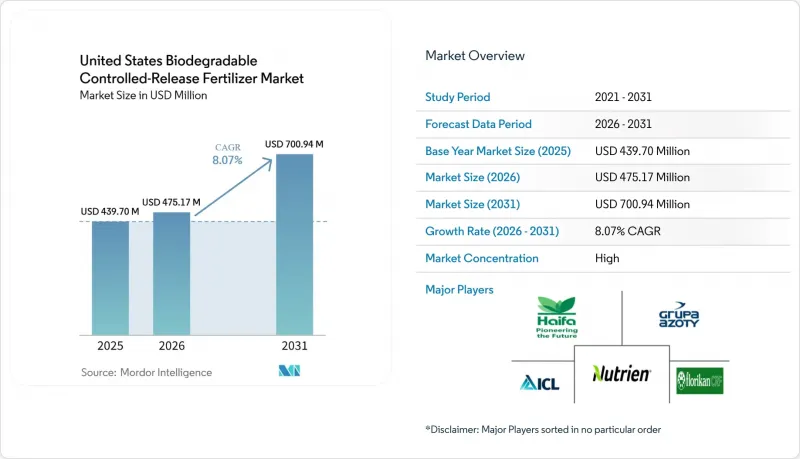
據 Mordor Intelligence 稱,2025 年美國可生物分解緩釋肥料市場價值為 4.397 億美元,預計到 2031 年將達到 7.009 億美元,而 2026 年為 4.752 億美元,預測期(2026-2031 年)的複合年成長率為 8.1%。
本報告按作物類型(穀物、豆類和油籽、經濟作物、水果和蔬菜以及草坪和觀賞植物)進行分類。市場預測以價值(美元)和數量(公噸)兩種形式呈現。
美國可生物分解緩釋肥料市場的趨勢與洞察
擴大精密農業在輪作農業的應用
隨著變數施肥系統和基於感測器的養分施用技術的應用,美國可生物分解緩釋肥料市場在主流糧食種植中的重要性日益凸顯。精密農業技術在主要經濟作物中的應用顯著擴展,形成了一個強大的用戶基礎,為數據驅動的養分管理提供了支持。緩釋肥料非常適合一次性完成施肥的策略,有助於減少重複施肥、最大限度地減少浪費並提高施肥時間的精準度。這種優勢在犁地農業和減少施肥次數的耕作系統中尤為突出,因為種植者希望在整個生長季節獲得穩定的養分供應,而無需反覆施肥。精準施肥也有助於減少田邊肥料的流失,而田邊通常是肥料流失效率最低的地方,這使得即使在管理良好的農場,緩釋肥料的價值也更容易得到體現。随着精密農業在玉米和大豆种植系统中得到更广泛的应用,零售商越来越多地将缓释肥料整合到标准施肥方案中,而不是将其定位为小众产品或特殊解决方案。
全州範圍內對水徑流的限制加強了防止營養流失的措施。
全州範圍內的養分徑流法規正在改變美國可生物分解緩釋肥料的市場格局,使其從純粹的農業可自由支配改良類別轉變為與監管合規緊密相關的類別。愛荷華州於2025年2月修訂了其養分減排策略,為種植者提供了一個更正式的框架,以便根據當地情況最佳化氮肥施用。政策更新和州級計畫明確了最佳化氮肥使用的框架,而獎勵機制則提高了採用高效肥料產品的經濟效益。這些措施鼓勵種植者將養分施用實踐與環境績效標準一致。同時,流域持續面臨達到養分減量目標的壓力,進一步增加了控制滲濾液和徑流解決方案的需求。地方法規透過規定農業和非農業用途肥料中緩釋氮含量的最低要求,進一步強化了這一趨勢。雖然這些政策沒有強制規定特定的肥料類型,但它們始終強調提高養分利用效率,並減少對傳統施用方法的依賴。因此,更嚴格的監管仍然是推動美國可生物分解緩釋肥料市場成長的主要短期因素。
與傳統尿素相比的價格差異
可生物分解緩釋肥料進入美國市場的最大障礙仍然是其相對於傳統尿素的價格溢價。受供應中斷和地緣政治不確定性影響,氮肥成本不斷上漲,對生產者的預算造成更大壓力,也使他們對投入成本的上漲更加敏感。在大型農業區,這項挑戰尤其突出,因為生產者會仔細評估每英畝的獲利能力,並將所有投入與成本更低的通用肥料進行比較。雖然緩釋產品具有提高效率、減少養分流失和減少施肥次數等優勢,但這些優勢並非總是能體現在初始價格的簡單比較中。州和聯邦政府的獎勵計劃有助於抵消部分成本差異,但無法完全消除初始購買的障礙。只要傳統肥料仍然是更簡單、成本更低的選擇,價格阻力就可能繼續限制可生物分解緩釋肥料在美國的廣泛應用。
細分市場分析
到2025年,穀物將占美國可生物分解緩釋肥料市場佔有率的86.9%,使其成為美國可生物分解緩釋肥料市場中按作物類型分類的最大佔有率。這一細分市場的規模主要源自於玉米種植面積廣闊,以及氮肥管理在農作物盈利和合規性方面所扮演的核心角色。即使在如此廣泛的面積上,包膜性肥料的使用量略有增加,也能顯著提升整體銷售量。此外,研究表明,緩釋氮肥有助於提高穀物作物的養分利用效率和產量,從而推動其在整個穀物種植系統中廣泛應用。對於豆類和油籽作物而言,其優勢在於可以減少在有限的種植季節內的施肥次數;而對於經濟作物和草坪應用,則更多地體現在對施肥時間和勞動效率要求較高的持續性應用場景中。
預計到2031年,蔬果市場將以12.0%的複合年成長率成長,成為美國可生物分解緩釋肥料市場中成長最快的作物細分市場。這一成長反映了漿果、柑橘類水果、堅果和新鮮蔬菜等作物每英畝盈利的不斷提高,在這些領域,合理施肥時機的價值很容易轉化為實際收益。更好地控制養分輸送時間能夠直接提高作物品質和增加利潤,使高品質的肥料解決方案對專業農民更具經濟效益。此外,該領域與永續性目標和高效用水密切相關,因此對專業園藝產業越來越有吸引力。雖然穀物在規模上仍然佔據主導地位,但果蔬產業的高速成長為供應商提供了一條盈利的途徑,使其能夠在進一步滲透到大田作物之前,先在果蔬領域推廣可生物分解肥料的應用。
其他好處:
- Excel格式的市場預測(ME)表
- 3個月的分析師支持
目錄
第1章:引言
- 研究假設和市場定義
- 調查範圍
第2章:調查方法
第3章執行摘要
第4章 市場狀況
- 市場概覽
- 市場促進因素
- 擴大精密農業在輪作農業的應用
- 遵守國家洩漏法規,加強營養物質洩漏法規。
- 生物分解塗料的商業化降低了價格障礙。
- 陽光地帶對草坪和觀賞植物的需求不斷成長,導致優質肥料的使用範圍更廣。
- 美國農業部 (USDA) 的氣候適應性獎勵支持提高氮肥利用效率。
- 地方政府和組織對永續採購的需求日益成長
- 市場限制因素
- 與傳統尿素相比的價格差異
- 對進口樹脂和原料的依賴
- 玉米帶地區的獨立生產者鮮為人知。
- 商品價格波動對投資報酬率的敏感性
- 監理情勢
- 技術展望
- 波特五力分析
第5章 市場規模與成長預測
- 按作物類型
- 穀物和穀類
- 豆類和油籽
- 經濟作物
- 水果和蔬菜
- 草坪和觀賞植物
第6章 競爭情勢
- 市場集中度
- 策略趨勢
- 市佔率分析
- 公司簡介
- Nutrien Ltd.
- ICL Group Ltd.
- Haifa Group
- Grupa Azoty SA(COMPO EXPERT)
- Florikan ESA LLC(Profile Products LLC)
- The Scotts Miracle-Gro Company
- JR Simplot Company
- Helena Agri-Enterprises, LLC
- The Mosaic Company
- Koch Fertilizer LLC(Koch Industries, Inc.)
- Timac Agro USA(Groupe Roullier)
- Yara International ASA
- Pursell Fertilizer
- AgroLiquid
- Kingenta Ecological Engineering Group Co. Ltd.
第7章 市場機會與未來趨勢
According to Mordor Intelligence, the United States biodegradable controlled-release fertilizer market size was valued at USD 439.7 million in 2025 and is estimated to grow from USD 475.2 million in 2026 to reach USD 700.9 million by 2031, at a CAGR of 8.1% during the forecast period (2026-2031).
This report is Segmented by Crop Type (Grains and Cereals, Pulses and Oilseeds, Commercial Crops, Fruits and Vegetables, and Turfs and Ornamentals). The Market Forecasts are Provided in Terms of Value (USD) and Volume in (Metric Tons).
United States Biodegradable Controlled-Release Fertilizer Market Trends and Insights
Rising Precision Agriculture Adoption in Row Crop Farming
Variable-rate systems and sensor-guided nutrient placement are making the United States biodegradable controlled-release fertilizer market increasingly relevant to mainstream grain farming. Adoption of precision technologies has expanded significantly across major commodity crops, creating a strong installed base that supports data-driven nutrient management. Controlled-release fertilizers align well with single-pass application strategies, helping reduce overlap, minimize waste, and improve timing accuracy. This alignment is particularly beneficial in no-till and reduced-pass systems, where growers seek season-long nutrient performance without repeated field applications. Precision guidance also helps limit fertilizer loss at field edges, where inefficiencies are typically highest, making the value of controlled-release products easier to justify even in well-managed operations. As precision agriculture becomes more widely adopted in corn and soybean systems, retailers are increasingly integrating controlled-release fertilizers into standard fertility programs rather than positioning them as niche or specialty solutions.
State Runoff Compliance Tightening Nutrient Loss Controls
State nutrient-loss rules are turning the United States biodegradable controlled-release fertilizer market into a more compliance-linked category rather than a purely discretionary agronomic upgrade. Iowa updated its Nutrient Reduction Strategy in February 2025, providing growers with a more formal framework for optimizing nitrogen decisions based on local conditions. Policy updates and state programs are providing clearer frameworks for optimizing nitrogen use, while incentive-based initiatives are improving the economic case for adopting efficiency-enhancing products. These measures are encouraging growers to align nutrient application practices with environmental performance standards. At the same time, continued pressure on watershed regions to meet nutrient reduction targets is reinforcing the need for solutions that limit leaching and runoff. Local regulations are further strengthening this trend by setting minimum requirements for slow-release nitrogen content in fertilizers used across agricultural and non-agricultural applications. While these policies do not mandate specific product types, they consistently favor higher nutrient-use efficiency and reduce reliance on conventional applications. As a result, regulatory tightening remains a key near-term driver supporting adoption in the United States biodegradable controlled-release fertilizer market.
Premium Price Gap Versus Conventional Urea
The biggest barrier in the United States biodegradable controlled-release fertilizer market remains the price premium compared with conventional urea. Rising nitrogen fertilizer costs, driven by supply disruptions and broader geopolitical uncertainties, have increased pressure on grower budgets and heightened sensitivity to higher input costs. This challenge is particularly pronounced in large-scale farming regions, where producers closely evaluate per-acre returns and benchmark all inputs against lower-cost commodity fertilizers. Although controlled-release products offer benefits such as improved efficiency, reduced nutrient loss, and fewer application passes, these advantages are not always reflected in simple upfront price comparisons. While incentive programs at the state and federal levels can help offset some of the cost difference, they do not fully eliminate the initial purchase barrier. As long as conventional fertilizers remain the more straightforward, low-cost option, price resistance is likely to continue limiting broader adoption of biodegradable controlled-release fertilizers in the United States.
Other drivers and restraints analyzed in the detailed report include:
- Biodegradable Coating Commercialization Reduces Price Barriers
- Sun Belt Turf and Ornamental Demand is Expanding Premium Fertilizer Usage
- Imported Resin and Feedstock Dependence
For complete list of drivers and restraints, kindly check the Table Of Contents.
Segment Analysis
Grains and cereals accounted for 86.9% of the market in 2025, which gave this segment the largest United States biodegradable controlled-release fertilizer market share by crop type. The segment's scale is tied to the sheer acreage base of corn and the central role of nitrogen management in row-crop profitability and compliance. Even modest increases in the adoption of coated fertilizer across large crop areas can translate into significant overall volume growth. Research also indicates that controlled-release nitrogen fertilizers improve nutrient-use efficiency and yield performance in cereal crops, supporting broader adoption across grain systems. Pulses and oilseeds benefit from reduced application passes during tight planting windows, while commercial crops and turf applications provide more consistent use cases where timing and labor efficiency are critical.
Fruits and vegetables are projected to grow at a 12.0% CAGR through 2031, which makes them the fastest-growing crop segment in the United States biodegradable controlled-release fertilizer market. That growth reflects stronger per-acre economics in berries, citrus, tree nuts, and fresh vegetables, where the value of better nutrient timing is easier to monetize. The ability to better manage nutrient timing directly translates into improved crop quality and higher returns, making premium fertilizer solutions more economically viable for specialty growers. This segment also aligns closely with sustainability goals and efficient water use, increasing its appeal in professional horticulture. While grains remain dominant in scale, the higher growth rate in fruits and vegetables provides suppliers with a profitable pathway to expand biodegradable fertilizer adoption before wider penetration in row crops.
Complete Report Scope:
- By Crop Type
- Grains and Cereals
- Pulses and Oilseeds
- Commercial Crops
- Fruits and Vegetables
- Turf and Ornamentals
List of Companies Covered in this Report:
- Nutrien Ltd.
- ICL Group Ltd.
- Haifa Group
- Grupa Azoty S.A. (COMPO EXPERT)
- Florikan ESA LLC (Profile Products LLC)
- The Scotts Miracle-Gro Company
- J.R. Simplot Company
- Helena Agri-Enterprises, LLC
- The Mosaic Company
- Koch Fertilizer LLC (Koch Industries, Inc.)
- Timac Agro USA (Groupe Roullier)
- Yara International ASA
- Pursell Fertilizer
- AgroLiquid
- Kingenta Ecological Engineering Group Co. Ltd.
Additional Benefits:
- The market estimate (ME) sheet in Excel format
- 3 months of analyst support
TABLE OF CONTENTS
1 Introduction
- 1.1 Study Assumptions and Market Definition
- 1.2 Scope of the Study
2 Research Methodology
3 Executive Summary
4 Market Landscape
- 4.1 Market Overview
- 4.2 Market Drivers
- 4.2.1 Rising precision agriculture adoption in row crop farming
- 4.2.2 State runoff compliance, tightening nutrient loss controls
- 4.2.3 Biodegradable coating commercialization reduces price barriers
- 4.2.4 Sun Belt turf and ornamental demand is expanding premium fertilizer usage
- 4.2.5 USDA climate-smart incentives supporting nitrogen efficiency
- 4.2.6 Municipal and institutional sustainability procurement is in increasing demand
- 4.3 Market Restraints
- 4.3.1 Premium price gap versus conventional urea
- 4.3.2 Imported resin and feedstock dependence
- 4.3.3 Limited independent grower awareness in the corn belt
- 4.3.4 Return on investment sensitivity under commodity price volatility
- 4.4 Regulatory Landscape
- 4.5 Technological Outlook
- 4.6 Porter's Five Forces Analysis
- 4.6.1 Bargaining Power of Buyers
- 4.6.2 Bargaining Power of Suppliers
- 4.6.3 Threat of New Entrants
- 4.6.4 Threat of Substitutes
- 4.6.5 Intensity of Competitive Rivalry
5 Market Size and Growth Forecasts (Value and Volume)
- 5.1 By Crop Type
- 5.1.1 Grains and Cereals
- 5.1.2 Pulses and Oilseeds
- 5.1.3 Commercial Crops
- 5.1.4 Fruits and Vegetables
- 5.1.5 Turf and Ornamentals
6 Competitive Landscape
- 6.1 Market Concentration
- 6.2 Strategic Moves
- 6.3 Market Share Analysis
- 6.4 Company Profiles (Includes Global Level Overview, Market Level Overview, Core Segments, Financials as Available, Strategic Information, Market Rank/Share, Products and Services, Recent Developments)
- 6.4.1 Nutrien Ltd.
- 6.4.2 ICL Group Ltd.
- 6.4.3 Haifa Group
- 6.4.4 Grupa Azoty S.A. (COMPO EXPERT)
- 6.4.5 Florikan ESA LLC (Profile Products LLC)
- 6.4.6 The Scotts Miracle-Gro Company
- 6.4.7 J.R. Simplot Company
- 6.4.8 Helena Agri-Enterprises, LLC
- 6.4.9 The Mosaic Company
- 6.4.10 Koch Fertilizer LLC (Koch Industries, Inc.)
- 6.4.11 Timac Agro USA (Groupe Roullier)
- 6.4.12 Yara International ASA
- 6.4.13 Pursell Fertilizer
- 6.4.14 AgroLiquid
- 6.4.15 Kingenta Ecological Engineering Group Co. Ltd.
7 Market Opportunities and Future Trends

 緩釋液體肥料市場:全球市場預測,2026-2032年
 尿素酶抑制劑市場規模、佔有率和成長分析:按產品類型、劑型、應用、作物類型、最終用戶和地區分類 - 產業預測,2026-2033年
 油籽和豆類接種劑市場規模、佔有率和成長分析:按作物類型、微生物、配方、應用和地區分類-2026-2033年產業預測
 生物分解聚合物包膜複合肥料:市場佔有率分析、產業趨勢與統計、成長預測(2026-2031)
 富含抗氧化劑的果油市場規模、佔有率和成長分析:按原料水果、萃取方法、終端用戶產業、銷售管道和地區分類-2026-2033年產業預測歐洲緩效肥料:市場佔有率分析、產業趨勢與統計及成長預測(2026-2031 年)美國緩釋肥料:市場佔有率分析、行業趨勢和統計數據以及成長預測(2026-2031 年)中國緩釋肥料:市場佔有率分析、產業趨勢與統計及成長預測(2026-2031年)北美緩釋肥料:市佔率分析、產業趨勢與統計及成長預測(2026-2031 年)
 2026 年至 2035 年緩釋肥料市場的商業機會、成長要素、產業趨勢與預測。