


 |
市場調查報告書
商品編碼
2100554
歐洲LED構裝:市場佔有率分析、產業趨勢與統計及成長預測(2026-2031年)Europe LED Packaging - Market Share Analysis, Industry Trends & Statistics, Growth Forecasts (2026 - 2031) |
||||||

※ 本網頁內容可能與最新版本有所差異。詳細情況請與我們聯繫。
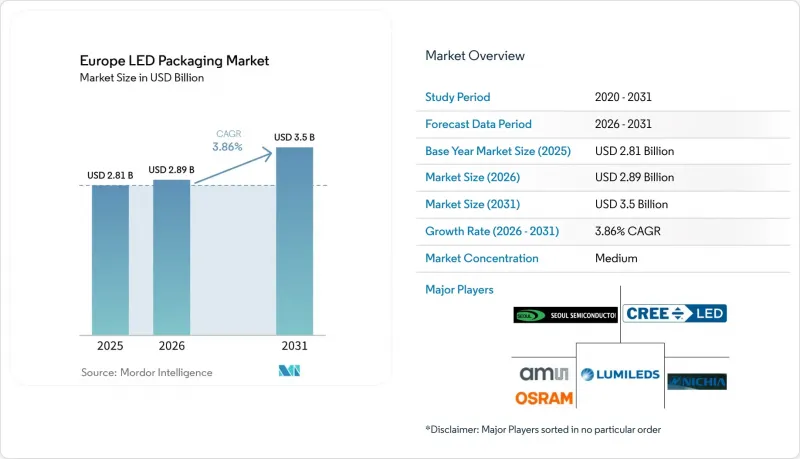
根據 Mordor Intelligence 預測,歐洲LED構裝市場規模將從 2025 年的 28.1 億美元和 2026 年的 28.9 億美元成長到 2031 年的 35 億美元,2026 年至 2031 年的複合年成長率為 3.86%。
本報告按封裝架構(SMD、COB、CSP、覆晶等)、功率等級(低、中、高、超高)、發光類型(可見光、紅外線、紫外線)、材料化學(基板、封裝等)、應用領域(通用照明、汽車等)和地區進行細分。市場預測以美元計價。
歐洲LED構裝市場趨勢與洞察
歐洲電視和顯示器生產中採用Mini-LED背光技術的趨勢正在迅速成長。
在2026年國際消費電子展(CES 2026)上,電視製造商發表了超過20款mini-LED電視。波蘭和捷克的歐洲組裝廠正在擴大生產線,生產採用可承受260 度C回流焊接溫度的CSP晶片的組件。隨著每個面板擁有超過1000個局部調光區域,HDR1400認證顯示器的普及速度正在加快,組件成本也降低了30%。這些促進因素導致市場對覆晶和專為直下式背光最佳化的CSP架構的訂單不斷成長。
由於歐盟生態設計法規,傳統照明正在逐步淘汰。
生態設計指令將於2023年逐步淘汰T8螢光,並於2025年9月前淘汰鹵素燈,這將加速柏林等地的維修計劃,例如更換22萬盞燈具。最低光通量效率標準為120 lm/W,這意味著舊技術已無法滿足該標準,迫使市政採購負責人採用符合RoHS無鉛要求的高功率LED模組。
間距小於 10µm 的先進封裝生產線需要大量的資金投入。
間距小於10µm的凸塊生產線需要光刻步進機和質傳設備,總投資超過1億歐元(1.13億美元)。這導致投資回收期超過五年,並將生產集中在少數幾家現有的垂直整合公司手中。
細分市場分析
由於汽車儀錶板和消費性電子設備對緊湊型封裝和低熱阻的需求,晶片級封裝 (CSP) 正以每年 4.51% 的速度成長。預計到 2031 年,歐洲 CSP LED構裝市場規模將達到 11.1 億美元。同時,表面黏著型元件(SMD) 的相對重要性正在下降,因為覆晶設計在「每美元流明數」方面具有更優的經濟性。到 2025 年,SMD 的銷售額將佔 42.78%。照明製造商擴大指定表面黏著型元件條中使用 CSP,因為小型化可以改善散熱並允許更小的彎曲半徑。另一方面,對於需要均勻光通量和簡化光學結構的體育場館泛光照明和高棚工業照明燈具,板載晶片(COB) 模組仍然是首選。
覆晶封裝透過將晶片直接鍵合到陶瓷載體上,彌合了傳統表面貼裝(SMD)技術和陶瓷表面貼裝(CSP)小型化之間的差距,實現了超過10,000像素/平方厘米的像素密度。雙列直插式和通孔封裝形式仍用於傳統的標牌應用,但隨著供應鏈轉向可回流焊接的表面黏著技術替代方案,它們的市場佔有率持續下降。正如OptiLamp系列所展示的那樣,在組件級整合式驅動器和狀態監控電路,凸顯了封裝和系統模組之間界限日益模糊的藍圖。
預計到2031年,高功率LED封裝(1-3瓦)將以4.23%的年成長率成長,這主要得益於工業設備維修和市政路燈的改造,後者透過減少照明燈具的數量來縮短安裝時間。儘管到2025年,中功率LED構裝在歐洲的市佔率將達到39.61%,但由於聚光太陽能板(CSP)能夠在更小的體積內實現相同的功率輸出,其複合年成長率低於該細分市場的平均水平。功率超過3瓦的超高高功率裝置主要面向體育場館和園藝設施,但由於溫度控管的限制,其出貨量受到限制。
透過將導熱係數超過 380 W/mK 的銅芯 PCB 與陶瓷基板結合,可將結溫維持在 125 度C以下,從而提高光通量保持率。採購團隊從整體擁有成本 (TCO) 的角度出發,傾向於選擇高功率LED,他們願意接受更高的單價,以換取更少的燈具數量和更短的投資回收期。
其他好處:
- Excel格式的市場預測(ME)表
- 3個月的分析師支持
目錄
第1章:引言
- 本研究的假設、市場定義與範圍
第2章:調查方法
第3章執行摘要
第4章 市場狀況
- 市場概覽
- 產業價值鏈分析
- 市場促進因素
- 歐洲電視和顯示器生產中採用Mini-LED背光技術的趨勢正在迅速成長。
- 由於歐盟生態設計法規,傳統照明正在逐步淘汰。
- 汽車製造商向像素式LED大燈的過渡
- 降低覆晶CSP技術的成本曲線
- 歐洲IDM公司的垂直整合策略
- 歐盟晶片製造法為企業回流提供了激勵措施。
- 市場限制因素
- 間距小於 10µm 的先進封裝生產線需要高額資本支出 (CAPEX)。
- 供應鏈中對亞洲基板供應商的依賴
- 高功率封裝中的溫度控管限制
- 來自新興微型OLED顯示器的競爭
- 監理情勢
- 技術展望
- 宏觀經濟因素的影響
- 波特五力分析
第5章 市場規模與成長預測
- 所以
- 表面黏著型元件(SMD)
- 板載晶片(COB)
- 晶片級封裝(CSP)
- 覆晶LED構裝
- 雙列直插封裝(DIP/通孔)
- 其他(IMD、GOB、Mini-LED顯示封裝)
- 按電力等級
- 低功耗(小於0.5瓦)
- 中功率(0.5–1 瓦)
- 高功率(1-3瓦)
- 高功率(超過 3 瓦)
- 按排放類型
- 可見光LED構裝
- 紅外線(IR) LED構裝
- 紫外線 (UV) LED構裝
- 材料化學
- 基材
- 封裝
- 黏接/晶片貼裝
- 磷光體/塗層
- 透過使用
- 一般照明
- 汽車照明
- 顯示器和背光
- 家用電子產品
- 工業和專業應用
- 按地區
- 歐洲
- 英國
- 德國
- 法國
- 其他歐洲國家
- 歐洲
第6章 競爭情勢
- 市場集中度
- 策略趨勢
- 市佔率分析
- 公司簡介
- ams-OSRAM AG
- Lumileds Holding BV
- Nichia Corporation
- Seoul Semiconductor Co., Ltd.
- Cree LED
- Everlight Electronics Co., Ltd.
- Samsung Electronics Co., Ltd.
- LG Innotek Co., Ltd.
- Lite-On Technology Corp.
- Citizen Electronics Co., Ltd.
- Dominant Opto Technologies Sdn. Bhd.
- Epistar Corporation
- Lextar Electronics Corp.
- Bridgelux, Inc.
- Seoul Semiconductor Co., Ltd.
- Vishay Intertechnology, Inc.
- Rohm Semiconductor GmbH
- Stanley Electric Co., Ltd.
- Toyoda Gosei Co., Ltd.
第7章 市場機會與未來展望
According to Mordor Intelligence, the Europe LED packaging market size is projected to expand from USD 2.81 billion in 2025 and USD 2.89 billion in 2026 to USD 3.50 billion by 2031, registering a CAGR of 3.86% between 2026 and 2031.
This report is Segmented by Packaging Architecture (SMD, COB, CSP, Flip-Chip, and More), Power Class (Low, Mid, High, and Ultra-High), Emission Type (Visible, IR, and UV), Material Chemistry (Substrates, Encapsulation, and More), Application (General Lighting, Automotive, and More), and Geography. The Market Forecasts are Provided in Terms of Value (USD).
Europe LED Packaging Market Trends and Insights
Surging Mini-LED Backlight Adoption In European TV And Monitor Production
Television brands introduced more than twenty mini-LED models at CES 2026, with European assembly plants in Poland and the Czech Republic ramping module lines that consume CSPs able to endure 260 °C reflow temperatures. Localized dimming zones exceed 1,000 per panel, broadening HDR1400-certified displays and compressing bill-of-materials cost by 30%. These pull-through dynamics elevate unit orders for flip-chip and CSP architectures tailored to direct-lit backlighting.
EU Ecodesign Regulations Phasing-Out Conventional Lighting
The Ecodesign Directive removed T8 fluorescents in 2023 and halogen capsules by September 2025, triggering accelerated retrofit programs such as Berlin's 220,000-fixture swap-out. Minimum efficacy thresholds of 120 lm/W disqualify legacy technologies, forcing municipal buyers toward high-power LED modules that comply with RoHS lead-free mandates.
High CAPEX For Advanced Packaging Lines Below 10 µm Pitch
A sub-10 µm bump-pitch line requires lithography steppers and mass-transfer tools that together exceed EUR 100 million (USD 113 million), stretching payback beyond five years and consolidating production among a few vertically integrated incumbents.
Other drivers and restraints analyzed in the detailed report include:
- Automotive OEM Shift Toward Pixel-LED Headlamps
- Declining Cost Curve Of Flip-Chip CSP Technology
- Supply-Chain Exposure To Asian Substrate Vendors
For complete list of drivers and restraints, kindly check the Table Of Contents.
Segment Analysis
Chip-scale packages are growing at a 4.51% rate as automotive dashboards and consumer devices demand compact footprints and low thermal resistance. The Europe LED packaging market size for CSPs is projected to reach USD 1.11 billion by 2031, while surface-mount devices decline in relative importance as flip-chip designs deliver superior lumen-per-dollar economics. Surface-mount devices accounted for 42.78% of revenue in 2025. Fixture makers increasingly specify CSPs for linear strips where smaller footprints improve heat spreading and enable tighter bend radii. Meanwhile, chip-on-board modules remain favored in stadium floodlights and high-bay industrial luminaires that require uniform beams and simplified optics.
Flip-chip packages bridge the gap between SMD heritage and CSP miniaturization by bonding die directly to ceramic carriers, achieving pixel densities above 10,000 px/cm2. Dual in-line and through-hole formats persist in legacy signage, yet their volume share keeps sliding as supply chains pivot to reflow-capable surface-mount alternatives. Component-level integration of driver and health-monitor circuits, as demonstrated by the OptiLamp series, underscores a roadmap in which package boundaries blur with system modules.
High-power packages (1-3 W) are projected to grow 4.23% annually through 2031, fueled by industrial retrofits and municipality streetlighting where reducing fixture count cuts installation labor. The Europe LED packaging market share for mid-power packages stood at 39.61% in 2025, yet their CAGR trails the segment average because CSPs deliver equivalent output in smaller footprints. Ultra-high-power devices above 3 W target stadium and horticulture installations, but thermal-management constraints cap their volumes.
Copper metal-core PCBs with >380 W/mK conductivity, coupled with ceramic substrates, maintain junction temperatures below 125 °C, thereby extending lumen maintenance. Procurement teams favor high-power LEDs on a total-cost-of-ownership basis, accepting higher unit prices in exchange for fewer luminaires and quicker payback periods.
Complete Report Scope:
- By Packaging Architecture
- Surface Mount Device (SMD)
- Chip-on-Board (COB)
- Chip Scale Package (CSP)
- Flip-Chip LED Packages
- Dual In-line Package (DIP / Through-hole)
- Others (IMD, GOB, Mini-LED display packaging)
- By Power Class
- Low Power (Less Than 0.5 W)
- Mid Power (0.5 - 1 W)
- High Power (1 - 3 W)
- Ultra-High Power (Greater Than 3 W)
- By Emission Type
- Visible LED Packages
- Infrared (IR) LED Packages
- Ultraviolet (UV) LED Packages
- By Material Chemistry
- Substrates
- Encapsulation
- Bonding / Die-Attach
- Phosphors / Coatings
- By Application
- General Lighting
- Automotive Lighting
- Display and Backlighting
- Consumer Electronics
- Industrial and Specialty
- By Geography
- Europe
- United Kingdom
- Germany
- France
- Rest of Europe
- Europe
List of Companies Covered in this Report:
- ams-OSRAM AG
- Lumileds Holding B.V.
- Nichia Corporation
- Seoul Semiconductor Co., Ltd.
- Cree LED
- Everlight Electronics Co., Ltd.
- Samsung Electronics Co., Ltd.
- LG Innotek Co., Ltd.
- Lite-On Technology Corp.
- Citizen Electronics Co., Ltd.
- Dominant Opto Technologies Sdn. Bhd.
- Epistar Corporation
- Lextar Electronics Corp.
- Bridgelux, Inc.
- Seoul Semiconductor Co., Ltd.
- Vishay Intertechnology, Inc.
- Rohm Semiconductor GmbH
- Stanley Electric Co., Ltd.
- Toyoda Gosei Co., Ltd.
Additional Benefits:
- The market estimate (ME) sheet in Excel format
- 3 months of analyst support
TABLE OF CONTENTS
1 INTRODUCTION
- 1.1 Study Assumptions and Market Definition, Scope of the Study
2 RESEARCH METHODOLOGY
3 EXECUTIVE SUMMARY
4 MARKET LANDSCAPE
- 4.1 Market Overview
- 4.2 Industry Value-Chain Analysis
- 4.3 Market Drivers
- 4.3.1 Surging Mini-LED Backlight Adoption in European TV and Monitor Production
- 4.3.2 EU Ecodesign Regulations Phasing-out Conventional Lighting
- 4.3.3 Automotive OEM Shift Toward Pixel-LED Headlamps
- 4.3.4 Declining Cost Curve of Flip-Chip CSP Technology
- 4.3.5 Vertical-integration Strategies of European IDMs
- 4.3.6 On-shoring Incentives via the EU Chips Act
- 4.4 Market Restraints
- 4.4.1 High CAPEX for Advanced Packaging Lines Below 10 µm Pitch
- 4.4.2 Supply-chain Exposure to Asian Substrate Vendors
- 4.4.3 Thermal-management Limits in Ultra-High Power Packages
- 4.4.4 Competition from Emerging Micro-OLED Displays
- 4.5 Regulatory Landscape
- 4.6 Technological Outlook
- 4.7 Impact of Macroeconomic Factors
- 4.8 Porter's Five Forces Analysis
- 4.8.1 Bargaining Power of Suppliers
- 4.8.2 Bargaining Power of Buyers
- 4.8.3 Threat of New Entrants
- 4.8.4 Threat of Substitutes
- 4.8.5 Intensity of Competitive Rivalry
5 MARKET SIZE AND GROWTH FORECASTS (VALUE)
- 5.1 By Packaging Architecture
- 5.1.1 Surface Mount Device (SMD)
- 5.1.2 Chip-on-Board (COB)
- 5.1.3 Chip Scale Package (CSP)
- 5.1.4 Flip-Chip LED Packages
- 5.1.5 Dual In-line Package (DIP / Through-hole)
- 5.1.6 Others (IMD, GOB, Mini-LED display packaging)
- 5.2 By Power Class
- 5.2.1 Low Power (Less Than 0.5 W)
- 5.2.2 Mid Power (0.5 - 1 W)
- 5.2.3 High Power (1 - 3 W)
- 5.2.4 Ultra-High Power (Greater Than 3 W)
- 5.3 By Emission Type
- 5.3.1 Visible LED Packages
- 5.3.2 Infrared (IR) LED Packages
- 5.3.3 Ultraviolet (UV) LED Packages
- 5.4 By Material Chemistry
- 5.4.1 Substrates
- 5.4.2 Encapsulation
- 5.4.3 Bonding / Die-Attach
- 5.4.4 Phosphors / Coatings
- 5.5 By Application
- 5.5.1 General Lighting
- 5.5.2 Automotive Lighting
- 5.5.3 Display and Backlighting
- 5.5.4 Consumer Electronics
- 5.5.5 Industrial and Specialty
- 5.6 By Geography
- 5.6.1 Europe
- 5.6.1.1 United Kingdom
- 5.6.1.2 Germany
- 5.6.1.3 France
- 5.6.1.4 Rest of Europe
- 5.6.1 Europe
6 COMPETITIVE LANDSCAPE
- 6.1 Market Concentration
- 6.2 Strategic Moves
- 6.3 Market Share Analysis
- 6.4 Company Profiles (includes Global Level Overview, Market Level Overview, Core Segments, Financials as available, Strategic Information, Market Rank/Share, Products and Services, Recent Developments)
- 6.4.1 ams-OSRAM AG
- 6.4.2 Lumileds Holding B.V.
- 6.4.3 Nichia Corporation
- 6.4.4 Seoul Semiconductor Co., Ltd.
- 6.4.5 Cree LED
- 6.4.6 Everlight Electronics Co., Ltd.
- 6.4.7 Samsung Electronics Co., Ltd.
- 6.4.8 LG Innotek Co., Ltd.
- 6.4.9 Lite-On Technology Corp.
- 6.4.10 Citizen Electronics Co., Ltd.
- 6.4.11 Dominant Opto Technologies Sdn. Bhd.
- 6.4.12 Epistar Corporation
- 6.4.13 Lextar Electronics Corp.
- 6.4.14 Bridgelux, Inc.
- 6.4.15 Seoul Semiconductor Co., Ltd.
- 6.4.16 Vishay Intertechnology, Inc.
- 6.4.17 Rohm Semiconductor GmbH
- 6.4.18 Stanley Electric Co., Ltd.
- 6.4.19 Toyoda Gosei Co., Ltd.
7 MARKET OPPORTUNITIES AND FUTURE OUTLOOK
- 7.1 White-space and Unmet-Need Assessment

 LED構裝測試設備市場:全球市場預測,2026-2032年晶片級封裝 (CSP) LED 市場:2026-2032 年全球市場預測(按產品類型、顏色類型、功率等級、應用、終端用戶產業和分銷管道分類)
 全球LED構裝市場規模、佔有率、趨勢及成長分析報告(2026-2034年)
 LED構裝市場規模、佔有率和趨勢分析報告:按材料、封裝類型、應用、地區和細分市場分類(2026-2033年)
 LED構裝設備:市場佔有率分析、產業趨勢與統計、成長預測(2026-2031年)LED構裝:市場佔有率分析、產業趨勢與統計、成長預測(2026-2031年)中國LED構裝:市佔率分析、產業趨勢與統計及成長預測(2026-2031年)北美LED構裝:市佔率分析、產業趨勢與統計及成長預測(2026-2031年)美國LED構裝:市場佔有率分析、產業趨勢與統計、成長預測(2026-2031年)亞太地區LED構裝:市佔率分析、產業趨勢與統計及成長預測(2026-2031年)