


 |
市場調查報告書
商品編碼
2099172
義大利人工智慧能源管理軟體:市場佔有率分析、行業趨勢和統計數據以及成長預測(2026-2031 年)Italy AI-powered Energy Management Software - Market Share Analysis, Industry Trends & Statistics, Growth Forecasts (2026 - 2031) |
||||||

※ 本網頁內容可能與最新版本有所差異。詳細情況請與我們聯繫。
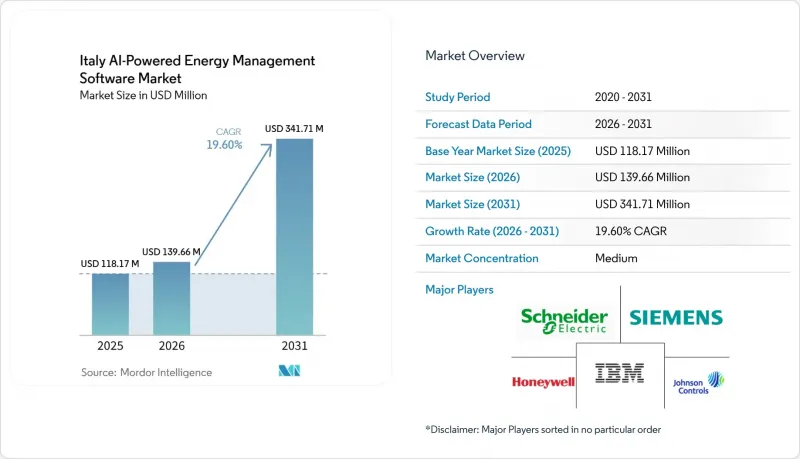
據 Mordor Intelligence 稱,義大利人工智慧能源管理軟體市場預計將從 2025 年的 1.1817 億美元成長到 2026 年的 1.3966 億美元,到 2031 年達到 3.4171 億美元,2026 年至 2031 年的複合成長率為 19.60%。
本報告按元件(軟體和服務)、部署模式(雲端、本地部署、混合部署)、應用程式(例如,能源消耗和需求最佳化、資產效能和預測性維護、智慧電網和分散式能源 (DER) 管理)以及最終用戶(例如,公共產業、商業建築)進行細分。市場預測以美元計價。
義大利人工智慧能源管理軟體市場的趨勢和見解。
嚴格的能源效率法規和合規要求正在推動人工智慧軟體的普及應用。
義大利人工智慧能源管理軟體市場正獲得監管機構的直接支持。這是因為如今實現合規性依賴可衡量的能源績效和更一致的監控系統。修訂後的《能源性能指令》(EPBD)於2024年生效,要求包括義大利在內的歐盟成員國在2026年5月29日之前將其納入本國法律。這增加了大規模非住宅資產對建築自動化和控制系統的需求。此外,義大利2014年第102號法令強制要求大型企業定期進行審計,從而提高了系統化能源資料管理和數位化追蹤在業務營運中的優先順序。 「轉型5.0計畫」提供了財政支持,因為稅額扣抵與可衡量的能源消耗減少掛鉤。這使得能夠記錄、分析和存檔這些結果的軟體獲得了優先待遇。因此,義大利人工智慧能源管理軟體市場減少了對自願性永續發展投資的依賴,並加強了與正式營運合規性的連結。
公用事業成本上漲和能源價格波動正在加速投資回報。
義大利人工智慧能源管理軟體市場的發展也受到義大利企業在2025年面臨的直接成本壓力的推動。根據義大利工業家聯合會(Confindustria)預測,2025年上半年工業用電價格將達到278歐元/兆瓦時(302.9美元/兆瓦時),為歐盟最高水平,這將對企業的競爭力造成沉重負擔。同時,2025年服務業電力消耗量年增2.9%,顯示儘管能源價格持續高企,數位化管理的商業需求依然活躍。在此背景下,由於成本節約效果更顯著、投資回收期更短,因此採用能夠提高預測精度、實現負載轉移和即時控制的軟體變得更加合理。這種成本環境使得義大利人工智慧能源管理軟體市場不再只是一個數位化實驗,而是一個植根於實際營運經濟效益的市場。
與傳統能源系統整合的複雜性減緩了企業採用此方案的速度。
義大利的AI能源管理軟體市場在棕地建築環境中的普及速度仍然顯著放緩,因為許多工業和公共產業設施運作過時的控制架構。都靈理工大學的一項研究發現,從傳統的BACnet系統遷移到BACnet Secure Connect會為建築能源管理環境帶來顯著的架構和安全複雜性。對於擁有多個營運場所的營運商而言,這個問題尤其關鍵,因為不同軟體平台對傳統協議的支援各不相同,限制了不同供應商產品組合的標準化。因此,與商業建築相比,義大利工業領域對AI能源管理軟體的採用仍然較為緩慢,因為商業建築更容易實現數位化系統連接和升級。
細分市場分析
2025年,軟體在義大利人工智慧能源管理軟體市場佔據60.13%的佔有率,成為收入最高的組成部分。這一主導地位反映了義大利人工智慧能源管理軟體市場清晰的採購模式:企業傾向於選擇基於許可的分析、監控和最佳化平台,因為這些平台的部署速度比全面升級硬體快得多。不斷上漲的電費和日益嚴格的合規期限也推動了軟體的普及,因為它使營運商無需等待大規模的硬體維修即可開始衡量成本節約並報告結果。基於這些原因,軟體在2025年仍然是商業建築和公共產業領域支出的重點。
預計到2031年,服務業將以20.12%的複合年成長率成長,成為義大利人工智慧能源管理軟體市場中成長最快的細分領域。服務業的成長與棕地工業設施、公共產業資產和混合營運技術(OT)環境維修的複雜性密切相關,這些環境僅靠簡單的軟體安裝無法實現互聯互通。在傳統基礎設施仍然普遍存在的地區,系統配置、協定映射、增強的網路安全和託管分析支援仍然至關重要。雖然隨著時間的推移,部分工作可能會轉移回產品層,但隨著義大利大規模部署不斷跨越新舊系統之間的界限,對服務的需求預計仍將保持強勁。
到2025年,基於雲端的部署將佔義大利人工智慧能源管理軟體市場66.21%的佔有率,成為主導交付模式。其主要原因在於速度。商業建築管理人員和能源零售商無需承擔新建現場基礎設施的負擔,即可採用雲端軟體。義大利廣泛的數位化政策也透過與國家數位轉型計畫相關的「雲端優先」原則,為此方向提供了支持。在義大利人工智慧能源管理軟體產業,這使得雲端供應商能夠在易於集中和管理營運數據的環境中迅速建立競爭優勢。
預計到2031年,混合部署將以19.92%的複合年成長率成長,顯示下一波需求正轉向監管更嚴格、技術更複雜的環境。公共產業和工業運營商通常需要本地處理以確保延遲、資料居住要求和營運技術的連續性,同時也需要雲端分析和遠端報告功能。 Gridspertise的「ERALIS Suite」透過模組化設計,結合邊緣、本地和雲端功能,協助電網數位化,從而順應了這一趨勢。因此,混合功能已成為義大利人工智慧能源管理軟體市場的關鍵差異化因素,尤其是在網路安全和營運彈性與分析效能同等重要的領域。
其他好處:
- Excel格式的市場預測(ME)表
- 3個月的分析師支持
目錄
第1章:引言
- 研究假設和市場定義
- 調查範圍
第2章:調查方法
第3章執行摘要
第4章 市場狀況
- 市場概覽
- 市場促進因素
- 商業建築必須嚴格遵守能源效率標準。
- 電力價格波動性日益加劇以及對持續最佳化的需求
- 人工智慧驅動的預測控制在暖通空調和負載轉移領域的應用日益廣泛
- 擴展投資組合規模的ESG和CSRD報表工作流程
- 在配備開放式建築管理系統 (BMS) 的現有設施中實施「輕型改造」。
- 電網連接靈活性和需量反應。
- 市場限制因素
- 與傳統OT和BMS堆疊整合的複雜性。
- 網路安全和資料主權的限制
- 取得高品質的計量數據和入住率數據的機會有限。
- 小規模、分散投資組合的投資報酬率存在不確定性
- 產業價值鏈分析
- 宏觀經濟因素對市場的影響
- 監理情勢
- 技術展望
- 波特五力分析
第5章 市場規模與成長預測
- 按組件
- 軟體
- 服務
- 部署模式
- 基於雲端的
- 現場
- 混合
- 透過使用
- 最佳化能源消耗和需求
- 資產性能和預測性維護
- 智慧電網和分散式能源(DER)管理
- 可再生能源預測與整合
- 能源交易、定價和市場訊息
- 最終用戶
- 公用事業
- 商業建築
- 工業設施
- 住宅大樓
第6章 競爭情勢
- 市場集中度
- 策略趨勢
- 市佔率分析
- 公司簡介
- C3.ai, Inc.
- Bidgely, Inc.
- GridPoint, Inc.
- EnergyCAP, LLC
- Uplight, Inc.
- Enel X Srl
- Dexma Sensors, SL
- Wattics Ltd.
- EnergyElephant Ltd.
- BrainBox AI Inc.
- Verdigris Technologies, Inc.
- SkyFoundry, LLC
- BuildingIQ, Inc.
- Next Sense BV
- Enersee BV
- Ecolibrium Energy Private Limited
- Nuuka Solutions Oy
- Ento Pty Ltd
- Carbonsight, Inc.
- Edo Energy LLC
- Schneider Electric SE
- Siemens AG
- Honeywell International Inc.
- IBM Corporation
- Johnson Controls International plc
第7章 市場機會與未來展望
According to Mordor Intelligence, the Italy AI-powered energy management software market size is expected to increase from USD 118.17 million in 2025 to USD 139.66 million in 2026 and reach USD 341.71 million by 2031, growing at a CAGR of 19.60% over 2026-2031.
This report is Segmented by Component (Software and Services), Deployment Mode (Cloud-Based, On-Premises, and Hybrid), Application (Energy Consumption and Demand Optimization, Asset Performance and Predictive Maintenance, Smart Grid and DER Management, and More), and End User (Utilities, Commercial Buildings, and More). The Market Forecasts are Provided in Terms of Value (USD).
Italy AI-powered Energy Management Software Market Trends and Insights
Stringent Energy Efficiency Regulations And Compliance Mandates Drive AI Software Adoption
The Italy AI-powered Energy Management Software Market is receiving direct regulatory support, as compliance now depends on measurable energy performance and more consistent monitoring systems. The recast EPBD entered into force in 2024 and had to be transposed by EU member states, including Italy, by May 29, 2026, which increased the need for building automation and control systems in large non-residential assets. Italy's Legislative Decree 102/2014 also kept large enterprises on a recurring audit cycle, which raised the priority of structured energy data management and digital tracking within corporate operations. The Transition 5.0 Plan added a financial push because tax credits are linked to measurable reductions in energy consumption, which favors software that can record, analyze, and document those results. This made the Italian AI-powered energy management software market less dependent on voluntary sustainability spending and more closely tied to formal operational compliance.
Rising Utility Costs And Energy Price Volatility Accelerate Return Cases
The Italian AI-powered energy management software market is also being boosted by the direct cost pressures Italian businesses faced in 2025. Industrial electricity prices reached EUR 278/MWh (USD 302.9/MWh) in the first half of 2025, the highest level in the EU and a burden on competitiveness, according to Confindustria. At the same time, services sector electricity consumption rose 2.9% year over year in 2025, indicating that digitally managed commercial demand remained active even as energy bills remained elevated. In that setting, software that improves forecasting, load shifting, and real-time control became easier to justify because savings were more visible and payback periods shortened. This cost backdrop keeps the Italian AI-powered energy management software market anchored in practical operating economics rather than optional digital experimentation.
Integration Complexity With Legacy Energy Systems Delays Enterprise Deployments
The Italy AI-powered Energy Management Software Market still faces a significant slowdown in brownfield environments, as many industrial and utility sites run on older control architectures. Research from the Politecnico di Torino found that moving from traditional BACnet systems to BACnet Secure Connect introduced significant architectural and security complexity into building energy management environments. That problem is especially important for multi-site operators because legacy protocol support varies across software platforms, limiting vendor standardization across portfolios. This keeps the Italian AI-powered energy management software market slower in industrial rollouts than in commercial buildings, where digital systems are easier to connect and upgrade.
Other drivers and restraints analyzed in the detailed report include:
- Growth Of AI And IoT Integration In Energy Infrastructure Creates Platform Demand
- Expansion Of Renewable Energy And Smart Grid Investment Opens New Application Demand
- Cybersecurity And Data Privacy Risks In Connected Energy Infrastructure Constrain Adoption
For complete list of drivers and restraints, kindly check the Table Of Contents.
Segment Analysis
Software accounted for 60.13% of the Italy AI-powered Energy Management Software Market share in 2025, making it the leading component by revenue. This lead reflects a clear buying pattern in the Italian AI-powered energy management software market, where enterprises prefer licensed analytics, monitoring, and optimization platforms that can be deployed faster than full hardware overhauls. High electricity costs and tighter compliance timelines also favor software, as operators can begin measuring savings and reporting outcomes without waiting for major physical retrofits. That kept software at the center of commercial building and utility spending through 2025.
Services are projected to expand at a 20.12% CAGR through 2031, making them the fastest-growing component of the Italy AI-powered Energy Management Software Market. Growth in services is closely linked to the complexity of retrofitting brownfield industrial sites, utility assets, and mixed OT environments that cannot be connected with a simple software installation. System configuration, protocol mapping, cybersecurity hardening, and managed analytics support remain important where legacy infrastructure is still common. Over time, some of this work will move back into the product layer, but service demand should remain strong while large-scale Italian deployments continue to cross old and new system boundaries.
Cloud-based deployment commanded a 66.21% share of the Italy AI-powered Energy Management Software Market in 2025, making it the dominant delivery model. The main reason was speed: commercial building managers and energy retailers could adopt cloud software without bearing the full burden of new on-site infrastructure. Italy's broader digital policy also reinforced that direction through cloud-first principles tied to national digital transformation programs. In the Italian AI-powered energy management software industry, this gave cloud vendors an early edge in settings where operational data was easier to centralize and manage.
Hybrid deployment is projected to grow at a 19.92% CAGR through 2031, which shows that the next wave of demand is moving into more regulated and technically complex environments. Utilities and industrial operators often need local processing for latency, data residency, and OT continuity, while still wanting cloud analytics and remote reporting. Gridspertise's ERALIS Suite reflected this direction in 2026 through a modular design that combined edge, on-premises, and cloud functions for grid digitalization. That makes hybrid capability an important differentiator in the Italian AI-powered energy management software market, especially where cybersecurity and operational resilience matter as much as analytics performance.
Complete Report Scope:
- By Component
- Software
- Services
- By Deployment Mode
- Cloud-Based
- On-Premises
- Hybrid
- By Application
- Energy Consumption and Demand Optimization
- Asset Performance and Predictive Maintenance
- Smart Grid and Distributed Energy Resource (DER) Management
- Renewable Energy Forecasting and Integration
- Energy Trading, Pricing and Market Intelligence
- By End User
- Utilities
- Commercial Buildings
- Industrial Facilities
- Residential Buildings
List of Companies Covered in this Report:
- C3.AI, Inc.
- Bidgely, Inc.
- GridPoint, Inc.
- EnergyCAP, LLC
- Uplight, Inc.
- Enel X S.r.l.
- Dexma Sensors, S.L.
- Wattics Ltd.
- EnergyElephant Ltd.
- BrainBox AI Inc.
- Verdigris Technologies, Inc.
- SkyFoundry, LLC
- BuildingIQ, Inc.
- Next Sense B.V.
- Enersee B.V.
- Ecolibrium Energy Private Limited
- Nuuka Solutions Oy
- Ento Pty Ltd
- Carbonsight, Inc.
- Edo Energy LLC
- Schneider Electric SE
- Siemens AG
- Honeywell International Inc.
- IBM Corporation
- Johnson Controls International plc
Additional Benefits:
- The market estimate (ME) sheet in Excel format
- 3 months of analyst support
TABLE OF CONTENTS
1 INTRODUCTION
- 1.1 Study Assumptions and Market Definition
- 1.2 Scope of the Study
2 RESEARCH METHODOLOGY
3 EXECUTIVE SUMMARY
4 MARKET LANDSCAPE
- 4.1 Market Overview
- 4.2 Market Drivers
- 4.2.1 Stringent Energy Efficiency Compliance in Commercial Buildings
- 4.2.2 Rising Utility Tariff Volatility and Demand for Continuous Optimization
- 4.2.3 Growth of AI-Enabled Predictive Control for HVAC and Load Shifting
- 4.2.4 Expansion of Portfolio-Scale ESG and CSRD Reporting Workflows
- 4.2.5 Retrofit-Light Adoption in Legacy Facilities With Open BMS Overlays
- 4.2.6 Rising Need for Grid-Interactive Flexibility and Demand Response Monetization
- 4.3 Market Restraints
- 4.3.1 Integration Complexity With Legacy OT and BMS Stacks
- 4.3.2 Cybersecurity and Data Sovereignty Constraints
- 4.3.3 Limited Access to High-Quality Meter and Occupancy Data
- 4.3.4 Unclear ROI in Small and Fragmented Portfolios
- 4.4 Industry Value Chain Analysis
- 4.5 Impact of Macroeconomic Factors on the Market
- 4.6 Regulatory Landscape
- 4.7 Technological Outlook
- 4.8 Porter's Five Forces Analysis
- 4.8.1 Bargaining Power of Suppliers
- 4.8.2 Bargaining Power of Buyers
- 4.8.3 Threat of New Entrants
- 4.8.4 Threat of Substitutes
- 4.8.5 Competitive Rivalry
5 MARKET SIZE AND GROWTH FORECASTS (VALUE)
- 5.1 By Component
- 5.1.1 Software
- 5.1.2 Services
- 5.2 By Deployment Mode
- 5.2.1 Cloud-Based
- 5.2.2 On-Premises
- 5.2.3 Hybrid
- 5.3 By Application
- 5.3.1 Energy Consumption and Demand Optimization
- 5.3.2 Asset Performance and Predictive Maintenance
- 5.3.3 Smart Grid and Distributed Energy Resource (DER) Management
- 5.3.4 Renewable Energy Forecasting and Integration
- 5.3.5 Energy Trading, Pricing and Market Intelligence
- 5.4 By End User
- 5.4.1 Utilities
- 5.4.2 Commercial Buildings
- 5.4.3 Industrial Facilities
- 5.4.4 Residential Buildings
6 COMPETITIVE LANDSCAPE
- 6.1 Market Concentration
- 6.2 Strategic Moves
- 6.3 Market Share Analysis
- 6.4 Company Profiles (includes Global Level Overview, Market Level Overview, Core Segments, Financials as available, Strategic Information, Market Rank/Share, Products and Services, Recent Developments)
- 6.4.1 C3.ai, Inc.
- 6.4.2 Bidgely, Inc.
- 6.4.3 GridPoint, Inc.
- 6.4.4 EnergyCAP, LLC
- 6.4.5 Uplight, Inc.
- 6.4.6 Enel X S.r.l.
- 6.4.7 Dexma Sensors, S.L.
- 6.4.8 Wattics Ltd.
- 6.4.9 EnergyElephant Ltd.
- 6.4.10 BrainBox AI Inc.
- 6.4.11 Verdigris Technologies, Inc.
- 6.4.12 SkyFoundry, LLC
- 6.4.13 BuildingIQ, Inc.
- 6.4.14 Next Sense B.V.
- 6.4.15 Enersee B.V.
- 6.4.16 Ecolibrium Energy Private Limited
- 6.4.17 Nuuka Solutions Oy
- 6.4.18 Ento Pty Ltd
- 6.4.19 Carbonsight, Inc.
- 6.4.20 Edo Energy LLC
- 6.4.21 Schneider Electric SE
- 6.4.22 Siemens AG
- 6.4.23 Honeywell International Inc.
- 6.4.24 IBM Corporation
- 6.4.25 Johnson Controls International plc
7 MARKET OPPORTUNITIES AND FUTURE OUTLOOK
- 7.1 White-Space and Unmet-Need Assessment

 2034年人工智慧市場在發電領域的預測-按組件、部署模式、人工智慧技術、電源、應用、企業規模、最終用戶和地區分類的全球分析
 全球能源電力領域人工智慧(AI)市場:機會與策略展望(至2035年)
 中國人工智慧能源管理軟體:市場佔有率分析、產業趨勢與統計及成長預測(2026-2031)中東和非洲人工智慧能源管理軟體:市場佔有率分析、行業趨勢和統計數據以及成長預測(2026-2031 年)中東地區人工智慧能源管理軟體:市場佔有率分析、行業趨勢和統計數據以及成長預測(2026-2031 年)南美洲人工智慧能源管理軟體:市場佔有率分析、行業趨勢和統計數據以及成長預測(2026-2031 年)印度人工智慧能源管理軟體:市場佔有率分析、行業趨勢和統計數據以及成長預測(2026-2031 年)德國人工智慧能源管理軟體:市場佔有率分析、行業趨勢和統計數據以及成長預測(2026-2031 年)新加坡人工智慧能源管理軟體:市場佔有率分析、行業趨勢和統計數據以及成長預測(2026-2031 年)日本人工智慧能源管理軟體:市場佔有率分析、產業趨勢與統計及成長預測(2026-2031)