


 |
市場調查報告書
商品編碼
2097457
新加坡人工智慧能源管理軟體:市場佔有率分析、行業趨勢和統計數據以及成長預測(2026-2031 年)Singapore AI-powered Energy Management Software - Market Share Analysis, Industry Trends & Statistics, Growth Forecasts (2026 - 2031) |
||||||

※ 本網頁內容可能與最新版本有所差異。詳細情況請與我們聯繫。
據 Mordor Intelligence 稱,2025 年新加坡人工智慧能源管理軟體的市場規模為 4861 萬美元,預計從 2026 年的 5902 萬美元成長到 2031 年的 1.6812 億美元,在預測期(2026-2031 年)內複合年成長率為 23.29%。
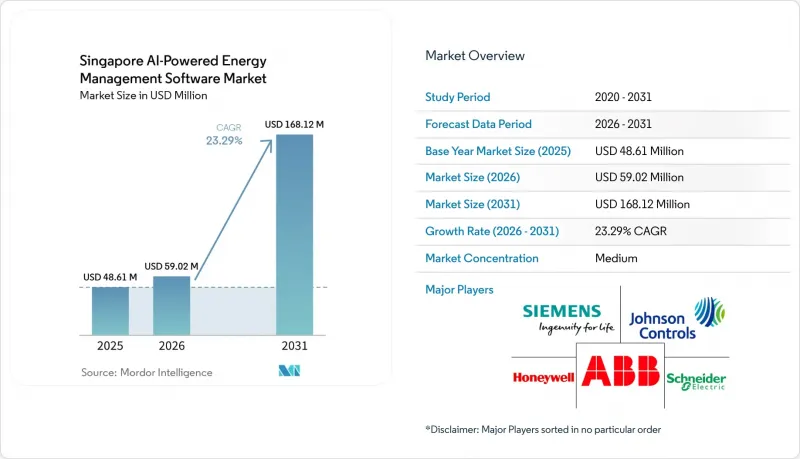
本報告按元件(軟體和服務)、部署模式(雲端、本地部署、混合部署)、應用程式(例如,能源消耗和需求最佳化、資產效能和預測性維護)以及最終用戶(例如,公共產業、商業建築)進行細分。市場預測以美元計價。
新加坡人工智慧能源管理軟體市場趨勢與洞察
新加坡商業地產智慧建築維修日益增多
為了降低總占地面積超過5000平方米的私人建築進行維修的經濟門檻,新加坡推出了總額達6300萬新元(約合4600萬美元)的“現有建築綠色標誌獎勵計劃2.0”。該計劃直接擴大了新加坡人工智慧能源管理軟體市場的應用範圍,因為更多老舊建築正在安裝人工智慧最佳化所需的控制系統和測量設備。此外,新加坡還啟動了“能源改善強制計劃”,要求高能耗建築如果連續三年超過能耗強度閾值,則必須採取措施,從而鼓勵業主實施系統性的維修計劃。這些維修計劃通常需要精細的分錶計量,而這一資料層可以降低後續添加人工智慧軟體的整合成本。這種影響在酒店和醫療產業尤其顯著,因為這些行業的業主需要在同一個資本週期內同時滿足合規性要求、綠色標誌重新認證要求以及投資者報告要求。
更嚴格的企業能源報告和ESG資訊揭露要求
在新加坡,更嚴格的氣候變遷報告要求將能源數據從單純的設施管理問題提升為財務和管治問題。新加坡交易所(SGX)上市公司將被要求從2025會計年度起報告範圍1和範圍2的排放量,而海峽時報指數(STI)成分股公司也將被要求從2026會計年度起報告範圍3的排放量。這項轉變推動了對連續且可審計的能源數據的需求,因為定期的人工測量無法確保報告團隊目前所需的一致性。此外,碳排放稅從2024-2025會計年度的每噸二氧化碳當量25新元提高到2026會計年度的每噸二氧化碳當量45新元,也讓財務團隊在決定支出分配方向時,更清楚地看到了碳稅帶來的商業效益。在新加坡的人工智慧能源管理軟體市場,這些政策正促使設施管理、財務和永續發展部門圍繞實施單一軟體解決方案達成共識。
過時的建築系統中存在資料碎片化問題
老舊建築的資料片段化仍然是新加坡人工智慧能源管理軟體市場面臨的最大障礙之一。許多2005年以前建造的商業建築仍然使用專有的建築管理系統,導致BACnet、Modbus和LonWorks系統之間的協議實現不一致。不同承包商隨著時間的推移進行的多次維修,造成了電錶、暖通空調控制系統、照明平台和門禁系統之間的數據缺失,延緩了統一資料擷取。這些缺失降低了基準質量,削弱了預測準確性,並使審計報告難以編制。擁有強大的邊緣層協議轉換能力的供應商在贏得維修工程比例較高的項目中具有顯著優勢,因為他們無需完全更換建築管理系統即可實現數據標準化。
細分市場分析
到2025年,軟體在新加坡人工智慧能源管理軟體市場佔據65.18%的佔有率。這反映出公共產業、商業房地產組合和工業設施等領域對平台的日益普及。買家已將能源分析、即時儀錶板和碳排放報告功能整合到日常營運流程中,使軟體層成為建築營運的核心組成部分。切換成本進一步強化了這一地位。當建築管理系統資料、歷史基準和報告流程整合到單一平台時,更換供應商對業主和營運商而言將造成重大干擾。這使得現有軟體供應商能夠維持比其他許多相關企業軟體領域更高的合約續約率。
預計2026年至2031年間,服務業將以24.31%的複合年成長率成長,成為新加坡人工智慧能源管理軟體市場中成長最快的領域。推動這一成長的主要動力來自中型商業和工業企業,其中許多企業缺乏內部能源工程團隊,更傾向於以結果為導向的營運而非軟體管理。新加坡歷時多年的原生人工智慧生態系統舉措透過將能源監測和ESG報告整合到更連續的管理工作流程中,直接應對了這一轉變。基於結果的能源績效合約也越來越受歡迎,因為它們將部分執行風險轉移給了供應商,並將初始投資轉化為持續的營運成本。
至2025年,基於雲端的部署方案將佔新加坡人工智慧能源管理軟體市場55.14%的佔有率。這主要得益於訂閱模式的經濟效益、持續的模型更新以及跨多地點資產組合進行基準測試的便利性。此外,雲端部署方案還減少了定期現場硬體更新的需求,而這正是許多業主和營運商所希望避免的。儘管如此,混合部署方案預計將在2026年至2031年間以24.42%的複合年成長率成長,成為高度監管且複雜環境下的首選架構。企業正在採用混合配置,以便在本地保留敏感的遙測數據,同時將標準化的效能指標傳送到雲端分析層。
這種平衡尤其適用於新加坡的AI能源管理軟體市場,因為它為買家提供了一種將AI可擴展性與更嚴格的數據管理相結合的方法。這在醫院、資料中心和政府機構中尤其重要,因為在這些場所,空氣間隙、本地託管或更嚴格的篩選流程仍然會影響採購政策。因此,本地部署仍然發揮著至關重要的作用,尤其是在完全雲端連接在營運上難以實現或不理想的情況下。在CES 2026上發布的Univers EnOS™ AI Box等專門設計的邊緣推理硬體也表明,在高頻控制應用中,本地部署和混合架構之間的差距正在縮小。
其他好處:
- Excel格式的市場預測(ME)表
- 3個月的分析師支持
目錄
第1章:引言
- 研究假設和市場定義
- 調查範圍
第2章:調查方法
第3章執行摘要
第4章 市場狀況
- 市場概覽
- 市場促進因素
- 新加坡商業地產智慧建築維修日益增多
- 收緊企業能源報告和ESG資訊揭露要求
- 最佳化電價並加速基於需求的電價管理
- 引入人工智慧驅動的故障檢測、診斷和預測控制。
- 邊緣連接的物聯網測量系統與建築管理系統的整合
- 企業對連續性能驗證和自主最佳化的興趣日益濃厚
- 市場限制因素
- 傳統建築系統中的資料碎片化
- 雲端託管能源平台中的網路安全和資料儲存問題
- 在擁有多家供應商的複雜建築群中,高層整合的複雜性。
- 老舊中小建築能源基準值的可見度低。
- 宏觀經濟因素對市場的影響
- 產業價值鏈分析
- 監理情勢
- 技術展望
- 波特五力分析
第5章 市場規模與成長預測
- 按組件
- 軟體
- 服務
- 部署模式
- 基於雲端的
- 現場
- 混合
- 透過使用
- 最佳化能源消耗和需求
- 資產性能和預測性維護
- 智慧電網與分散式能源(DER)的管理
- 可再生能源預測與整合
- 能源交易、定價和市場訊息
- 最終用戶
- 公用事業
- 商業建築
- 工業設施
- 住宅大樓
第6章 競爭情勢
- 市場集中度
- 策略趨勢
- 市佔率分析
- 公司簡介
- Schneider Electric SE
- Siemens AG
- Johnson Controls International plc
- Honeywell International Inc.
- ABB Ltd
- Delta Electronics, Inc.
- Eaton Corporation plc
- IBM Corporation
- Cisco Systems, Inc.
- SAP SE
- Oracle Corporation
- C3.ai, Inc.
- Univers
- Keppel Infrastructure
- Azendian Solutions
- Planon BV
- SP Digital
- Carrier Global Corporation
- Trane Technologies plc
- SensorFlow
第7章 市場機會與未來展望
According to Mordor Intelligence, the Singapore AI-powered energy management software market size was valued at USD 48.61 million in 2025 and is estimated to grow from USD 59.02 million in 2026 to reach USD 168.12 million by 2031, at a CAGR of 23.29% during the forecast period (2026-2031).
This report is Segmented by Component (Software, and Services), Deployment Mode (Cloud-Based, On-Premises, and Hybrid), Application (Energy Consumption and Demand Optimization, Asset Performance and Predictive Maintenance, and More), and End User (Utilities, Commercial Buildings, and More). The Market Forecasts are Provided in Terms of Value (USD).
Singapore AI-powered Energy Management Software Market Trends and Insights
Rising Smart Building Retrofits in Singapore Commercial Real Estate
The Green Mark Incentive Scheme for Existing Buildings 2.0, a SGD 63 million (USD 46 million) program, lowered the financial barrier to retrofitting in privately owned buildings with a gross floor area above 5,000 m2. That directly widened the deployment base for the Singapore AI-powered Energy Management Software Market because more older buildings are now being fitted with the controls and metering needed for AI optimization. The Mandatory Energy Improvement regime also began to require action when energy-intensive buildings exceeded Energy Use Intensity thresholds for three consecutive years, pushing owners toward structured upgrade programs. These retrofit programs often require granular submetering, and that data layer lowers integration costs later when AI software is added on top. The effect is especially visible in hospitality and healthcare, where owners are trying to meet compliance, Green Mark recertification, and investor reporting needs within the same capital cycle.
Tightening Corporate Energy Reporting and ESG Disclosure Requirements
Mandatory climate reporting is moving energy data from a facilities issue into a finance and governance issue in Singapore. SGX-listed companies must report Scope 1 and Scope 2 emissions from the financial year 2025, and STI constituents must also report Scope 3 emissions from FY2026. That shift is driving demand for continuous, audit-ready energy data because periodic manual readings do not provide the consistency reporting teams now need. The carbon tax increase from SGD 25/tCO2e in 2024-2025 to SGD 45/tCO2e in 2026 is also making the business case more direct for finance teams that are deciding where to allocate spending. In the Singapore AI-powered Energy Management Software Market, this policy stack is aligning facilities, finance, and sustainability functions around a single software decision.
Data Fragmentation across Legacy Building Systems
Data fragmentation across older building estates remains one of the clearest barriers in the Singapore AI-powered Energy Management Software Market. Many commercial properties built before 2005 still operate with proprietary building management environments and uneven protocol implementation across BACnet, Modbus, and LonWorks systems. Retrofit layers added over time by different contractors have left gaps between meters, HVAC controls, lighting platforms, and access systems, which slows unified data ingestion. Those gaps degrade baseline quality, weakening forecast accuracy and making audit-ready reporting harder to defend. Vendors with strong edge-layer protocol translation are better placed to win retrofit-heavy projects because they can normalize data without forcing a full BMS replacement.
Other drivers and restraints analyzed in the detailed report include:
- Accelerating Utility Tariff Optimization and Demand Charge Management
- AI-Enabled Fault Detection, Diagnostics, and Predictive Control Adoption
- Cybersecurity And Data Residency Concerns in Cloud-Hosted Energy Platforms
For complete list of drivers and restraints, kindly check the Table Of Contents.
Segment Analysis
Software held 65.18% of the Singapore AI-powered Energy Management Software Market share in 2025, which reflected the depth of platform adoption across utilities, commercial real estate portfolios, and industrial facilities. Buyers have already embedded energy analytics, real-time dashboards, and carbon reporting into day-to-day operating workflows, which gives the software layer a central role in building operations. That position is reinforced by switching costs: once building management system data, historical baselines, and reporting workflows are housed on a single platform, vendor migration becomes disruptive for owners and operators. This helps incumbent software providers maintain stronger renewal rates than many adjacent enterprise software categories.
Services are projected to expand at a 24.31% CAGR from 2026 to 2031, making them the fastest-growing component of the Singapore AI-powered Energy Management Software Market. Mid-size commercial and industrial operators are driving much of this momentum because many lack in-house energy engineering teams and prefer managed outcomes over software administration. A multi-year AI-native ecosystem initiative from Singapore directly addressed this shift by linking energy monitoring and ESG reporting into a more continuous managed workflow. Outcome-based energy performance contracts are also becoming more attractive because they shift part of the execution risk to vendors and convert upfront investment into recurring operating expense.
Cloud-based deployment accounted for 55.14% of the Singapore AI-powered Energy Management Software Market in 2025, supported by subscription economics, continuous model updates, and easier benchmarking across multi-site portfolios. It also reduced the need for regular on-site hardware refresh cycles, which many property owners and operators prefer to avoid. Even so, hybrid deployment is projected to grow at a 24.42% CAGR from 2026 to 2031 and is becoming the preferred architecture for more regulated and complex environments. Enterprises are using hybrid setups to keep sensitive telemetry local while still sending normalized performance indicators into cloud analytics layers.
This balance fits the Singapore AI-powered Energy Management Software Market well because it gives buyers a way to combine AI scalability with tighter data control. It is particularly relevant in hospitals, data centers, and government-linked sites where air-gapping, local hosting, or stricter review processes still shape procurement. On-premises deployment, therefore, retains a role, especially where full cloud connectivity is operationally difficult or not preferred. Purpose-built edge inference hardware, including the Univers EnOS(TM) AI Box introduced at CES 2026, also shows how the gap between on-premises and hybrid architecture is narrowing for high-frequency control applications.
Complete Report Scope:
- By Component
- Software
- Services
- By Deployment Mode
- Cloud-Based
- On-Premises
- Hybrid
- By Application
- Energy Consumption and Demand Optimization
- Asset Performance and Predictive Maintenance
- Smart Grid and Distributed Energy Resource (DER) Management
- Renewable Energy Forecasting and Integration
- Energy Trading, Pricing and Market Intelligence
- By End User
- Utilities
- Commercial Buildings
- Industrial Facilities
- Residential Buildings
List of Companies Covered in this Report:
- Schneider Electric SE
- Siemens AG
- Johnson Controls International plc
- Honeywell International Inc.
- ABB Ltd
- Delta Electronics, Inc.
- Eaton Corporation plc
- IBM Corporation
- Cisco Systems, Inc.
- SAP SE
- Oracle Corporation
- C3.AI, Inc.
- Univers
- Keppel Infrastructure
- Azendian Solutions
- Planon B.V.
- SP Digital
- Carrier Global Corporation
- Trane Technologies plc
- SensorFlow
Additional Benefits:
- The market estimate (ME) sheet in Excel format
- 3 months of analyst support
TABLE OF CONTENTS
1 INTRODUCTION
- 1.1 Study Assumptions and Market Definition
- 1.2 Scope of the Study
2 RESEARCH METHODOLOGY
3 EXECUTIVE SUMMARY
4 MARKET LANDSCAPE
- 4.1 Market Overview
- 4.2 Market Drivers
- 4.2.1 Rising Smart Building Retrofits in Singapore Commercial Real Estate
- 4.2.2 Tightening Corporate Energy Reporting and ESG Disclosure Requirements
- 4.2.3 Accelerating Utility Tariff Optimization and Demand Charge Management
- 4.2.4 AI-Enabled Fault Detection, Diagnostics, and Predictive Control Adoption
- 4.2.5 Edge-Connected IoT Metering and Building Management System Integration
- 4.2.6 Growing Enterprise Preference for Continuous Commissioning and Autonomous Optimization
- 4.3 Market Restraints
- 4.3.1 Data Fragmentation Across Legacy Building Systems
- 4.3.2 Cybersecurity and Data Residency Concerns in Cloud-Hosted Energy Platforms
- 4.3.3 High Integration Complexity With Mixed Vendor Building Estates
- 4.3.4 Limited Energy Baseline Visibility in Older Small and Medium Buildings
- 4.4 Impact of Macroeconomic Factors on the Market
- 4.5 Industry Value-Chain Analysis
- 4.6 Regulatory Landscape
- 4.7 Technological Outlook
- 4.8 Porter's Five Forces Analysis
- 4.8.1 Bargaining Power of Buyers
- 4.8.2 Bargaining Power of Suppliers
- 4.8.3 Threat of New Entrants
- 4.8.4 Threat of Substitutes
- 4.8.5 Intensity of Competitive Rivalry
5 MARKET SIZE AND GROWTH FORECASTS (VALUE)
- 5.1 By Component
- 5.1.1 Software
- 5.1.2 Services
- 5.2 By Deployment Mode
- 5.2.1 Cloud-Based
- 5.2.2 On-Premises
- 5.2.3 Hybrid
- 5.3 By Application
- 5.3.1 Energy Consumption and Demand Optimization
- 5.3.2 Asset Performance and Predictive Maintenance
- 5.3.3 Smart Grid and Distributed Energy Resource (DER) Management
- 5.3.4 Renewable Energy Forecasting and Integration
- 5.3.5 Energy Trading, Pricing and Market Intelligence
- 5.4 By End User
- 5.4.1 Utilities
- 5.4.2 Commercial Buildings
- 5.4.3 Industrial Facilities
- 5.4.4 Residential Buildings
6 COMPETITIVE LANDSCAPE
- 6.1 Market Concentration
- 6.2 Strategic Moves
- 6.3 Market Share Analysis
- 6.4 Company Profiles (includes Global Level Overview, Market Level Overview, Core Segments, Financials as available, Strategic Information, Market Rank/Share, Products and Services, Recent Developments)
- 6.4.1 Schneider Electric SE
- 6.4.2 Siemens AG
- 6.4.3 Johnson Controls International plc
- 6.4.4 Honeywell International Inc.
- 6.4.5 ABB Ltd
- 6.4.6 Delta Electronics, Inc.
- 6.4.7 Eaton Corporation plc
- 6.4.8 IBM Corporation
- 6.4.9 Cisco Systems, Inc.
- 6.4.10 SAP SE
- 6.4.11 Oracle Corporation
- 6.4.12 C3.ai, Inc.
- 6.4.13 Univers
- 6.4.14 Keppel Infrastructure
- 6.4.15 Azendian Solutions
- 6.4.16 Planon B.V.
- 6.4.17 SP Digital
- 6.4.18 Carrier Global Corporation
- 6.4.19 Trane Technologies plc
- 6.4.20 SensorFlow
7 MARKET OPPORTUNITIES AND FUTURE OUTLOOK
- 7.1 White-Space and Unmet-Need Assessment

 2034年人工智慧市場在發電領域的預測-按組件、部署模式、人工智慧技術、電源、應用、企業規模、最終用戶和地區分類的全球分析
 人工智慧在能源市場的應用:市場規模、佔有率、成長、全球產業分析、區域趨勢及2026-2034年預測電力產業人工智慧市場規模、佔有率、成長、全球產業分析、區域趨勢以及2026-2034年的預測
 全球能源電力領域人工智慧(AI)市場:機會與策略展望(至2035年)
 中國人工智慧能源管理軟體:市場佔有率分析、產業趨勢與統計及成長預測(2026-2031)中東和非洲人工智慧能源管理軟體:市場佔有率分析、行業趨勢和統計數據以及成長預測(2026-2031 年)中東地區人工智慧能源管理軟體:市場佔有率分析、行業趨勢和統計數據以及成長預測(2026-2031 年)南美洲人工智慧能源管理軟體:市場佔有率分析、行業趨勢和統計數據以及成長預測(2026-2031 年)印度人工智慧能源管理軟體:市場佔有率分析、行業趨勢和統計數據以及成長預測(2026-2031 年)德國人工智慧能源管理軟體:市場佔有率分析、行業趨勢和統計數據以及成長預測(2026-2031 年)