


 |
市場調查報告書
商品編碼
2099085
南美洲人工智慧能源管理軟體:市場佔有率分析、行業趨勢和統計數據以及成長預測(2026-2031 年)South America AI-powered Energy Management Software - Market Share Analysis, Industry Trends & Statistics, Growth Forecasts (2026 - 2031) |
||||||

※ 本網頁內容可能與最新版本有所差異。詳細情況請與我們聯繫。
根據 Mordor Intelligence 預測,南美洲人工智慧能源管理軟體市場規模預計將在 2025 年達到 1.301 億美元,2026 年達到 1.602 億美元,到 2031 年達到 4.01 億美元,2026 年至 2031 年預測期內的複合年成長率為 20.09%。
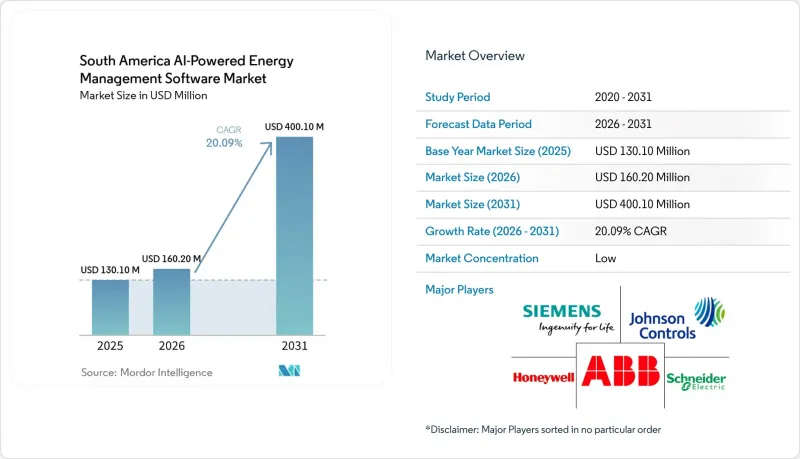
本報告按元件(軟體和服務)、部署模式(雲端、本地部署、混合部署)、應用(例如,能源消耗和需求最佳化、資產性能和預測性維護)、最終用戶(例如,商業建築、工業設施)和地區進行細分。市場預測以美元計價。
南美洲人工智慧能源管理軟體市場趨勢與洞察
工業界對利用人工智慧進行負載最佳化的需求日益成長
在南美洲能源密集型工業基地,尤其是在採礦、水泥、紙漿造紙和金屬產業,人工智慧驅動的負載最佳化正取得顯著成效。 2026年6月,淡水河谷在米納斯吉拉斯州運作了其首個由人工智慧驅動的礦石加工廠。該工廠透過即時最佳化400多個變量,實現了25%的生產效率提升,這表明能源選擇正被整合到核心生產管理中,而不是被視為一個孤立的問題。 2026年4月,ABB在其ABB Ability能源管理系統中加入了生成式人工智慧,支援對能源消耗、排放和設備效能進行自然語言查詢,從而降低了工廠團隊的技能需求。在智利,不斷上漲的電價使得人工智慧驅動的負載轉移和分時電價成為礦業公司直接的獲利工具,也使得南美洲人工智慧驅動的能源管理軟體市場的角色不再局限於合規層面。 Samarco 於 2026 年 4 月實施的「COI Maestro」系統也表明,買家對整合生產監控、品管、供應鏈協調和能源追蹤的單一營運層的需求日益成長。
促進能源效率和碳排放報告的法規制定
南美洲的AI能源管理軟體市場也受惠於將能源監測與碳排放揭露和正式管理系統掛鉤的法規。巴西第15.042/2024號法令規定,年二氧化碳當量排放量超過1萬噸的公司必須編製年度溫室氣體清冊。這意味著從2026年起,能源資料收集將更加細化到資產層面。智利的《能源效率法》於2026年進行了擴展,新增522家公司納入能耗報告義務範圍,並強制要求在2026年8月前實施營運能源管理系統。 2025年12月,哥倫比亞參議院通過了第143/2024號法律,擴大了能源效率標準和減排的政策基礎。這些法規的組合為南美洲的AI能源管理軟體市場創造了更穩定的需求基礎。然而,供應商仍需要區分出於合規目的而實施軟體的買家和出於提升績效目的而實施軟體的買家。
分散式站點中的雲端和邊緣部署
受分散式能源資產和遠端工業設施的驅動,南美洲的AI能源管理軟體市場正向雲端邊緣架構轉型。巴西根據15.269/2025號法律推行的市場自由化政策,增加了對能夠與國家電力機構協同協調交易、需量反應和P2P交易的雲端原生平台的需求。全國輸電系統營運商在12個流程和4個中心部署了AVEVA PI系統,實現了即時調度自動化,充分展現了集中式資料層如何支援電網級最佳化。同時,採礦、遠端水力發電設施和海上設施仍需要亞秒級邊緣控制來實現運作迴路和安全功能,因此混合部署在南美洲AI能源管理軟體市場迅速發展。隨著買家對能夠連接公用事業公司、計量表和分散式能源的系統的需求日益成長,OpenADR和DLMS/COSEM等採購標準在這一環境中變得愈發重要。
細分市場分析
預計到2025年,軟體將佔據南美洲人工智慧能源管理軟體市場71.19%的佔有率。這反映出市場正從孤立的儀器轉向集預測、報告、異常檢測和基準測試於一體的平台。巴西的碳排放清單法規和智利的SGE報告要求都在推動對能夠自動檢驗數據並定期提交的平台的需求。這些法律規範賦予軟體結構性優勢,因為它們可以根據不斷變化的國家義務持續更新。在此背景下,軟體在南美洲人工智慧能源管理軟體市場中扮演著控制層的角色,將營運數據與業務報告連結起來。
預計到2031年,服務市場將以20.23%的複合年成長率成長,因為許多用戶仍需要外部支援來進行整合、模型調優、合規工作流程和持續監控。西門子和CPFL Energia的測量項目表明,長期價值越來越不僅體現在設備出貨量上,還體現在資料管理、詐欺偵測和分析服務的訂閱上。 ABB於2026年4月對其ABB Ability能源管理系統進行的更新進一步推動了這一轉變,使工廠團隊更容易使用該平台,並即使在內部分析師資源有限的情況下,也能建立更深入、更持續的服務關係。 ISO 50001在大規模工業環境中的重要性日益凸顯,也推動了對託管服務的需求,因為認證和報告流程需要在南美洲整個人工智慧驅動的能源管理軟體市場進行持續監控。
2025年,基於雲端的部署方案佔據了南美洲人工智慧能源管理軟體市場59.14%的佔有率。這主要得益於公共產業和大型營運商對其龐大資產網路的集中式可視性需求。 Eletrobras和C3 AI於2025年8月推出的擴展方案表明,雲端原生架構能夠在10秒內檢測並緩解全國範圍內的輸電中斷。雲端環境也與巴西日益成長的自由能源市場相契合,該市場需要一個共用的數據層來進行結算、計量、交易和基準測試。因此,雲端技術在南美洲人工智慧能源管理軟體市場,尤其是在擁有跨區域營運的企業中,維持了主導地位。
預計到2031年,混合部署將以20.34%的複合年成長率成長。這是因為偏遠礦場、水力發電廠和海上資產既需要現場邊緣控制,也需要雲端企業級分析。安託法加斯塔在智利的營運模式清晰地展現了這項需求,它將遠端營運與整個電力消耗量礦區的規劃和最佳化相結合。 ONS對AVEVA PI系統的運用也為巴西電網環境中平衡集中式可視性和現場基礎設施控制提供了一個切實可行的模型。由於資料居住要求和關鍵基礎設施法規限制了外部託管,本地部署的需求雖然小規模,但依然強勁,這使得拉丁美洲人工智慧驅動的能源管理軟體市場呈現出廣泛的部署選擇。
其他好處:
- Excel格式的市場預測(ME)表
- 3個月的分析師支持
目錄
第1章:引言
- 研究假設和市場定義
- 調查範圍
第2章:調查方法
第3章執行摘要
第4章 市場狀況
- 市場概覽
- 市場促進因素
- 工業界對利用人工智慧進行負載最佳化的需求日益成長
- 監管部門為提高能源效率和碳排放報告所做的努力
- 公共產業部署高階計量基礎設施(AMI)和智慧電錶
- 分散式站點中的雲端和邊緣部署
- 出口導向型產業的ESG關聯採購
- 採礦、製造業和商業房地產的維修需求
- 市場限制因素
- 與傳統OT和IT系統整合的複雜性。
- 維修的初始資本支出(CAPEX)以及較長的投資回收期
- 多站點營運中資料品質和互通性面臨的挑戰。
- 對關鍵能源資產的網路安全和數據主權問題的擔憂
- 宏觀經濟因素對市場的影響
- 產業價值鏈分析
- 監理情勢
- 技術展望
- 波特五力分析
第5章 市場規模與成長預測
- 按組件
- 軟體
- 服務
- 部署模式
- 基於雲端的
- 現場
- 混合
- 透過使用
- 最佳化能源消耗和需求
- 資產性能和預測性維護
- 智慧電網與分散式能源(DER)的管理
- 可再生能源預測與整合
- 能源交易、定價和市場訊息
- 最終用戶
- 公用事業
- 商業建築
- 工業設施
- 住宅大樓
- 按地區
- 巴西
- 阿根廷
- 智利
- 哥倫比亞
- 其他南美國家
第6章 競爭情勢
- 市場集中度
- 策略趨勢
- 市佔率分析
- 公司簡介
- ABB Ltd.
- Schneider Electric SE
- Siemens AG
- Honeywell International Inc.
- Johnson Controls International plc
- IBM Corporation
- SAP SE
- Oracle Corporation
- Cisco Systems, Inc.
- Rockwell Automation, Inc.
- Eaton Corporation plc
- Emerson Electric Co.
- Mitsubishi Electric Corporation
- Yokogawa Electric Corporation
- Enel X Srl
- C3.ai, Inc.
- Stem Inc.
- Tractian,
- Bidgely Inc.
- AutoGrid Systems, Inc.
第7章 市場機會與未來展望
According to Mordor Intelligence, the South America AI-powered energy management software market was valued at USD 130.1 million in 2025 and estimated to grow from USD 160.2 million in 2026 to reach USD 400.1 million by 2031, at a CAGR of 20.09% during the forecast period 2026-2031.
This report is Segmented by Component (Software, and Services), Deployment Mode (Cloud-Based, On-Premises, and Hybrid), Application (Energy Consumption and Demand Optimization, Asset Performance and Predictive Maintenance, and More), End User (Commercial Buildings, Industrial Facilities, and More), and Geography. The Market Forecasts are Provided in Terms of Value (USD).
South America AI-powered Energy Management Software Market Trends and Insights
Rising Industrial Demand for AI-Based Load Optimization
South America's energy-intensive industrial base is generating clear returns from AI-based load optimization, especially in mining, cement, pulp, paper, and metals. Vale inaugurated its first AI-powered ore processing plant in Minas Gerais in June 2026, and the site delivered a 25% productivity gain while optimizing more than 400 variables in real time, demonstrating how energy choices are being integrated into core production control rather than handled separately. ABB added generative AI to the ABB Ability Energy Management System in April 2026, which lowered the skill barrier for plant teams by enabling natural-language queries on energy use, emissions, and equipment performance. In Chile, rising power tariffs are making AI load shifting and time-of-use management a direct margin tool for mining companies, which broadens the role of the South America AI-powered Energy Management Software Market beyond compliance work alone. Samarco's COI Maestro rollout in April 2026 also showed that buyers increasingly want one operating layer that combines production monitoring, quality control, supply chain coordination, and energy tracking.
Regulatory Push for Energy Efficiency and Carbon Reporting
The South America AI-powered Energy Management Software Market is also benefiting from regulations that now link energy monitoring to carbon disclosure and formal management systems. Brazil's Law 15.042/2024 created annual greenhouse gas inventory obligations for companies that emit more than 10,000 tons of CO2 equivalent per year, which pushed energy data collection closer to the asset level from 2026 onward. Chile's Energy Efficiency Law, expanded in 2026, added 522 companies to mandatory consumption reporting, with operational energy management systems required by August 2026. Colombia's Senate approved Law 143/2024 in December 2025, which widened the policy base for energy efficiency standards and emissions reduction. This regulatory mix is giving the South America AI-powered Energy Management Software Market a steadier demand base, although vendors still need to separate buyers moving for compliance from those moving for performance gains.
Cloud and Edge Deployment for Distributed Sites
Distributed energy assets and remote industrial sites are pushing the South America AI-powered Energy Management Software Market toward mixed cloud and edge architectures. Brazil's market liberalization under Law 15.269/2025 increased the need for cloud-native platforms that can coordinate trading, demand response, and peer-to-peer transactions while linking with national power institutions. The National Grid Operator used the AVEVA PI System across 12 processes and 4 centers to automate real-time dispatch, which showed how centralized data layers support grid-scale optimization. At the same time, mining sites, remote hydropower assets, and offshore facilities still need sub-second edge control for operational loops and safety functions, which is why hybrid deployment is rising quickly in the South America AI-powered Energy Management Software Market. Procurement standards such as OpenADR and DLMS/COSEM are gaining weight in this environment because buyers want systems that can connect across utilities, meters, and distributed energy resources.
Other drivers and restraints analyzed in the detailed report include:
- Utility AMI and Smart Meter Rollouts
- High Integration Complexity With Legacy OT and IT Systems
- Upfront Retrofit CAPEX and Long Payback Cycles
For complete list of drivers and restraints, kindly check the Table Of Contents.
Segment Analysis
Software held 71.19% of the South America AI-powered Energy Management Software Market share in 2025, reflecting the shift from isolated instruments toward platforms that combine forecasting, reporting, anomaly detection, and benchmarking. Brazil's carbon inventory rules and Chile's SGE reporting requirements are both pushing buyers toward platforms that can validate data and automate recurring submissions. That regulatory structure gives software a structural advantage because it can be updated continuously as obligations change across countries. In this setting, software serves as the control layer that links operational data with business reporting in the South America AI-powered Energy Management Software Market.
Services are projected to expand at a 20.23% CAGR through 2031, because many users still need outside support for integration, model tuning, compliance workflows, and ongoing monitoring. The Siemens and CPFL Energia metering program showed that the long-term value increasingly lies in data management, fraud detection, and analytics subscriptions rather than in device shipments alone. ABB's April 2026 update to the ABB Ability Energy Management System also supports this shift by making the platform easier for plant teams to use, thereby deepening recurring service relationships even when internal analyst resources are limited. The relevance of ISO 50001 in large industrial settings further supports demand for managed services, as certification and reporting routines require steady oversight across the South America AI-powered Energy Management Software Market.
Cloud-based deployment held 59.14% of the South America AI-powered Energy Management Software Market share in 2025, supported by utilities and large operators that need centralized visibility across wide asset networks. The Eletrobras and C3 AI expansion in August 2025 showed that cloud-native architecture can detect and mitigate transmission faults in under 10 seconds across a national network. Cloud environments also align with Brazil's growing free energy market, where settlement, metering, trading, and benchmarking require shared data layers. This has kept cloud deployment in the lead across the South America AI-powered Energy Management Software Market, especially where operating footprints span several regions.
Hybrid deployment is projected to grow at a 20.34% CAGR through 2031, because remote mines, hydropower sites, and offshore assets need edge control at the site and enterprise analytics in the cloud. Antofagasta's operating model in Chile illustrated this need by linking remote operations with planning and optimization across a power-intensive mining base. The ONS use of the AVEVA PI System also provided a practical model for balancing centralized visibility with local infrastructure control inside Brazil's grid environment. On-premises demand remains smaller but durable, as data residency and critical infrastructure rules limit external hosting, keeping deployment choices varied across the South America AI-powered Energy Management Software Market.
Complete Report Scope:
- By Component
- Software
- Services
- By Deployment Mode
- Cloud-Based
- On-Premises
- Hybrid
- By Application
- Energy Consumption and Demand Optimization
- Asset Performance and Predictive Maintenance
- Smart Grid and Distributed Energy Resource (DER) Management
- Renewable Energy Forecasting and Integration
- Energy Trading, Pricing and Market Intelligence
- By End User
- Utilities
- Commercial Buildings
- Industrial Facilities
- Residential Buildings
- By Geography
- Brazil
- Argentina
- Chile
- Colombia
- Rest of South America
List of Companies Covered in this Report:
- ABB Ltd.
- Schneider Electric SE
- Siemens AG
- Honeywell International Inc.
- Johnson Controls International plc
- IBM Corporation
- SAP SE
- Oracle Corporation
- Cisco Systems, Inc.
- Rockwell Automation, Inc.
- Eaton Corporation plc
- Emerson Electric Co.
- Mitsubishi Electric Corporation
- Yokogawa Electric Corporation
- Enel X S.r.l.
- C3.AI, Inc.
- Stem Inc.
- Tractian,
- Bidgely Inc.
- AutoGrid Systems, Inc.
Additional Benefits:
- The market estimate (ME) sheet in Excel format
- 3 months of analyst support
TABLE OF CONTENTS
1 INTRODUCTION
- 1.1 Study Assumptions and Market Definition
- 1.2 Scope of the Study
2 RESEARCH METHODOLOGY
3 EXECUTIVE SUMMARY
4 MARKET LANDSCAPE
- 4.1 Market Overview
- 4.2 Market Drivers
- 4.2.1 Rising Industrial Demand for AI-Based Load Optimization
- 4.2.2 Regulatory Push for Energy Efficiency and Carbon Reporting
- 4.2.3 Utility AMI and Smart Meter Rollouts
- 4.2.4 Cloud and Edge Deployment for Distributed Sites
- 4.2.5 ESG-Linked Procurement in Export-Oriented Industries
- 4.2.6 Retrofit Demand in Mining, Manufacturing, and Commercial Real Estate
- 4.3 Market Restraints
- 4.3.1 High Integration Complexity With Legacy OT and IT Systems
- 4.3.2 Upfront Retrofit CAPEX and Long Payback Cycles
- 4.3.3 Data Quality and Interoperability Gaps Across Multi-Site Operations
- 4.3.4 Cybersecurity and Data Sovereignty Concerns for Critical Energy Assets
- 4.4 Impact of Macroeconomic Factors on The Market
- 4.5 Industry Value-Chain Analysis
- 4.6 Regulatory Landscape
- 4.7 Technological Outlook
- 4.8 Porter's Five Forces Analysis
- 4.8.1 Bargaining Power of Buyers
- 4.8.2 Bargaining Power of Suppliers
- 4.8.3 Threat of New Entrants
- 4.8.4 Threat of Substitutes
- 4.8.5 Intensity of Competitive Rivalry
5 MARKET SIZE AND GROWTH FORECASTS (VALUE)
- 5.1 By Component
- 5.1.1 Software
- 5.1.2 Services
- 5.2 By Deployment Mode
- 5.2.1 Cloud-Based
- 5.2.2 On-Premises
- 5.2.3 Hybrid
- 5.3 By Application
- 5.3.1 Energy Consumption and Demand Optimization
- 5.3.2 Asset Performance and Predictive Maintenance
- 5.3.3 Smart Grid and Distributed Energy Resource (DER) Management
- 5.3.4 Renewable Energy Forecasting and Integration
- 5.3.5 Energy Trading, Pricing and Market Intelligence
- 5.4 By End User
- 5.4.1 Utilities
- 5.4.2 Commercial Buildings
- 5.4.3 Industrial Facilities
- 5.4.4 Residential Buildings
- 5.5 By Geography
- 5.5.1 Brazil
- 5.5.2 Argentina
- 5.5.3 Chile
- 5.5.4 Colombia
- 5.5.5 Rest of South America
6 COMPETITIVE LANDSCAPE
- 6.1 Market Concentration
- 6.2 Strategic Moves
- 6.3 Market Share Analysis
- 6.4 Company Profiles (includes Global Level Overview, Market Level Overview, Core Segments, Financials as available, Strategic Information, Market Rank/Share, Products and Services, Recent Developments)
- 6.4.1 ABB Ltd.
- 6.4.2 Schneider Electric SE
- 6.4.3 Siemens AG
- 6.4.4 Honeywell International Inc.
- 6.4.5 Johnson Controls International plc
- 6.4.6 IBM Corporation
- 6.4.7 SAP SE
- 6.4.8 Oracle Corporation
- 6.4.9 Cisco Systems, Inc.
- 6.4.10 Rockwell Automation, Inc.
- 6.4.11 Eaton Corporation plc
- 6.4.12 Emerson Electric Co.
- 6.4.13 Mitsubishi Electric Corporation
- 6.4.14 Yokogawa Electric Corporation
- 6.4.15 Enel X S.r.l.
- 6.4.16 C3.ai, Inc.
- 6.4.17 Stem Inc.
- 6.4.18 Tractian,
- 6.4.19 Bidgely Inc.
- 6.4.20 AutoGrid Systems, Inc.
7 MARKET OPPORTUNITIES AND FUTURE OUTLOOK
- 7.1 White-Space and Unmet-Need Assessment

 2034年人工智慧市場在發電領域的預測-按組件、部署模式、人工智慧技術、電源、應用、企業規模、最終用戶和地區分類的全球分析
 人工智慧在能源市場的應用:市場規模、佔有率、成長、全球產業分析、區域趨勢及2026-2034年預測電力產業人工智慧市場規模、佔有率、成長、全球產業分析、區域趨勢以及2026-2034年的預測
 全球能源電力領域人工智慧(AI)市場:機會與策略展望(至2035年)
 中國人工智慧能源管理軟體:市場佔有率分析、產業趨勢與統計及成長預測(2026-2031)中東和非洲人工智慧能源管理軟體:市場佔有率分析、行業趨勢和統計數據以及成長預測(2026-2031 年)中東地區人工智慧能源管理軟體:市場佔有率分析、行業趨勢和統計數據以及成長預測(2026-2031 年)印度人工智慧能源管理軟體:市場佔有率分析、行業趨勢和統計數據以及成長預測(2026-2031 年)德國人工智慧能源管理軟體:市場佔有率分析、行業趨勢和統計數據以及成長預測(2026-2031 年)新加坡人工智慧能源管理軟體:市場佔有率分析、行業趨勢和統計數據以及成長預測(2026-2031 年)