

 |
市場調查報告書
商品編碼
2097456
日本人工智慧能源管理軟體:市場佔有率分析、產業趨勢與統計及成長預測(2026-2031)Japan AI-powered Energy Management Software - Market Share Analysis, Industry Trends & Statistics, Growth Forecasts (2026 - 2031) |
||||||

※ 本網頁內容可能與最新版本有所差異。詳細情況請與我們聯繫。
根據 Mordor Intelligence 預測,日本人工智慧能源管理軟體市場規模預計將在 2025 年達到 1.5 億美元,並在 2026 年至 2031 年以 20.11% 的複合年成長率成長,到 2031 年達到 4.5 億美元。
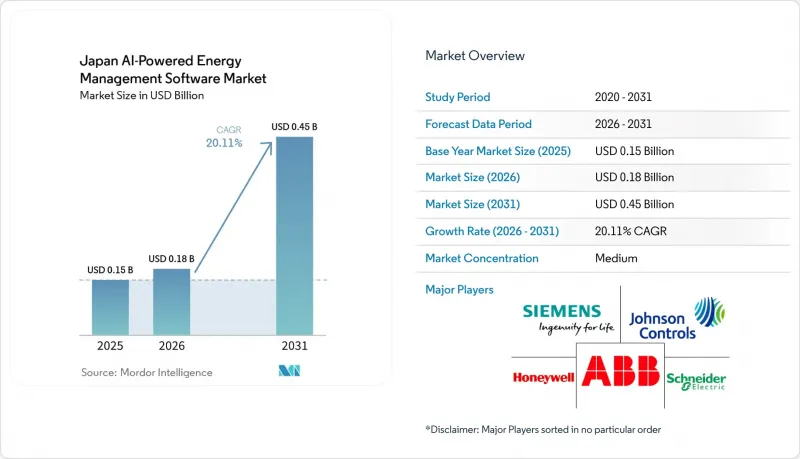
本報告按元件(軟體和服務)、部署模式(雲端、本地部署、混合部署)、應用(例如,能源消耗和需求最佳化、資產性能和預測性維護)、最終用戶(例如,商業建築、工業設施)和地區進行細分。市場預測以美元計價。
日本人工智慧能源管理軟體市場趨勢及洞察。
日本電力價格波動加劇
日本批發電力市場已擺脫短期季節性波動,進入更廣泛的結構性變革階段。 JERA集團內部購電協議於2026年4月到期,導致大量電力湧入現貨市場,將東京和中部地區的電價推至2022年能源危機以來的最高水準。此外,隨著市場參與企業尋求更有效的對沖工具以應對反覆出現的價格衝擊,電力期貨市場的重要性在2025年之前持續提升。 2026年4月的規則變更將平衡調整間隔縮短至30分鐘,並調整了不平衡電價,這增加了零售商和大型能源需求者因預測誤差而產生的成本。這項轉變進一步提升了日本人工智慧能源管理軟體市場的重要性,因為買家現在不僅需要靜態的能源報告,還需要更快速的需求預測和採購支援。在此背景下,日本人工智慧能源管理軟體市場正朝著成為受日常市場價格波動影響的企業核心營運工具的目標邁進。
商業建築中智慧電錶和物聯網感測器的快速普及
在日本,第一代智慧電錶已於2024年底前部署到8,600萬條電力合約線路。隨後,第二代智慧電錶開始部署,增加了雙向通訊功能,並為設施營運商和供應商提供更詳細的間隔數據。隨著人工智慧模型不斷改進,能夠以更短的周期匹配用電模式、天氣變化、設備運作狀態和市場價格,數據品質的提升至關重要。此外,在東京、大阪和其他人口密集的大都市地區的商業建築中持續部署分錶和聯網感測器,擴展了大規模物業的可用運作數據。這使得在軟體部署期間只需對新的測量設備進行少量投資,從而推動了日本人工智慧能源管理軟體市場的發展。將智慧電錶數據與暖通空調控制、設施系統和市場數據整合的供應商,相比基礎監控平台,展現出明顯的優勢。
與原有建築管理系統整合難度很高。
日本許多老舊商業建築仍然運作專有控制系統,這些系統在設計之初並未考慮整合現代人工智慧。因此,穩定部署新平台需要額外的工作,例如中間件、介面開發、硬體升級和現場試運行。日本電氣工程師學會 (IEEJ) 發布的《2026 年展望》指出,組織準備不足和投資障礙持續阻礙人工智慧在能源系統需求面的運作。問題不僅在於技術層面;許多建築也與現有自動化供應商簽訂了長期服務合約。即使節能和報告需求明確,這也會導致決策延遲。因此,日本人工智慧能源管理軟體市場在老舊建築的銷售週期往往較長。另一方面,在現有控制環境下營運的供應商更有可能減少實施過程中的阻力。
細分市場分析
2025年,軟體在日本人工智慧能源管理軟體市場佔據67.14%的佔有率,仍是該領域的核心收入來源。這一地位的取得得益於分析平台和需量反應調整工具的廣泛應用,以及公共產業和大型設施中建築能源儀錶板的開發。此外,日本在電力業務營運和商業能源管理領域率先向數位化基礎設施轉型,也推動了這一細分市場的發展。長期以來,買家一直傾向於選擇授權平台而非獨立的支援合約。 2026年1月,日本氣象協會在其下一代中央指揮系統中為所有三個預測功能選擇了軟體,這表明先進軟體已深度滲透到電網運作中。隨著軟體成為核心調度和平衡工作流程的一部分,可靠性、延遲和預測準確性的採購標準也隨之提高。這種轉變一直是推動日本人工智慧能源管理軟體市場發展的動力。這是因為電力公司和企業買家越來越期望能源軟體不僅能作為報告工具,還能作為即時運作層發揮作用。
預計2026年至2031年間,服務業將以20.22%的複合年成長率成長,成為日本人工智慧能源管理軟體產業成長最快的細分市場。由於希望供應商承擔更多整合和營運方面的負擔,買家越來越傾向於以結果為導向的支援。這在需要同時連接智慧電錶、物聯網感測器、JEPX資料來源和傳統建築系統的專案中尤其重要。此外,「GX2040」計畫提高了合規性報告和能源視覺性在支援綠色轉型應用中的重要性,從而推動了對託管服務的需求。因此,在日本人工智慧能源管理軟體產業,服務正從輔助角色轉變為更強大的成長引擎,為供應商帶來更穩定、更可觀的收入。
到2025年,基於雲端的部署將佔日本人工智慧能源管理軟體市場57.18%的佔有率,成為最大的部署模式。這一主導地位反映了企業對可擴展的SaaS工具的強烈偏好,這些工具無需大規模的本地基礎設施即可聚合來自眾多設施的數據。雲端環境也非常適合虛擬電廠調整、多站點需求預測和集中式分析等需求,因為它能夠並行接收來自電錶和感測器的大量資料流。隨著平衡週期縮短,使用者在採購和負載調度方面需要更快的決策支持,這一點變得尤為重要。對於服務於地理位置分散的客戶的供應商而言,雲端系統也為日本人工智慧能源管理軟體市場帶來了許多好處,例如便於更新、模型重新訓練和遠端監控。本地部署系統仍然重要,但由於網路安全和營運技術控制的考慮,在關鍵資料必須保留在企業網路內的環境中,其作用已受到限制。
預計2026年至2031年間,混合部署將以20.34%的複合年成長率成長,成為日本人工智慧能源管理軟體市場中成長最快的選擇。許多日本企業目前仍在多種技術混合的環境中運營,因此需要在現有本地作業系統之上部署雲端分析功能,而不是完全過渡到單一模型。遵守排放交易體系(ETS)也是推動這一趨勢的原因之一,因為企業需要在確保記錄可審計性的同時,加強對敏感營運數據的控制,從而利用雲端規模的分析和報告工具。此外,富士通與東京大學於2025年12月開展的先導計畫表明,在日本的營運環境中,雲端工作負載可以與即時電網狀況和電力市場價格關聯起來。此結果證明了在不完全重建現有基礎設施的情況下,結合現場控制、雲端智慧和市場驅動的最佳化方案的實用價值,進一步推動了混合部署的發展。
其他好處:
- Excel格式的市場預測(ME)表
- 3個月的分析師支持
目錄
第1章:引言
- 研究假設和市場定義
- 調查範圍
第2章:調查方法
第3章執行摘要
第4章 市場狀況
- 市場概覽
- 市場促進因素
- 日本電力價格波動加劇
- 商業建築中智慧電錶和物聯網感測器的快速普及
- 企業強而有力的脫碳計畫和實現淨零排放的努力
- 對人工智慧驅動的負載轉移和高峰需求最佳化的需求日益成長。
- 高密度都市區和工業區電網擁塞管理的必要性。
- 擴大需要動態能量調節的可再生能源的引入
- 市場限制因素
- 與傳統建築管理系統整合具有高度複雜性
- 能源數據人員和人工智慧營運專業知識短缺
- 互聯能源平台中的網路安全與資料管治問題
- 企業客戶的銷售週期長,客製化解決方案的成本高。
- 宏觀經濟因素對市場的影響
- 產業價值鏈分析
- 監理情勢
- 技術展望
- 波特五力分析
第5章 市場規模與成長預測
- 按組件
- 軟體
- 服務
- 部署模式
- 基於雲端的
- 現場
- 混合
- 透過使用
- 最佳化能源消耗和需求
- 資產性能和預測性維護
- 智慧電網和分散式能源(DER)管理
- 可再生能源預測與整合
- 能源交易、定價和市場訊息
- 最終用戶
- 公用事業
- 商業建築
- 工業設施
- 住宅大樓
第6章 競爭情勢
- 市場集中度
- 策略趨勢
- 市佔率分析
- 公司簡介
- Schneider Electric SE
- Siemens AG
- Honeywell International Inc.
- Johnson Controls International plc
- ABB Ltd
- IBM Corporation
- Cisco Systems, Inc.
- Oracle Corporation
- SAP SE
- Mitsubishi Electric Corporation
- Fujitsu Limited
- NEC Corporation
- Hitachi, Ltd.
- Panasonic Holdings Corporation
- Toshiba Corporation
- NTT DATA Group Corporation
- eSolar, Inc.
- Enel X Srl
- AutoGrid Systems, Inc.
- Aspen Technology, Inc.
第7章 市場機會與未來展望
According to Mordor Intelligence, the Japan AI-powered energy management software market size was USD 0.15 billion in 2025 and is projected to reach USD 0.45 billion by 2031, at a CAGR of 20.11% from 2026 to 2031.
This report is Segmented by Component (Software, and Services), Deployment Mode (Cloud-Based, On-Premises, and Hybrid), Application (Energy Consumption and Demand Optimization, Asset Performance and Predictive Maintenance, and More), End User (Commercial Buildings, Industrial Facilities, and More), and Geography. The Market Forecasts are Provided in Terms of Value (USD).
Japan AI-powered Energy Management Software Market Trends and Insights
Rising Electricity Price Volatility in Japan
Japan's wholesale electricity market has shifted beyond short seasonal swings and entered a phase of broader structural volatility. The April 2026 end of JERA Group's intra-group power purchase agreements pushed major volumes into the open spot market and lifted prices in the Tokyo and Chubu areas to levels not seen since the 2022 energy crisis. The electricity futures market also gained greater prominence through 2025 as participants sought stronger hedging tools against recurring price shocks. Rule changes that moved balancing to 30-minute intervals in April 2026 and adjusted imbalance pricing raised the cost of forecast errors for retailers and large energy users. That shift made the Japan AI-powered Energy Management Software Market more relevant because buyers needed faster demand forecasting and procurement support, not just static energy reporting. In this setting, the Japan AI-powered Energy Management Software Market moved closer to a core operating tool for entities exposed to daily market pricing.
Rapid Smart Meter and IoT Sensor Penetration Across Commercial Buildings
Japan completed the first-generation rollout of smart meters across 86 million electricity customer connections by the end of 2024. Second-generation installations then began, adding bidirectional communication and more granular interval data for facility operators and software vendors. That data quality mattered because AI models perform better when they can match occupancy patterns, weather shifts, equipment behavior, and market prices in shorter cycles. The commercial building base in Tokyo, Osaka, and other dense urban markets also kept adding sub-metering and connected sensors, expanding the usable operating data available within large properties. This supported the Japan AI-powered Energy Management Software Market by lowering the need for fresh metering investment at the point of software adoption. Vendors that combined smart meter feeds with HVAC controls, facility systems, and market data gained a clearer edge over basic monitoring platforms.
High Integration Complexity with Legacy Building Management Systems
A large share of Japan's older commercial buildings still runs on proprietary control systems that were not built for modern AI integration. That creates extra work around middleware, interface development, hardware upgrades, and site-level commissioning before a new platform can run reliably. The IEEJ Outlook 2026 also noted that institutional readiness and investment barriers continue to slow demand-side AI adoption in the energy system. The problem is not only technical, as many buildings are also tied to long-term service agreements with incumbent automation providers. That slows decision-making even when energy savings and reporting needs are clear. The Japan AI-powered Energy Management Software Market, therefore, faced longer sales cycles in older building stock, while vendors that worked inside existing control environments had a better chance of lowering deployment friction.
Other drivers and restraints analyzed in the detailed report include:
- Strong Corporate Decarbonization Programs and Net-Zero Commitments
- Growing Demand for AI-Based Load Shifting and Peak Demand Optimization
- Shortage Of Energy Data Talent and AI Operations Expertise
For complete list of drivers and restraints, kindly check the Table Of Contents.
Segment Analysis
Software held 67.14% of the Japan AI-powered Energy Management Software Market share in 2025, and it remained the core revenue base for the category. That position came from the widespread use of analytics platforms and demand response orchestration tools, and from the development of building energy dashboards across utilities and large facilities. The segment also benefited from Japan's earlier move toward digital infrastructure in utility operations and commercial energy management, where buyers had long favored licensed platforms over stand-alone support contracts. Japan Meteorological Association's selection in January 2026 for all three forecasting functions in the country's next-generation central dispatch command system showed how deeply advanced software had moved into grid operations. Once software becomes part of core dispatch and balancing workflows, procurement standards tend to rise around reliability, latency, and forecast precision. That shift supported the Japan AI-powered Energy Management Software Market, as utilities and enterprise buyers increasingly expected energy software to operate as a live layer rather than a simple reporting tool.
Services are projected to expand at a 20.22% CAGR from 2026 to 2031, making it the fastest-growing component in the Japan AI-powered energy management software industry. Buyers increasingly preferred outcome-based support because they wanted vendors to absorb a greater share of the integration and operating burden. That was especially relevant when projects needed to connect smart meters, IoT sensors, JEPX feeds, and older building systems simultaneously. The GX2040 vision also strengthened demand for managed services, as compliance reporting and energy visualization became more important for applications supporting green transformation. As a result, the Japan AI-powered energy management software industry saw services shift from a supporting role to a stronger growth engine, with steadier recurring revenue potential for vendors.
Cloud-based deployment accounted for 57.18% of the Japan AI-powered Energy Management Software Market size in 2025, making it the largest deployment model. Its lead reflected a strong enterprise preference for scalable SaaS tools that could aggregate data across many facilities without heavy local infrastructure. Cloud environments are also suited to the demands of virtual power plant coordination, multi-site forecasting, and centralized analytics because they can ingest large streams of meter and sensor data in parallel. That mattered more as balancing intervals shortened, and users needed faster decision support for procurement and load scheduling. The Japan AI-powered Energy Management Software Market also benefited from cloud systems, which made updates, model retraining, and remote oversight easier for vendors serving geographically dispersed customers. On-premises systems remained relevant, but they served a narrower role in settings where cybersecurity and operational technology controls kept critical data inside enterprise networks.
Hybrid deployment is projected to grow at a 20.34% CAGR from 2026 to 2031, making it the fastest-moving option in this part of the Japan AI-powered Energy Management Software Market. Many Japanese organizations still run mixed technology environments, so they need cloud analytics layered on top of their local operational systems rather than a full migration to a single model. ETS compliance added to this pattern because companies needed auditable records and stronger control over sensitive operating data while still using cloud-scale analytics and reporting tools. Fujitsu's December 2025 pilot with the University of Tokyo also showed that cloud workloads can be linked to live grid conditions and electricity market pricing in Japan's operating environment. That result supported hybrid adoption by demonstrating practical value in combining on-site control, cloud intelligence, and market-linked optimization without requiring a complete rebuild of existing infrastructure.
Complete Report Scope:
- By Component
- Software
- Services
- By Deployment Mode
- Cloud-Based
- On-Premises
- Hybrid
- By Application
- Energy Consumption and Demand Optimization
- Asset Performance and Predictive Maintenance
- Smart Grid and Distributed Energy Resource (DER) Management
- Renewable Energy Forecasting and Integration
- Energy Trading, Pricing and Market Intelligence
- By End User
- Utilities
- Commercial Buildings
- Industrial Facilities
- Residential Buildings
List of Companies Covered in this Report:
- Schneider Electric SE
- Siemens AG
- Honeywell International Inc.
- Johnson Controls International plc
- ABB Ltd
- IBM Corporation
- Cisco Systems, Inc.
- Oracle Corporation
- SAP SE
- Mitsubishi Electric Corporation
- Fujitsu Limited
- NEC Corporation
- Hitachi, Ltd.
- Panasonic Holdings Corporation
- Toshiba Corporation
- NTT DATA Group Corporation
- eSolar, Inc.
- Enel X S.r.l.
- AutoGrid Systems, Inc.
- Aspen Technology, Inc.
Additional Benefits:
- The market estimate (ME) sheet in Excel format
- 3 months of analyst support
TABLE OF CONTENTS
1 INTRODUCTION
- 1.1 Study Assumptions and Market Definition
- 1.2 Scope of the Study
2 RESEARCH METHODOLOGY
3 EXECUTIVE SUMMARY
4 MARKET LANDSCAPE
- 4.1 Market Overview
- 4.2 Market Drivers
- 4.2.1 Rising Electricity Price Volatility in Japan
- 4.2.2 Rapid Smart Meter and IoT Sensor Penetration Across Commercial Buildings
- 4.2.3 Strong Corporate Decarbonization Programs and Net-Zero Commitments
- 4.2.4 Growing Demand for AI-Based Load Shifting and Peak Demand Optimization
- 4.2.5 Grid Congestion Management Needs in Dense Urban and Industrial Corridors
- 4.2.6 Expansion of Renewable Energy Integration Requiring Dynamic Energy Orchestration
- 4.3 Market Restraints
- 4.3.1 High Integration Complexity With Legacy Building Management Systems
- 4.3.2 Shortage of Energy Data Talent and AI Operations Expertise
- 4.3.3 Cybersecurity and Data Governance Concerns in Connected Energy Platforms
- 4.3.4 Long Enterprise Sales Cycles and High Solution Customization Costs
- 4.4 Impact of Macroeconomic Factors on the Market
- 4.5 Industry Value-Chain Analysis
- 4.6 Regulatory Landscape
- 4.7 Technological Outlook
- 4.8 Porter's Five Forces Analysis
- 4.8.1 Bargaining Power of Buyers
- 4.8.2 Bargaining Power of Suppliers
- 4.8.3 Threat of New Entrants
- 4.8.4 Threat of Substitutes
- 4.8.5 Intensity of Competitive Rivalry
5 MARKET SIZE AND GROWTH FORECASTS (VALUE)
- 5.1 By Component
- 5.1.1 Software
- 5.1.2 Services
- 5.2 By Deployment Mode
- 5.2.1 Cloud-Based
- 5.2.2 On-Premises
- 5.2.3 Hybrid
- 5.3 By Application
- 5.3.1 Energy Consumption and Demand Optimization
- 5.3.2 Asset Performance and Predictive Maintenance
- 5.3.3 Smart Grid and Distributed Energy Resource (DER) Management
- 5.3.4 Renewable Energy Forecasting and Integration
- 5.3.5 Energy Trading, Pricing and Market Intelligence
- 5.4 By End User
- 5.4.1 Utilities
- 5.4.2 Commercial Buildings
- 5.4.3 Industrial Facilities
- 5.4.4 Residential Buildings
6 COMPETITIVE LANDSCAPE
- 6.1 Market Concentration
- 6.2 Strategic Moves
- 6.3 Market Share Analysis
- 6.4 Company Profiles (includes Global Level Overview, Market Level Overview, Core Segments, Financials as available, Strategic Information, Market Rank/Share, Products and Services, Recent Developments)
- 6.4.1 Schneider Electric SE
- 6.4.2 Siemens AG
- 6.4.3 Honeywell International Inc.
- 6.4.4 Johnson Controls International plc
- 6.4.5 ABB Ltd
- 6.4.6 IBM Corporation
- 6.4.7 Cisco Systems, Inc.
- 6.4.8 Oracle Corporation
- 6.4.9 SAP SE
- 6.4.10 Mitsubishi Electric Corporation
- 6.4.11 Fujitsu Limited
- 6.4.12 NEC Corporation
- 6.4.13 Hitachi, Ltd.
- 6.4.14 Panasonic Holdings Corporation
- 6.4.15 Toshiba Corporation
- 6.4.16 NTT DATA Group Corporation
- 6.4.17 eSolar, Inc.
- 6.4.18 Enel X S.r.l.
- 6.4.19 AutoGrid Systems, Inc.
- 6.4.20 Aspen Technology, Inc.
7 MARKET OPPORTUNITIES AND FUTURE OUTLOOK
- 7.1 White-Space and Unmet-Need Assessment

 2034年人工智慧市場在發電領域的預測-按組件、部署模式、人工智慧技術、電源、應用、企業規模、最終用戶和地區分類的全球分析
 全球能源電力領域人工智慧(AI)市場:機會與策略展望(至2035年)
 中國人工智慧能源管理軟體:市場佔有率分析、產業趨勢與統計及成長預測(2026-2031)中東和非洲人工智慧能源管理軟體:市場佔有率分析、行業趨勢和統計數據以及成長預測(2026-2031 年)中東地區人工智慧能源管理軟體:市場佔有率分析、行業趨勢和統計數據以及成長預測(2026-2031 年)南美洲人工智慧能源管理軟體:市場佔有率分析、行業趨勢和統計數據以及成長預測(2026-2031 年)印度人工智慧能源管理軟體:市場佔有率分析、行業趨勢和統計數據以及成長預測(2026-2031 年)德國人工智慧能源管理軟體:市場佔有率分析、行業趨勢和統計數據以及成長預測(2026-2031 年)新加坡人工智慧能源管理軟體:市場佔有率分析、行業趨勢和統計數據以及成長預測(2026-2031 年)東協地區人工智慧能源管理軟體:市場佔有率分析、產業趨勢與統計及成長預測(2026-2031 年)